
Lecture
The Langevin equation — a stochastic differential equation describing Brownian motion.
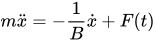
The first equation, studied by Langevin, described Brownian motion with a constant potential, that is, the acceleration  of a Brownian particle of mass
  is expressed through the sum of the viscous friction force, which is proportional to the velocity of the particle
  (Stokes' law), the noise term
  (a name used in physics to denote a stochastic process in a differential equation) — due to the continuous collisions of the particle with the molecules of the liquid, and
  — the systematic force arising from intramolecular and intermolecular interactions:

Let us rewrite the Langevin equation without external forces. Moreover, without loss of generality one can consider only one of the coordinates.
We shall assume that the random force satisfies the following conditions:


where b — a certain constant, which we shall determine later,  — the Dirac delta function. Angle brackets denote averaging over time. This is the so-called delta-correlated random variable: its autocorrelation function is equal to the delta function. Such a random process is also called white noise.
Let us rewrite the equation in terms of the velocity:
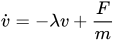 , where
Suppose that at the initial time moment  the particle had velocity
  . We shall seek the solution in the form:
  , then for
  we obtain the following differential equation:
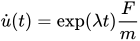
As a result, we obtain the desired expression for the velocity:

Two important relations follow from it:
 . That is, the mean value of the velocity tends to zero with time.
 . The mean square of the velocity tends over time to the value
  . If we assume that the kinetic energy of the particle tends over time to the thermal energy, then one can determine the value of the coefficient
  :
:
By transforming the original expression one can obtain that:
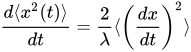
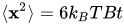
Whence follows the Einstein relation:

where B — the mobility of the Brownian particle.
The Wiener process (the so-called Brownian motion) is an integral of the Gaussian white-noise process. It is not stationary, but it has stationary increments.
The Ornstein — Uhlenbeck process — is a stationary Gaussian process.
The Brownian bridge (similar to the Ornstein — Uhlenbeck process) is an example of a Gaussian process whose increments are not independent.
Fractional Brownian motion is a Gaussian process whose covariance function is a generalization of the covariance function of the Wiener process.

Comments