
Lecture
If, for t>0 the renewal function has a derivative H’(t)=h(t), then it is called the renewal density. It follows from representations (2.4) and (2.10) that the renewal density exists if and only if the densities of the distributions F(t)=f(t) and F1(t)=f1(t) exist for t>0. Since the series converges uniformly on every finite interval, it may be differentiated term by term. Then from (2.4) we obtain
,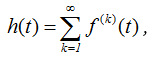
where f(k)(t) denotes the k-fold convolution of the density f(t).
Taking into account the estimates (2.12) and the equality dH(t)=h(t)dt for differentials, we find that the function h(t)dt is the probability of a renewal occurring in an infinitesimal neighborhood of the point t.
It is not difficult to obtain the renewal equations for the densities and their solutions in terms of the Laplace–Stieltjes transform. We give these relations
, 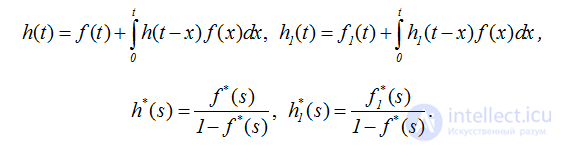 (2.21)

Comments