
Lecture
Ito's formula — a formula for the change of variables in a stochastic differential equation. The author of Ito's formula, Kiyosi Ito, was a Japanese mathematician and statistician.
Let a random process 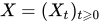 be given on a filtered probability space
  with filtration
  .
.
Let a stochastic differential equation  be given, or, in integral form
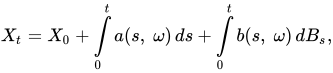
where  — is Brownian motion.
Now let  — be a continuous function defined on
  of class
  , that is, having derivatives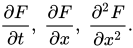
Under these assumptions:

More rigorously, for every  the following Ito's formula holds for
  :
:

A process S is said to follow geometric Brownian motion with constant volatility σ and constant drift μ, if it satisfies the stochastic differential equation  , for a Brownian motion B . Applying Ito's lemma with
  gives
gives
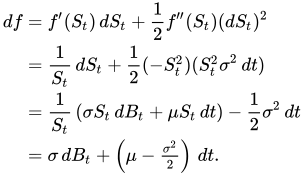
It follows that

exponentiating gives the expression for S ,

The correction term -σ 2/2corresponds to the difference between the median and the mean of the lognormal distribution, or, equivalently for this distribution, between the geometric mean and the arithmetic mean, with the median (geometric mean) being lower. This is related to the AM – GM inequality and corresponds to a downward-convex logarithm, so the correction term can accordingly be interpreted as a convexity correction. This is an infinitesimal version of the fact that the annualized return is less than the average return, with the difference proportional to the variance. See Geometric moments of the lognormal distribution for further discussion.
The same factor σ 2/2appears in the auxiliary variables d 1 and d 2 of the Black – Scholes formula and can be interpreted as a consequence of Ito's lemma.
The Doleans-Dade exponential (or stochastic exponential) of a continuous semimartingale X can be defined as the solution of the SDE д = Y йХ with initial condition У 0 = 1 . It is sometimes denoted Ɛ ( X ) . Applying Ito's lemma with f ( Y ) = log ( Y ) gives
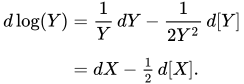
Exponentiating gives the solution

Ito's lemma can be used to derive the Black – Scholes equation for an option . Suppose that the stock price follows geometric Brownian motion, given by the stochastic differential equation dS = S ( σdB + μ dt ) . Then, if the option price at time t equals f ( t , S t ), Ito's lemma gives

The term ∂ f/∂ S dS represents the change in value over time dt of a trading strategy that consists of holding an amount∂ f/∂ Sin stock. If this trading strategy is followed and it is assumed that any cash on hand will grow at the risk-free rate r , then the total value V of this portfolio satisfies the SDE.

This strategy replicates the option if V = f ( t , S ). Combining these equations gives the famous Black – Scholes equation

Let  be a two-dimensional Ito process with SDE:

Then we can use the multidimensional form of Ito's lemma to find an expression for  .
.
We have  and
and  .
.
We set  and note that
  and
and 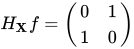
Substituting these values into the multidimensional version of the lemma gives us:

This is a generalization of the Leibniz product rule to non-differentiable Ito processes.
Next, using the second form of the multidimensional version above gives us

Thus, we see that the product  is itself a drift-diffusion Ito process .


Comments