
Lecture
We now use relations (2.4) and (2.10) to derive the integral renewal equations.
To this end, recall the notion of k--fold convolution, which is defined recursively,
 (2.13)
 (2.14)
In addition to relations (2.14), the convolutions admit another form of notation, via the convolutions F(n)(t)
.  (2.15)
Since the series (2.4) and (2.10) converge uniformly on every finite interval, the order of summation and integration may be interchanged.
Then, summing relations (2.13), we obtain
.
Since , we obtain two integral equations for the renewal function of the ordinary renewal process
 (2.16)
It is easy to see that one equation can be obtained from the other by integration by parts.
Summing relations (2.14), we obtain two integral equations for the renewal function of the delayed renewal process
 (2.17)
Finally, summing relations (2.15), we obtain relations connecting the renewal functions H1(t) and H(t),
 (2.18)
The solutions of the renewal equations can be written out using the Laplace–Stieltjes transform , Res>0. 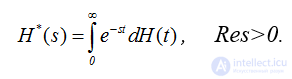 It is known (Mathematical Appendix 2) that the Laplace–Stieltjes transform of a convolution integral equals the product of the Laplace–Stieltjes transforms. Therefore, from (2.16) we obtain
H*(s)=F*(s)+ H*(s)F*(s),
. 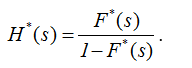 (2.19)
Similarly, from (2.17) we obtain for the delayed renewal process
. 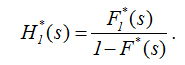 (2.20)
The formulas (2.19) and (2.20) are used to determine the functions H(t) and H1(t), for which it is necessary to invert the transforms H*(s) and H1*(s), that is, to find such functions H(t) and H1(t), whose given transforms are H*(s) and H1*(s). Since there is a one-to-one correspondence between functions and their Laplace–Stieltjes transforms, the functions H(t) and H1(t) so found will be the unique solutions of the integral renewal equations.

Comments