
Lecture
We now study the asymptotic behavior of the renewal function as t→∞.
THEOREM 2.1. For the ordinary renewal process, as t→∞ the following asymptotic expansion holds
, 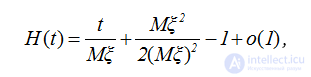 (2.22)
provided the expectation and second moment exist.
PROOF. The proof uses a Tauberian theorem, the statement of which is given in Mathematical Appendix 3. In order to apply this theorem, it is necessary to construct an expansion of the function H*(s) as s→0. In the case under consideration
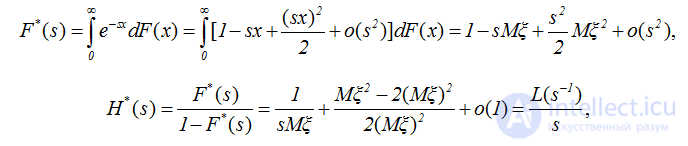
where the following notation is used
,  (2.23)
μ= Mξ, σ2=Mξ2-(Mξ)2.
Next we must check whether the function L(t) is slowly varying at infinity, that is, whether the equality
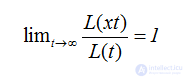
holds for every positive x. The latter equality is obvious for the function (2.23). Thus all the conditions of the Tauberian theorem are satisfied. Consequently, as t→∞
,
which proves the assertion of the theorem.*
The theorem just proved is called the elementary renewal theorem and is stated in the form of the following assertion.
Let us make two remarks on the theorem just proved.
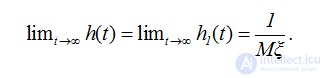
Remark 1. An almost verbatim repetition of the proof for the renewal function H1(t) gives the following asymptotic expansion as t→∞
.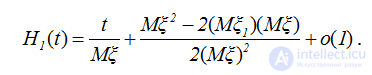
From the last equality it can be concluded that the leading term of the expansion does not depend on the distribution F1(t). This expansion will also be obtained below using the key renewal theorem.
Remark 2. For the renewal densities the following equalities are obvious
.

Comments