
Lecture
DEFINITION 2.3. An alternating renewal process is a flow with limited aftereffect, for which
F2k-1(t)=F(t), F2k(t)=G(t), k=1,2,3,..., F(t)≠ G(t). (2.64)
Thus, an alternating renewal process is specified by the distribution F(x) of the odd intervals and the distribution G(x) of the even intervals between successive renewal epochs.
It is easy to see that the flow of even renewals of the alternating process forms an ordinary renewal process with the interval distribution equal to the convolution of the distributions F(t) and G(t),
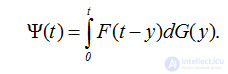 (2.65)
The flow of odd renewals of the alternating process forms a delayed renewal process, determined by the functions F(t) and Ψ(t).
Denote by H0(t) and H1(t) the renewal functions of these flows, and H(t)=H0(t)+H1(t) the renewal function of the alternating process. By virtue of (2.16) and (2.19)
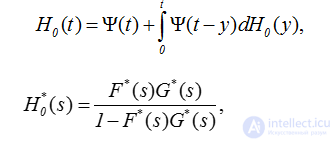
since Ψ*(s)=F*(s)G*(s).
From equalities (2.17) and (2.20) we obtain
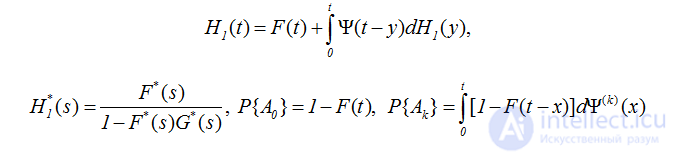
and, consequently,
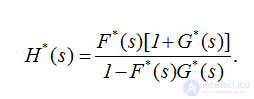
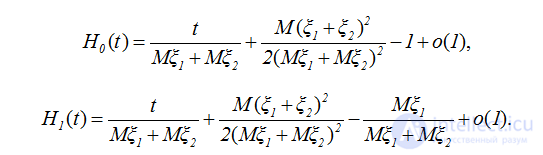
Consequently, for the renewal function of the alternating renewal process we shall have the following asymptotic expansion

.
Then the event A, consisting in the instant t being covered by an odd renewal interval, can be written as the sum of mutually exclusive events Ak, i.e.  . Therefore
.
Since  for k>0, then
 .(2.66)
For the probability P2(t) of the opposite event - the instant t is covered by an even interval - the following equality holds
,
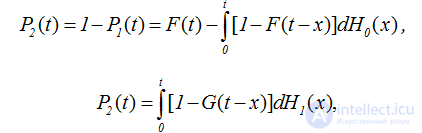 (2.67)
if we carry out reasoning analogous to that carried out in deriving (2.66), for the alternating process regarded as a delayed renewal process.
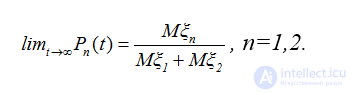
Equalities (2.66) and (2.67) are used to investigate the limit limt→∞Pn(t), n=1,2. To determine the limit of the integral we use the key renewal theorem. If at least one of the distributions F(x) or G(x) is non-lattice and their expectations exist, then the limits exist and
 (2.68)

Comments