
Lecture
It is often necessary to estimate the behavior of the renewal function H(t) for a finite value of the argument t. To this end, we give some useful estimates for the renewal function on any finite time interval. These estimates are based on relation (2.4) for the renewal function and the analogous relation for the renewal density.
For the renewal function it follows from (2.4) that the obvious inequality F(t)<=H(t) holds. To obtain an upper estimate, note that since ξk>=0 and the following relation between events holds
{maxk=(1,2,...,n)ξk⊇{tn
and, consequently, the following inequality holds
F(n)(t)=P(tn<=P{maxk=(1,2,...,n)ξkn(t),
since the random variables ξk are independent. Therefore from (2.4) we obtain the two-sided estimate
. 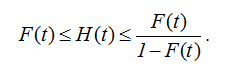 (2.54)
Estimate (2.54) can be refined. For this we use the obvious equality
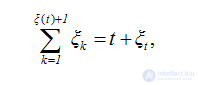
where, as before, ξ(t) denotes the number of renewals that have occurred by time t, and ξt is the forward recurrence time (the overshoot time).
If we use Wald's identity (Mathematical Appendix 5), we obtain
M(ξ1+ξ2+...+ξξ(t)+1)=Mξ (Mξ(t)+1)= Mξ[H(t)+1]=t+Mξt,
since the random variables ξi are identically distributed and, for i>ξ(t)+1, do not depend on ξ(t) by the definition of the renewal process.
Consequently,
. 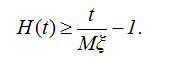 (2.55)
Combining inequalities (2.54) and (2.55), we obtain
. 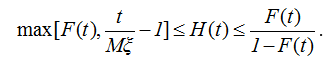 (2.56)
For the derivative of the convolution the following estimate holds for n>1
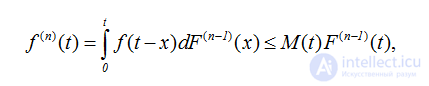
where we denote .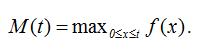
Then from the equality for the renewal density 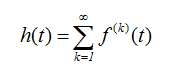 we obtain the following estimates
. 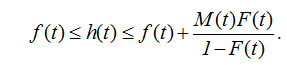 (2.57)
The property to be discussed here can be called the property of monotone dependence of the renewal function on the distribution function corresponding to it.
So, let two ordinary renewal processes be given, for which the intervals between renewals have distributions F(x) and G(x), respectively. Denote by HF(x) and HG(x) their renewal functions. Then the following holds
LEMMA 2.3. If for x>=0 the inequality F(x)>=G(x) holds, then
HF(x)>=HG(x). (2.58)
PROOF. Using the method of mathematical induction, we prove the inequality F(n)(x)>=G(n)(x), n>0. Indeed, since F(1)(x)=F(x) and G(1)(x)=G(x), the inequality holds for n=1 by the condition of the lemma. Suppose it holds for an arbitrary n>1. Let us prove this inequality for n+1 . From the definition of the convolution integral we obtain
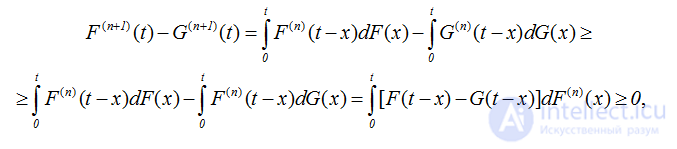
which proves the assertion of the lemma, if we use equality (2.4) for the renewal function. *

Comments