
Lecture
For the simple renewal process, denote by H(t)=Mξ(t) the expected number of renewals that have occurred up to time t, t>=0. We shall further call this expectation the renewal function. Then, by the definition of expectation, we have
 (2.2)
(2.2)
Obviously, all sample paths of the renewal process are nondecreasing functions, so the renewal function is nondecreasing as well,
Denote by Bk(t)={tk0, the event that, on the interval (0,t), at least k renewals occur. Then, by definition
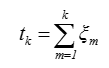
and since the random variables ξk are positive, between the events Bk(t)={tk0 the following relations hold: Bk(t)⊃Bk+1(t), that is, the occurrence of the event Bk+1(t) entails the occurrence of the event Bk(t). Then

moreover, the events on the right-hand side of this equality are mutually exclusive. Hence we obtain
P{tkk+1>=t}= P{tkk+1ξ(t)=k}, (2.3)
since the event {tkk+1>=t} means that on the interval (0,t) exactly k, k>=0 renewals occur, that is, {tkk+1>=t}={ξ(t)=k} .
Let us prove the lemma on the representation and existence of the renewal function.
LEMMA 2.1. If, for the distribution F(t) defining the simple renewal process, there exists x>0 such that F(x)<1, then for any finite t, 0∞, the renewal function is finite, H(t)<∞, and
, 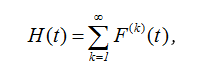 (2.4)
(2.4)
where F(k)(t) denotes the k-fold convolution of the distribution F(t), F(1)(t)=F(t).
PROOF. By definition, F(k)(t)=P{tk. Hence, substituting (2.3) into (2.2) and using the fact that the sum of a series is the limit of its partial sums, we obtain
 . (2.5)
For any t>0, x>0 there exists an integer k, k>0, for which (k-1)x<= kx. The following obvious relation holds between the events
 , (2.6)
since the random variables ξj are nonnegative. From the last relation between the events, by the independence of the random variables ξj and the inequality F(x)<1 we obtain a bound for the convolution
F(k)(t)<=1-[1-F(x)]k<1, k>0. (2.7)
Note that in (2.7) the quantities x, t and k are related by a relation, where the symbol [α] denotes the integer part of the number α. By definition of the integer part, the inequality [α]<=α. Note also that for t>0, x>0 the parameter k>0.
Next we have. The random variables ξj are nonnegative, hence F(n)(t)<=F(m)(t) for n>m.
The last inequality follows from the following statement (see the proof of Lemma 2.3 for more detail):
if, for any t>0, an inequality holds for two distributions of positive random variables, then, since
.
For m>0 denote by 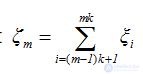 and
and 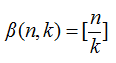 the integer part of the ratio, k>0. From this definition, the inequality follows
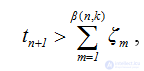 , since
 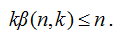 .
.
Then the following chain of inequalities holds
 (2.8)
(2.8)
In deriving (2.8), the following properties of the random variables were used:
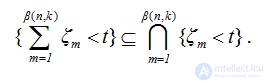
Then, from (2.8) and the inequality n<=β(n,k)+1 (by the definition of the integer part) we obtain the bound
nF(n+1)(t)<=[β(n,k)+1][1-[1-F(x)]k]β(n,k). (2.9)
Obviously, β(n,k)→∞ as n→∞. Consequently, inequalities (2.8) and (2.9) prove the lemma, since the series (2.4) converges at the rate of a geometric progression with ratio q=1-[1-F(x)]k<1, and, consequently, the limiting relation limn→∞nF(n+1)(t)=0 holds (an exponential function tends to zero faster than a power function tends to infinity). Note one important circumstance: since the bound (2.8) does not depend on t, the series (2.4) converges on any finite interval uniformly. The lemma is proved.*
Thus, the conditions for the existence of the renewal function are related to the behavior of the distribution function F(t) of the intervals between successive renewal epochs — it must not have a unit jump at zero, that is, the case of a distribution concentrated at zero is excluded.
If this restriction does not hold, then one can assert that the process does not evolve in time. Indeed, in that case, for any positive t and k>=0 we have P{ξ(t)=k}=0. Consequently, all renewal epochs coincide with zero, and the renewal process does not evolve in time. In what follows we shall not specifically stipulate this condition, taking it to be satisfied.
From relation (2.3) it follows that for any positive t, since (here we take F(0)(t)=1 for t>0, since t0=0). Then the equality
is understood as the following property of the renewal process: on any finite time interval, with probability one, a finite number of renewals occur.
Now let us turn to the analysis of the delayed renewal process. For the delayed renewal process defined by the pair of distributions {F1(t),F(t)}, denote by H1(t)=Mξ1(t) the renewal function — the expected number of renewals that have occurred up to time t, t>=0. Then, for the new renewal process, relations (2.2) and (2.3) remain in force. The conditions of the lemma concerning the function F(t) are preserved, and statement (2.4) remains valid.
To distinguish the case under consideration from the previous one, denote . Then equality (2.4) takes the form
. 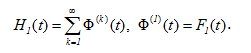 (2.10)
Relation (2.6) does not change; only the distribution of the random variable ξ1 changes, and therefore the bound for the function 

This change in the bound does not affect the convergence of the series (2.10) or the final conclusions. Thus, for the existence of the renewal function of the delayed renewal process as well, it is necessary to exclude the case of a unit jump of the distribution function F(t) at zero.
By definition, the differential of a function is the principal part of its increment. For the distribution function F(x)=P{ξof the random variable ξ it coincides, up to o(Δ), with the probability
P{x<=ξΔ}=F(x+Δ)-F(x)=dF(x)+o(Δ) as Δ→0.
Let us introduce the following notation:
 — the event that, on the interval [x,x+Δ), a renewal with number n occurred,
The following relations are obvious

Consequently,
. (2.11)
If we use equality (2.11), then the differential of the renewal function can be given a new, interesting interpretation.
Note that for k, the inclusion of events holds  . This relation holds because, if on the interval [x,x+Δ) the k-th and j-th renewals occurred, then the (k+1)-th renewal also occurred in this interval. Hence

Since , we obtain a two-sided bound, which we can write taking into account the two-sided bound for the probability of a union of events (mathematical appendix 1),
Then 
As n→∞ we obtain the bound
[1-F(Δ)][H(x+Δ)-H(x)]<= limn→∞ P{Bn(x,Δ)}=P{A(x,Δ)}<= [H(x+Δ)-H(x)]. (2.12)
Conclusion. If the distribution function F(x) is continuous at zero, then the increment of the renewal function at the point x, or its differential, can be interpreted as the probability of having a renewal (regardless of which one in order) in some infinitesimal neighborhood of the point x.

Comments