
Lecture
In solving a number of practical and theoretical problems, the need arises to pass to the limit in a convolution integral when the integrand functions are not bounded at infinity. In particular, integrals of the following form arise in renewal theory
. 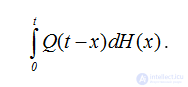 (2.28)
If the renewal process is not terminating, i.e., the distribution F(x) is proper, F(∞)=1, and the expectation Mξ,, exists, then the renewal function H(t) is not bounded at infinity, and in accordance with the elementary renewal theorem it grows at infinity as a linear function. In this case Lemma 2.2, given in the preceding section, cannot be applied directly. In the present section we give, without proof, two theorems - Blackwell's theorem and the key renewal theorem - which fill this gap. The proofs can be found in .
Before turning to the statement of the theorems, let us give the definition of an arithmetic distribution.
DEFINITION 2.1. A discrete distribution of a random variable ξ , defined by a sequence of values and probabilities , k>0, is called arithmetic (lattice) if there exist a C and an h>0 such that for every xn the representation xn=C+knh holds, where kn is an integer.
Distributions that do not possess these properties are not arithmetic. In particular, a continuous distribution is not arithmetic. In what follows we shall call such distributions non-lattice.
The meaning of an arithmetic (lattice) distribution is that for such a distribution one can choose a new origin (choice of the constant C) and a new scale (choice of the constant h), under which the values taken by the random variable become integers.
BLACKWELL'S THEOREM. If the distribution F(t)=P{ξ0
. 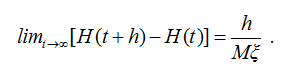 (2.29)
KEY RENEWAL THEOREM. Let Q(x) be a nonnegative, nonincreasing, integrable function, let the integral exist, and let the distribution F(t)=P{ξ
. 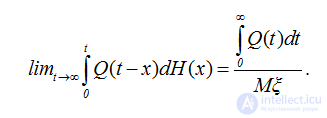 (2.30)
Here we also prove the equivalence of the theorems stated.
If we set , then (2.29) obviously follows from (2.30).
Next, suppose that the limiting relation (2.29) holds. Then the difference H(t+h)-H(t)∞ is uniformly bounded for any h>0. By the condition of the theorem, limt→∞Q(t)=0.
For fixed h>0 and k>=0 define the function qk(t,h)=1 for kh<=x<(k+1)h and qk(t,h)=0 outside this interval. In this notation, by virtue of the monotonicity of the integrand function, we obtain the two-sided estimate

Then for the integral we have the following estimates
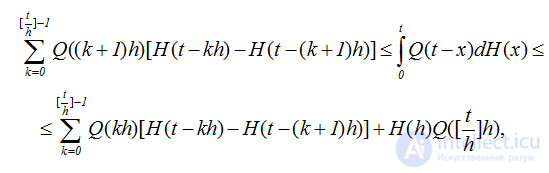 (2.31)
where denotes the integer part of the ratio.
For fixed h>0 and n>=0 , if t is large, t>t(n), from (2.31) we obtain
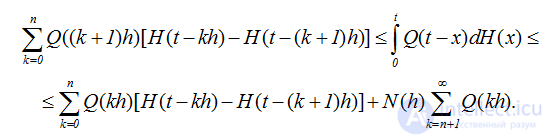 (2.32)
Let us pass to the limit in (2.32) as t→∞ and obtain, by virtue of (2.29),
 (2.33)
By virtue of the integrability of the function Q(x) we have
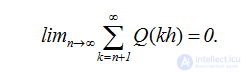 (2.34)
Therefore, passing to the limit in (2.33) as n→∞, we obtain

which, as h→0, proves the limiting equality (2.30).*

Comments