
Lecture
The Cramér — Lundberg model — a mathematical model that makes it possible to assess the ruin risk of an insurance company. Under this model it is assumed that insurance premiums arrive continuously, at a rate of  conventional monetary units per unit time, that is,
  — the size of the insurance premium. The model allows one to determine the premium size required for the company to avoid ruin.
The insurance model consists in describing a random process  , characterizing the company's capital at time
  .
.
The model looks as follows:
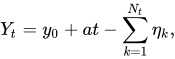 where
where
— the company's capital at time ,
 — the initial capital,
  ,
,
– the rate at which insurance premiums are received,
 — the number of insurance claims from the start up to time ,
 — the payout for the
  -th insurance claim, the payment being made at time
  .
.
It is reasonable to define the random process as a Poisson process of intensity  . This is because insurance claims are unrelated to one another, so the random variable equal to the time interval between two claims has an exponential distribution (since this distribution has the "memoryless" property). To move from the intervals between insurance payouts to a random process depending on time , we consider the renewal process:
 – independent random variables with distribution
  (the time intervals between insurance claims),
 ,
,
 .
.
This renewal process is an explicit construction of a Poisson process. Thus the definition of is justified.
The company is considered ruined if  . Let
. Let  – be the first time at which the company's capital becomes zero or negative. Our task is to find the probability of ruin:
  .
.
1. From the properties of the Poisson process we obtain the distribution of the number of payouts for each time :
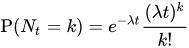 .
.
2. Suppose that the payout sizes – are independent identically distributed random variables with  .
.

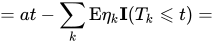


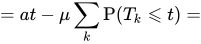
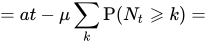

From this we obtain the condition that the company operates at a positive profit (that is,  ):
):
 .
.
The meaning of this expression is as follows: for positive profit, the insurance premium must be greater than the average payout per insurance claim, multiplied by the reciprocal of the average time between two claims.
Using statistical or other methods, the insurance company must calculate the average size of a single insurance payout, as well as the probability of a claim occurring. The size of the insurance premium must be set at a level no less than the product of  (the probability of a claim being filed per unit time) and the average cost of a claim
  . In that case, the probability that the insurance company will not go bankrupt is nonzero.

Comments