
Lecture
Stochastic integral — an integral of the form  , where
  — a random process with independent normal increments. Stochastic integrals are widely used in stochastic differential equations. A stochastic integral cannot be evaluated as an ordinary Stieltjes integral.
The stochastic integral can be defined by means of sums 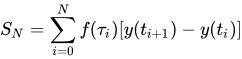 . The integral is obtained, as with the Stieltjes integral, by passing to the limit:
 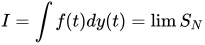 .
.
Consider the integral 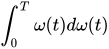 , where
  — a Wiener process with unit variance parameter. Divide the interval
  by points
  into
into  subintervals. Using the previous definition of the integral for a deterministic function, the stochastic integral can be defined by either of two expressions:
 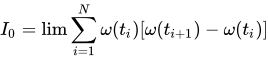 , or
, or 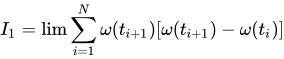 . These integrals are not equal, since, by the definition of the Wiener process:
  . A generalized stochastic integral can be defined as the sum of the integrals, weighted by the parameter
  , of
, of  and
and  , according to the following formula:
  , for
, for  . The integral corresponds to the Ito integral, and
  coincides with the Stratonovich integral.
The Stratonovich integral has the form:  .
.
The Ito integral has the form:  . Its main properties:
  ,
,  .
.
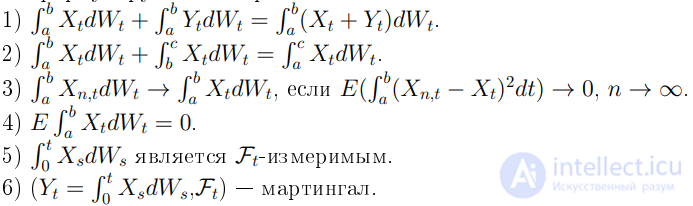
Let us formulate some of its properties:
Let us assign to each trajectory of a one-dimensional Wiener process a certain number  . Then this trajectory can be described by means of the stochastic function
  . An integral of the form
 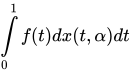 is called the Wiener stochastic integral. This integral is computed analogously to integration by parts:
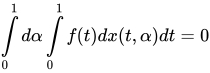
  . Its main properties:
  ,
, 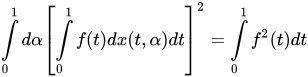 .
.
Ito calculus — a mathematical theory describing methods for manipulating random processes, such as Brownian motion (or the Wiener process). Named after its creator, the Japanese mathematician Kiyosi Ito. It is often applied in financial mathematics and in the theory of stochastic differential equations. The central concept of this theory is the Ito integral
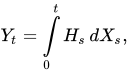
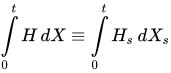
also written in the form  , where
  — Brownian motion or, in a more general formulation, a semimartingale. It can be shown that the path of integration for Brownian motion cannot be described by standard techniques of integral calculus. In particular, Brownian motion is not an integrable function at every point of its path and has infinite variation over any time interval. Thus, the Ito integral cannot be defined in the sense of the Riemann — Stieltjes integral. However, the Ito integral can be defined correctly if one notes that the integrand function
  is an adapted process; this means that the dependence on time
  of its mean value is determined by the behavior only up to the moment .
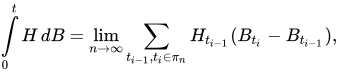
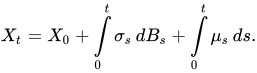
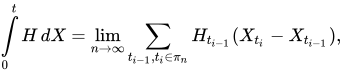
where  ,
,  - a sequence of partitions of the interval [0, t] with the length of the subintervals tending to zero.




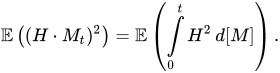
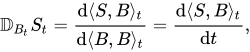
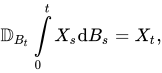 and
and 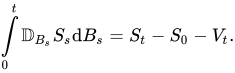

Comments