
Lecture
In probability theory , empirical measure is a random measure arising from a particular realization (usually finite) of a sequence of random variables . The precise definition is given below. Empirical measures are related to mathematical statistics .
The motivation for studying empirical measures is that it is often impossible to know the true underlying probability measure . We collect observations and compute relative frequencies . We can estimate or the associated distribution function by means of the empirical measure or the empirical distribution function, respectively. These are always good estimates under certain conditions. Theorems in the area of empirical processes provide the rate of such convergence. 


Let be a sequence of independent identically distributed random variables with values in a state space S with probability distribution P . 
Definition
The empirical measure P n is defined for measurable subsets of S and is given by
where is the indicator function and is the Dirac measure .

Properties

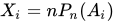


Definition
 is the empirical measure indexed by , the collection of measurable subsets of S .
To generalize this notion further, note that the empirical measure maps measurable functions to their empirical mean , 


In particular, the empirical measure of A is simply the empirical mean of the indicator function, P n ( ) = P n I A .

By the strong law of large numbers , P n ( converges) to P ( A ) almost surely for fixed A . Similarly converges to almost surely for a fixed measurable function . The problem of the uniform convergence of P n to P remained open until Vapnik and Chervonenkis solved it in 1968. 

If the class (or ) is a Glivenko – Cantelli class with respect to P, then P n converges to P uniformly over (or ). In other words, with probability 1 we have 




The empirical distribution function is an example of empirical measures. For real-valued iid random variables it is defined as 

In this case the empirical measures are indexed by the class. It has been shown that this is a uniform Glivenko – Cantelli class , in particular, 

with probability 1.

Comments