
Lecture
DEFINITION 2.2. A stationary renewal process ξ(t) is a renewal process for which the distribution of the number of renewals occurring on any interval of a given length does not depend on the location of that interval, i.e. the function P{ξ(t+x)-ξ(t)=k} does not depend on t, but depends only on x and k.
In the theory of random processes such processes are called processes with stationary increments, or homogeneous processes. In queueing theory, following Khinchin, such flows are called stationary. We shall adhere to this terminology, since we are oriented toward the queueing-theory literature.
Denote by H1(t) the renewal function of the stationary renewal process ξ(t). With H1(0)=0 we obtain
M[ξ(t+x)-ξ(t)]=H1(t+x)-H1(t)=H1(x)=M[ξ(x)-ξ(0)].
The first equality follows from the definition of the renewal function of a renewal process, and the second equality follows from the definition of stationarity of the process.
Therefore, for the renewal function of a stationary renewal process the equality H1(t+x)=H1(t)+H1(x) holds. The only function that is not identically equal to a constant and satisfies this relation is a linear function, since the coefficient is determined by the behavior of the renewal function at infinity (see the elementary renewal theorem). Let us determine which functions (F1(x), F(x)) define a delayed renewal process whose renewal function is a linear function. To this end we substitute the function into the integral renewal equation (2.17) and obtain the distribution F1(x) corresponding to the given renewal function,
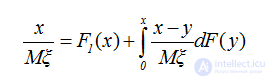
or
. 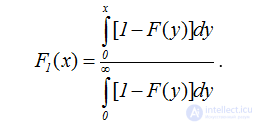 (2.59)
Thus we have obtained relation (2.59), which establishes the connection between the functions F1(x) and F(x) when the renewal process is stationary. In other words, by specifying the function F(x) we obtain the distribution function of the first interval F1(x) for a stationary renewal process. Condition (2.59) is a necessary condition for stationarity of the renewal process, that is, if the renewal process is stationary, then equality (2.59) holds.
Equality (2.59) allows us to assert that for a stationary renewal process the function F1(x) must be differentiable and, consequently, the equality holds
.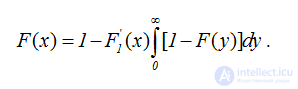
Consequently, conversely, by specifying F1(x) and the constant, we obtain the function F(x) for which the renewal process will be stationary.
Let us prove that (2.59) is also a sufficient condition for stationarity of the renewal process.
So, suppose we are given a delayed renewal process, whose determining distribution functions, F1(x) and F(x), are related by relation (2.59). Then we obtain the relation between the Laplace–Stieltjes transforms
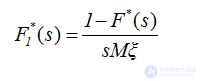
and from (2.20) we obtain the Laplace–Stieltjes transform of the renewal function of the stationary renewal process
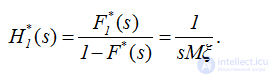 (2.60)
The only function for which the Laplace–Stieltjes transform is (2.54) and H1(0)=0 is a linear function.
Next, note that equalities (2.36), (2.39) and (2.41), derived above for the ordinary renewal process, carry over readily to the delayed renewal process. We give them without detailed explanation
 , for 0<= t, (2.61)
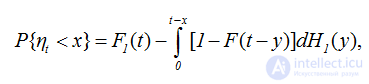 for 0<= t, (2.62)
 for x>0. (2.63)
If we substitute into equality (2.63) the function (2.59) and the linear renewal function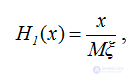 , then we obtain .
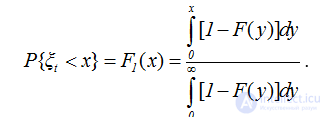
This means that the development of the renewal process on the intervals (0,x) and (t,t+x) is determined by one and the same probabilistic characteristics. Then the distributions of the number of renewals occurring on these intervals coincide. Consequently, the renewal process is stationary. We have thus proved the following
THEOREM 2.3. A renewal process is stationary if and only if the functions F1(x) and F(x) that determine it are related by relation (2.59).
The necessary and sufficient conditions for stationarity of a renewal process formulated above can be taken as the definition of its stationarity.

Comments