
Lecture
Up to this point, the restrictions have been:
Under these conditions the renewal process develops over time: in a finite time a finite number of renewals occur (there is no infinite accumulation), while over an infinite time an infinite number of renewals occur, that is, as t→∞, with probability one ξ(t)→∞.
Such a situation occurs when the distribution defining the renewal process is proper, that is, P{ξ<∞}=limt→∞F(t)=F(∞)=1 (a condition necessary for the existence of moments).
A different picture arises when the distribution F(t) is improper, F(∞)<1, P{ξ=∞}=1-F(∞)>0. Then, with positive probability 1-F(∞)>0, the renewal process may terminate at some step, that is, the time until the next renewal will be equal to infinity.
A renewal process whose distribution of the intervals between successive renewal epochs is improper is called a terminating renewal process.
Before formulating the theorem on the limiting behavior of a terminating renewal process, we prove a lemma on the limiting behavior of convolution integrals.
LEMMA 2.2. If the functions A(x) and B(x) are positive, nondecreasing and uniformly bounded for x>0, then
PROOF. By virtue of the conditions of the theorem, for any ε1>0 there exists t1(ε1)>0 such that for t>t1(ε1)
.
For any ε2>0 there exists t2(ε2)>0 such that for t>t2(ε2) and
.
Then for t>max[t1(ε1), t2(ε2)] we obtain the estimate
which proves the assertion of the lemma. *
THEOREM 2.2. For a terminating renewal process starting at time t=0, the following statements hold:
; 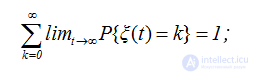 (2.24)
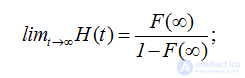 (2.25)
.  (2.26)
PROOF. For an improper distribution, direct passage to the limit as t→∞ in the convolution integral gives F(k)(∞)=[F(∞)]k<1, k>0, and F(0)(∞)<1. This fact is easily proved by induction, using Lemma 2.2. The distribution functions satisfy the conditions of the lemma. Hence . If , then it follows from the assertion of the lemma that 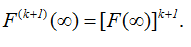
Then from (2.3) we obtain
P{ξ(∞)=k}=limt→∞ P{ξ(t)=k}=limt→∞ [F(k)(t)-F(k+1)(t)]=(F(∞))k[1-F(∞)] (2.27)
and hence (2.24) holds.
To prove (2.25) we make use of equality (2.4)

where the interchange of the order of summation and passage to the limit is legitimate, since the series (2.4) converges uniformly for 0<=t<∞.
Equality (2.27) shows that the number of terms ξm before the renewal process terminates has a geometric distribution. Then, by the total probability formula, we obtain
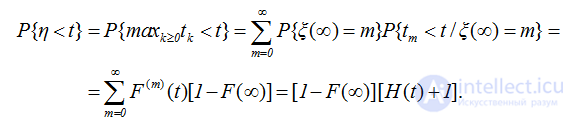
When computing the conditional probability ,  we note that the following equality of events holds

Therefore, by the independence of the random variables ξm+1 and tm we have

Thus, all the statements of the theorem are proved. *
COROLLARY 2.1. If the nondecreasing function B(x) has a limit as x→∞, B(∞)=limx→∞B(x), and H(x) is the renewal function of a terminating renewal process, then
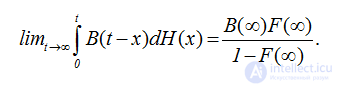
PROOF. The proof follows directly from equality (2.25) and the assertion of Lemma 2.2.*

Comments