
Lecture
Starlink satellites are equipped with electrostatic Hall-effect thrusters that use krypton. Their own thrusters allow the satellites to raise their orbit, maneuver in space, and deorbit at the end of their useful life. The satellite's mass is about 260 kg, and its shape is a flat panel. Starlink satellites use data from the US Department of Defense's space debris tracking system to autonomously perform maneuvers in order to avoid collisions with space debris and other spacecraft. Each spacecraft is equipped with 1 solar panel, 4 phased array antennas, and star trackers for orientation.
The system will not connect directly from its satellites to phones, unlike the Iridium, Globalstar, Thuraya, and Inmarsat satellite communication systems. Instead, it will rely on pizza-box-sized user terminals equipped with phased array antennas that track the satellites. The terminals can be installed anywhere they have a direct line of sight to the satellites.
As part of the public testing of the system, which began on October 26, 2020 in the US and Canada, customers are offered the option to purchase an equipment kit for $499, with a monthly subscription for communication services costing $99[10].
| Phase | Orbital altitude
(km) |
Number
of satellites |
Inclination
(degrees) |
Deadline for deploying 50% of satellites | Deadline for deploying 100% of satellites | Deployed to orbit | Deorbited |
|---|---|---|---|---|---|---|---|
|
|
550 | 1584 | 53 | until March 2024 | until March 2027 | 953 | 58 |
| 1110 | 1600 | 53.8 | 0 | ||||
| 1130 | 400 | 74 | 0 | ||||
| 1275 | 375 | 81 | 0 | ||||
| 1325 | 450 | 70 | 0 | ||||
|
|
335,9 | 2493 | 42 | until November 2024 | until November 2027 | 0 | |
| 340,8 | 2478 | 48 | 0 | ||||
| 345,6 | 2547 | 53 | 0 |
TINTIN A and TINTIN B are experimental prototype telecommunications satellites for a next-generation communications network. The goal of Starlink, the company that created them, is to develop next-generation internet access for everyone, even the most remote regions of the globe, at an affordable price. These spacecraft could become the forerunners of a huge series of satellites — more than 11 thousand units.
TINTIN A and TINTIN B fly one after another in slightly different, but still distinct orbits, close to one another. They are observed by five fixed ground broadband access stations located in the western United States. They are also observed by three mobile ground stations near the five main fixed stations. Measurement experiments are carried out by the ground stations with a frequency of every 0.9 days for 15 minutes. The stationary stations likely play the role of internet operators, while the mobile ones simulate ordinary moving network users. Using two satellites it is possible to model the sequential entry and exit of the future system's satellites into and out of the radio visibility zone of ground stations, and the handover of subscriber communication sessions between spacecraft without a loss of connection. The fact is that the total orbital period of both satellites is only 94 minutes, and they quickly leave the visibility zone, moving on to the next pass over the Earth's poles along their high-inclination orbit. The original idea is that a satellite disappearing over the horizon should be replaced by a new one already appearing from beyond the horizon.
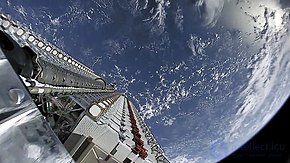
The SpaceX satellite communication system project comprising 4000 satellites, with a projected capacity of up to 50% of all internet traffic and about 10% of local traffic in cities with high population density, was presented to the public by Elon Musk in January 2015 during the opening of the company's research and production center in Redmond, Washington
In November 2016, the company filed an application with the Federal Communications Commission to place 4425 satellites in orbits at altitudes from 1150 to 1325 km to provide access to high-speed internet virtually anywhere in the world. The satellites will use Ka- and Ku-band frequencies. Initial, limited service provision was expected to begin after the deployment of the first 800 spacecraft, with each satellite's mass expected to be 386 kg
In March 2017, an application was filed for an additional 7518 satellites using V-band frequencies, to be placed in very low Earth orbits at altitudes between 335 and 345 km[
On February 22, 2018, using a Falcon 9 launch vehicle that lifted off from Vandenberg Air Force Base in California, SpaceX placed into orbit two experimental satellites, Tintin-A and Tintin-B, for the Starlink system, along with the Spanish government satellite PAZ, intended for radar surveillance
On March 29, 2018, the Federal Communications Commission approved SpaceX's application to build, deploy, and operate a constellation of 4425 communications satellites in low Earth orbit to provide broadband internet access to consumers in the United States and around the world. According to the commission's rules, the entire constellation must be launched within 9 years, and at least 50% of the satellites must be launched and begin operation within 6 years of the application's approval. If this requirement is not met, the commission has the right to limit the size of the constellation to only those satellites that were launched before the specified deadline
On November 15, 2018, an application to launch 7518 V-band satellites into orbits at an altitude of 335—345 km was approved[19].
In December 2018, the US Air Force signed a $28 million contract with SpaceX to study various options for using the Starlink system's capabilities for military purposes. In 2019, as part of service performance testing, a throughput of 610 Mbps was demonstrated aboard a C-12J Huron military transport aircraft. Later, test Starlink terminals are planned to be installed on an AC-130 gunship and a KC-135 tanker aircraft[
In April 2019, the Federal Communications Commission approved SpaceX's request to lower the orbital altitude for 1584 satellites from 1150 to 550 km. The satellites will be placed in 24 orbital planes with an orbital inclination of 53°. According to the company's statement, lowering the orbital altitude will speed up the satellite deployment process and reduce their required number, lower the signal latency to 15 ms, and also reduce the likelihood of space debris, since, in the event of a propulsion system malfunction, the spacecraft will deorbit and burn up in the atmosphere much faster — within a maximum of 5 years. The total number of satellites in the constellation operating in the Ka- and Ku-bands decreased to 4409[22][23].
On May 24, 2019, SpaceX launched 60 test satellites of the Starlink global internet system into a low Earth orbit at an altitude of 440 km using a Falcon 9 launch vehicle. All 60 satellites separated from the second stage simultaneously, using only the momentum obtained from the stage's rotation
In early September 2019, an incident of a potential collision occurred between the Starlink-44 satellite and the European Aeolus satellite. Initially, on August 28, the probability of collision was assessed as low (1 in 50,000), and the SpaceX and European Space Agency teams decided not to take any action. Subsequently, the collision probability forecast worsened to 1 in 1000, but a bug in the computer system prevented the SpaceX operator from receiving further messages from the ESA operator. On September 2, in the absence of contact with SpaceX, the agency decided to perform an avoidance maneuver
In September 2019, SpaceX filed an application to increase the number of orbital planes from 24 to 72 for satellites at an altitude of 550 km. This will reduce the number of launches required and allow the company to begin providing services in the southern United States before the 2020 hurricane season. Each launch will place satellites into three orbital planes at once, with 22 satellites in each plane. This application was approved by the commission in December 2019
On September 10, 2019, the president of SpaceX announced the company's plans to perform up to 24 Starlink satellite launches in 2020. The company plans to begin providing services in mid-2020
In October 2019, the company filed 20 applications with the Federal Communications Commission to place a total of 30,000 additional Starlink satellites for operation in orbits at altitudes from 238 to 580 km
In February 2020, the company's president Gwynne Shotwell announced a potential plan to spin off the Starlink project from SpaceX into a separate public company
In March 2020, the company received a license for 1 million user terminals for communication with Starlink satellites
In April 2020, an application was filed with the communications commission to change the orbital altitude of the remaining 2824 first-phase satellites. Instead of orbits at altitudes between 1100 and 1325 km with inclinations of 53.8, 70, 74, and 81°, the company wants to place satellites at altitudes between 540 and 570 km with orbital inclinations of 53.2, 70, and 97.6°. The new request mentions 4408 satellites, one fewer than stated in the previous application
On May 20, 2020, the US Army signed a 3-year agreement with SpaceX to test the Starlink system for transmitting data between its ground units .
In September 2020, SpaceX reported that during the initial stages of the service's beta testing, company employees demonstrated ultra-low signal latency and download speeds exceeding 100 Mbps. The first laser communication tests between two satellites in orbit were also carried out .
| Launch No. | Mission | Launch date (UTC) | Launch vehicle | Satellites in launch | Satellite version | Orbit (operational) |
Result |
|---|---|---|---|---|---|---|---|
| Tintin | February 22, 2018 | Falcon 9 FT B1038-2 | 2 | — | 514 km | success | |
| These two satellites, MicroSat-2a (Tintin A) and MicroSat-2b (Tintin B), are not elements of the future network, but, as prototypes, were important elements for verifying technical solutions. | |||||||
| 1 | Starlink | May 24, 2019 | Falcon 9 FT B1049-3 | 60 | 0.9 | 550 km, 53° | success[40] |
| The satellites represent a test version with reduced functionality, intended to work out the placement, deployment, and separation scheme for satellites in orbit, as well as to confirm the viability of the design and various technological solutions. These satellites lack an inter-satellite communication system; they only maintain communication with ground stations, using only Ku-band equipment[41]. The mass of each satellite is 227 kg, and the total payload mass at launch was about 13.6 tonnes[27]. After being placed into an orbit at an altitude of 440 km, all 60 satellites successfully deployed their solar panels and maintained communication with the ground control center[42].
On June 28, a month after launch, SpaceX reported that 45 satellites had reached their operational orbit at an altitude of 550 km, 5 satellites were in the process of moving, and another 5 were completing checks before beginning orbit raising. Contact was lost with three of the 60 satellites, and they will passively deorbit under the influence of gravity and Earth's atmosphere. Another 2 satellites will be intentionally deorbited to confirm the spacecraft's capability to do so[43]. |
|||||||
| 2 | Starlink-1 | November 11, 2019 | Falcon 9 FT B1048-4 | 60 | 1.0 | 550 km, 53° | success[44] |
| The satellites received several improvements: throughput increased by 400%, the number of phased-array antenna beams generated was doubled, and Ka-band equipment was added. Now 100% of the satellite's components will burn up in the atmosphere upon deorbiting after its operational life ends (in the previous batch, only 95%). The spacecraft's mass increased to 260 kg. The satellites were placed into an orbit at an altitude of 280 km, from where they will raise themselves to their orbital planes at 550 km[45]. | |||||||
| 3 | Starlink-2 | January 7, 2020 | Falcon 9 FT B1049-4 | 60 | 1.0 | 550 km, 53° | success[46] |
| One of the launched satellites has an experimental dark coating to reduce the spacecraft's brightness for astronomical observations[47]. | |||||||
| 4 | Starlink-3 | January 29, 2020 | Falcon 9 FT B1051-3 | 60 | 1.0 | 550 km, 53° | success[48] |
| 5 | Starlink-4 | February 17, 2020 | Falcon 9 FT B1056-4 | 60 | 1.0 | 550 km, 53° | success[49][50] |
| Unlike previous launches, the satellites were placed not into a circular intermediate orbit, but into an elliptical orbit with parameters of 212 × 386 km, inclination 53°. This type of insertion trajectory is planned to be used in all future launches[51]. | |||||||
| 6 | Starlink-5 | March 18, 2020 | Falcon 9 FT B1048-5 | 60 | 1.0 | 550 km, 53° | success |
| 7 | Starlink-6 | April 22, 2020 | Falcon 9 FT B1051-4 | 60 | 1.0 | 550 km, 53° | success |
| 8 | Starlink-7 | June 4, 2020 | Falcon 9 FT B1049-5 | 60 | 1.0 | 550 km, 53° | success |
| One of the launched satellites (VisorSat) has a shading visor to reduce the spacecraft's brightness for astronomical observations . | |||||||
| 9 | Starlink-8 | June 13, 2020 | Falcon 9 FT B1059-3 | 58 | 1.0 | 550 km, 53° | success |
| Along with Starlink, three SkySat satellites operated by Planet Labs, intended for observing the Earth's surface, were also launched | |||||||
| 10 | Starlink-9 | August 7, 2020 | Falcon 9 FT B1051-5 | 57 | 1.0 | 550 km, 53° | success |
| All satellites are equipped with fold-out visors to reduce visibility. Additionally, two small Earth remote sensing satellites — Global-5 and 6 of the American company BlackSky — were placed into orbit | |||||||
| 11 | Starlink-10 | August 18, 2020 | Falcon 9 FT B1049-6 | 58 | 1.0 | 550 km, 53° | success |
| Three additional small SkySat Earth remote sensing satellites operated by Planet Labs were also placed into orbit | |||||||
| 12 | Starlink-11 | September 3, 2020 | Falcon 9 FT B1060-2 | 60 | 1.0 | 550 km, 53° | success |
| 13 | Starlink-12 | October 6, 2020[57] | Falcon 9 FT B1058-3 | 60 | 1.0 | 550 km, 53° | success |
| 14 | Starlink-13 | October 18, 2020 | Falcon 9 FT B1051-6 | 60 | 1.0 | 550 km, 53° | success |
| 15 | Starlink-14 | October 24, 2020 | Falcon 9 FT B1060-3 | 60 | 1.0 | 550 km, 53° | success |
| 16 | Starlink-15 | November 25, 2020 | Falcon 9 FT B1049-7 | 60 | 1.0 | 550 km, 53° | success |
| 17 | Starlink-16 | January 2021 | Falcon 9 FT | 60 | 1.0 | 550 km, 53° | |

Some astronomers have suggested that the numerous Starlink satellites in low orbits will interfere with astronomical observations of the sky and distant objects[58]. The International Astronomical Union expressed concern and stated that there is insufficient understanding of the impact of such large satellite constellations[59]. Initial observations confirmed these concerns, showing that Starlink satellites were among the brightest and fastest-moving objects in the night sky[60][61].
SpaceX reported that it is actively working together with leading astronomical organizations to ensure that their work is not disrupted by Starlink satellites. The company's engineers are working to make the underside of future satellite versions black in order to reduce their reflective effect on astronomical observations. The company is also willing to adjust satellite orbits to accommodate the most sensitive observations[62]. However, the batch of Starlink communication satellites that SpaceX launched into space in November 2019 was not equipped with the special coating that would make them invisible to telescopes. As a result, a total of 19 probes interfered with the operation of the DECam telescope (Dark Energy Survey) for 5 minutes; this telescope is designed to search for traces of dark energy. In total, SpaceX plans to increase the number of satellites operating simultaneously in orbit to 12 thousand units.[63].

Comments