
Lecture
There are many different wireless data transmission technologies, some of which compete directly with one another, while others are designed for specific applications. Wireless technologies can be evaluated by various metrics, some of which are described in this article.
Standards can be grouped as follows in order of increasing range:
Personal area network (PAN) systems are intended for short-range communication between devices, typically controlled by a single person. Examples include wireless headsets for mobile phones or wireless heart-rate sensors communicating with a wristwatch. Some of these technologies include standards such as ANT, UWB, Bluetooth, ZigBee, and Wireless USB.
Wireless sensor networks (WSN/WSAN) are generally networks of low-power, inexpensive devices that communicate wirelessly to collect, share, and sometimes take action based on data gathered from their physical environment — «sensor networks». Nodes are usually connected in a star or mesh topology. While most individual nodes in a WSAN are expected to have limited range (Bluetooth, ZigBee, 6LoWPAN, etc.), individual nodes may be capable of wider communication (Wi-Fi, cellular networks, etc.), and any individual WSAN can span a wide geographic range. An example of a WSAN could be a set of sensors placed throughout an agricultural facility to monitor soil moisture levels, transmitting data back to a computer at the main office for analysis and trend modeling, and possibly turning on automatic irrigation valves if the level is too low.
A wireless local area network (WLAN) is used for longer-range communication. WLANs are often known by the commercial name Wi-Fi. These systems are used to provide wireless access to other local network systems, such as other computers, shared printers, and other similar devices, as well as to the Internet. As a rule, a WLAN provides much higher speed and lower latency within the local network than Internet access does for the average user. Older systems supporting WLAN functionality include DECT and HIPERLAN. However, these are no longer widely used. One characteristic feature of WLANs is their predominantly local nature, without the ability to seamlessly hand over from one network to another.
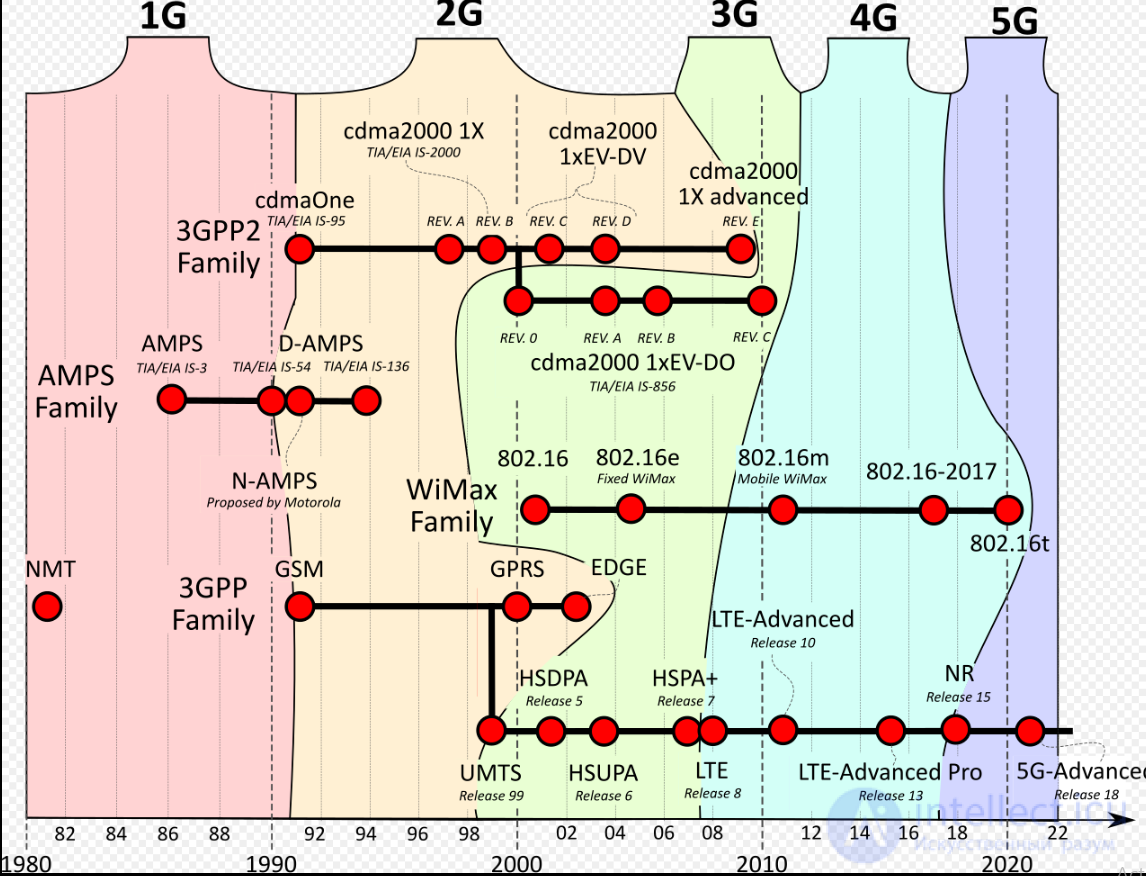
Cellular networks, or WANs, are designed to cover urban/national/global areas and provide seamless mobility from one access point (often defined as a base station) to another, ensuring seamless coverage over very wide areas. Cellular network technologies are often divided into second-generation 2G, 3G, and 4G networks. Originally, 2G networks were voice or even voice-only digital cellular systems (as opposed to 1G analog networks). Typical 2G standards include GSM and IS-95, with extensions via GPRS, EDGE, and 1xRTT, providing Internet access to users of originally voice-only 2G networks. Both EDGE and 1xRTT are 3G standards as defined by the ITU, but are usually marketed as 2.9G due to their comparatively low speeds and high latency compared to true 3G technologies.
True 3G systems, such as EV-DO and W-CDMA (including HSPA and HSPA+), originally provide combined circuit-switched and packet-switched data and voice services, generally with much higher data rates than 2G networks with their extensions. All of these services can be used to provide combined mobile voice and Internet access in remote locations.
4G networks provide even higher data rates and numerous architectural improvements that are not always noticeable to the consumer. Currently, 4G WiMAX and LTE systems are widely deployed. These networks are purely packet-switched networks, without traditional voice capabilities. These networks provide voice services via VoIP or VoLTE.
| Protocol | Frequency (MHz/GHz) | Frequency type | Modulation | Channels | Encryption types | Comments |
|---|---|---|---|---|---|---|
| Matter | 2.4 GHz (via Thread/BLE) | Fixed within the band | OFDM (Wi-Fi), DSSS (Thread) | Depends on Thread/Wi-Fi 16/160 | AES-128, TLS, IPsec | Uses Thread (based on IEEE 802.15.4) and BLE for communication. |
| Zigbee | 2.4 GHz / 868 MHz / 915 MHz | Fixed, region-dependent | O-QPSK (2.4 GHz), BPSK (868/915 MHz) | 16 channels (2.4 GHz) | AES-128 | 2.4 GHz — global, 868/915 MHz — Europe/US. |
| Z-Wave | 868.42 MHz (EU), 908.42 MHz (US) | Fixed, regional | FSK | ~9 channels (depending on region) | S2 Security (AES-128) | Narrow band, less interference. |
| Bluetooth | 2.4 GHz | Variable within 79 channels | GFSK (BLE), FHSS | 79 channels (BLE) | AES-CCM, ECDH, Secure Simple Pairing | Uses FHSS (frequency hopping). |
| Wi-Fi | 2.4 GHz / 5 GHz / 6 GHz | Variable within channels | OFDM, QAM (up to 1024-QAM in Wi-Fi 6) | 11–14 channels (2.4 GHz), up to 160 channels (5/6 GHz) | WPA2/WPA3 (AES-128/256) | Depends on standard: Wi-Fi 4/5/6. |
| ANT+ | Z-Wave | Bluetooth | Bluetooth LE | Zigbee | |
|---|---|---|---|---|---|
| Standardization | Proprietary | Proprietary | Standard | Standard | Standard |
| Topologies | Point-to-point, star, tree, mesh | Mesh | Point-to-point, Scatternet | Point-to-point, star, mesh | Mesh |
| Band | 2.4 GHz | 2.4 GHz and 900 MHz (varies slightly by country) | 2.4 GHz | 2.4 GHz | 2.4 GHz (+ sub-GHz for Zigbee PRO) |
| Range | 30 meters at 0 dBm | 10–100 meters | 1–100 meters | 10–600 meters in air (Bluetooth 5) | 10–100 meters |
| Maximum data rate | Broadcast/Ack – 200 Hz × 8 bytes × 8 bits = 12.8 kbit/s
Burst – 20 kbit/s |
100 kbit/s | 1–3 Mbit/s | 125 kbit/s, 250 kbit/s, 500 kbit/s, 1 Mbit/s, 2 Mbit/s (Bluetooth 5 PHY rates) | 250 kbit/s (at 2.4 GHz) |
| Application throughput | 0.5 Hz – 200 Hz (8 bytes of data) | 0.7–2.1 Mbit/s | 305 kbit/s (Bluetooth 4.0) | ||
| Maximum number of nodes in a piconet | 65533 per shared channel (8 shared channels) | 232 devices per network | 1 receiver and 7 active sensors, >200 inactive | 1 receiver and 7 sensors (but scatternet is unlimited), mesh – 32767 | star – 65536 |
| Security | AES-128 and 64-bit key | AES-128 | 56–128-bit key | AES-128 | AES-128 |
| Modulation | GFSK | FSK | GFSK | GFSK | OQPSK |
IP-based, runs over Thread and Wi-Fi.
Supports end-to-end interoperability between ecosystems (Apple, Google, Amazon).
Energy-efficient when using Thread.
Requires a hub for Thread, but can work directly over Wi-Fi.

Matter — is a technical standard for smart home and Internet of Things (IoT) devices. It aims to improve interoperability and compatibility across different manufacturers and security, while always allowing local control as an option.
Matter emerged in December 2019 as the Project Connected Home over IP (CHIP) working group, founded by Amazon, Apple, Google, and the Zigbee Alliance, now called the Connectivity Standards Alliance (CSA). Subsequent members included IKEA, Huawei, and Schneider. Version 1.0 of the specification was published on October 4, 2022. The Matter software development kit is open source under the Apache license.
The software development kit (SDK) is provided royalty-free, although the ability to bring a finished product into the Matter network in the field requires certification and membership fees, which entail both one-time and recurring costs, as well as per-product costs. This is enforced using public key infrastructure (PKI) and so-called device attestation certificates
Matter-compatible software updates for many existing hubs became available in late 2022, and Matter-enabled devices and software updates began shipping in 2023.
Mesh network: devices relay the signal.
Low power consumption — sensors run for years on batteries.
Requires a hub (coordinator).
High interference resistance, but limited range.

Zigbee — is a specification, based on the IEEE 802.15.4 standard, for a set of high-level communication protocols used to build personal area networks with low-power digital radios, for example for home automation, collecting data from medical devices, and other tasks requiring low-power, narrowband connectivity, designed for small projects requiring a wireless connection. Thus, Zigbee is a low-power, low-data-rate, short-range wireless ad hoc network (e.g. a personal area network).
The technology defined by the ZigBee specification is intended to be simpler and cheaper than other wireless personal area networks (WPAN), such as Bluetooth, or more general wireless networks, such as Wi-Fi (or Li-Fi). It can be applied in wireless light switches, home energy monitoring systems, traffic control systems, and other consumer and industrial equipment requiring short-range wireless data transfer at low speed.
Low power consumption limits the data transmission range to 10–100 meters (33–328 feet) within line of sight, depending on output power and environmental characteristics. ZigBee devices can transmit data over greater distances by passing it through a mesh network of intermediate devices to reach more distant devices. ZigBee is typically used in low-data-rate applications requiring long battery life and a secure network. (ZigBee networks are protected by 128-bit symmetric encryption keys.) ZigBee has a defined rate of up to 250 kbit/s, best suited for intermittent data transmission from a sensor or input device.
The ZigBee protocol was developed in 1998, standardized in 2003, and revised in 2006. The name relates to the waggle dance of honeybees after they return to the hive
Mesh network, but with a limit on the number of hops in a route.
Very low power consumption.
Less interference due to the sub-1 GHz frequency.
Requires a certified hub, less universal.
Z-Wave — is a wireless communication protocol used primarily for residential and commercial building automation. It is a mesh network that uses low-energy radio waves to communicate between devices, enabling wireless control of «smart» home devices such as intelligent lighting, security systems, thermostats, sensors, smart door locks, and garage door openers. The Z-Wave brand and technology are owned by Silicon Labs. More than 300 companies working with this technology are united in the Z-Wave Alliance.

Like other protocols and systems intended for the residential, commercial, multi-family housing, and building markets, a Z-Wave system can be controlled from a smartphone, tablet, or computer, as well as locally via a smart speaker, wireless key fob, or wall panel with a Z-Wave gateway or central controller acting as a hub or controller. Z-Wave provides application-layer interoperability between home control systems from different manufacturers belonging to its alliance. The number of compatible Z-Wave products is growing: more than 1,700 in 2017, more than 2,600 by 2019, and more than 4,000 by 2022.
Suitable for short distances (up to 10 m).
Energy-efficient (BLE).
Does not support mesh networks by default (only in BLE Mesh).
Easy to set up, but limited in scalability.

Bluetooth is a standard for short-range wireless technology used for exchanging data between fixed and mobile devices over short distances and building personal area networks (PAN). In the most widely used mode, transmission power is limited to 2.5 milliwatts, providing a very short range — up to 10 meters (33 feet). It uses UHF radio waves in the ISM (industrial, scientific, and medical) bands from 2.402 GHz to 2.48 GHz. It is mainly used as an alternative to wired connections for exchanging files between nearby portable devices and for connecting mobile phones and music players to wireless headphones, wireless speakers, HIFI systems, car audio systems, and for wireless data transfer between TVs and soundbars.
Bluetooth is managed by the Bluetooth Special Interest Group (SIG), which includes more than 35,000 member companies in telecommunications, computing, networking, and consumer electronics. The IEEE standardized Bluetooth as IEEE 802.15.1, but no longer maintains this standard. The Bluetooth SIG oversees development of the specification, manages the qualification program, and protects the trademarks. A manufacturer must meet Bluetooth SIG standards to market it as a Bluetooth device. A network of patents applies to the technology, which is licensed to individual qualifying devices. As of 2021, 4.7 billion Bluetooth chips are shipped annually. Bluetooth was first demonstrated in space in 2024, an early test intended to expand IoT capabilities.
Technical specifications and features
| Version | Year adopted | Maximum speed | Maximum range | Radio frequency | ||
|---|---|---|---|---|---|---|
| Major | Minor | Classic | Low Energy | |||
| 1 | 1.0 | 1999 | 732.2 kbit/s | — | 10 m | 2.4 GHz |
| 1.1 | 2001 | |||||
| 1.2 | 2003 | 1 Mbit/s | ||||
| 2 | 2.0 | 2004 | 2.1 Mbit/s | |||
| 2.1 | 2007 | |||||
| 3 | 3.0 | 2009 | 24 Mbit/s | |||
| 4 | 4.0 | 2009 | 3 Mbit/s | 1 Mbit/s | 60 m | |
| 4.1 | 2013 | |||||
| 4.2 | 2014 | |||||
| 5 | 5.0 | 2016 | 50 Mbit/s | 2 Mbit/s | 240 m | |
| 5.1 | 2019 | |||||
| 5.2 | 2020 | |||||
| 5.3 | 2021 | |||||
| 5.4 | 2023 | |||||
| 6 | 6.0 | 2024 | ? | 3 Mbit/s | 300 m | |
| 6.1 | 2025 | ? | ? | ? | ||
The specifications were formalized by the Bluetooth Special Interest Group (SIG) and officially
High data rate.
Does not require a hub — devices connect directly.
High power consumption.
Prone to congestion when there are many devices.
Wi-Fi— is a family of wireless network protocols based on the IEEE 802.11 standards, typically used to combine devices into local networks and provide Internet access, allowing nearby digital devices to exchange data via radio waves. These are the most common computer networks used worldwide in home and small-office networks to connect devices and provide Internet access via wireless routers and wireless access points in public places such as cafes, restaurants, hotels, libraries, and airports.
Wi-Fi is a trademark of the Wi-Fi Alliance, which restricts the use of the term «Wi-Fi Certified» to products that have successfully passed compatibility certification testing. Non-compliant equipment is simply called WLAN and may or may not work with devices holding «Wi-Fi Certified» status. As of 2017, the Wi-Fi Alliance included more than 800 companies from around the world. As of 2019, more than 3.05 billion Wi-Fi-enabled devices are shipped worldwide each year.
Wi-Fi uses several parts of the IEEE 802 protocol family and is designed to work well with its wired sibling, Ethernet. Compatible devices can be networked with each other via wireless access points, as well as with wired devices and the Internet. Different versions of Wi-Fi are defined by different IEEE 802.11 protocol standards, with different radio technologies defining the radio bands, maximum ranges, and speeds that can be achieved. Wi-Fi most commonly uses the 2.4 gigahertz (120 mm) UHF and 5 gigahertz (60 mm) SHF radio bands, with the 6 gigahertz SHF band used in newer generations of the standard; these bands are subdivided into several channels. Channels can be shared by multiple networks, but within range only one transmitter can transmit on a channel at a time.
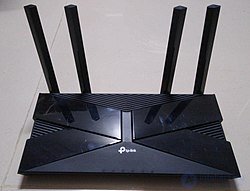
TP-Link AX1500 Wi-Fi 6 router
Wi-Fi radio bands work best under line-of-sight conditions. Ordinary obstacles, such as walls, columns, household appliances, etc., can significantly reduce range, but this also helps minimize interference between different networks in crowded places. An access point's range is about 20 m (66 feet) indoors, while some access points claim ranges of up to 150 m (490 feet) outdoors. An access point's coverage area can be as small as a single room with walls blocking radio waves, or as large as several square kilometers when using multiple overlapping access points with roaming enabled between them. Over time, Wi-Fi's speed and spectral efficiency have increased. As of 2019, some versions of Wi-Fi, running on suitable equipment at close range, can reach speeds of 9.6 Gbit/s (gigabits per second). [8]
Wireless USB

Wireless USB is a version of a short-range, high-bandwidth wireless radio protocol for Universal Serial Bus (USB), created by the Wireless USB Promoter Group. It is unrelated to Wi-Fi and Cypress Wireless USB. It was supported by the WiMedia Alliance, which ceased operations in 2009.
Wireless USB is based on the WiMedia Alliance's ultra-wideband (UWB) platform, capable of transmitting data at 480 Mbit/s over distances of up to 3 meters (9.8 feet) and 110 Mbit/s over distances of up to 10 meters (33 feet). It is designed to operate in the 3.1 to 10.6 GHz frequency range, although in some countries the permitted operating range may be restricted by local regulations.
The standard is now obsolete, and no new equipment has been produced for many years, although it was adopted by Android for precision signaling.
Support for the standard was dropped in Linux 5.4 and removed in Linux 5.7.
ANT (derived from Adaptive Network Topology) — is a proprietary (but openly accessible) multicast wireless sensor network technology developed and promoted by ANT Wireless (a division of Garmin Canada). It provides personal area networks (PANs), primarily for activity trackers. ANT was introduced by Dynastream Innovations in 2003, followed by the low-power ANT+ standard in 2004, after which Dynastream was acquired by Garmin in 2006.

ANT defines a wireless communication protocol stack that allows equipment operating in the 2.4 GHz ISM band to communicate, establishing standard rules for coexistence, data representation, signaling, authentication, and error detection. It is conceptually similar to Bluetooth Low Energy (BLE), but geared toward use with sensors.
As of November 2020, the ANT website lists nearly 200 brands using ANT technology. Samsung, and to a lesser extent Fujitsu, HTC, Kyocera, Nokia, and Sharp, have added built-in support (without using a USB adapter) to their smartphones, with Samsung starting support with the Galaxy S4 and ending support with the Galaxy S20 lineup.
In 2025, Garmin announced it would discontinue certification of ANT+ devices, citing changes in wireless regulations. This is likely to lead future devices to drop ANT+ support in favor of BLE.
In telecommunications, LTE (Long-Term Evolution) technology is a wireless broadband communication standard for cellular mobile devices and data terminals. It is considered a «transitional» 4G technology and is therefore also designated 3.95G, as a step above 3G.
LTE is based on the 2G GSM/EDGE and 3G UMTS/HSPA standards. It increases the throughput and speed of these standards through the use of a different radio interface and core network improvements. [3] [4] LTE is an upgrade path for operators using both GSM/UMTS and CDMA2000 networks. LTE was succeeded by LTE Advanced technology, which is officially defined as «true» 4G technology and is also called «LTE+».
The standard was developed by 3GPP (3rd Generation Partnership Project) and specified in its Release 8 series of documents, with minor improvements described in Release 9. LTE is also called 3.95G and marketed as 4G LTE and Advanced 4G; but the original version did not meet the technical criteria for a 4G wireless service as specified in the 3GPP Release 8 and 9 document series for LTE Advanced. The requirements were laid out by the ITU-R in the IMT Advanced specification; but due to market pressure and the significant advances that WiMAX, Evolved High Speed Packet Access, and LTE bring to the original 3G technologies, the ITU-R later decided that LTE and the aforementioned technologies could be called 4G technologies. The LTE Advanced standard formally meets the ITU-R requirements to be considered IMT-Advanced. To distinguish LTE Advanced and WiMAX-Advanced from contemporary 4G technologies, the ITU defined the latter as «True 4G».
Evolved High Speed Packet Access, better known as HSPA+, HSPA (Plus), or HSPAP, — is a technical standard for wireless broadband communication. It is a development of the earlier HSPA standard. The 3GPP (3rd Generation Partnership Project) organization, which handles mobile telecommunications standardization, developed the HSPA+ specification in its Release 7 and later releases. HSPA+ provides higher data rates than the original HSPA, with a theoretical downlink speed of up to 42.2 Mbit/s.
HSPA+ is considered a development of 3G technology, sometimes designated 3.75G. It allows existing 3G networks to be upgraded, providing speeds close to those of new 4G networks, without the need to build a completely new radio interface. Therefore, HSPA+ should not be confused with Long Term Evolution (LTE) technology – true 4G technology, which uses a different, OFDMA-based radio interface and follows a separate technological development path.

To achieve higher data rates, HSPA+ implements advanced antenna technologies such as beamforming and MIMO (multiple input/multiple output). Beamforming is a signal-processing technique that focuses the wireless signal from a base station on a specific receiving device rather than dispersing it in all directions. This concentration of the signal provides better reception and higher data rates. MIMO increases throughput by using multiple antennas on both the transmitting (base station) and receiving (user device) sides to simultaneously send and receive multiple data streams. Later versions of the standard introduced a dual-carrier mode of operation, which allows a device to operate simultaneously in two separate 5 MHz frequency bands, effectively doubling throughput.
Advanced HSPA+ is a further development of the technology, which theoretically provides peak download speeds of up to 168 Mbit/s and upload speeds of up to 22 Mbit/s. This performance is achieved through technologies such as using a more complex modulation method (for example, 64-QAM), which encodes more data in each transmission, or combining multiple radio-frequency carriers with features such as Dual-Cell HSDPA.
Enhanced Data Rates for GSM Evolution (EDGE) technology, also known as 2.75G and by various other names, — is a 2G digital mobile technology for packet data transmission. It is a subset of General Packet Radio Service (GPRS) technology in the GSM network and surpasses it, offering speeds close to those of 3G technology, hence the name 2.75G. EDGE is standardized by 3GPP as part of the GSM family and as an enhanced version of GPRS.
EDGE was deployed on GSM networks in 2003 — initially by Cingular (now AT&T) in the US. It could be readily deployed on existing GSM and GPRS cellular equipment, which made upgrading easier for cellular companies compared to 3G UMTS technology, which required significant changes. Through the introduction of sophisticated coding and data transmission methods, EDGE provides a higher data rate per radio channel, resulting in a threefold increase in capacity and throughput compared to a standard GSM/GPRS connection — the original maximum speed was 384 kbit/s. Evolved EDGE was later developed as an improved standard, providing even lower latency and more than double the throughput, with peak data rates of up to 1 Mbit/s.
Enhanced Data rates for GSM Evolution is the general full name of the EDGE standard. Other names include: Enhanced GPRS (EGPRS), IMT Single Carrier (IMT-SC), and Enhanced Data rates for Global Evolution.
Although 3GPP calls EDGE «2.75G», it falls within the International Telecommunication Union's (ITU) definition of 3G. It is also recognized as part of the International Mobile Telecommunications-2000 (IMT-2000) standard for 3G

Comments