
Practice
To start, let's recall what «100 Mbit/s Ethernet» is. 100 Mbit/s is the speed at the physical layer.
These are raw bits that travel over the cable, including:
the preamble,
MAC addresses,
EtherType/Length,
CRC,
the inter-frame gap,
service encoding bits (for example, 4B/5B in Fast Ethernet).
That is, 100 Mbit/s is NOT useful data.
The useful (payload) rate is always lower.
In Ethernet this is:
A standard Ethernet frame contains:
| Field | Size |
|---|---|
| Preamble + SFD | 8 bytes |
| MAC dest | 6 bytes |
| MAC source | 6 bytes |
| EtherType/Length | 2 bytes |
| Payload (IP+TCP+data) | 46–1500 bytes |
| CRC (FCS) | 4 bytes |
| Inter-frame gap (IFG) | 12 bytes «pause» |
8 + 6 + 6 + 2 + 4 + 12 = 38 bytes
Service encoding is sometimes added on top of this (see below).
Let's take the maximum frame (MTU 1500). Then:
Payload: 1500 bytes
Full frame with IFG: 1538 bytes
Percentage:
Overhead=38.1538≈2.47%
≈ 2.5% — transport overhead within Ethernet.
But this is only the Ethernet layer.
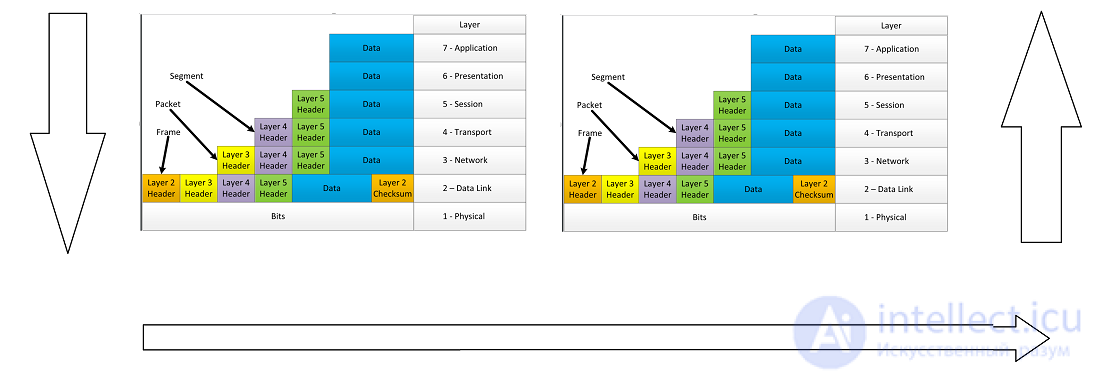
The packet is also affected by IP and TCP/UDP.
Standard headers:
IP: 20 bytes
TCP: 20 bytes
Total: +40 bytes
Useful TCP data in the frame:
1500 − 40 = 1460 bytes
Full Ethernet frame + IFG: 1538 bytes
(1538−1460)/1538=5.08%
Total is roughly 5% overhead with TCP.
Fast Ethernet (100 Mbit/s) uses:
4B/5B encoding
Every 4 bits are turned into 5.
This increases the bit stream by another 25%.
But 100 Mbit/s — is already the rate after encoding has been accounted for.
That is, the user does NOT get 125 Mbit/s — they get exactly 100.
However, this means that 125 Mbit/s physically travels on the cable,
but the interface reports «100 Mbit/s».
1) UDP (without TCP overhead)
≈ 97–98 Mbit/s of payload.
≈ 94–95 Mbit/s
(loss of ~5%)
Overhead is higher → the rate drops.
Yes, the rate includes all service data.
100 Mbit/s is the physical rate on the line.
The payload rate is always less than 100 Mbit/s, never more.
Typically:
UDP: payload ≈ 97–98%
TCP: payload ≈ 94–95%
Small frames: can be as low as 70–80%

Comments