
Lecture
Telecommunication systems have gone through several stages in their development (Fig. 13.9). In Fig. 13.9, the lower a layer lies, the higher-speed the corresponding technology is, and hence it can support the transmission of the information types of the technologies above it. Information transfer between secondary networks built on the basis of different telecommunication technologies is carried out using transitional elements called gateways, which are located at their boundaries.
At the first stage, the primary network was built on the basis of standard channels and paths of analog transmission systems (ATS).
The second stage was characterized by the creation of digital transmission systems based on the plesiochronous digital hierarchy, which formed the primary digital network. At both stages of development, the corresponding primary network resource in the form of standard channels and paths was rigidly assigned to the corresponding secondary networks. This approach, based on the rigid assignment of primary network resources to secondary communication networks, did not allow dynamic redistribution of primary network resources under non-stationary loads of various types of information, was characterized by the use of dissimilar channel-forming and switching equipment, and was economically inefficient. The coexistence of analog transmission systems and digital transmission systems required solving the problem of interfacing analog channels and paths with digital ones, which also led to additional complexity and increased communication costs (modems, ADC-DAC, TMUX – transmultiplexers).
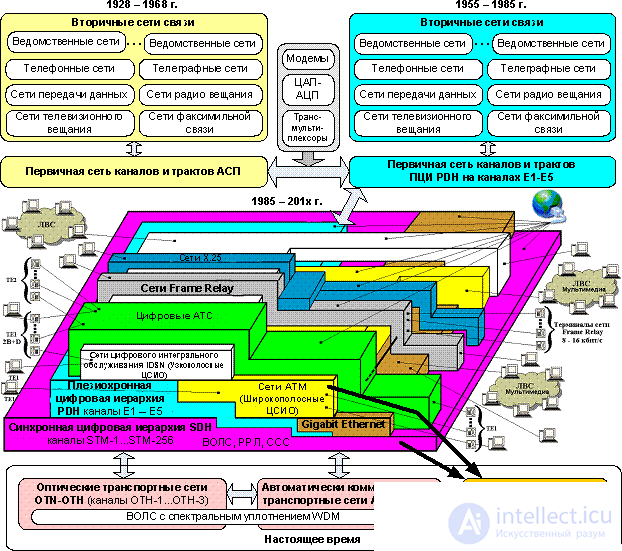
Figure 13.9 – Stages of development of telecommunication technologies
At these stages, secondary communication networks generally used cross-connect switching and traditional analog and digital circuit switching; in telegraph communication networks both circuit switching and message switching were used; data transmission was carried out over dedicated and switched communication channels, as well as using the packet switching method. Video and television information was transmitted over broadband analog or high-speed digital transmission paths of ATS and DTS dedicated for these purposes, respectively.
The third stage of development of telecommunication systems is associated with the emergence of new information transmission technologies, both in the construction of the primary network and in the use of new integrated-type technologies for building secondary networks.
At this stage, secondary networks provide, in a unified digital form, joint transmission of various types of information, dynamically redistributing the available resource among messages of different information types. At the same time, within each secondary network technology, the same type of switching equipment is used.
The basis of the primary network at the third stage consists of digital transmission systems of the plesiochronous and synchronous hierarchies, which support the operation of all secondary networks using various methods of operational switching: fast circuit switching, fast packet switching, and frame, packet, and cell switching.
Recently, in the development of telecommunication systems, the concept of next/new generation networks NGN (Next/New Generation Network) has been developed. The NGN concept envisages the creation of a new multiservice network, with integration of existing services achieved through the use of distributed software switching (soft-switches).
The evolution of corporate networks from an analog-digital variant to an NGN architecture is illustrated in Fig. 13.10.
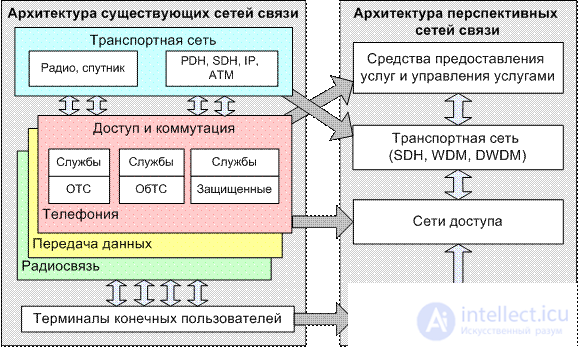
Figure 13.10 – Evolution of telecommunication network architecture
Next generation networks (NGN) represent a new network concept that combines voice functions, quality of service (QoS), and switched networks with the advantages and efficiency of a packet network. NGN networks mean the evolution of existing telecommunication networks, reflected in the merging of networks and technologies. This provides a wide range of services, from classic telephony services to various data transmission services or a combination thereof.
ITU-T Recommendation Y.2001 defines the NGN terminology basis as follows:
NGN concept – the concept of building next/new generation communication networks (Next/NewGeneration Network), providing an unlimited set of services with flexible configuration of:
- management,
- personalization,
- creation of new services through unification of network solutions,
Multiservice network – a communication network built in accordance with the NGN concept and providing an unlimited set of infocommunication services (VoIP, Internet, VPN, IPTV, VoD, etc.).
NGN network – a packet-switched network suitable for providing telecommunication services and for using several broadband transport technologies with an enabled QoS function, in which service-related functions are independent of the technologies providing the transport [56].
NGN network capabilities:
- implementation of a universal transport network with distributed switching,
- moving service provisioning functions to end network nodes,
- integration with traditional communication networks.
An NGN network must have a broad range of capabilities – it must provide capabilities (infrastructure, protocols) for creating, deploying, and managing all possible types of services (known or not yet known). This concept includes services using various data types (for example, voice, video, text data, and their various combinations and pairings with other data types).
Transmission can be carried out with all types of coding schemes and data transmission technologies, for example interactive transmissions with addressing to a specific device, group addressing and broadcasting, message transmission services, simple real-time and offline data transmission, delay-managed and delay-tolerant services. Services with different bandwidth requirements, with or without guaranteed bandwidth, must be supported taking into account the technical capabilities of the data transmission technology used.
Particular attention in NGN networks is paid to the flexibility of service implementation in an effort to most fully satisfy all customer requirements. In some cases, it is also possible to give the user the ability to configure the services they use. NGN must support open application programming interfaces to support the creation, provisioning, and management of services.
Summarizing the above, it can be said that the current development of telecommunication communication networks is occurring through the integration of all the functional capabilities embedded in the transport network model. This integration has led to the creation of universal multiservice transport platforms with electrical and optical interfaces, with electrical and optical switching of channels and packets (frames and cells), providing any type of transport services, including services of automatically switched optical networks with signaling protocols based on the generalized label-switching protocol GMPLS (Generalized Multi-Protocol Label Switching).
Fig. 13.11 presents a generalized architecture of a transport platform, indicating possible sources of information load, matching protocols, and transport technologies, based on information from [57].
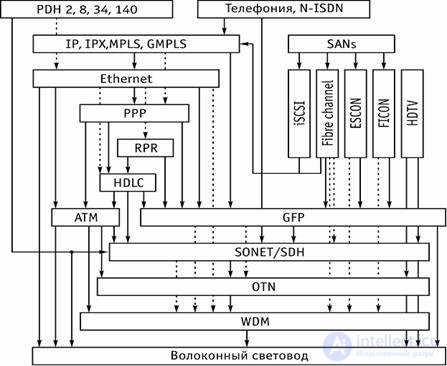
Figure 13.11 – Generalized architecture of an optical multiservice transport platform
Notations in Fig. 13.11 [57]:
- PDH, Plesiochronous Digital Hierarchy — plesiochronous digital hierarchy (rates of 2, 8, 34, and 140 Mbit/s);
- N-ISDN, Narrowband Integrated Services Digital Network — narrowband integrated services digital network;
- IP, Internet Protocol — internetwork protocol;
- IPX, Internet Packet eXchange — internetwork packet exchange;
- MPLS, Multi-Protocol Label Switching — multi-protocol label switching;
- GMPLS, Generalised MPLS — generalized label switching protocol;
- SANs, Storage Area Networks — storage area networks (service servers, databases);
- iSCSI, internet Small Computer System Interface — a protocol for establishing interaction and control between storage systems, servers, and clients;
- HDTV, High-Definition Television — high-definition television;
- ESCON, Enterprise Systems Connection — connection of enterprise systems (with databases, servers);
- FICON, Fiber Connection — fiber connection for data transmission;
- PPP, Point-to-Point Protocol — «point-to-point» protocol;
- RPR, Resilient Packet Ring — self-healing packet ring protocol;
- HDLC, High-level Data Link Control — high-level data link control protocol;
- GFP, Generic Framing Procedure — generic framing procedure.
The PPP, RPR, HDLC, and GFP protocols in transport networks perform the function of matching information data from load sources with transport structures in order to improve the efficiency of using the resources of these structures, for example, high- and low-order virtual containers in an SDH network or optical channels in an OTN network, or physical transmission frame resources of an Ethernet network [57].
The number of optical fibers in a cable determines the fiber count. Unfortunately, no published standard specifies how many fibers should be in a cable.
Therefore, the designer must decide independently how many fibers will be in each cable. When choosing a fiber optic cable, remember that fiber optic cable manufacturers generally make it with a fiber count that is a multiple of 6 or 12.
The general rule is: there should be as many fibers in the cable between buildings as your budget allows. But still, what is the practical minimum number of optical fibers?
Calculate how many fibers you need to initially support your network applications, then multiply that number by two, and you get the required minimum. For example, if you plan to use 31 fibers in the cable between two buildings, you need to round this number up to the nearest multiple of six, which equals 36. In our situation, a cable with at least 72 fibers would be required.
If you are used to working with UTP cables, 72 fibers may seem like too large a number. However, remember that the price of a 72-fiber cable is by no means twice the price of a 36-fiber cable. In fact, it costs only about 20% more than a 32-fiber cable. Also, remember that the cost and complexity of laying a 72-fiber cable will be practically the same as for a 36-fiber cable, and the extra fibers may well come in handy for you in the future.
Transmission speed. In TDM technology, throughput is increased by increasing the bit transmission rate on the communication line. The speed is limited only by the electronic components used. Data acquisition, storage, transmission, etc. – all of this requires the use of digital integrated circuits. They must operate at a speed equal to or close to the total transmission rate of the communication line. Equipment supporting the full throughput of the communication line must be installed for each channel.
WDM equipment in a channel can support only the transmission rate of that channel, not the full rate of the composite signal. Thus, the total throughput of the communication line is not limited by the operating speed of the electronic devices used. The fastest TDM communication line that can be created using the most modern technology can, in a WDM system, be transmitted as just one of many channels. Even from this comparison alone, it becomes clear that WDM technology has an undeniable advantage over other backbone information transmission technologies.
+Conclusions. Laying new optical cable (OC) on communication lines. This process involves the need for long-term planning, large capital investments, and is not always possible. When using new OC with improved technical characteristics, prospects arise for increasing the number of optical channels, increasing the maximum transmission rate, and correspondingly increasing the number of optical fibers. Using electronics with higher speed (10 Gbit/s, 40 Gbit/s). When choosing equipment, one must strive to use the very latest technological advances; the maximum information transmission rate and the amount of information transmitted will increase several-fold, while price and quality do not affect the choice. Transition from electronic components to fully optical ones. Unlike electronic components, the parameters of most optical components do not depend on the data transmission rate, and for them the price increase with increasing bit rate will be small. This allows switching to be performed at the optical level without signal conversion. Application of new channel multiplexing technologies, for example, by wavelength (WDM – wavelength division multiplexing). For this, it is enough to simply replace the terminals in the line with optical amplifiers. This latter approach to increasing the throughput of backbone data transmission networks is particularly attractive, as the most promising one, compared to replacing the OC and moving to the next level of the DTS hierarchy.

Comments