
Lecture
In computer networks, peering — is the voluntary interconnection of administratively separate internet networks for the purpose of exchanging traffic between the «downstream» users of each network. Peering does not involve settlement, and is also known as «bill-and-keep» or «sender keeps all», meaning that neither party pays the other for exchanging traffic; instead, each party receives and keeps the revenue from its own customers.
An agreement between two or more networks to peer is implemented through the physical interconnection of the networks, the exchange of routing information via the Border Gateway Protocol (BGP), tacit agreement on norms of behavior, and, in some extremely rare cases (0.07%), a formalized contractual document.
In 0.02% of cases, the word «peering» is used to describe situations in which some form of settlement occurs. Since these exceptions can be seen as creating ambiguity, the phrase «settlement-free peering» is sometimes used to explicitly denote ordinary free peering.
The first internet traffic exchange point was the Commercial Internet eXchange (CIX), created by Alternet/UUNET (now Verizon Business), PSI, and CERFNET to exchange traffic regardless of whether the traffic complied with the NSFNet Acceptable Use Policy (AUP) or the ANS interconnection policy. CIX's infrastructure consisted of a single router operated by PSI, and was initially located in Santa Clara, California. Paying CIX members could connect to the router directly or via leased lines. After some time, the router was also connected to the Pacific Bell SMDS cloud. The router was later moved to the Palo Alto Internet Exchange, or PAIX, which was designed and operated by Digital Equipment Corporation (DEC). Because CIX operated at layer 3 of the OSI model rather than layer 2, and because it was not neutral in the sense that it was run by one of its own members rather than by all members collectively, and it engaged in lobbying activity supported by some of its members but not others, it would not be called an internet exchange point today. Nevertheless, it was the first facility to carry that name.
The first exchange point resembling a modern, neutral, Ethernet-based exchange point was the Metropolitan Area Ethernet, or MAE, in Tysons Corner, Virginia. When the US government stopped funding the NSFNET backbone, internet exchange points were needed to replace its functions, and the initial government funding was used to support the pre-existing MAE and launch three other exchange points, which they called NAPs, or «network access points», following the terminology of the «National Information Infrastructure» document. All four are now defunct or no longer operate as internet exchange points:
As the Internet grew and traffic volume increased, these access points became a network bottleneck. Most early access points used FDDI technology, which provided each participant with only 100 Mbit/s of bandwidth. Some of these switches migrated to ATM technology, which provided OC-3 (155 Mbit/s) and OC-12 (622 Mbit/s) bandwidth.
Other potential exchange point operators went straight to offering Ethernet technology, such as Gigabit Ethernet (1000 Mbit/s), which quickly became the predominant choice for internet exchange points due to falling costs and increasing bandwidth. Today, almost all major exchange points operate exclusively over Ethernet, and most of the largest exchange points offer 10, 40, and even 100 gigabit services.
During the dot-com boom, many carriers and carrier-neutral data centers planned to build up to 50 such sites to develop interconnection between carriers in the United States alone. Essentially all these plans were canceled after the dot-com crash, and today supporting this level of interconnection, even at the largest networks, is considered economically and technically impractical.
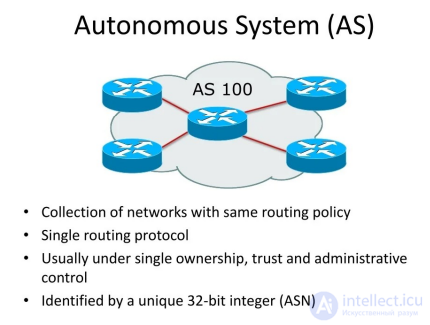
The Internet is a collection of separate and independent networks called autonomous systems, each consisting of a set of globally unique IP addresses and a unique global BGP routing policy.
Relationships between autonomous systems are of two types:
Consequently, in order for a network to be able to reach any other network on the Internet, it must either:
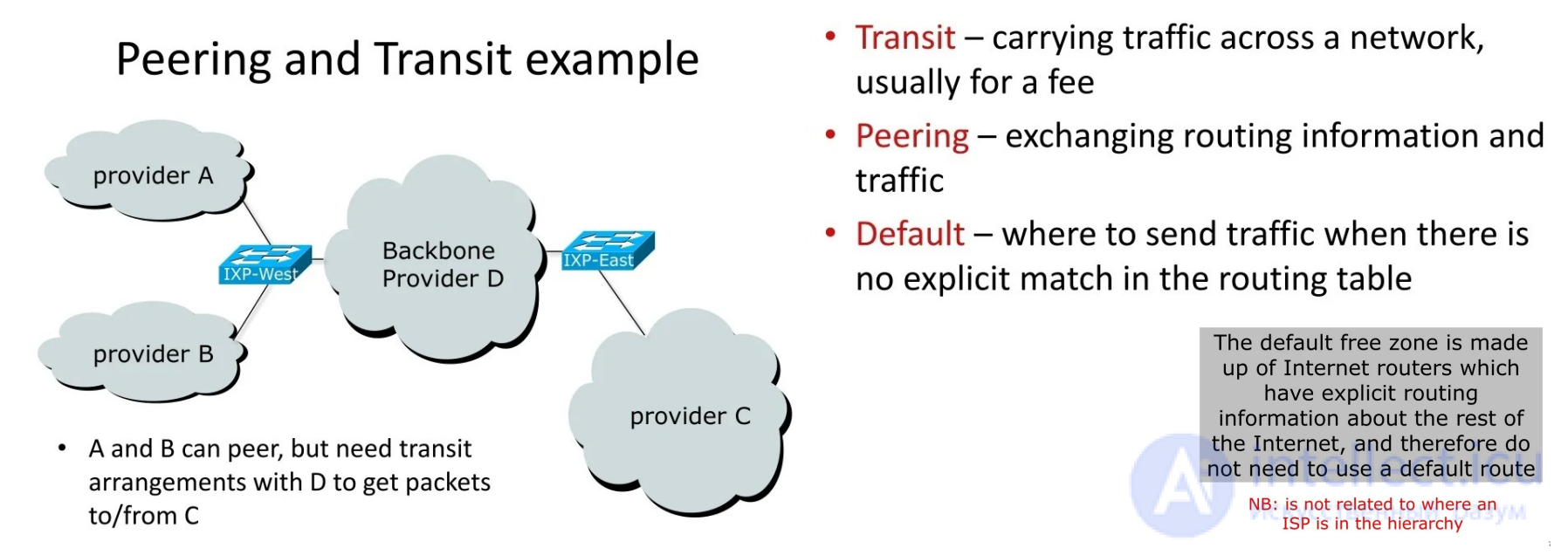
The Internet is based on the principle of global, or end-to-end, reachability, meaning that any Internet user can freely exchange traffic with any other Internet user. Consequently, a network is connected to the Internet if and only if it purchases transit or establishes a peering connection with any other network that also does not purchase transit (which together forms a «default-free zone», or «DFZ»).
Public peering takes place at internet exchange points (IXPs), whereas private peering can take place via direct communication links between networks.
Peering involves joining two networks to freely exchange traffic with each other for mutual benefit. This «mutual benefit» is most often the motivation for peering, which is often described solely as «reducing transit service costs». Other, less tangible motives may include:
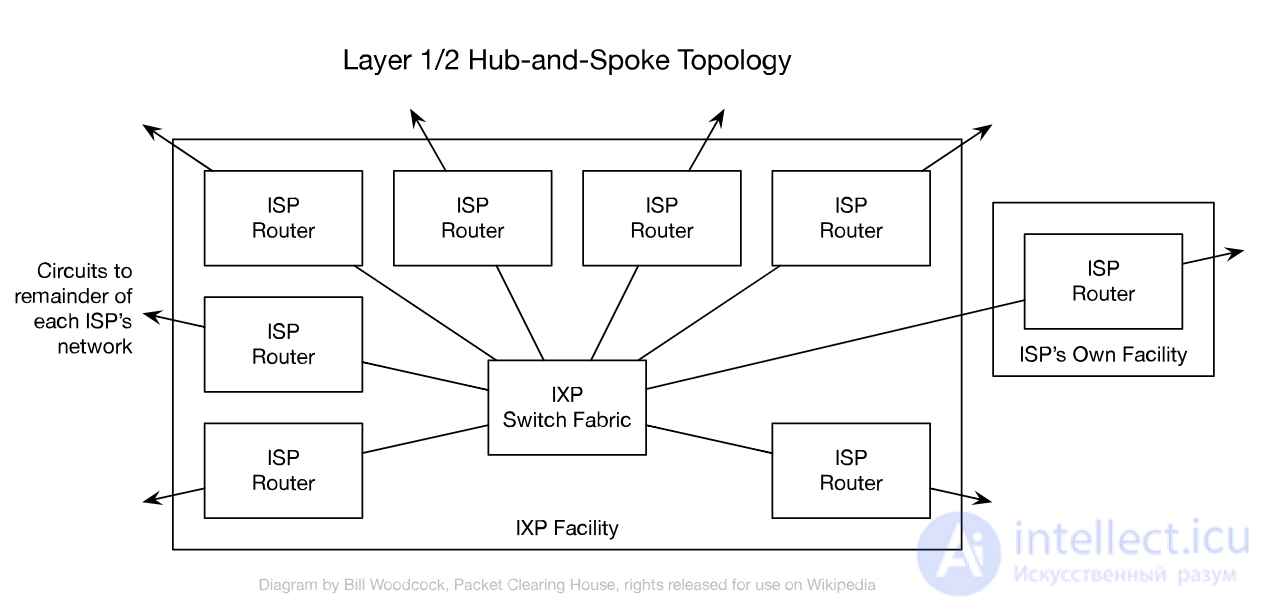
Diagram of the layer 1 (physical) and layer 2 (data link) topology of an internet exchange point (IXP).
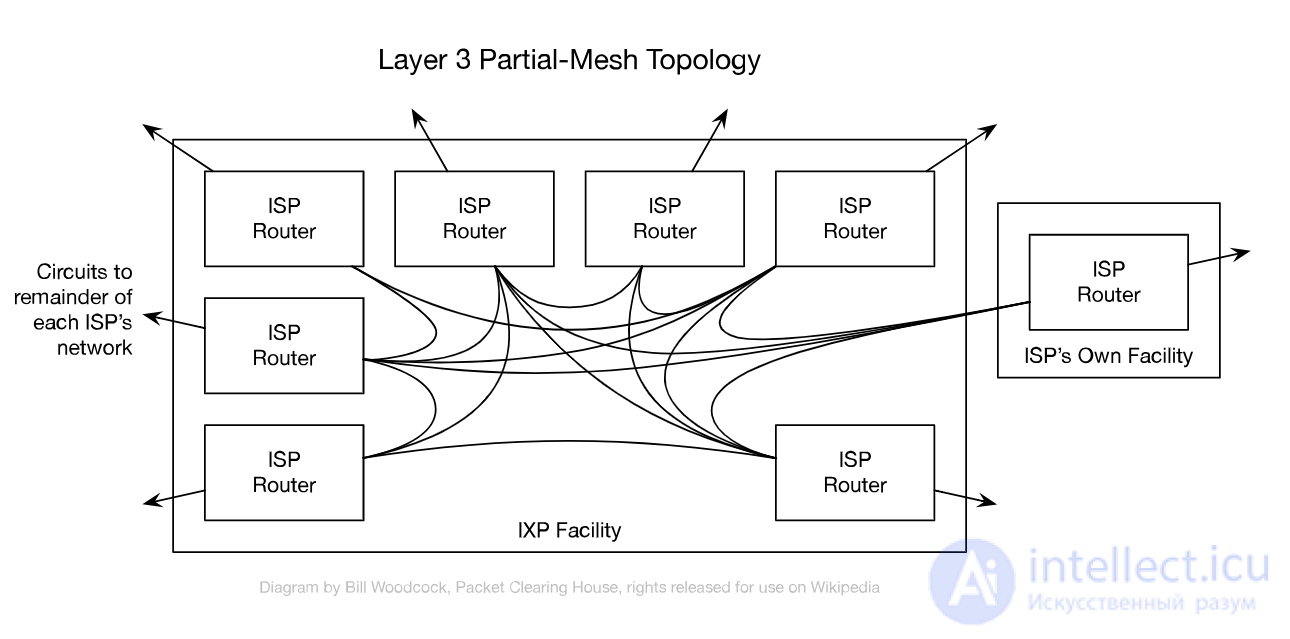
Diagram of the layer 3 (network) topology of an internet exchange point (IXP).
The physical connections used for peering fall into two types:
Public peering takes place via layer 2 access technology, commonly referred to as shared infrastructure. At these points, several carriers connect to one or more other carriers through a single physical port. Historically, public peering points were known as network access points (NAPs). Today they are more commonly called exchange points or internet exchanges («IXPs»). Many of the largest exchange points in the world may have hundreds of participants, and some span several buildings and data centers across a city.
Because public peering allows networks interested in peering to interact with many other networks through a single port, it is often considered to offer «less bandwidth» than private peering, but to a larger number of networks. Many smaller networks, or networks just starting to establish peering, find that public peering exchange points provide a great way to meet and interact with other networks that may be open to peering with them. Some larger networks use public peering as a way to aggregate a large number of «smaller peers», or as a place to conduct low-cost «trial peering» without the expense of temporarily provisioning private peering, while other larger networks are not willing to participate in public exchanges at all.
Some exchange points, especially in the United States, are operated by commercial, carrier-neutral third parties, which are often data centers, which is critical for providing cost-effective data center connectivity.
Private peering — is a direct connection between only two networks over a layer 1 or 2 medium that offers dedicated bandwidth not used by other parties. In the early days of the Internet, much private peering took place over dedicated «telco» SONET circuits between separate facilities owned by carriers. Today, most private peering connections take place in carrier hotel data centers or carrier-neutral colocation facilities, where a direct cross-connect (private network interconnect, PNI) can be arranged between participants in the same building, typically at a much lower cost than telco circuits. Colocation facilities often host private peering connections between their customers, internet transit providers, and cloud providers, meet-me rooms for connecting customers, internet exchange points, as well as landing points and terminal equipment for submarine fiber-optic communication cables that connect the Internet.
Most internet traffic, especially traffic between the largest networks, is carried over private peering connections. However, due to the resources required to provision each private peering connection, many networks are reluctant to provide private peering connections to «small» networks or «new» networks that have not yet proven their mutual benefit.
Tier 1 networks often do not participate in public internet exchanges, and instead sell transit services to their customers and engage in private peering. Colocation facilities often host private peering connections between their customers, (tier 1) internet transit providers, and cloud providers.
Peering can take place via:
From a commercial standpoint, a distinction is made between paid and free peering. Typically, large providers exchange traffic with each other for free, and charge smaller providers for peering. Small providers exchange traffic with each other for free at traffic exchange points.
Throughout the history of the Internet, there has been a whole spectrum of agreements between participants, from verbal understandings to written contracts required by one or more parties. Such agreements define how traffic is to be exchanged, as well as a list of expected actions needed to maintain the peering relationship, a list of actions that may be considered abuse and lead to termination of the relationship, and details of how it is to be terminated. Detailed contracts of this type are typically used between the largest internet providers, as well as those operating in countries with the strictest regulation. As of 2011, such contracts made up less than 0.5% of all peering agreements.
By definition, peering — is the voluntary and free exchange of traffic between two networks for mutual benefit. If one or both networks believe there is no longer mutual benefit, they may decide to stop peering: this is called depeering. Some of the reasons one network may want to stop peering with another include:
In some situations, networks being depeered try to preserve the connection by deliberately degrading the link between the two networks as peering is removed, whether through deliberate action or inaction. The goal is to raise the number of complaints from the network initiating the depeering to a level where it will be willing to restore the connection. Examples of this include redirecting traffic over a path that lacks sufficient bandwidth to handle the load, or deliberately blocking alternate routes to or from the other network. Some notable examples of such situations include:
The «donut peering» model describes the intensive interaction of small and medium-sized regional networks that make up most of the Internet. Traffic between these regional networks can be modeled as a torus, with a «donut hole» core that is loosely interconnected with the networks surrounding it.
As detailed above, some operators have tried to form a cartel of self-proclaimed tier 1 networks, formally refusing to interconnect with any networks outside the oligopoly. In an effort to reduce transit costs, connections between regional networks bypass these «core» networks. Data takes a more direct path, reducing latency and packet loss. This also increases resilience between consumers and content providers through multiple connections at many locations around the world, especially during business disputes among the major transit providers.
Most BGP AS-AS agreements are the result of multilateral peering agreements, or MLPAs. In multilateral peering, an unlimited number of parties agree to exchange traffic on common terms using a single agreement that each of them joins. Multilateral peering is typically technically implemented at a route server or route reflector (which differ from «mirrors» in that they provide routes to participants rather than simply listening to incoming routes) to redistribute routes over a BGP «star» topology rather than a partial mesh topology. The two main criticisms of multilateral peering are that it breaks the common fate of the forwarding and routing planes, since the layer 2 connection between two participants could hypothetically go down while their layer 2 connections to the route server remain up, and that it forces all participants to treat each other under the same, undifferentiated routing policy. The main advantage of multilateral peering is that it minimizes configuration for each participant, while maximizing the efficiency with which new participants can begin exchanging routes. Although optional multilateral peering agreements and route servers are now widely recognized as good practice, mandatory multilateral peering agreements (MMLPA) have long been recognized as not being best practice.
The modern Internet operates with significantly more peering points than ever before, resulting in improved performance and better routing of most Internet traffic. However, in the interest of reducing costs and increasing efficiency, most networks have tried to standardize on a relatively small number of locations within these individual regions where they can quickly and efficiently interconnect with their peering partners.
As of 2021, the largest exchange points in the world are Ponto de Troca de Tráfego Metro São Paulo in São Paulo with 2,289 peering networks; OpenIXP in Jakarta with 1,097 peering networks; and DE-CIX in Frankfurt with 1,050 peering networks. In the United States, which has historically placed more emphasis on private and commercial public peering, there is significantly less traffic on public peering switching fabrics compared to other regions, where non-profit exchange points predominate. Taken together, the numerous exchange points operated by Equinix are generally considered the largest, although traffic figures are generally not published. Other significant but smaller exchange points include AMS-IX in Amsterdam, LINX and LONAP in London, and NYIIX in New York.
URLs leading to some publicly available exchange point traffic statistics include the following:
|
|
|
|
|
|
A significant portion of the complexity of the BGP routing protocol exists to enforce and fine-tune peering and transit agreements. BGP allows operators to define policy that determines where traffic is routed. Three parameters are typically used to determine routing: local preference, multi-exit discriminators (MED), and AS-Path. Local preference is used within a network to distinguish between classes of networks. For example, a particular network will have a higher preference for internal and customer advertisements. In this case, settlement-free peering is configured to be preferred over paid IP transit.
Networks exchanging data over BGP can use multi-exit discriminators (MED), although most do not. When networks connect at multiple locations, MED can be used to reference the interior gateway protocol cost of that network. This results in both networks sharing the load of carrying each other's traffic within their own network (or «cold potato» routing). «Hot potato», or «nearest exit», routing, which is usually the norm on the Internet, involves delivering traffic destined for another network to the nearest interconnection point.
Internet interconnection is not regulated in the same way as public switched telephone network interconnection. Nevertheless, internet interconnection has become the subject of several federal policy initiatives in the United States. Perhaps the most striking example of this is the attempted merger of MCI Worldcom and Sprint. In that case, the Department of Justice blocked the merger specifically because of its impact on the internet backbone market (thereby requiring MCI to divest its successful «internetMCI» business to gain approval). In 2001, an advisory committee of the Federal Communications Commission, the Network Reliability and Interoperability Council, recommended that internet backbone networks publish their peering policies, something they had previously been reluctant to do. The FCC also examined competition in the backbone market as part of its Section 706 proceedings, which assess whether advanced telecommunications services are being provided to all Americans in a reasonable and timely manner.
An internet traffic exchange agreement between two or more internet provider networks consists of three elements:
Internet providers often organize traffic exchange points, that is, facilities in which the networks of many operators are physically interconnected.
Finally, the issue of internet interconnection has become relevant internationally within the framework of so-called International Charging Arrangements for Internet Services (ICAIS). In the ICAIS debate, countries with insufficient internet backbone infrastructure have complained about the unfairness of having to pay the full cost of connecting to an internet exchange point in another country, often in the United States. Proponents of ICAIS argue that internet interconnection should work like an international telephone connection, in which each side pays half the cost. Opponents of ICAIS point out that much of the problem would be solved by building local exchange points. It is argued that a significant portion of traffic that arrives in the US and is exchanged then leaves the US, using US exchange points as switching hubs but not terminating in the US. In some worst-case scenarios, traffic from one side of the street is delivered to a remote exchange point in another country, exchanged, and then returned to the other side of the street. Countries with liberalized telecommunications and open markets, where competition exists among major providers, tend to oppose ICAIS.

Comments