
Lecture
The ethics of business relations in personnel management is a set of norms and principles that organisations and their members must be guided by in the field of human resource management
The ethics of personnel management is a system of norms, principles, and values that guide the actions and decisions of managers and leaders with respect to employees. It covers a wide range of issues related to the relationship between the employer and employees, and is aimed at creating fair, effective, and human-centred working conditions. Here are some of the basic principles and aspects of this ethics:
Fairness and equality: Managers must ensure fair and equal treatment of all employees, regardless of their gender, race, age, religious beliefs, and other characteristics.
Transparency: Effective communication and openness on matters relating to working conditions, rules, and expectations are important aspects of personnel management ethics.
Trust and confidentiality: Employees must trust management and be confident that their confidential information will be handled with respect and in compliance with confidentiality laws.
Respect and tolerance: The work environment must be free from discrimination and include respect for the diversity of employees, their opinions, and cultural characteristics.
Motivation and development: Personnel management should include measures to motivate employees, as well as provide opportunities for professional and personal development.
Honesty and integrity: Managers must act with honesty and integrity, not deceive employees, and not violate the promised terms of the employment relationship.
Work-life balance: Managers must respect employees' right to a work-life balance, avoiding excessive overload and striving to create conditions for a healthy working life.
Combating corruption and preventing fraud: Managers and employers must uphold high standards of ethics and combat corruption and fraud in the workplace.
Fair pay and working conditions: Employees must receive fair compensation and have working conditions that match their level of qualification and market standards.
Training and development: Employers must invest in the training and development of their employees, helping them develop the necessary skills and competencies.
Compliance with personnel management ethics helps create a positive and productive organisational culture, strengthens the relationship between management and employees, contributes to increasing employee satisfaction, and, as a result, can contribute to the success and long-term development of the organisation.
The professional significance of each employee of an enterprise is inseparably linked to their observance of certain ethical norms and rules of conduct in relationships with colleagues, subordinates, clients, or partners. Observance of the rules of business protocol is one of the most important indicators of professionalism, both for an individual employee and for the organisation as a whole.
Ethics is a system of universal and specific norms of behaviour used in the course of social life. Accordingly, business ethics represents one of the spheres of social life.
The ethical norms of professional relations are based on universal human moral norms and rules of conduct, but they also have certain distinctive features.
Ethics and ethicality are relative concepts, which is connected with the process of the evolutionary development of society, in which the norms and rules of conduct of members of society gradually developed and changed5.
Business ethics is characterized by two features:
Modern science distinguishes two types of ethics:
Within the scope of the issue under consideration, ethics of the second type is of particular interest.
As a rule, this category of ethics identifies a number of fundamental norms:
The above list of norms of professional ethics in personnel management is not exhaustive and undergoes constant transformation depending on various factors. However, if the norms of ethics are violated or not observed by human resources specialists, negative consequences immediately affect the image of the entire organization. Every organization has an interest in preserving corporate ethics.
The basis for this consists of the values adopted by the organization, and when a new employee is hired for a particular position, they are made familiar with them. For example, it is forbidden to break the law, create conflicts, or breach trade secrets.
In general, personnel management is one of the most important areas of a manager's activity.
Even if these functions are delegated within the organization's management system to the relevant departments or to a specific manager, strategic personnel management — that is, determining the organization's personnel policy, making the most important decisions, and selective oversight, the intensity of which is determined by how satisfied the manager is with the state of affairs — remains one of the most important managerial functions of a leader6.
In the early 1930s, when the science of management was taking its first steps, a group led by Professor Mayo in the USA studied the conditions that had the greatest influence on workers' productivity.
Over the course of three years, working conditions for this group of workers were changed: the working-day schedule was altered or abolished altogether, the air temperature and lighting were changed, and refined meals were provided at the company's expense, or discontinued entirely, and so on.
But the most important thing — was that the composition of the working groups changed.
It turned out that, with all other conditions of work being roughly equal, it is precisely the composition of the working groups — that is, the personnel — that has the greatest influence on changes in labour productivity.
Naturally, the results of these experiments cannot be considered absolute. Business today and its conditions have changed significantly compared with those under which the experiments were conducted.
Given the various forms of organising a company's activities, the wide variety of fields of activity, and the increased level of education and management, the degree of influence of the composition of the working groups varies.
Nevertheless, the significant influence of an organisation's staff composition on the outcome of its activity is beyond doubt even today.
There is no universal answer to the question of how best to organise work with personnel, just as there is no universal answer to the question of how to treat a sick patient. After all, illnesses differ, and the ways of treating them also differ greatly. What works well in one case may prove fatally dangerous in another.
However, there are basic principles, patterns established by specialists, and, finally, the colossal experience accumulated by generations of managers, without knowledge of which managing personnel is like walking across a field that may be mined, guided only by one's own intuition. It is better to use a map that shows where the possible mines are located.
The professional significance of each employee depends on several key factors that determine how they contribute to the organisation and its success. Here are some of the main aspects of professional significance:
Skills and competencies: Important elements of professional significance are the knowledge and abilities an employee possesses. This includes technical skills specific to their field of activity, as well as soft skills such as communication, leadership and time management.
Experience: Work experience in a specific area or field of activity can significantly increase an employee's professional significance. Experience allows for a better understanding of processes, more informed decision-making, and more effective problem-solving.
Education and training: Ongoing learning and professional development are important for staying up to date with the latest trends and changes in one's field. An employee who strives to improve their knowledge and skills can be more professionally significant.
Drive to achieve goals: An employee who works diligently toward achieving their own goals and the goals of the organisation makes a greater contribution and has greater professional significance.
Adaptability and flexibility: The ability to adapt to changing conditions and respond quickly to new challenges is an important part of professional significance in today's world.
Communication and collaboration: The ability to communicate effectively, work in a team, and build relationships with colleagues and clients also contributes to professional significance.
Value to the organisation: Finally, an employee's professional significance is determined by how they contribute to achieving the organisation's goals and mission. An employee who brings benefit and profit to the organisation usually has greater professional significance.
It is important to note that an employee's professional significance can change over time and depending on their development. Therefore, encouraging employees' training, development and motivation is an important task for an organisation striving for success.
The relationship between an employee and an employer plays an important role in determining the working atmosphere, productivity and job satisfaction. The psychological aspects of the relationship between these two parties can have a significant impact on the success and level of satisfaction of both sides. Here are some psychological issues that can arise in the context of this relationship:
Trust and honesty: Psychological trust between employee and employer is the foundation of a successful relationship. Questions about how much the employee trusts the employer, and vice versa, can affect cooperation and compliance with rules.
Communication: Effective communication between employee and employer is necessary for understanding expectations, feedback and conflict resolution. Psychological issues here can include the degree of openness, the frequency of communication and the ways in which information is conveyed.
Motivation and satisfaction: The psychological aspect of an employee's motivation can affect their productivity and job satisfaction. It is important to understand what motivates each employee and how the employer can create conditions for their maximum motivation.
Conflicts and disagreements: Workplace conflicts can have psychological consequences for both the employee and the employer. Resolving conflicts and being able to manage disagreements is important for maintaining a positive relationship.
Level of responsibility and obligations: Employees and employers may have different expectations regarding the level of responsibility and obligations toward one another. Specific duties and expectations should be clearly defined.
Fairness and equality: Psychological issues around fairness and equality can arise if an employee feels they are not receiving fair compensation, that their needs are not being taken into account, or that they are experiencing discrimination.
Career development and training: The opportunity for professional growth is important to employees. Employers can help with this by providing training and opportunities for career development.
Emotional state: Employees may experience emotional stress associated with their work. Employers can show understanding and a willingness to help them cope with these emotions.
A successful relationship between an employee and an employer is built on mutual respect, trust and effective communication. Working to resolve the psychological issues associated with this relationship can improve the work environment and increase productivity and the level of satisfaction of both sides.
.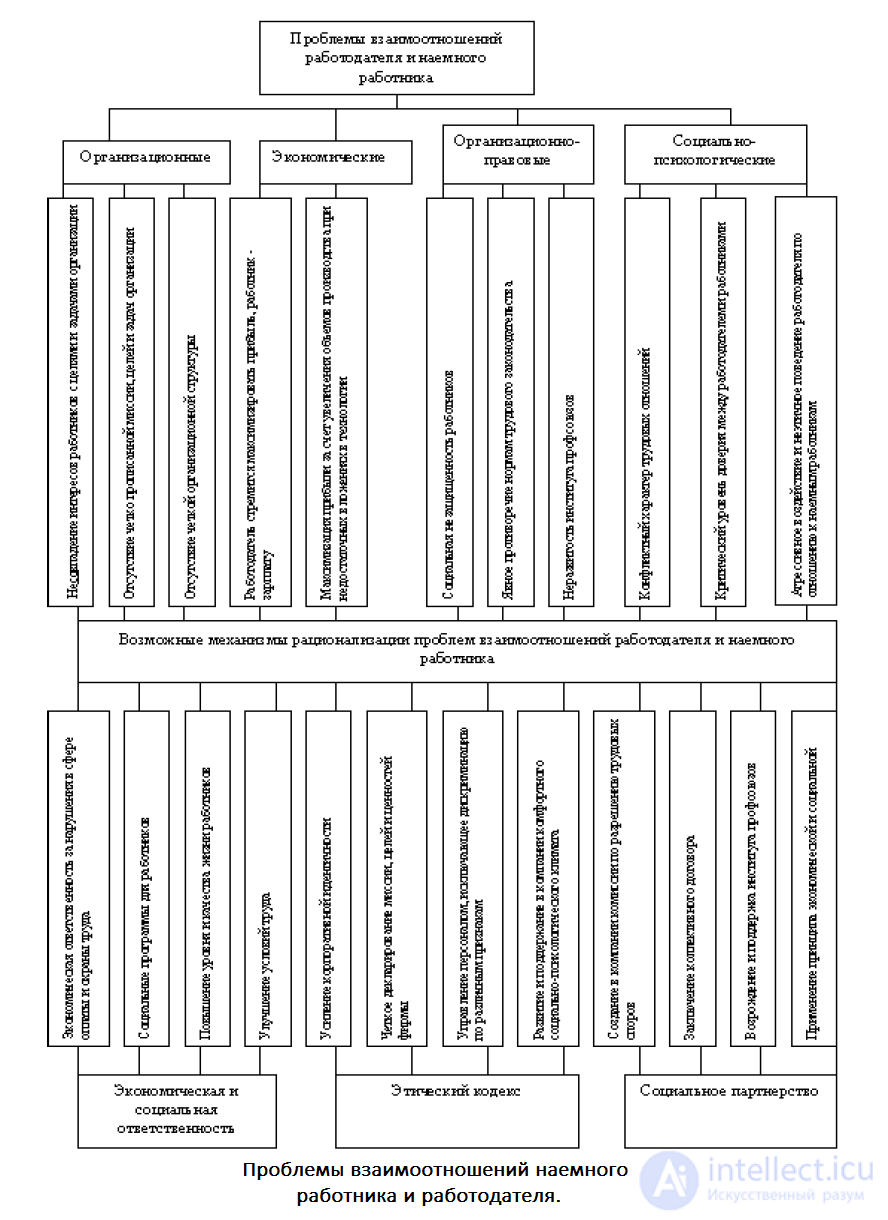
All the problems in the relationship between an employer and an employee can be divided into four main groups:
Among the organisational problems we can include:
Economic problems include the following:
Among the organisational-legal problems we can include:
Socio-psychological problems include:
Let us examine the content and dynamics of socio-labour relations from the standpoint of both the employer and the hired worker.
In the course of our study, 250 people employed in the small-business sector were surveyed, of whom 234 were hired workers and 16
were employers. As a result, contradictions were identified between the positions of employers and hired workers on the following main
areas:
On practically all key points of interaction between employer and hired worker we see discrepancies. First and foremost this concerns wages — without exception, all employers believe that pay is calculated fairly, while only a little more than half of workers agree with them. The situation regarding the social protection of workers is appalling — fewer than half of the workers surveyed are officially registered at work, and yet none of them receives an official salary, and only in rare cases are workers given paid
leave or sick pay.
On top of all this, not a single one of the organisations has a functioning system of social partnership, and there are no trade unions.
Only a few firms have adopted codes of ethics, and even these are not able to radically influence the current
situation. Today, small business does not resolve the problem of social, legal, and economic protection of employees.
There is a profound difference in the value orientations of employers and hired employees; they represent one company, but are not a unified whole and do not strive toward a common goal — this cannot but affect the functioning of the organi-
sation and its potential.
Undoubtedly, in the current situation, some mechanism is needed to reconcile the
interests of the employer and the hired employee, combining, as it seems to us, three main blocks: economic and social responsibility, a code of ethics, and social partnership.
The measures of economic and social responsibility include:
The block of the organisation's code of ethics includes:
The block of social partnership includes:
Thus, the relationship between the employer and the hired employee is complex and multidimensional in nature, is multi-channel, and largely
depends on the degree of mutual preparedness for professional and social communication.

Comments