
Lecture
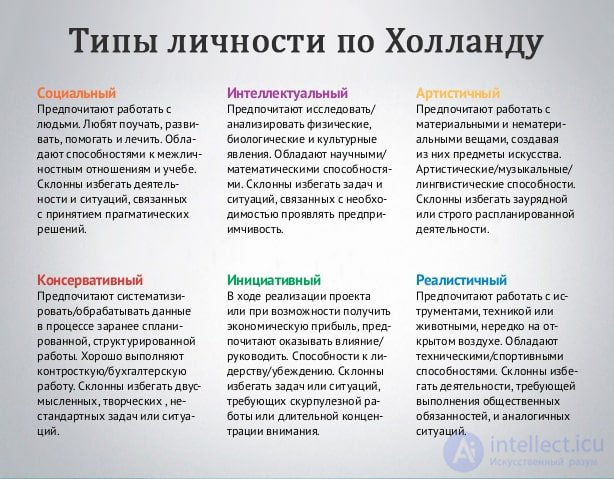
Personality type – is a combination of many different traits that are interrelated and determine stable and generalized behavioural characteristics.
Psychological type shows how a person prefers to act in various situations and in what environment they feel most comfortable.
There are many different theories, classifications, and models describing personality types. One of the most well-known and widely used is the 16-type Myers-Briggs Type Indicator (MBTI) model and the "Big Five" model. Here is a brief description of these two models, as well as some other personality types:
MBTI (Myers-Briggs Type Indicator):
MBTI is based on the assumption that there are 16 main personality types, determined by four main parameters:
Extraversion (E) vs. Introversion (I): Reflects a preference for the outer world (interaction with others) or the inner world (one's own reflections).
Sensing (S) vs. Intuition (N): Reflects the ability to handle information – concretely and detail-oriented (sensing) or abstractly and future-oriented (intuition).
Thinking (T) vs. Feeling (F): Reflects the way decisions are made – rationally and analytically (thinking) or with regard to emotions and values (feeling).
Judging (J) vs. Perceiving (P): Reflects a tendency toward organization and control (judging) or flexibility and adaptability (perceiving).
Each of the 16 personality types is designated by a combination of letters, for example, ESTJ (Extraversion, Sensing, Thinking, Judging).
The "Big Five":
The "Big Five" model is based on five main personality traits:
Extraversion: Attitude toward social activity and communication.
Agreeableness (Compatibility): The level of trust, benevolence, and cooperation.
Emotional stability (Neuroticism): The level of emotional stability or instability.
Conscientiousness (Prudence): The level of responsibility, organization, and discipline.
Openness to new things (Openness to experience): Readiness for new ideas and experiences.
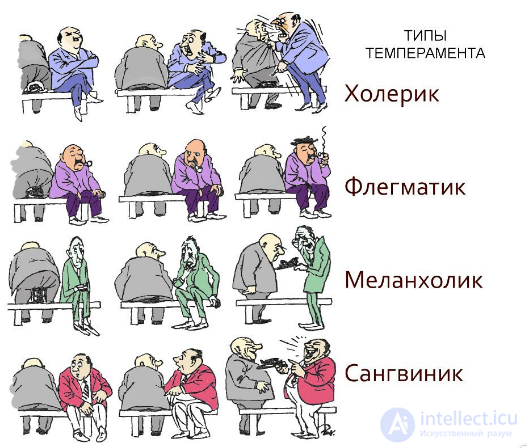
Personality types by temperament:
According to the theory of temperaments, there are four main personality types:
Sanguine: Energetic, sociable, optimistic.
Choleric: Active, self-confident, purposeful.
Melancholic: Sensitive, analytical, prone to worry.
Phlegmatic: Balanced, calm, non-confrontational.
Enneatype theory:
The Enneagram describes 9 basic enneatypes, each of which is associated with specific personality traits, motives, and behaviour.
Examples of enneatypes: The Perfectionist, The Hedonist, The Anxious Type, and others.
Other classifications:
There are also other classifications, for example, personality types by astrology, personality types by cultural characteristics, and others.
It is important to understand that these models and classifications describe different aspects of personality and can be combined. A person's personality is unique and multifaceted,
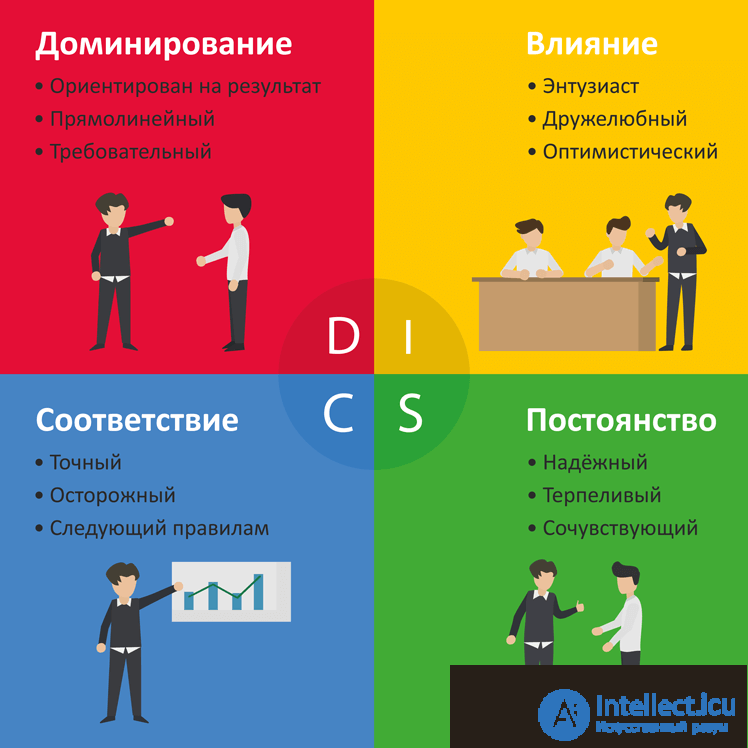
Building relationships at work with people of different personality types can be challenging, but it is an important skill for successful business and teamwork within a group. Here are some ways to build relationships with different personality types:
With extraverts:
Listen and communicate: Extraverts enjoy communication and are usually open to new ideas and suggestions. Be ready to listen and actively take part in discussions.
Support their activity: Help them stay active and motivated. Give them the opportunity to work in a team and demonstrate leadership qualities.
With introverts:
Respect personal space: Introverts value their personal space and time for reflection. Don't force communication on them; give them the opportunity to enjoy some quiet.
Support written communication: Introverts often prefer written communication, so give them the opportunity to express their thoughts through emails or messages.
With sensors:
Be specific: Sensors value clarity and concrete facts. When communicating, provide details and practical information.
Focus on reality: Sensors tend to focus on current events and facts, so discuss specific tasks and plans.
With intuitives:
Be flexible: Intuitives usually think abstractly and can see long-term prospects. Be ready to discuss new ideas and possible changes.
Support creativity: Appreciate their capacity for innovation and encourage creative thinking.
With thinkers:
Be objective: Thinkers value logic and objectivity. Provide facts and arguments when discussing issues.
Support analysis: Help them conduct analysis and identify logical connections in the data.
With emotional personalities:
Show empathy: Be ready to listen and offer support when they need emotional support.
Respect their feelings: Help them express their feelings and emotions, and don't ignore their emotional needs.
With analysts:
Support their rationality: Analysts value logic and analysis. Respect their ability to look at issues from the point of view of data and facts.
Collaborate based on facts: Help them make decisions based on objective data and analysis.
With ambiverts:
Take their flexibility into account: Ambiverts can display traits of both extraverts and introverts. Take their needs into account in different situations.
Discuss and analyse: Give them the opportunity to discuss and analyse information when necessary.
It is important to remember that every person is unique, and personality type is only one aspect of their individuality. Listen, learn to understand, and adapt to the traits of each employee in order to build positive and productive relationships at work.
Psychological compatibility — a characteristic of prolonged interaction between two or more individuals, in which the manifestation of stable character traits typical of these individuals does not lead to lasting contradictions that cannot be resolved without outside intervention.
Psychological compatibility is a concept that describes how well two people can interact and get along with each other from a psychological point of view.
Psychological compatibility at work plays an important role in forming productive and healthy working relationships. It involves aligning personal characteristics, views, communication styles and work values between colleagues. Here are some aspects of psychological compatibility at work:
Shared values and goals: Colleagues who have similar professional values and career goals tend to collaborate more successfully. For example, if one employee values developing new ideas while another values completing a task on time, this can lead to conflict. However, if they share common goals, such as achieving success in a project, this can contribute to psychological compatibility.
Communication style: People have different communication styles. Some prefer to openly discuss all aspects of a task, while others tend to discuss only the key points. Psychologically compatible colleagues are usually able to adapt their communication style to each other's needs and communicate effectively.
Level of stress resilience: Work can be stressful, and employees' level of stress resilience can vary greatly. People with different levels of stress resilience may perceive the same events differently. Psychological compatibility can manifest itself in how much colleagues support one another in stressful situations.
Teamwork: In some work environments employees must work as a team, while in others they work on tasks individually. Psychologically compatible colleagues are able to easily adapt to the demands of team or individual work and complement one another.
Conflict situations: Conflicts in the workplace are inevitable, and it is important that colleagues are able to effectively resolve disagreements. Psychological compatibility can manifest itself in the ability to find compromises, discuss differences constructively, and resolve conflicts.
Motivation and energy: Different employees may have different levels of motivation and energy. Psychologically compatible colleagues can inspire one another, motivate each other to achieve common goals, and maintain a high level of energy within the team.
Emotional intelligence: Well-developed emotional intelligence allows colleagues to better understand each other's emotional needs and reactions. This contributes to effective communication and interaction.
Understanding and taking into account psychological compatibility between colleagues can contribute to more productive work, reduced conflicts, and an improved overall working climate.
Although the concept is used in psychological literature, and especially often in popular quasi-psychological literature, no general theory of psychological compatibility has yet been created, though research in this direction continues. Well-known works include T. Leary's interpersonal compatibility questionnaire, W. Schutz's three-factor hypothesis of psychological compatibility (and the FIRO-B questionnaire created on its basis), H. J. Eysenck's hypothesis on temperament compatibility, R. L. Ackoff and F. E. Emery's hypothesis on attitude compatibility, and L. N. Sobchik's DMO method (diagnosis of interpersonal relations), among others.
Among the key problems associated with developing a theory of psychological compatibility, the following can be noted:
The psychological climate in a work team represents the overall atmosphere and nature of relationships between employees in an organisation or workplace. It is assessed through several key aspects, including the social, moral, and psychological climates.
Social climate: This aspect characterises what kind of relationships are established between employees. Important factors in the social climate include:
Collective support: Whether employees feel support and solidarity from colleagues. This may include mutual assistance in difficult situations and support in achieving common goals.
Social integration: Relationships between colleagues, including friendliness, communication, and mutual understanding, shape social integration within the team.
Openness and trust: The ability to openly discuss and share ideas and opinions, and to ensure trusting relationships, influences the social climate.
Moral climate: The moral climate is related to the ethical and moral aspects of work and relationships within the team. This aspect includes:
Ethical behaviour: An assessment of the extent to which employees adhere to ethical standards and norms in their work.
Honesty and fairness: The moral climate assesses how honest and fair the actions and decisions made in the workplace are.
Respect for diversity: An assessment of respect and tolerance for diversity among employees, including respect for differences in gender, culture, religion, and so on.
Psychological climate: This aspect is related to the emotional atmosphere in the workplace and within the team. It assesses:
Stress level: Employees assess how stressful they consider their working conditions to be and how they cope with stress.
Comfort level: An assessment of how comfortable employees feel within the team and in the workplace.
Job satisfaction level: An assessment of employees' satisfaction with their work, growth opportunities, and professional development.
All these aspects are interconnected and can affect productivity, morale, and overall well-being within the organisation. Creating a healthy psychological climate is important for attracting and retaining talented employees, as well as for achieving success in the team's work.
Static -
This is a stable attitude of employees toward work, and constant interpersonal
relations. The climate is stable and withstands external influences well. It is not easy to establish a climate at this level, but afterward it is easy to maintain. Team members feel this stability, which makes them more confident in their own position. Correction of the climate is practically not required, and monitoring is only occasional. This level is also called the socio-psychological climate.
Dynamic
This is the changeable character of a team. The climate changes daily due to shifts in the moods of its members. This level is also called the psychological atmosphere. It changes faster and is felt less by participants. As changes accumulate, it can
create an unhealthy climate within the team.
A favourable socio-psychological climate
An unfavourable socio-psychological climate
Signs by which one can indirectly judge the atmosphere within a group.
A manager can purposefully regulate the nature of relationships within the group and influence the SPC (socio-psychological climate). To do this, it is necessary to know
the patterns governing its formation and
to carry out managerial activity taking into account the factors that influence the SPC.
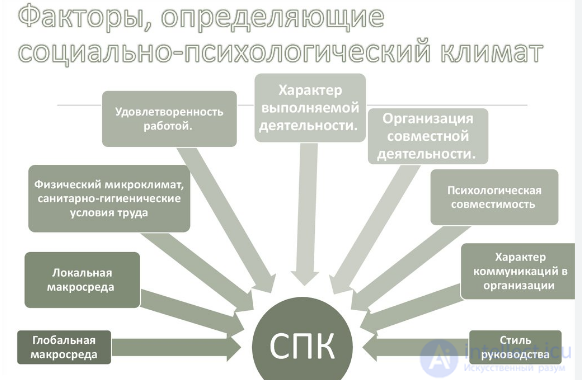
Factors determining the socio-psychological climate
Global macro-environment - the situation in society, the totality of economic, cultural, political, and other conditions. Stability in the economic
and political life of society ensures the social and psychological well-being of its members and indirectly affects the socio-psychological climate of work groups.
Local macro-environment - i.e., the organization within whose structure the work team is located. The size of the organization, the status-role structure, the absence of functional-role contradictions, the degree of centralization of power, employee participation in planning and in resource allocation, the composition of structural units (by sex/age, profession, ethnicity), etc.
. Physical microclimate
Heat, stuffiness, poor lighting, and constant noise can become a source of increased irritability and indirectly affect the psychological atmosphere in the group. Conversely, a well-equipped workplace and favourable sanitary and hygienic conditions increase
overall satisfaction with work, contributing to the formation of a favourable social-psychological climate (SPC).
Job satisfaction
Of great importance for the formation of a favourable SPC is how interesting, varied, and creative the work is for a person, whether it matches their professional level, and whether it allows them to realise their creative potential and grow professionally.
The attractiveness of the job increases satisfaction with working conditions, pay, and the system
of material and moral incentives,
social security, distribution of leave, work schedule, provision of information, career growth prospects, the opportunity to raise one's level of professionalism, the level of competence of colleagues, the nature of business and personal
relationships within the team, both vertically and horizontally, etc.
The attractiveness of the job depends on how well its conditions match the subject's expectations and allow them to realise their own interests and satisfy their personal needs:
The nature of the activity performed
The monotony of the activity, its high level of responsibility, the presence of risk to the employee's health and life, its stress-inducing nature, emotional intensity, etc. — all these are factors that can indirectly have a negative effect on the SPC within the work team.
Organisation of joint activity
The formal structure of the group, the way authority is distributed, and the presence of a common goal all affect the SPC. Interdependence of tasks, unclear distribution of functional responsibilities, a mismatch between an employee and their professional role, and psychological incompatibility among participants in joint activity increase tension in relationships within the group and can become a source of conflict.
Psychological compatibility is the ability to engage in joint activity, based on an optimal combination of the personal qualities of team members. People who resemble one another find it easier to establish interaction. Similarity fosters a sense of security and self-confidence, and boosts self-esteem. It is also based on differences in characteristics on the principle of complementarity. In such a case, people are said to suit each other «like a key to a lock». A condition for, and a result of, compatibility is interpersonal sympathy and attachment between the participants in the interaction. Being forced to communicate with an unpleasant person can become a source of negative emotions.
The psychophysiological level of compatibility is based on an optimal combination of the characteristics of the sensory organ system (vision, hearing, touch, etc.) and
temperament traits.
The psychological level involves compatibility of characters, motives, and behaviour patterns
The socio-psychological level of compatibility is based on the consistency of social roles, social attitudes, value
orientations, and interests.
The nature of communications in the organisation
The absence of complete and accurate information on a matter important to employees creates fertile ground for the emergence and spread of rumours and gossip, intrigue, and behind-the-scenes games. A manager should closely monitor the adequate provision of information about the organisation's activities. Low communicative competence among employees also leads to communication barriers, growing tension in interpersonal relationships, misunderstanding, distrust, and conflicts. The ability to state one's point of view clearly and precisely, mastery of constructive criticism techniques, and skills of
active listening, etc. create the conditions for satisfactory communication within the organisation.
1. For department heads, introduce a rule: praise employees more and don't dwell on mistakes.
2. Introduce elements of play into the work. Apply gamification. This will lift the mood, and people will develop interest and enthusiasm. Suggest that department heads set serious tasks for employees in the form of a game. The game is based on competition. The winner gets a prize.
3. Create conditions for leisure within the company. Organise a sports area. There's no need to buy expensive equipment or allocate a lot of space. For example, in the office of the company «Stream» a wall bar and darts board were installed. Employees can stretch and warm up during the day. And in the office they installed table tennis and table football, and created
a library.
4. Look more often for reasons to celebrate and organise them. This doesn't necessarily mean a corporate party or banquet. It can be a celebration that unites all employees and puts them in a positive mood. For example, at company AAAA they organised an exhibition of employees' childhood photos and held a quiz «Who can guess the most colleagues?».
5. In summer, go out into nature as a whole company, organise offsite corporate events
There is always an opportunity to change the moral and psychological climate within a team. Holding corporate parties, celebrations,
congratulating employees, giving recognition – these are the kinds of events that will help bring employees together. By working to improve the climate within the team, each
manager ensures they have satisfied employees who work cohesively and results-focused.

Comments