
Lecture
An interview with an employer is a process in which the employer and the candidate meet and talk to assess whether the candidate meets the requirements of the position and the company. This is a key stage in getting a job, and it is important to be prepared for it. Below are the main features of an interview with an employer:
Purpose of the interview: The main purpose of the interview is to assess how well the candidate fits a particular vacancy and how well they align with the company's culture and values. From the candidate's side, it is an opportunity to learn more about the company and the position.
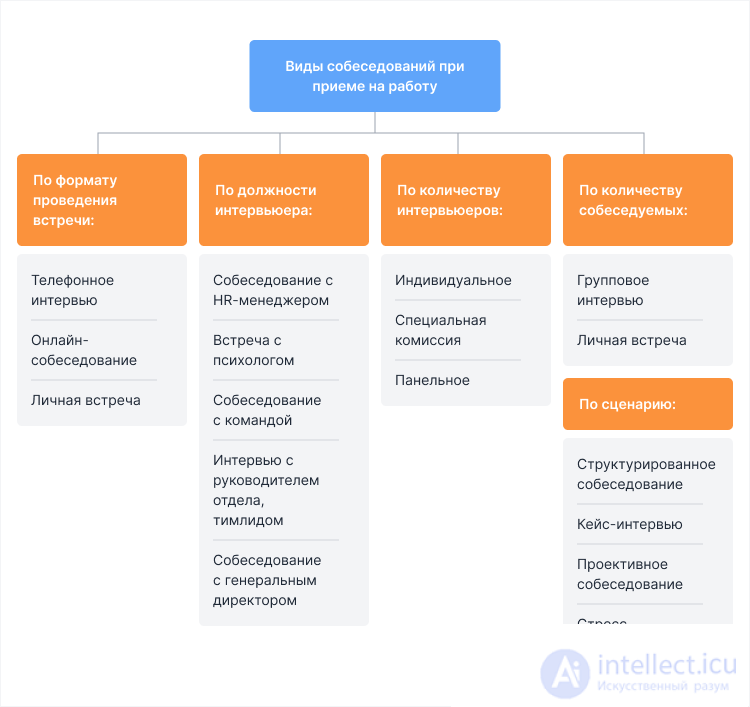
Types of interviews: Interviews can take various forms, including:
An interview is an opportunity not only for the employer to assess you, but also for you - to learn more about the company and assess whether it suits you. Preparation, professional conduct, and clear answers can help you succeed in an interview.
appearance; manner of behaviour; voice and speech; having a career plan with clear goals and objectives; sincerity and composure; courtesy, etc.
Evaluating a candidate at an interview involves a number of criteria that employers use to determine how well a candidate fits a particular position and company. Below are the main criteria for evaluating a candidate:
Professional skills and experience: This is probably the most important criterion. Employers assess how well the candidate possesses the technical skills and experience necessary to perform the job.
Soft skills: Soft skills include communication abilities, leadership, adaptability, the ability to work in a team, and other social and interpersonal skills. They play an important role in evaluating a candidate.
Cultural fit: Employers assess how well the candidate matches the company's culture and its values. This includes the level of professional ethics and the culture of interaction.
Motivation and drive: Candidates with clear career goals and the motivation to achieve them are usually rated higher.
Problem-solving ability: Employers are interested in the candidate's ability to analyse complex situations and find effective solutions.
Personal qualities: Appearance, manner of behaviour, voice, and speech can influence the first impression, although this is not always a decisive factor. It is important to look professional and well-groomed.
Sincerity and composure: Employers value sincere and composed candidates who are able to control their emotions and be honest in their answers.
Courtesy and sociability: The ability to communicate with other people and behave politely and respectfully during an interview is an important aspect of candidate evaluation.
Career plan and goals: Employers may be interested in your future plans and how they relate to the position and the company.
Education and professional development: Your education and your drive for professional development may also be important criteria.
References and recommendations: Recommendations from previous employers or colleagues can confirm your professional reputation.
Level of training and competencies: Having the necessary certifications, licenses or training can be an important factor for certain positions.
It is important to remember that each company and position may have their own unique evaluation criteria. Therefore, preparing for an interview, including researching the company and its requirements, is an important part of successful employment.
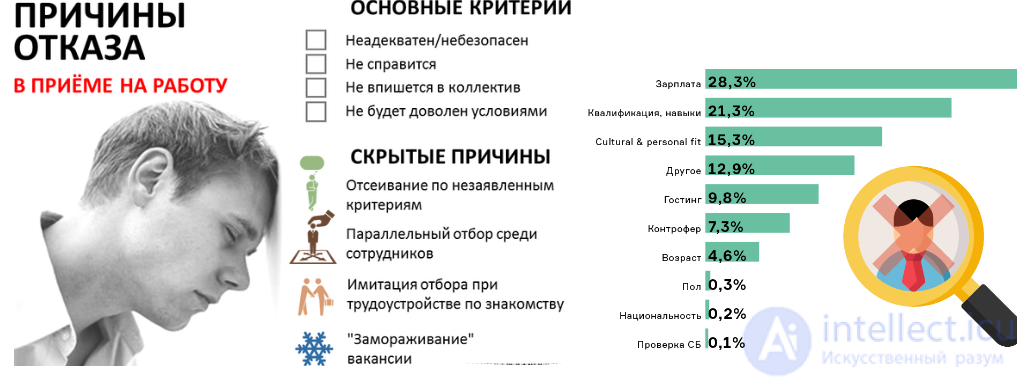
Conflict situations in employment can arise for various reasons and between different parties, including job seekers, employers and intermediaries (if used). Here are some typical conflict situations:
Mismatched expectations: A job seeker may expect a higher salary or better conditions than the employer offers. This can lead to disagreements and conflicts when discussing the terms of employment.
Discrimination: If a job seeker believes that their rejection is related to discrimination based on sex, age, race, nationality, disability or other grounds, this can lead to conflict.
Insufficient information: If an employer has provided incomplete or inaccurate information about a vacancy or the terms of employment, this can cause dissatisfaction on the part of the job seeker.
Delay or change of terms: Sometimes employers may change the terms of an offer after the job seeker has already made a decision. This can cause irritation and conflict.
Selection process: If the selection process is perceived as unfair or disorganized, this can cause indignation on the part of the job seeker.
Timelines: Delays in the hiring process, especially if unexplained, can cause indignation among job seekers.
Mismatched expectations regarding duties: If a job seeker expects to perform certain duties but the employer offers different ones, disagreements arise.
Termination terms: Details regarding the terms of dismissal or termination of the employment relationship can cause conflicts if they were not clearly agreed upon.
Confidentiality: If the employer or job seeker fails to maintain the confidentiality of information, this can also lead to conflicts.
Conflicts in employment are best prevented from the very start through clear and open communication between the parties. If a conflict does arise, it is important to try to resolve it through constructive dialogue and the search for compromises, and, if necessary, to consult labour relations specialists or lawyers.
When hiring, employers may use various kinds of tests and assessments to evaluate candidates for their fit with the job requirements and to assess their professional skills and abilities. Here are several types of tests that may be used:
Interview: This is the most common type of assessment when hiring. The candidate meets with representatives of the employer for a conversation, during which their communication skills, motivation and fit with the company culture are evaluated.
Skills tests: Candidates may be given tests to check their technical skills, proficiency with software, or knowledge of specific areas (such as mathematics, programming, etc.).
Personality tests and behavioral assessment: These tests help employers understand candidates' personality traits and their approach to working in a group. They can be used to determine whether a candidate is a good fit for a particular team or role.
Practical assignments: Candidates may be asked to complete practical assignments or projects related to the job they are applying for. This can include writing test code, developing a business plan, or creating a design.
Work-sample interview: This is a type of interview in which the candidate is given a task related to the job and must perform it in the presence of the employer. This can be a sample assignment or a simulation of a work situation.
Group interview: Several candidates may be invited to the same interview, where they must work in a group on a given task or solve a problem. This allows the employer to assess the candidates' teamwork skills and interaction.
English language tests: If the job requires knowledge of English, candidates may be given proficiency tests such as TOEFL or IELTS.
Analytical ability tests: These tests assess a candidate's ability to solve analytical and logical problems. They are often used when hiring in finance, engineering and data analytics.
Tests on moral and professional values: Some companies may conduct tests to assess candidates' ethical and professional values.
Case interviews: This type of interview is often used at consulting and strategy firms. The candidate is asked to analyze a business case and provide recommendations.
Each type of assessment has its own purpose and may be used depending on the requirements and goals of a specific vacancy and company. It is important for candidates to be prepared for different types of tests and assessments in the course of their job search.
A probationary period is a period of time during which a new employee undergoes adaptation and is evaluated by the employer to determine whether they are a good fit for the specific position and company. Here are some key aspects of the probationary period:
Duration: The length of the probationary period can vary depending on the company and position. It typically lasts from one to three months, but it can be longer.
Purpose: The main purpose of the probationary period is to assess the performance of the new employee and their compliance with the requirements of the position. It is also a time for adapting to the new environment and team.
Assessment and feedback: During the probationary period, the employer assesses the employee. This may include regular conversations, feedback, and possibly formal performance reviews.
Rights and obligations: During the probationary period, both the employer and the employee have rights and obligations. For example, the employer may terminate the employment contract without notice or with a reduced notice period. The employee, in turn, also has the right to decide whether the company and the position suit them.
Pay attention to the contract: Before accepting a position with a probationary period, carefully study the employment contract and the rules relating to the probationary period. Pay attention to the terms and deadlines related to the completion of the probationary period and its possible consequences.
Adaptation and effort: It is important to put maximum effort into adapting to the new environment and to show professionalism and diligence in your work. This can increase your chances of successfully completing the probationary period.
Completion of the probationary period: At the end of the probationary period, the employer and the employee usually conduct an assessment. If the results are positive, the employee officially becomes a permanent member of the team. If the results are negative, a decision to dismiss the employee may be made.
The probationary period is an important stage for both the employer and the employee, and it provides an opportunity to assess whether the employee meets the expectations and requirements of the position. It is important to carefully evaluate and weigh all aspects related to the probationary period before deciding to take up such a position.
A job interview is an important stage of the hiring process, during which the employer and the candidate can meet, discuss questions, and determine whether the position suits the candidate.
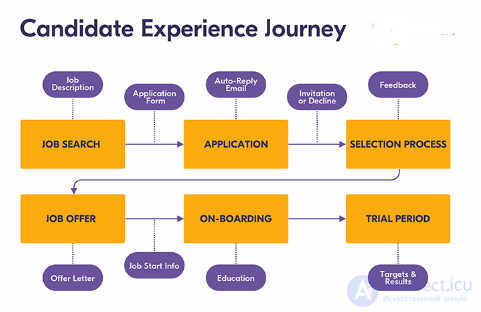
Here are the main stages of a job interview:
Preparation:
Preliminary interview:
In-person interview:
Testing and assessment:
Questions and answers:
Candidate's questions:
Wrapping up and awaiting the decision:
Post-interview actions:
Accepting the offer (if the outcome is positive) (Offer):
Each stage of the interview gives the employer and the candidate an opportunity to get to know each other better and make an informed decision about the candidate's suitability for the position.
Preparing for an interview with an employer is a key step in a successful job search. Here are some recommendations to help you prepare for the interview:
Research the company: Look into information about the company you are going to interview with. Understanding their business, values, culture and products/services will help you prepare better and show that you are interested in the position.
Analyse the job posting: Read the job description carefully. Think about what skills and qualities are required, and how you can demonstrate them at the interview.
Prepare for the questions: Think about the typical questions that may be asked at the interview, and prepare answers to them. These may be questions about your experience, skills, motivation and problem-solving abilities.
Practise your answers: Practise your answers to questions with a friend, a family member or in front of a mirror. This will help you improve your speech and confidence.
Prepare questions for the employer: Prepare a few questions you would like to ask the employer. These could relate to details about the position, the team, opportunities for development, or expectations of the candidate.
Prepare supporting materials: If you have examples of work or projects you can show the employer (for example, a portfolio, presentations, code samples), prepare them in advance.
Define your goal: Ask yourself what you want to achieve in this interview and what impression you want to leave of yourself. This will help you leave a stronger impression on the employer.
Dress appropriately: Choose professional attire that matches the style of the company and the position. Your appearance is the first thing people notice at an interview.
Arrive early: Try to arrive at the interview early so you have enough time to get oriented and check your appearance.
Improve your communication skills: Employers assess communication skills. Improve your speech, language culture, and gestures.
Manage stress: An interview can be stressful, but try to manage your stress. You can use breathing or relaxation techniques for this.
Close the interview properly: At the end of the interview, express your gratitude for the opportunity to participate and confirm your interest in the position.
Follow up on the post-interview process: If the employer requested any information or documents after the interview, provide them promptly. Also send a thank-you letter or email after the interview, emphasizing your interest.
Preparing for an interview is a key moment in a successful job search. It will help you perform confidently and demonstrate your strengths to the employer.
Self-presentation (from Latin — «self-offering») — the process by which a person presents their own image in the social world, characterized by intentionality and a focus on creating a certain impression of themselves in others.
Self-presentation is the skill of presenting yourself and your qualities in a way that creates a positive impression on other people, whether at an interview, at a professional event, or in everyday life.
The concept of «self-presentation» is the subject of study in many sciences: psychologists emphasize its focus on producing the reaction the subject of the self-presentation desires by evoking a given range of emotions in the object being influenced. Sociologists emphasize the need for self-presentation so that others can form a complete and reliable image of the person presenting themselves. At the same time, when speaking of reliability and possible idealization of the image, the degree of closeness to and striving toward that idealization matters.
The American sociologist E. Goffman names determining the nature of the social situation, taking into account the possibility of regulating most social interactions, as the main function of self-presentation. Through the use of self-presentation, society effectively accepts the personal roles of the subject of influence and their interaction. The nature of self-presentation can change depending on the circumstances or goals of the subject of self-presentation. Thanks to E. Goffman's analysis of this concept, self-presentation came to serve as a subject of socio-psychological research.
Self-presentation acts as an important part of the communication skills used by various individuals in order to shape a particular image in the minds of other people for the further receipt of material and social benefits. Self-presentation may be used in a variety of settings: from talking to strangers on the street to meeting with high-ranking partners.
Self-presentation comes in two types:
— natural, also called natural distribution, — is characteristic of all individuals and is marked by the absence of contrivance in the process and by its naturalness. Natural self-presentation results in a person being placed within the system of social consciousness. A distinctive feature of this type of self-presentation is the impossibility of controlling or adjusting it, which can be regarded as a drawback of natural self-presentation owing to the unpredictability of the effect produced.
— artificial self-presentation, within which specially developed self-presentation skills are applied, with a planned result. The main goal of artificial self-presentation is to build a positive attitude on the part of people who matter to the person doing the influencing.
Two types of self-presentation are distinguished:
1. corresponding to one's own self-assessment — the main goal of this type of self-presentation is the influencer's striving toward the ideal of themselves formed in their own mind.
2. corresponding to the expectations and preferences of the audience — the most common type of self-presentation, aimed at shaping the influencer's image in the eyes of others.
An indisputable fact is the expressiveness of self-presentation, which stems from people's desire to create for themselves an image that matches their personal identity. But society often controls a person's identification because of the existence of conventional rules of conduct in every sphere. A person's reaction to such control can be provocative. An example of this is the "clergyman's daughter", whose personal identity and emotions are suppressed as a result of the particular features of her father's professional activity. Under such conditions she cannot present herself in any way other than that befitting a "preacher's daughter". Ultimately, this provokes a negative reaction in her family and in society.
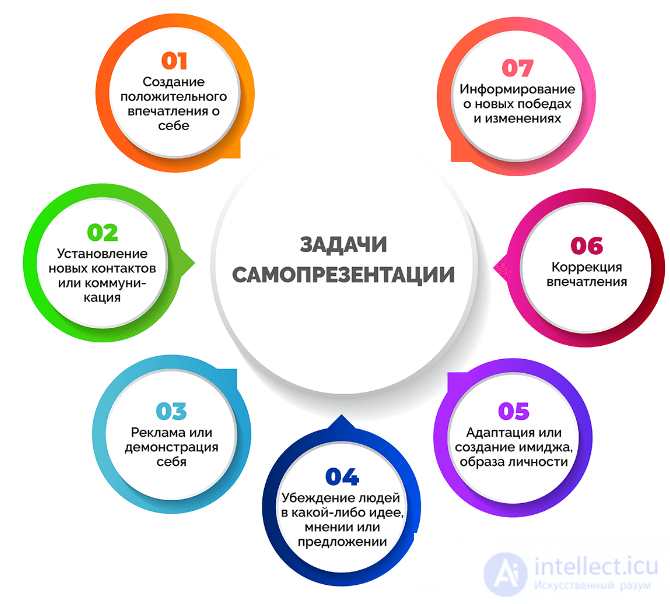
Here are some tips for delivering a successful self-presentation:
Prepare in advance: Decide in advance what you want to say about yourself. Highlight the key points you would like to emphasise.
Structure the information: Self-presentation should have a structure. Begin with a brief introduction about yourself, then move on to your professional experience, achievements, skills and interests.
Highlight your strengths: Pay special attention to your strengths, skills and achievements that are relevant to the situation or audience.
Give examples: Your self-presentation will be more convincing if you back it up with concrete examples from your experience. Tell stories that illustrate your skills and successes.
Listen to your interlocutor: Remember that self-presentation is not only about how you talk about yourself, but also about how you enter into dialogue with others. Listen to your interlocutor's questions and comments and respond to them appropriately.
Take context into account: Your self-presentation may change depending on the situation and audience. Adapt to the context so that your message is as relevant and interesting as possible to your listeners.
Learn it by heart: Although self-presentation should sound natural, it helps to practise it and learn it by heart so that you feel confident.
Work on your manner of speech and gestures: Your manner of speech and gestures can say a lot about you. Practise expressing your thoughts clearly and confidently.
Be confident in yourself: Self-confidence is a key aspect of successful self-presentation. Pay close attention to your inner state and maintain a positive attitude.
Practise: Rehearse your self-presentation in front of friends or colleagues to get feedback and improve your skills.
Be sincere: It is important to be sincere and authentic in your self-presentation. Do not try to create an artificial image that does not match your personality.
Finish strong: End your self-presentation strongly, emphasizing that you are ready for further communication and cooperation.
Remember that self-presentation is an important skill in personal and professional life. Learn it and improve at it in order to successfully present yourself and achieve your goals.
The following tactics are used in everyday life:
Self-presentation strategies can take on a defensive or assertive character. Defensive self-presentation is aimed at preventing threatening life situations. In this case the «supplication» tactic is used. The assertive style of self-presentation is characterized by more active behaviour, marked by idealization of one's own personality and benevolence. This style includes the tactics of «flattery», «self-promotion», and «exemplification».
These strategies play an important role in maintaining one's self-esteem. A person's self-esteem depends on the assessment of their own activity and on the perception of how others react to their performance. As a result, people actively project impressions that evoke a sense of self-worth, which is reinforced by the reaction of others.
Very often, artificial self-presentation is resorted to by public figures and politicians, who create a coherent image of themselves in order to build a respectful attitude among others and convince people of their competence. However, criticism is directed at the ability to transform image characteristics amid shifting politics, which leads to the inconsistency of artificial self-presentation. Also, amid an actively developing information society, self-presentation on the internet is gaining ever-greater popularity; to carry this out, the subject of influence creates their own page, on which they post information about themselves and their qualities, often concealing or distorting the facts of their life and the true information about their personality in order to manipulate public opinion. Thus, the virtuality of telecommunication technologies makes this kind of self-presentation unreliable
Self-presentation of the individual is widely used in mass culture, in politics, in business, in educational activity, in socio-cultural activity, management, sales, advertising, public relations, when applying for a job, and in other fields.
An effective interview is a mutual process in which both the candidate and the employer seek to assess whether the position and the candidate are a good fit for each other. Here are some key factors for a successful interview:
Prepare in advance:
Demonstrate your professional experience:
Communication and listening:
Demonstrate soft skills:
Be positive:
Prepare for questions about weaknesses:
Adapt to the situation:
Appearance and manner:
Finish strong:
After the interview:
Remember that an interview is a mutual process, and your goal is not only to pass it successfully, but also to make sure that this position and company match your goals and expectations.
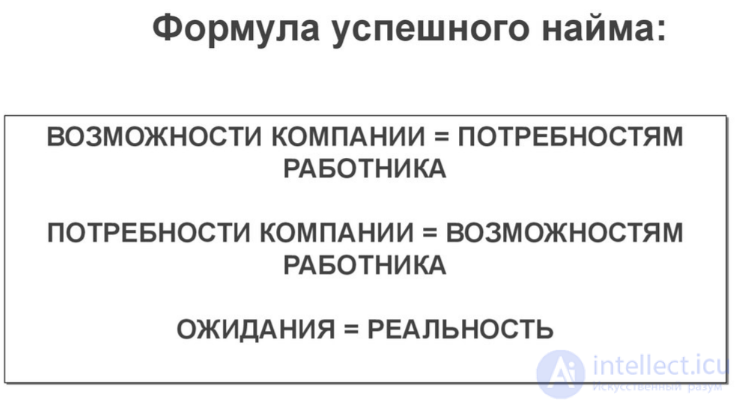
|
Company opportunities: Income level Compensation Benefits package conditions Prospects for career growth Training |
Company needs: Productivity (number of functions, operations per unit of time) Efficiency (minimum expenditure – maximum effect) Result (indicators) Development (new ideas, initiatives, improvements, achievements) Loyalty (reliability, engagement) |
|
Employee's capabilities: Job performance skills: operations, functions Intellectual potential (the ability to improve one's work, to bring in new ideas) Competencies (established models of professional behaviour) Personal potential (the ability to influence relationships with people, a set of personal qualities) Abilities and talents (effectiveness and uniqueness) |
Employee's needs: for security (material well-being, confidence in the future) for belonging (social status, one's own circle, being among equals) for recognition (success, fame, respect) for self-realization (content of the activity, responsibility, cooperation) for power (over people and events: exerting influence, getting one's way) for understanding, acceptance (relationship with the immediate supervisor, atmosphere in the team) for achievement (seeing the results of one's efforts, attaining high results) for advancement (career growth) |

Comments