
Lecture
answer: «A knowledgeable and competent leader from whom I can learn to set goals and achieve them».
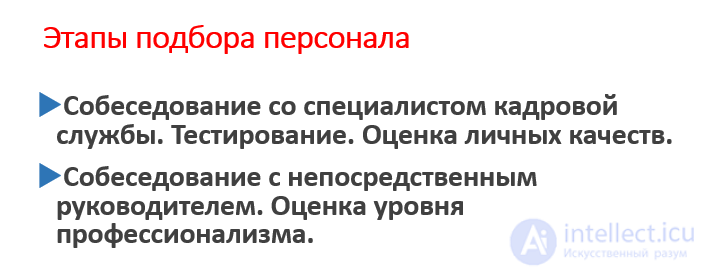
stages of staff selection
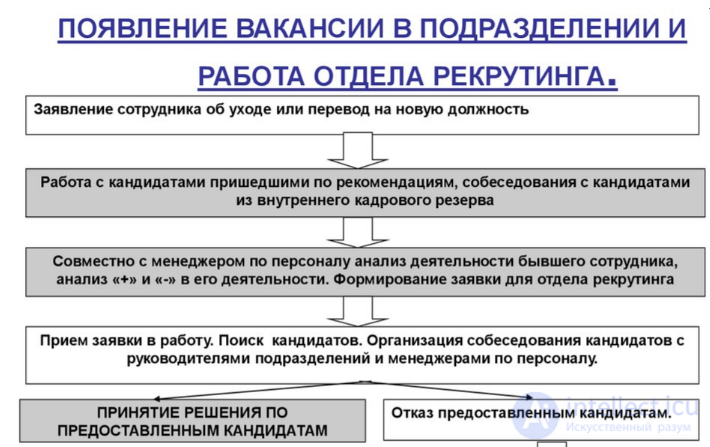
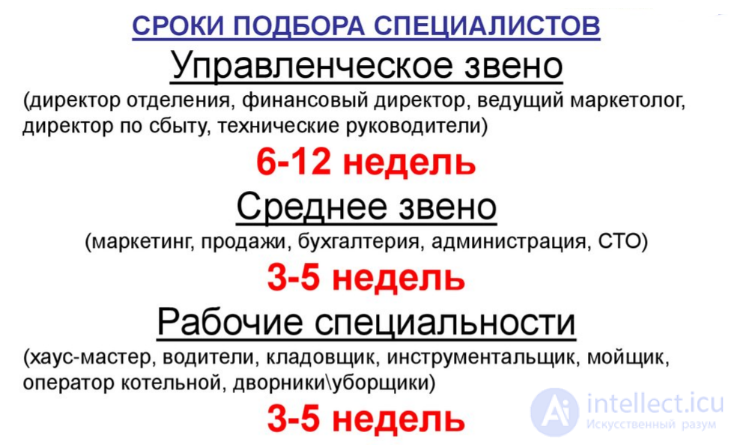
Staff selection timelines
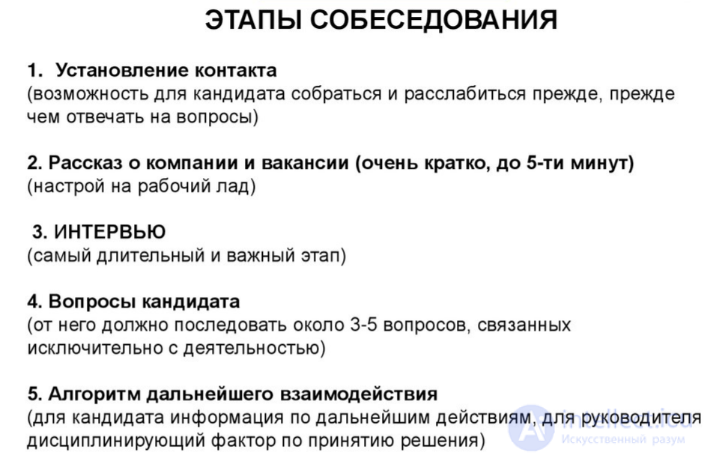
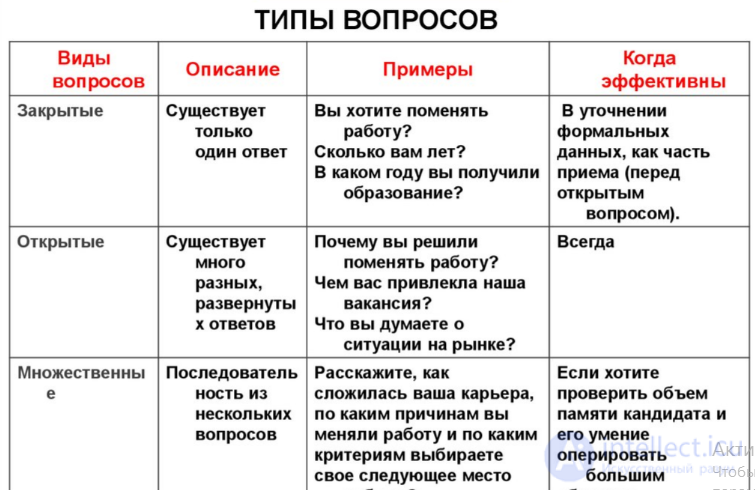
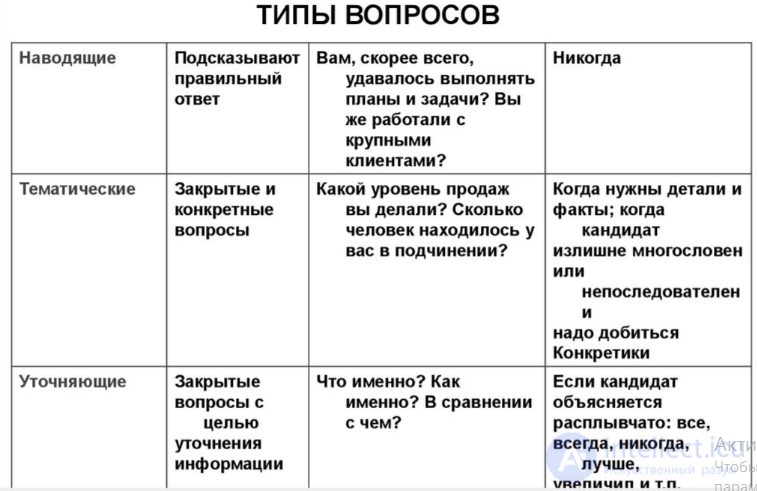
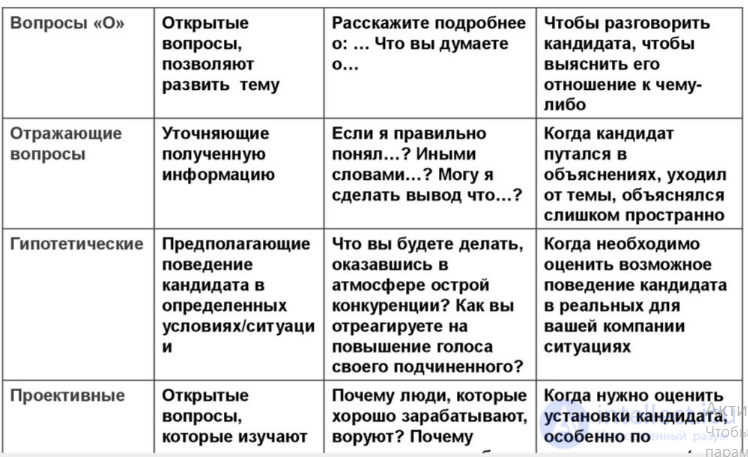
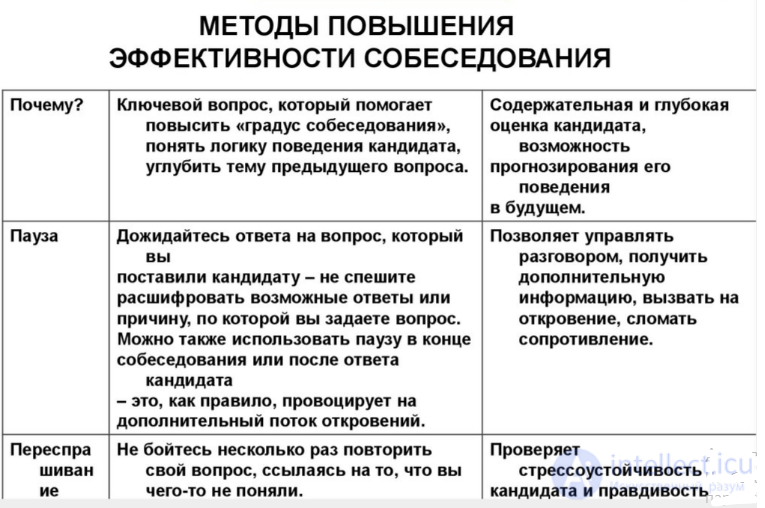
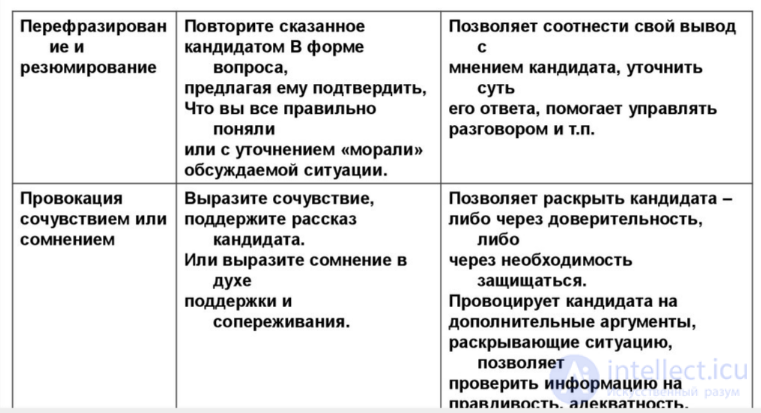
Methods for improving interview effectiveness
What project or task do you consider your most significant career achievement to date?
Does it have unique clients or a philosophy that sets it apart from competitors? How was it created, and by whom? After studying the website, move on to the biography of the CEO and top management. Are you impressed by their achievements, and is there something you could learn from them? Then say so with pride. Or do you like the products and services the company provides? Then tell the interviewer that you truly want to be part of the team that works on this.
Talk about your previous work experience and your interest in this field. Talk about your ideas, which in your opinion could be useful for the team you want to work with. Share other objective facts and quantitative measures of achievement (i.e. how you increased sales at your last job, helped cut costs, etc.).
Tell me about yourself.
Sample answer: "I hold a bachelor's degree in information technology and have spent the last three years working as a systems administrator at XYZ company. My responsibilities included managing servers, ensuring network security and providing user support. I have also completed Cisco certification and have experience working with Cisco equipment."
What are your strengths?
Sample answer: "My strength is analytical thinking. I'm good at understanding complex problems and can find effective solutions. I'm also a good communicator and work well in a team."
What are your weaknesses?
Sample answer: "I can sometimes be overly self-critical, which slows down my pace of work. However, I'm working on this and trying to improve my productivity."
Why do you want to work at our company?
Sample answer: "I want to work at your company because you are known for your innovative approach to product development and your commitment to quality. I'm confident I can contribute to your team and help you achieve your goals."
Tell me about a time when you solved a difficult problem.
Sample answer: "Once, at my previous job, we ran into a serious server problem that caused the system to go down. I organised an emergency team meeting, and working through the night, we were able to restore the system within 6 hours."
How do you manage stress and deadlines?
Sample answer: "To manage stress and deadlines, I use planning and organisational methods. I make task lists, set priorities and follow a schedule. I also take short breaks to rest and come back to work with renewed energy."
How would you rate your skills in [a particular area]?
Sample answer: "I believe I have good skills in [a particular area]. In my previous job, I successfully handled tasks related to this area and received positive feedback from management."
What do you know about our company?
Sample answer: "I researched your company and know that you specialise in [description of the company's activities]. You are also known for your innovations in [description of the company's innovations]."
How do you respond to constructive criticism?
Sample answer: "I believe constructive criticism is very important for my professional growth. I am always open to feedback and try to use it to improve my work."
Why should we choose you specifically?
Sample answer: "I am confident that my skills, experience and motivation make me a suitable candidate for this position. I am ready to contribute to your team and help you achieve your goals."
It is important to prepare for the interview in advance by researching the company and the position you are applying for, and thinking through answers to potential questions. This will help you make a good impression on the employer and increase your chances of success.
Candidate assessment is the process of analyzing information about candidates and determining their suitability for a specific position. This includes evaluating their résumé, their responses to interview questions, test results and reference checks. Assessment allows the employer to select the best candidates from the pool of applicants.
Selection system (SS): A selection system is a structured approach to recruiting and selecting personnel, which involves developing procedures, criteria and tools for effectively choosing candidates. An SS can include stages such as posting vacancies, evaluating résumés, conducting interviews, testing and checking references. The purpose of an SS is to minimize hiring errors and select candidates who meet the company's requirements.
The concept of the "WAMS SELECTION SYSTEM", using the letters W, A, M and S, describes important criteria and characteristics that can be applied when selecting and assessing candidates for a position. Let's break down what each of these letters means:
W - Wants (Want): This criterion describes how much the candidate wants to hold this position and how well it matches their wishes and interests. Desire and motivation play an important role in a successful career.
A - Able (Able): This criterion indicates the candidate's ability to meet the requirements of the position. This includes the skills, knowledge, experience and abilities needed to perform work tasks.
M - Manageable (Manageable): This aspect assesses how well the candidate can be managed and integrated into a team or organization. This includes social skills, the ability to work in a group, adaptation to the corporate culture, and the ability to follow instructions.
S - Safe (Safety): This criterion assesses how well the candidate can ensure safety and reliability within their work. In some industries and positions, such as healthcare workers or engineers, safety can be critically important.
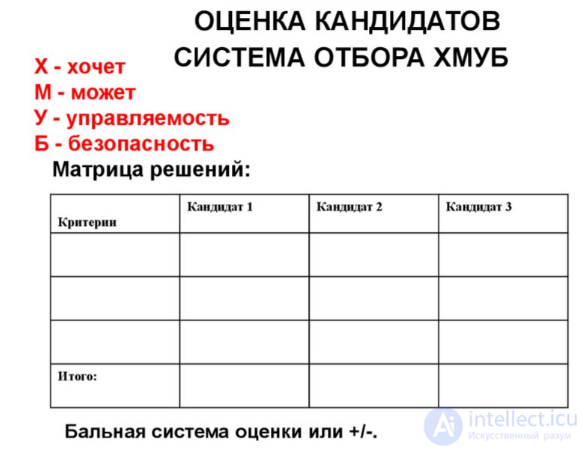
CANDIDATE ASSESSMENT
WANTS
•Strongly expressed interest in the vacancy
•Willingness to make concessions in terms of personal requirements
Questions: why do you believe you match this position? Why
should we choose you specifically? What do YOU consider your strongest
quality?
MANAGEABILITY
•Relationship with management
•Relationship with the team
•Relationship with colleagues
Questions: how do you take criticism?
Give an example of an issue on which you and your manager disagree. What kind of team do you feel comfortable working in?
CAN
•Match between previous experience and the employer's requirements
•Necessary specialised additional education
Questions: what did your job duties involve?
What kind of work gives you pleasure? In what direction would you like to develop?
SAFETY
• A large amount of information about the previous company, including commercially sensitive information
•Relatives – working for competitors
Questions: if the candidate starts describing company secrets in detail, you can ask directly whether they consider
this to be a trade secret, and whether the candidate has the right to disclose such things – track the reaction. Clarify where relatives work
PERSONAL CHARACTERISTICS
Questions: ask candidates how these characteristics manifest themselves in everyday life or professional activity – the answer should be reasonable
AMBITIONS
HOBBIES
FAMILY
Questions: how does your spouse feel about your decision, where do your close relatives work
ASSESSING CANDIDATES
questions the employer needs to clarify so there are no surprises later
1. Compensation package: expectations = the employer's capabilities
2. Commute time
3. «What I want» and «What they offer» (why the person is changing jobs, and what they want to improve)
4. A loner or a team player (fits into the team)
5. «Strengths and weaknesses» (Our task is to identify them and assess their possible impact on future results)
6. Other job offers (the candidate's value on the market, a possible «no» in case we select them)
7. What is needed to finally «settle the matter»? On what terms would the candidate agree to join your company unconditionally
8. Will the candidate «fit in» with your company's corporate culture?
EXAMPLES OF TYPICAL QUESTIONS
1.Greeting and building an atmosphere of trust.
Typical questions: How did you find us? How was your trip here? Do you find it easy to get around this area?
My name is _____________. Our interview is meant for getting acquainted and deciding on hiring the best candidate.
2.Presentation of the enterprise and the position.
Typical questions: Are you familiar with our enterprise? What do you know about the position being offered to you? What interests you most about our enterprise? What were your first impressions of meeting the staff?
3. Professional experience, skills, and knowledge.
Typical questions:
-Tell me about your last (current) job. What did you like (do you like) most about your work?
-Were you (are you) satisfied with everything about it?
-What were your functions and duties in your last organization?
-What work did you take part in beyond your usual job duties?
-What are your main achievements at work?
-How did you get your job at your previous organization?
-Did you have any mistakes, disappointments, or things that did not go very well in your work? Tell me about them.
4.Career plans. Achievements.
Typical questions:
-Have you made any plans for the future? Tell me about them.
-What are your long-term goals and objectives?
-Did your career advance during your previous job?
-What position do you see yourself in five years from now?
5.Motivation.
Typical questions:
-Why do you want this job?
-What are you looking for in a job?
-What would you like to avoid in a job? Why?
-What are your expectations from working for us?
-What is your current/last salary?
6.Self-image. Self-assessment.
Typical questions:
-Describe yourself in general terms
-Tell me in what ways you excel over other people?
-What do you think about your shortcomings, and which qualities should you develop first?
(What do you consider your strengths/weaknesses to be?)
7. Family
-Does your wife (husband) share your professional plans?
--How do you and your spouse feel about long-term work in remote regions?
1. STRUCTURED
The most ideal candidate. Answers questions clearly, logically, and competently. Answers take 2-5 minutes.
How to work with them: sometimes the answers turn out to be too brief. The interviewer should ask a large number of questions to clarify details.
2. THE CHATTERBOX
An unending stream of words. In the end, not only does the candidate forget the question, so does the person asking it. Such answers carry practically no information.
How to work with them: elements of a stress interview can be used. It is enough to interrupt fairly firmly and ask whether the candidate remembers the question that was
asked at the start. If this happens repeatedly, the candidate is unmanageable and is unlikely to be right for us
3. THE QUIET ONE
An ambiguous candidate. Because during the interview they try to preserve the trade secrets of their current company, they give practically no
information about themselves. The interview turns into a «game of hide-and-seek».
How to work with them: be the first to talk about the vacancy, so the candidate relaxes and does not think they were invited in order to extract information; if the candidate closes up, re-establish contact with them. If that does not work – «lay your cards on the table», say out loud that this is simply an interview,
not a spy game.
4. THE EMPTY SHELL
The candidate provides information about everything and nothing. In describing their work, they constantly use the pronoun «we». They constantly refer
to authorities in order to make an impression. As a rule, nothing that is written in their CV was actually done by them personally – it was merely observed from
the other side
How to work with them: at the first signs, steer the conversation toward personal experience and professional questions, bring them back to individual activity (they said «we» did it – tell me what you personally did), do not react to name-dropping («I know Vasya» - «Great, but what exactly did your role involve»). Check references.
5. THE SALESPERSON
The most difficult type of candidate. Ideal experience and résumé, ideal appearance, ideal behaviour. Reasons for leaving previous companies – skillfully worded. A large volume of professional knowledge and fluent use of terminology. Well-known companies on the market. How to work with them: dig, dig, dig….. A series of interviews, with several participants,
specialists from the candidate's field. References are essential. Possible warning signs: frequent job changes, overly polished reasons for leaving (socially desirable answers), inflated self-assessment. Such candidates are most often exposed at the stage when they are already in
The central tendency error occurs when most candidates are rated with an average score (although one might expect some candidates to be better and some worse)
The leniency error - most candidates receive high ratings, which can lead to hiring unsuitable employees.
The strictness error - most candidates receive low ratings, which leads to screening out candidates who might have been suitable for the job.
The halo effect occurs when a manager rates a candidate as good or bad based on a single characteristic that in their
eyes outweighs all the others.
The contrast error occurs when an average candidate receives a high rating if they are interviewed after several weak candidates, or a low rating if they go after several strong candidates.
Stereotyping is the tendency to compare candidates against the stereotype of an "ideal candidate". This stereotype can vary greatly between different
managers and bear very little relation to the actual requirements of the job.
Graphic self-assessment.
The gist: we ask the candidate to indicate, on a scale from 1 to 10, their level of competence, success, managerial abilities, etc. Any criterion that interests us.
What this gives us: a reason to ask «Why?», to hear how the person justifies their choice and what motivates it.
Work assignments.
The gist: we ask the candidate to complete a hypothetical task with given parameters (for example, write a feasibility study, describe the org structure of a department or company, etc.)
What this gives us: the work reflects the candidate's train of thought, their level of competence and motivation to obtain this position, their independence and ability to analyze, etc.
Essays.
The gist: we ask the candidate to set out their vision or position on some situation or problem. (sample topics: my career growth at your company; how I would organize a sales department; my understanding of marketing, etc.)
What this gives us: information about the candidate's position on the question that interests us, etc.
Example:
The proposed list of questions requires your written response, in whatever form and as fully as you consider possible:
Which principles for organising the work of sales managers do you consider necessary for achieving maximum efficiency in the sales system?
What, in your opinion, is included in this system?
Which indicators would allow you to effectively manage the work of sales specialists?
Projective techniques.
Options: Psychogeometric test, the "Constructive Drawing of a Person from Geometric Shapes" test, an unfinished-sentences test on any topic.
The main thing in a sale is…..
The best way to respond to an objection is….
For me, every client is…..
It is necessary to place a time limit so that the reactions are more spontaneous, and therefore more genuine.
CASE tests:
The idea: you model a situation for the candidate (preferably from real practice) and ask them to describe or act out their reaction or decision
Example: You have come to meet a client, and your competitor happens to be negotiating with them at that very moment. What are your actions?
The client has made it clear that they work with competitors and are satisfied with that. What are your actions?
What this gives us: a clear understanding of the candidate's behavioural patterns and reasoning logic, and an assessment of skills under conditions close to real ones.
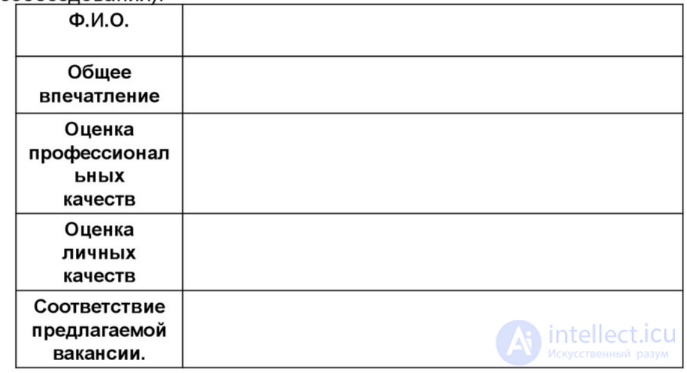
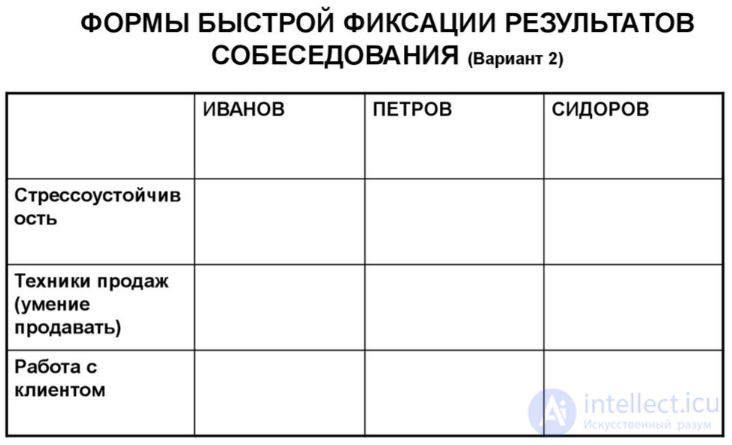
QUICK RESULT-RECORDING FORMS
filled in after the interview has been conducted, version 1
QUICK INTERVIEW RESULT-RECORDING FORMS (Version 2)
CONCLUDING THE INTERVIEW
1. Thank the candidate
2. If you used elements of a stress interview, mention this so the candidate doesn't leave feeling confused
3. Explain the candidate's next steps and the decision timeline. If the decision has already been made and you can give a socially acceptable reason for the rejection, you may tell the candidate so that they don't wait a long time for a positive decision
4. Immediately after the candidate leaves, make your notes on the candidate evaluation form.
5. Discuss the impressions with colleagues who were present at the interview
6. Make a decision
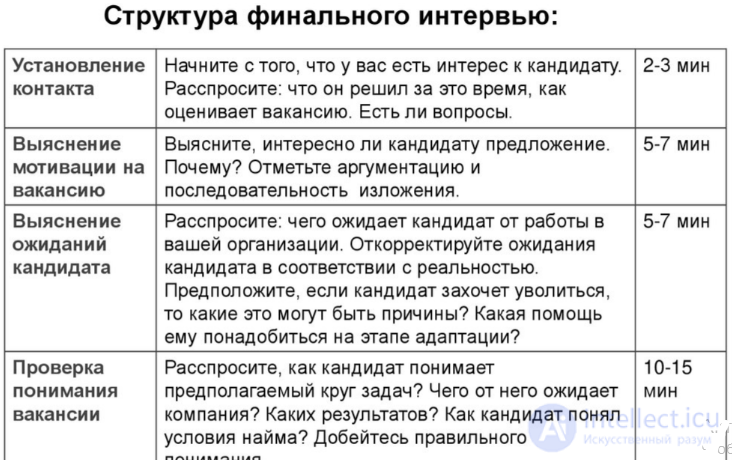
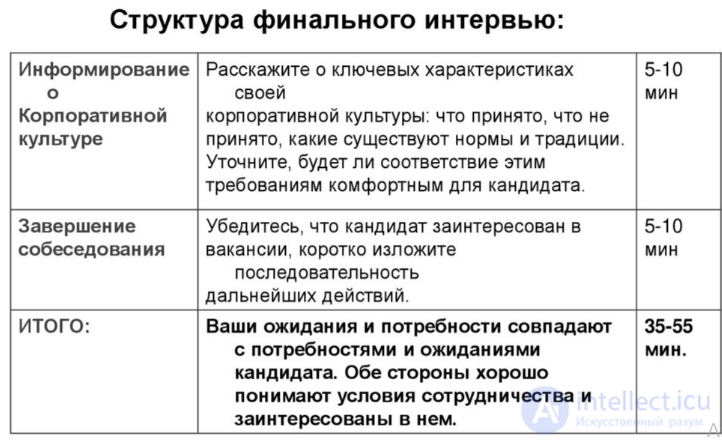
FINAL INTERVIEW
Structure of the final interview:
A selection system using these criteria allows employers to evaluate candidates more thoroughly and systematically, and to make more informed hiring decisions. Each of these aspects may carry different weight depending on the specific position and organisation.

Comments