
Lecture
Conflict is a process involving a clash of interests, values, opinions or needs that can arise between two or more parties. Conflicts can have various causes and take various forms. Here are the main aspects of conflicts and their typology:
Causes of conflict: Conflicts can be caused by a variety of factors, including:
Types of conflict:
Stages of conflict:
Managing conflict is important for maintaining healthy working relationships and ensuring effective work within an organisation. Resolving conflicts may require communication skills, the ability to listen and analyse, and the ability to find compromises and solutions that take into account the interests of all parties.
Workplace conflict is a type of conflict that arises in a work environment and is related to disagreements, dissatisfaction or conflicting interests between employees or different groups within an organisation, which directly affect the production process and work activity.
Here are some examples of workplace conflicts:
Conflict between employees: For example, employees of the same department may disagree with each other about the distribution of duties or priorities, which can make it difficult for the whole department to work.
Conflict between management and employees: For example, employees' dissatisfaction with company policy, salary or working conditions can cause conflict between them and management.
Conflict between different departments or groups: For example, the marketing and production departments may clash over different priorities and interests: marketing wants to launch a new product on the market quickly, while production may consider this too fast and difficult to achieve.
Conflict over resources: Conflicts can arise over the allocation of limited resources such as budget, staff or equipment.
Workplace conflicts can have a negative impact on the efficiency of an organisation's work, as well as on employee morale and satisfaction. However, they can also stimulate the search for new ideas, solutions and improvements in work processes. Managing workplace conflicts involves resolving disagreements, finding compromises, improving communication and establishing healthy relationships within the team.
Behaviour in conflict plays a decisive role in how the conflict is resolved and how relationships between the parties are preserved. Here are some key aspects of behaviour in conflict:
Calmness and self-composure: Try to remain calm and composed, even if the conflict is escalating. Strong emotions can make it harder to resolve the conflict and lead to negative consequences.
Listening: It is important to actively listen to the other side's point of view. Try to understand what exactly is troubling the other party and what their interests are.
Respect: Respect the other person, even if you disagree with their opinion. Use polite and respectful communication.
Using "I-statements": Instead of accusations and sweeping statements, express your feelings and needs. For example, "I feel hurt because I wasn't included in the decision on this task" instead of "You always ignore my opinions."
Active discussion: Try to actively discuss the causes of the conflict and possible ways to resolve it. Work with the other person to look for compromises and solutions that satisfy both parties.
Finding common interests: Try to find common interests and goals that unite you with the other person. This can help create a foundation for cooperation.
Avoiding aggression and threats: Do not use aggressive or threatening methods in conversation. They can only aggravate the conflict.
Reaching an agreement: If you manage to find a common solution, reach an agreement and stick to it. Remember that the agreement should be mutually beneficial and fair to both sides.
Seeking help: If the conflict cannot be resolved on your own, seek help from management, HR specialists, or professional conflict mediators.
Feedback and lessons from the conflict: After resolving the conflict, discuss it with the other person and try to draw lessons for the future. How can you avoid similar situations or resolve them more effectively?
Remember that conflicts are not always bad. They can stimulate discussion and the search for better solutions. The main thing is to be able to manage them constructively in order to achieve positive results and preserve relationships.
The emergence and resolution of conflicts is a normal part of interpersonal interactions, both in personal life and in the workplace. Conflicts can arise from differing views, interests, needs, and communication styles.
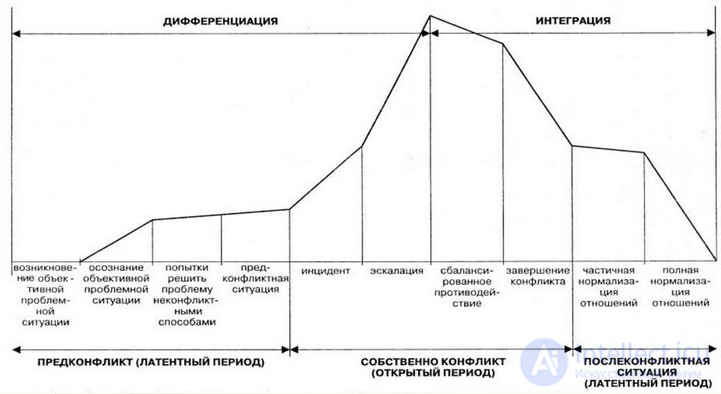
Fig. Dynamics of a conflict
It is important to know how to manage conflicts effectively. Here are the steps that help in the emergence and resolution of conflicts:
Step 1: Recognizing the conflict
The first and most important step in managing a conflict is acknowledging that it exists. Sometimes conflicts can be hidden or suppressed. It is important to pay attention to signs such as tension in relationships, conflicting interests, or a feeling of dissatisfaction.
Step 2: Identifying the causes of the conflict
Understanding the roots of the conflict helps in resolving it. Try to answer the questions: What interests and needs are involved? What events or actions led to the conflict? What differences in communication styles or perception might there be?
Step 3: Analysing the consequences
Assess what consequences this conflict has. How does it affect you, the other participants, and the overall situation? This will help determine the importance of resolving the conflict.
Step 4: Choosing a conflict management strategy
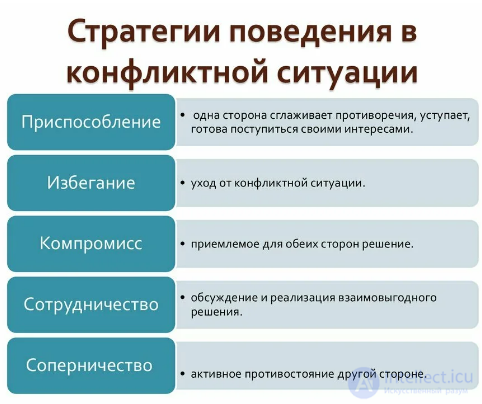
There are several strategies for managing conflict, and the choice depends on the specific situation and the degree of importance of the conflict:
Cooperation: An attempt to jointly solve the problem, satisfying the interests of both sides. This is often the best strategy, especially if the conflict involves an important relationship.
Concessions: Sometimes you can make concessions on less important matters in order to reach a compromise.
Compromise: Finding a middle path that satisfies both sides. This may require some concessions from both sides.
Avoidance: Avoiding the conflict if it is not so important or has no solution at the current moment.
Competition: Continuing the conflict in the hope that one side will win. This strategy rarely leads to long-term success.
Step 5: Developing and implementing a plan
If the chosen strategy involves resolving the conflict, develop a specific action plan. This may include direct communication with the other party, seeking compromises, and fulfilling commitments.
Step 6: Evaluating the results
After resolving the conflict, evaluate its results. Was it possible to achieve mutual understanding, satisfaction of interests, and improved relationships? If so, this can serve as a lesson for future conflicts.
It is important to remember that conflicts are not always bad. They can help facilitate discussion of problems, the search for better solutions, and the improvement of relationships, if managed correctly.
Attitudes toward conflicts can vary among different people and organizations. It depends on many factors, such as personal values, cultural characteristics, experience, level of education, and the degree of understanding of the role of conflicts in interpersonal relationships and organizational life. Here are several common attitudes toward conflicts:
Positive attitude toward conflicts: Some people and organizations see conflicts as a normal and useful part of life. They believe that conflicts can contribute to growth, innovation, and improved relationships. In such cases, conflicts are viewed as an opportunity to discuss different points of view and find the best solutions.
Negative attitude toward conflicts: Other people and organizations try to avoid conflicts or regard them as something undesirable and destructive. They may fear conflicts because of potential negative consequences, such as damaged relationships or a worsening work atmosphere.
Neutral attitude toward conflicts: Some people and organizations do not have a strongly expressed attitude toward conflicts and accept them as something natural, but not necessarily positive or negative. They may react to conflicts as they arise, without having a clear strategy for managing them.
Proactive conflict management: Some organizations actively develop strategies and policies for managing conflicts. They may provide employees with training in conflict-resolution skills, have procedures for filing complaints and grievances, and employ conflict-resolution specialists.
Ignoring conflicts: Some people and organizations may ignore conflicts, hoping that they will resolve themselves. However, this approach can lead to the aggravation of problems and the deterioration of relationships.
It is important to understand that one's attitude toward conflict can change depending on the situation and context. It is important to develop conflict-management skills in order to be able to respond effectively to different situations and achieve the best outcomes in interpersonal relationships and in an organisation.
In a conflict situation, people may display different behaviour styles, which can be identified as the main styles of conflict management. These styles can be divided into five main categories:
Cooperation (collaboration): This style is characterised by an active striving to satisfy the interests and needs of all parties to the conflict. People who use this style seek to find common solutions, work together and find compromises. They generally consider satisfying everyone's interests to be a priority.
Competition (rivalry): This style is characterised by a striving to dominate in the conflict and defend one's own interests regardless of the interests of others. People who use this style may employ aggressive tactics, such as persuasion and pressure. They generally consider winning the conflict to be the main goal.
Accommodation (concession): This style is characterised by a willingness to yield in the conflict for the sake of satisfying the interests of the other party. People who use this style may make concessions and compromises, even if this means giving up their own interests. They generally consider preserving the relationship to be more important than winning the conflict.
Avoidance: This style is characterised by a striving to avoid conflict or to put it off for later. People who use this style may withdraw from conflict, avoid confrontation, or ignore the problem. They generally consider that avoiding conflict can help preserve calm and relationships.
Accommodating style: This style is characterised by a willingness to satisfy the interests of others at the expense of one's own. People who use this style may be willing to make concessions and compromises in order to satisfy the needs of other parties. They generally consider preserving peace and good relationships to be more important than defending their own interests.
It is important to note that each behaviour style has its own strengths and weaknesses, and the effectiveness of a style depends on the specific situation and goals. Sometimes mixing different styles (for example, starting with cooperation and then moving to compromise) can be the most productive way of managing a conflict. It is important to develop conflict-management skills and to choose the most suitable style depending on the specific situation.

Comments