
Lecture
In today's world, following the rules of etiquette is extremely important. It is similar to how we do not throw litter on the street, so as not to create disorder in society. Some may think that the rules of etiquette are needed only for the "upper circles," but this is a mistaken idea. Regardless of social status and position, knowing and following etiquette is important for everyone.
Etiquette helps us communicate with different people and creates a favourable impression of ourselves. The ability to make the people you're talking with feel important and interesting is an important aspect of successful communication. Applying the norms of etiquette is especially important in the workplace, where it helps maintain professional relationships.
Professional etiquette includes punctuality, courtesy, and the ability to keep confidential information. Punctuality highlights an employee's organization and reliability, while courtesy shows respect for others. Not disclosing confidential information is a demonstration of trust and professionalism.
Finally, it is important to remember that it is not always necessary to say a lot. Maintaining confidentiality and communicating sensibly are key points of professional etiquette.
Professional etiquette is a set of rules and norms that govern how people interact in the workplace. These rules help create respectful, professional, and effective relationships at work. Here are some key aspects of professional etiquette:
Courtesy and respect: Professional communication should begin with polite greetings such as "good morning" or "hello." Respect for colleagues and superiors is the foundation of professional etiquette.
Dress code: Following the corporate dress code or the level of formality appropriate to the place and event is important for creating a professional appearance.
Communication: Competent and clear communication is a key aspect of professional etiquette. This includes the ability to listen to your interlocutor, express your thoughts clearly and respectfully, and respond to messages and letters within the established deadlines.
Punctuality: Arriving at work and meetings on time is an important element of professional etiquette. Delays can cause displeasure and create problems in planning and work.
Maintaining confidentiality: Personal and confidential information about colleagues and clients should remain private. Disclosing such information can lead to a breach of trust and legal consequences.
Email and social media etiquette: When using email and social media, it is important to maintain a professional tone, avoid using offensive or obscene language, and avoid posting confidential information.
Telephone etiquette: During phone calls, you should pay attention to your tone and volume, avoid long pauses, and make sure you are speaking with the right person.
Professional relationships: Personal and professional relationships should not be mixed in the workplace. This helps avoid conflicts and preserve professional status.
Dealing with conflicts: Conflicts are inevitable, but it is important to be able to resolve them constructively and peacefully, with respect for the other side's point of view.
Flexibility and adaptability: Professional etiquette also includes the ability to adapt to different cultural and professional contexts and to show flexibility and tolerance.
Observing professional etiquette helps create a pleasant and effective working environment, improves interpersonal relationships and contributes to success in the workplace.
The ethical principles and norms of conduct of business people — are the generally accepted principles of behavior in the business world. These include: freedom, tolerance, tact and delicacy, fairness, business reliability and others. Business ethics is based on such a universal human value as freedom.
In the context of traditional norms and values, the assessment of labor evokes mixed reactions. On one hand, physical labor was regarded as the opposite of sacred rituals and, compared to them, as a punishment or a lowly occupation. In this traditional social system, noble classes, such as warriors, nobles and priests of non-Christian faiths, looked down on physical labor, preferring disinterested service to "higher" ideals.
On the other hand, land in traditional culture was considered sacred, and working it was regarded as a noble occupation. Labor within the community strengthened collectivism and gave meaning to life. A lack of useful activity could lead to a disorderly way of life. For women, active diligence was considered a guarantee of their virtue, since household duties helped them maintain diligence and decency.
In traditional culture there was a hierarchy of types of labor from the standpoint of moral values. The highest place was occupied by the labor of the peasant, followed by the craftsman, especially if his products were not intended for sale. Next came trade, which was regarded as a less honorable occupation. But the lowest moral standing was given to occupations connected with trade and financial operations, especially moneylending. Everything connected with the sphere of exchange and commodity relations was usually associated with negative moral overtones.
Literate communication as the key to success: It is important to speak and write correctly. This not only makes understanding easier, but also creates a positive impression of you. Business success often depends on your ability to communicate with people. To achieve success in business, one must master the art of eloquence, as the ancient Greeks and Romans did.
It is also important to watch your pronunciation and intonation, avoiding slang words and offensive expressions. You should not display selfishness; it is important to take into account the opinions and interests of partners and clients. It is important to be tolerant, respectful and never insult opponents, even if they behave aggressively.
Style of dress is also important; it shapes the first impression of you and speaks to your status. It is important to maintain a style appropriate to your field and to observe the dress code.
The ability to listen and understand the other person is an important aspect of successful business communication. Do not interrupt the other person; give them the opportunity to express their opinion, and then offer your own arguments.
Relationships within the team are also important. A friendly attitude, respect and support for colleagues contribute to a good microclimate in the organization.
And finally, receiving delegations requires taking into account the national characteristics and mentality of representatives of another country. This helps avoid misunderstandings and ensures successful interaction.
The ethical norms of workplace relations are a set of rules and principles that regulate the behaviour and interaction of employees within an organization. They are aimed at creating honest, professional, and respectful working relationships. Here are some of the main ethical norms of workplace relations:
Honesty and integrity: Employees must be honest and principled in their work, must not deceive or mislead others, and must uphold the principles of honesty and integrity.
Respect and tolerance: All employees must respect one another, regardless of race, gender, age, religion, nationality, and other characteristics. Tolerance for diversity and multiple points of view is also important.
Confidentiality: Work-related information and data connected with work or clients must be treated as confidential and must not be disclosed without necessity or without appropriate authorization.
Fairness and equality: Employees must be fair in their actions and decisions, and must uphold the principles of equality toward all colleagues.
Transparency: Openness and honesty in communication are important aspects of workplace relations. Employees must provide reliable information and avoid hidden agendas.
Collaboration and teamwork: Employees must cooperate and support one another to achieve the organization's common goals. Teamwork and respect for others' opinions are important.
Motivation and professional growth: Employees must strive for professional growth, learning, and developing their skills in order to better serve the organization's interests.
Compliance with laws and rules: All employees must comply with applicable laws and corporate rules, as well as adhere to standards of professional conduct.
Fair pay and remuneration: Employees must receive fair wages and remuneration for their contribution and effort.
Fighting corruption: Corruption and fraud are prohibited. Employees must act with honesty and integrity and must not take part in illegal or unethical practices.
Adherence to the ethical norms of workplace relations helps create a professional and respectful work environment, promotes effective teamwork, and strengthens trust among colleagues. Organizations often develop codes of ethics or ethical standards to give their employees more specific guidance on these matters.
Professional ethics includes a number of fundamental norms that help regulate behaviour and relationships in the workplace. Here are some of the main norms of professional ethics:
Integrity and honesty: A professional must act with honesty and integrity, without engaging in fraud, deception, or corruption. This includes honesty in reporting and compliance with laws and ethical standards.
Confidentiality: A professional is obligated to maintain the confidentiality of information entrusted to them. Breaching confidentiality can lead to serious consequences.
Professionalism: An employee must maintain a high level of professional competence and keep their skills and knowledge up to date. They must also comply with the standards of their profession.
Respect: Professional respect for colleagues, clients and other participants in the work environment is a key norm. This includes respect for diversity, opinions and the rights of others.
Responsibility: A professional must take responsibility for their actions and decisions. This means being willing to accept the consequences of one's actions and to act in the interests of the company and society.
Fairness: Professional conduct must be fair and equal for everyone. There should be no discrimination based on gender, race, religion, or other characteristics.
Compliance with laws and rules: A professional is obliged to comply with all applicable laws, rules and regulations related to their field of activity.
Communication: Communication must be open, honest and effective. A professional must listen to interlocutors and express their thoughts clearly.
Care for customers and customer service: If the job involves serving customers, the professional must demonstrate a high level of service and care for customers.
Social responsibility: A professional must take into account the impact of their actions on society and the environment and act in accordance with the principles of sustainable development.
These norms of professional ethics help create a fair, respectful and effective work environment where everyone can demonstrate their professionalism and contribute to the organization's success.
Communication at work can be divided into formal and informal, and both types have their own characteristics:
Formal communication:
Official conversations: These are official discussions aimed at addressing work-related matters. This can include meetings, briefings, exchanges of information about projects and other formal gatherings. They usually follow specific rules and procedures.
Email and written correspondence: Official letters and emails are used to convey information and documents within an official framework. They should be formal and professional.
Reports and presentations: These forms of communication are used to present information or work results to colleagues or management. They should be structured and clear.
Business etiquette: In formal communication it is important to observe the rules of business etiquette, such as politeness, formality, punctuality and others.
Informal communication:
Conversations outside working hours: Colleagues can communicate with each other outside working hours, for example, during lunch or a coffee break. This is more informal communication, where various topics not related to work can be discussed.
Social events: Non-work events, such as corporate parties, picnics or other events, promote informal communication and strengthen relationships between colleagues.
Rumors and gossip: Informal communication can include conversations about rumors and gossip. It is important to be careful and avoid taking part in conversations that could harm the reputation of colleagues or the company.
Collegial relationships: Informal communication can help build friendly relationships between colleagues, which can improve teamwork.
Both types of communication have their significance in the workplace. Formal communication is necessary for effective work and the transfer of information, while informal communication helps build trusting relationships and strengthen team spirit. It is important to be able to balance these two types of communication and to maintain a professional and polite approach in both cases.
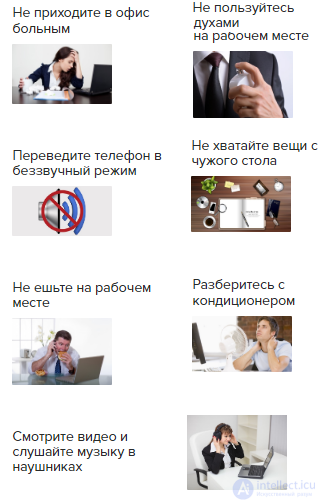
Observing rules of workplace etiquette helps create a respectful and professional atmosphere. Here are some basic rules of workplace etiquette:
Politeness and respect: Treat colleagues and management with respect and politeness. This includes greetings, expressions of thanks, and the use of "please" and "thank you".
Punctuality: Arrive at work on time and meet deadlines. Being late can be seen as disrespectful of the work process and of colleagues.
Personal hygiene: Maintain cleanliness and tidiness. This includes taking care of your clothing, hair and body. Come to work clean and well-groomed.
Clothing and dress code: Follow the dress code rules if your company has them. It is important that your style of dress matches the professional environment.
Use of equipment: If there is shared equipment at work (computers, printers, water coolers, etc.), make sure you use it with consideration for other employees.
Confidentiality: Maintain the confidentiality of information, especially if you work with sensitive data. Do not disclose personal or commercial secrets.
Communication: Communicate clearly and precisely. Avoid using jargon and abbreviations that may not be understood by colleagues.
Observing safety rules: Follow workplace safety rules, including fire safety rules and equipment usage rules.
Respect for personal space: Respect colleagues' personal space. Do not intrude on their personal zones and do not interrupt them without permission.
Handling criticism: If you need to voice criticism, do so constructively and in private, rather than in front of the whole group of colleagues.
Participation in group activities: Support participation in corporate events and activities, such as team lunches or corporate parties, to strengthen team spirit.
Respecting cultural differences: If you work in a multinational environment, take into account colleagues' cultural characteristics and religious beliefs and show respect for them.
Observing these rules of etiquette helps create a harmonious and professional atmosphere in the workplace and promotes effective cooperation with colleagues.

Comments