
Lecture
Lesson type: Lesson on forming new knowledge.
Teaching methods:
Objectives: Didactic: to introduce students to the concept of professional aptitude and professional competence.
Developmental: to continue developing the ability to analyse, compare, contrast, identify the main point, establish cause-and-effect relationships, give examples, and improve the ability to work independently and in a group
Educational: to form an emotional and personal attitude toward innovative technologies, to form an active life stance. Students acquire the ability to listen, ask questions, and behave correctly using their knowledge of business etiquette, and rules of conduct in society are developed.
Equipment:
Form of organizing learning activity in the lesson:
Motivation: the relevance of the lesson topic lies in forming students' knowledge about the concept of professional aptitude and professional competence.
Expected results:
The demand for professions on the labour market can vary considerably depending on a great many factors, such as the economic situation, technological trends, demographic changes, and sociocultural factors. Below are some professional fields and professions that tend to remain in demand:
Information technology (IT):
Healthcare:
Engineering:
Finance and accounting:
Education:
Marketing and advertising:
Cybersecurity specialists: Due to the growing threats in the field of cybersecurity, specialists in this area are in very high demand.
Environmental historians: Specialists in the assessment and management of environmental resources and issues.
Solar and alternative energy specialists: Due to growing interest in sustainable energy sources.
Robotics and automation: The introduction of robots and automation into various industries creates demand for engineers and specialists in this field.
It is important to note that the demand for professions can change according to the region and the specific situation on the labour market. It should also be taken into account that some professions may be subject to change solely due to technological innovations. Therefore, it is important for every person to constantly update their skills and keep track of trends in their industry.
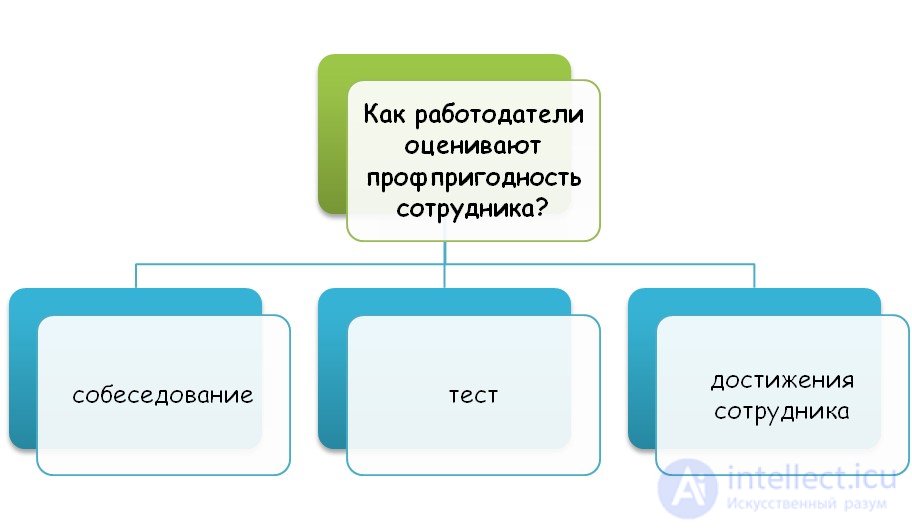
Lesson progress
|
No. |
Structural elements of the lesson |
Teacher's activity |
Students' activity |
|
1 |
Organizational moment (2 min.) |
Greeting |
Preparing for the lesson |
|
2 |
Announcing the topic and goal of the lesson (3 min) |
On the board: the name of the lesson topic. |
Write it down in their notebooks |
|
3 |
Review of previously covered material (5 min.) |
Ongoing assessment in question-and-answer form. |
Answer the questions |
|
4 |
Preparing students for the active, conscious acquisition of new material and presenting new knowledge: a) the concept of professional aptitude and professional competence b) testing (30 min) |
Goal: to apply a professional aptitude test |
Take the test, ask questions and answer the teacher's questions. |
|
5 |
Consolidating new knowledge (3 min.) |
Additions, clarifications, and announcement of grades. |
Check the notes in their notebooks. |
|
6 |
Assigning homework and instructions for completing it (2 min) |
Emphasize the purpose of the homework. |
Notes. |
Managerial activity — is a specific type of professional activity, and therefore mastering it requires certain personal qualities.
What is the essence of the requirements placed on a person who wishes to professionally engage in managerial activity?
First, its performance requires «special» psychophysiological qualities and outstanding personal potential.
Second, managerial activity, as an activity involving the organization and management of people, objectively places high demands on the cultural thesaurus of those engaged in it.
A manager's cultural education — is evidence of their need for constant contact with the finest achievements of human thought and artistic creation.
An attitude toward humanities knowledge, toward the creative world of music, painting, and art — is a kind of test of aptitude for managerial activity. Without such an inner spiritual foundation and its corresponding nourishment, a manager will not be able to inspire vital optimism, work enthusiasm, and humane attitudes toward one another among people. Thanks to cultural education, it becomes possible to bring to life the basic ideological position of managerial activity — recognition of the manager's social responsibility for contributing to the country's economic well-being and the spiritual elevation of the nation.
Third, a manager must possess wide-ranging specialized knowledge. Given that the volume of specialized knowledge in managerial activity is constantly growing, it can be grouped under the following headings: economic, legal, financial, marketing, logistics, information-related, mathematical, technical, and environmental.
A special place in the structure of a manager's specialized knowledge, of course, is occupied by knowledge that has a direct bearing on general, sector-specific and specialized management. For a communications manager, everything connected with communication theory, electronic technology and information technology is of particular practical interest.
The «Encyclopedia of Informatiology» cites an interesting fact: starting in 1964, Japan made the wealth of information and resources one of its management priorities, and this choice allowed the country, in the shortest possible time, to rise to second place in the world in gross income per capita and to first place in many indicators of science and technology.
Constant structural transformations of economic entities are natural for a market economy, as is the continuous process of reproducing and accumulating specialized knowledge of the most varied kinds. It is no accident that nowadays, alongside the professional training of individual employees or certain categories of them, organizational learning is widely used, in which the whole business structure is covered by training and top management sets itself the task of engaging the interest of the entire organization in improvement and renewal.
Fourth, a manager must be able to apply all the aforementioned knowledge in a technologically competent way in professional activity. One can be an erudite specialist yet not sufficiently master the skill of putting one's knowledge into practice.
If in the technical sphere it is impossible to be a technologically untrained worker, then in the sphere of communication there is often a gap between education and the ability to build relationships with people, to display remarkable skill in making communication comfortable. It is no accident that H. Ford (Sr.) said that he was ready to pay a manager several times more for the ability to communicate, while another no less famous entrepreneur, Lee Iacocca, categorically declared: if a manager cannot communicate, I fire him.
Thus, based on the specifics of the requirements that characterize managerial activity as a profession, one can build a three-block model of the personal and business qualities that a communications manager must possess (Table 10.1).
Table 10.1.
Model of the personal and business qualities of a communications manager
|
Block of general qualities: |
Block of specific qualities: |
Block of particular qualities: |
|
- exceptional intelligence - keen intuition - humanity - erudition - optimism - experience of communication and application of professional knowledge |
- integrity - competence - organizational ability - a taste for self-improvement - charisma |
- communication skills - empathy - reflectiveness - stress resistance |
A model of the personal and business qualities of a modern communications manager. This model provides an approximate picture of a person's professional suitability for managerial activity. In doing so, one must bear in mind the status of the activity: administrative (top manager) or functional (head of an analytical department), and the field of activity (for example, logistics or public relations). In the first case, managers differ in the scale to which their organisational abilities and their skill at planning and forecasting personnel work are expressed. In the second, they need specialised knowledge and work experience in specific professional fields. Overall, the more a manager's personal characteristics match the profile of the job - both its status and its substantive-target profile - the more professionally suited they are to it.
In his time, Charles Fourier made a futurological prediction: under the most favourable socio-economic conditions, the world would have no more than 15-17 million Newtons, Shakespeares and geniuses of that calibre. Of course, significant success in professional activity is achieved by those who best match it in terms of their personal and business qualities.
In management, an objective choice of profession is especially important because of the enormous responsibility it places on a person: dealing with people, the cost-effective use of modern equipment and technology - all of this must be taken into account by anyone who wants to pursue communications management as a profession.
A communications manager faces the fact that, besides collaboration techniques and the ability to win people over, they must master communication and information technologies, advertising and rebranding technologies, PR and image-building. The higher a communications manager's level of technological proficiency, the more professional their work. Their technical and technological abilities are of particular importance, given how saturated modern communications are with telephone, radio and television equipment.
Let us draw attention to the priority that should be given to training a communications manager in management technologies, among which we would single out the technology of preparing and implementing management decisions. Overall, it is precisely in their command of management technologies that a communications manager stands out as a professional from their public-relations colleagues - PR people and image-makers.
Thus, professional competence, understood as the combination of knowledge and experience needed for the effective performance of real job functions and official duties, can be regarded as a kind of standard applied to the individual. The level of professional competence is determined by how closely the person's educational and practical preparedness matches that standard.
Professional suitability and professional competence together give rise to two important moral-psychological factors that have a profound effect on a communications manager's vitality and on the effectiveness of their professional activity. These are professional satisfaction and professional success.
As long-term studies show, over the course of a lifetime a person achieves self-realization, on average, only within about 20%. The main reasons for this are an unsuccessful choice of professional education and work that is «not to one's liking». The first reason often gives rise to the second. It is no coincidence that more than 50% of university graduates change their profession.
The diversity and multifaceted nature of interpretations of the concept of «professional competence» are due to differences in scientific approaches to research problems: personal-activity, systemic-structural, knowledge-based, culturological, and others.
Definitions of professional competence found in foreign literature, such as «in-depth knowledge», «a state of adequate task performance», «the ability to actually carry out an activity» (J. K. Britell, R. M. Jaeger, W. E. Blank) and others, do not fully specify the content of this concept. Most often it is used intuitively, to express a high level of qualification and" professionalism. If one attempts to determine the place of competence within the system of levels of professional mastery, it lies between diligence and perfection. In pedagogy, some scholars (N. Rozov, E. V. Bondarevskaya) regard this category as a derivative component of «general cultural competence». A number of scholars interpret it as «the level of a specialist's education» (B. S. Gershunsky, A. D. Shchekatunova). T. G. Brazhe and N. I. Zaprudsky understand professional competence as a systemic phenomenon that includes knowledge, skills, abilities, and professionally significant personal qualities of a specialist that ensure the fulfilment of their own professional duties. V. P. Pugachev views professional competence as a characteristic quality of a specialist's training, a potential for the effectiveness of work activity. By professional competence the author means the ««technical» readiness of an employee to perform professional functions related to their specialization.
The concept of professional competence is examined in the works of V. V. Kamaev, E. F. Zeer, N. V. Kuzmina, L. M. Mitina, and others. By professional competence these authors mean the special knowledge and special skills necessary for a particular professional activity.
According to R. Kh. Gilmeeva's definition, professional competence is a person's ability, based on their knowledge and experience, to effectively solve problems that belong to the sphere of their professional activity. Professional competence presupposes knowledge, skills, and a fusion of experience and personal qualities — i.e., those potential capabilities that are important for achieving a high result in professional work.
In the field of social work, various approaches to defining the concept of «professional competence» have been identified.
E. R. Yarskaya-Smirnova includes in the concept of professional competence of social work specialists broad knowledge in the fields of pedagogy, psychology, and jurisprudence, as well as knowledge of the theory and methods of social work, a benevolent attitude toward people, their problems and situations, organizational and communicative abilities, a high moral and ethical level, and neuropsychological endurance.
The American researcher P. Brown considers the main criteria for a social worker's competence to be the ability to provide immediate and ongoing help to people who need it, to work with advocacy, to change the legislative side of things, and to raise public awareness in order to dispel myths about why people become poor.
Sociologists focus attention on professional values, methods of social interaction, professional calling, motivation for professional activity, and professional culture. Psychologists and acmeologists highlight professionalism, social prestige, criteria of success, the modelling of the personal-professional characteristics of a social worker, and technologies for developing professionalism. Educators give priority to shaping a motivational-value attitude toward the profession, professional consciousness and self-awareness, professionally conditioned qualities and personality traits, and readiness for professional activity.
According to E. I. Kholostova, professional competence also includes the formation of professionally important personal qualities, such as: a high level of general culture; professional tact capable of inspiring sympathy and trust among others; emotional stability, the ability to conscientiously fulfil one's duty while remaining calm, benevolent, and attentive; and the ability to make decisions in unexpected situations, formulate one's thoughts clearly, and express them competently and intelligibly.
So, let us give the following definition of professional competence.
In the broad sense, professional competence — is an integral characteristic that determines a specialist's ability to solve typical professional tasks and problems arising in situations of practical activity, using knowledge and professional and life experience, on the basis of a formed motivational-value attitude toward the profession and professionally conditioned personality qualities.
In the narrow sense, professional competence — is a set of knowledge and skills that determine the effectiveness of work; the scope of skills for performing a task; a combination of personal qualities and traits; a complex of knowledge and professionally significant personal qualities; a vector of professionalization; the unity of theoretical and practical readiness for work; the ability to carry out complex culturally appropriate types of action.
In conditionally separating professional competence from other personal formations, we mean that the acquisition of knowledge (the accumulation of an information base) — is not an end in itself, but a necessary condition for developing «knowledge in action», i.e., abilities and skills — the main criterion of professional readiness.
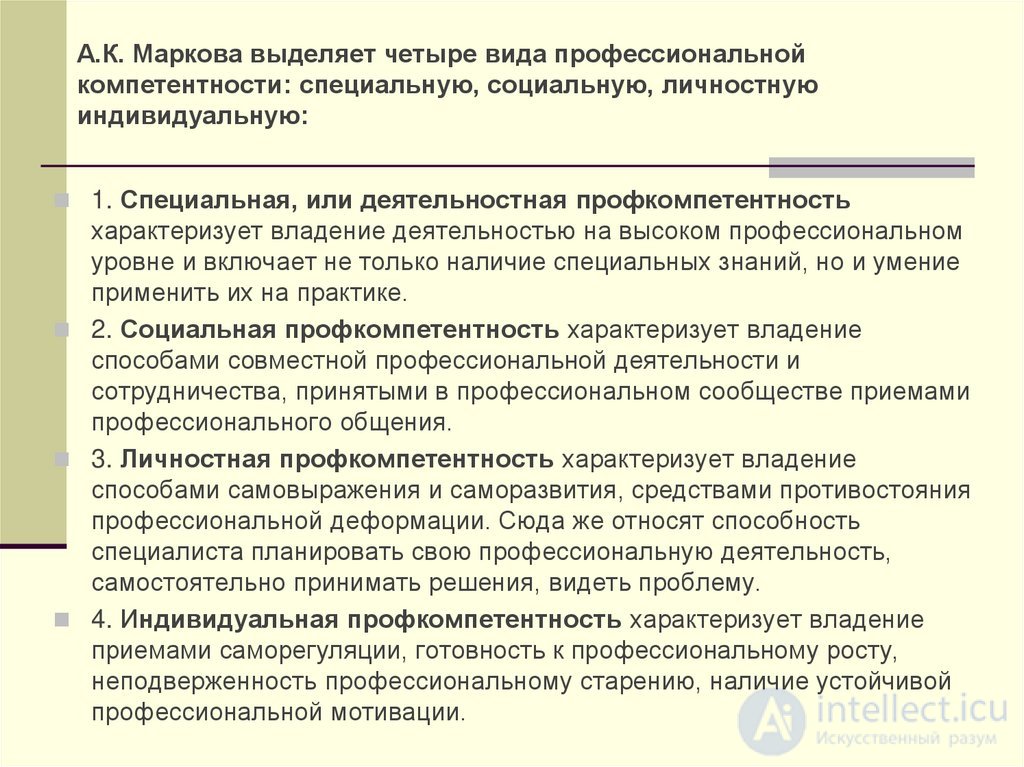
In the scientific literature, various components of professional competence are identified, such as special (related to the specifics of professional activity), social, personal, and individual.
Thus, by special competence we shall agree to understand mastery of the professional activity itself at a sufficiently high level. This is, in essence, operational-technical competence. The essence of social competence is characterized by skills of interaction and cooperation with the client, by professional communication techniques accepted in the social sphere, and by possession of social responsibility for the results of one's work.
Social competence, thus, is an integral personal formation that combines a value-based understanding of social reality, specific categorical social knowledge serving as a guide to action, a subjective capacity for self-determination and norm-creation, and a personal ability to carry out technologies of individual, group, and intergroup interaction.
A socially competent individual is able to place their own interests on an equal footing with the interests of others, understand the values of other people, and see partners in people.
Mastery of methods of personal self-expression and self-development, and of means of countering professional deformations of personality, characterises personal competence.
Finally, individual competence presupposes mastery of methods of self-realisation and development of an individual style of professional activity and communication, readiness for professional growth, capacity for individual self-preservation, and resistance to professional stagnation and degradation.
Thus, in the most general sense, competencies are defined as a holistic and systematised body of generalised knowledge.
Professional competence — is the consistency between a professional's knowledge, convictions, and behaviour.
The professional competence of a social work specialist includes the current level of personal development in the socio-cultural sphere of life activity.
The basic foundation and stock of professional knowledge of a social work specialist consist of knowledge:
of the norms and rules of psychological and social assistance;
of the rules of support and social assistance;
of the conditions for the social protection of a person in a difficult life situation;
of the principles of attitude toward a person in need of help and support;
- of the attitude toward work, toward another person, toward oneself. Professional convictions — a personal, partial
attitude of the specialist toward professional knowledge, manifested in principles, positions, worldview attitudes, and actual professional behaviour.
At the same time, professional knowledge does not always translate into convictions and may exist in parallel.
For example, all certified specialists studied gerontology at university and have a scholarly understanding of the typological changes in a person's well-being and behaviour in old age (rigidity, physiological memory impairment, disorientation in space and time, and, as a consequence, reactive anxiety, increased aggressiveness, and insufficient tolerance). However, it is precisely in pension fund institutions that one can often encounter intolerance among staff, and rejection and irritability among some employees.
Another example. At a consultation with a psychologist, a woman, a social work specialist (34 years old, 5 years of work experience in her field), was looking for a new job (she had previously worked at a territorial employment centre). Because she had upgraded her qualification in the specialisation of medical-social work, a vacant position was offered to her at a gerontology centre. To the counsellor's question, «What would you like to discuss?», the client replied that at the interview with the centre's director almost everything suited her: the workplace, job duties, and salary; the director was a pleasant and competent person. However, on leaving the office, in the corridor she saw elderly infirm people, people with disabilities, and old people who had come for physiotherapy and medical procedures. She became frightened at the thought that one day she too would become just as infirm. As a result, the client began to doubt whether her personal qualities matched the requirements of the profession.
Actual professional behaviour — is how a specialist embodies professional knowledge and beliefs in their professional actions and professional conduct.
The concept of «key competencies» was introduced by the International Labour Organization in the early 1990s into the qualification requirements for specialists within the system of postgraduate education, professional development and retraining of management personnel. In the mid-1990s it began to be used to define requirements for the training of specialists in vocational schools.
The Council of Europe identified five groups of key competencies that need to be developed in young people as they prepare for independent professional activity:
political and social competencies — the ability to take on responsibility, to work out decisions jointly and take part in their implementation, tolerance toward different ethnic cultures and religions, demonstrating the alignment of personal interests with the needs of enterprises and society, and participation in the functioning of democratic institutions;
intercultural competencies, which foster positive relationships among people of different nationalities, cultures and religions, and mutual understanding and respect;
communicative competencies, which determine command of the technologies of oral and written communication in different languages, including computer programming and communication over the Internet;
socio-informational competencies, which characterise command of information technologies and a critical attitude toward social information disseminated by the mass media;
personal competencies — readiness for continuous advancement of one's educational level, the need to actualise and realise one's personal potential, the ability to independently acquire new knowledge and skills, and the capacity for self-development.
This does not exhaust the list of key competencies. Key qualifications include basic competences, key competencies and meta-professional qualities.
Meta-professional qualities — are the abilities, qualities and personal traits that determine the productivity of a specialist's activity across a broad range of social and professional tasks. In the modern hospitality industry, qualities such as flexibility, organisation, independence, responsibility, practical intelligence, reliability, and the ability to plan and solve problems, among others, have proven especially in demand. Understanding professional competencies as a combination of mental qualities and states that allow a person to act independently and responsibly, and the possession of the abilities and skills needed to perform particular work functions, these can be represented as role characteristics of a specialist's professional competence. All other components are subjective characteristics that indicate a person's attitude toward the activity and their own strictly individual style.
Professionally significant knowledge encompasses information about the objects of study, the technologies for carrying out functional duties, the goals and objectives of the work, and data that determine the success of carrying out professional activity.
Professionally significant skills constitute the foundation, i.e. the formed, stable ability of a specialist to perform the techniques, actions and operations of a social worker's professional activity (organisational-managerial, corrective, preventive, therapeutic, mediatory, etc.).
Professionally significant skills needed for a specialist's productive activity encompass design, direction, organization, control, and other actions and techniques that lead to the effectiveness of work activity.
A person's professionalism — is not only their achievement of high professional results, not only labour productivity, but also the presence of psychological components — a person's inner attitude toward work, the state of their mental qualities. As a structural-functional concept, professional competence has its own content, structure, and level-based organization. To this day the component composition of the professional competence of a social work specialist has not been formalized as a final, standard module and remains a subject of heated discussion among analyst-scholars and practitioners. This question is often raised at conferences devoted to studying the problems of the professional competence of specialists in the social sphere.
The professional competencies of a social work specialist can be represented by five types of competencies: special, social, organizational-managerial, communicative, and technological.
The division into five blocks within the format of professional competence is purely conventional and is made in order to clarify the substantive aspect of their components, which makes it possible to determine the qualities of professional skills and, on that basis, to measure, form, and improve them.
To reflect the specific character of the substantive aspect of professional competence, we present working definitions of the competencies within it.
Special competence — is the knowledge that makes up a person's basic specialty (in accordance with the qualification of their diploma).
Special competence includes subject-specific and cross-subject knowledge that develops a person's personality. In other words, possessing special competence presupposes the integration of knowledge from the sciences that are fundamental to the worker and that determine their specialty, as well as those disciplines that directly or indirectly «work» for the profession: knowledge of psychology, communication theory, the theory of social work, conflict studies, and other disciplines, i.e., the sciences of the person and of society. In other words, within special competence two blocks of professional knowledge can be distinguished — cross-subject knowledge and knowledge of the core subject. Cross-subject knowledge is determined by a set of cultures, for example: legal, psychological, political, communication culture, and so on.
Knowledge of the core subject (subject-specific knowledge) is disciplinary, narrow knowledge that a professional must know everything about. Possessing special competence is a necessary condition for the professional activity of a specialist of any rank, but is insufficient for the manifestation of a high level of professional culture.
Social competence — is the ability to take responsibility, to work out a decision jointly and participate in its implementation, tolerance toward different ethnic cultures and religions, and the demonstration of alignment between personal interests and the needs of society. It characterizes knowledge and understanding of the processes taking place in contemporary society, the economy, the social sphere, and education, and the ability and capacity to interact with people of different socio-professional groups, ethnic backgrounds, and religious affiliations.
Technological competence is understood as the ability to work autonomously, the ability to learn, to acquire knowledge rationally, and to improve the practical skills and abilities of professional work.
Command of technological competence demonstrates, to a certain degree, a specialist's professional fitness.
Organisational-managerial competence — is the special organisational and managerial abilities that form the basis of management as a set of coordinating measures aimed at achieving goals set within an organisation (in American literature: the ability to get things done through the hands of others).
Managerial activity — is the direction not only of the production process (in our case, prevention, rehabilitation, etc.), but also of people, and it necessarily presupposes knowledge of the patterns of human behaviour (for example, the patterns and strategies of a person's behaviour in a difficult life situation).
Communicative competence — is the ability and capacity to conduct oral and written communication with clients, to communicate with colleagues, to resolve shared professional problems, and the capacity for partnership and cooperation.
A distinctive feature of communicative competence is that it is organically incorporated into special, technological and managerial competence as a means of putting them into practice, and the success of professional activity in the field of social work is largely determined by the quality of communicative competence. For psychosocial work in the social sphere, qualities of a specialist such as empathy, tolerance, mobility, responsiveness and flexibility are especially significant.
Thus, key professional competencies are treated in the literature as generalised modes of action that ensure the productive performance of professional activity. These are a person's abilities to put their professional competence into practice, which is understood as the coherence between professional knowledge, professional beliefs and actual professional behaviour.

Comments