Hiring (also called the recruitment or staffing process) involves a range of tests and assessments that help employers select the best candidates for specific positions.
Designing and administering the testing is the responsibility of an HR manager with a higher education in psychology. Their main task is to select the right test and correctly interpret its results. All tests are divided into::
-
Interview: The interview is one of the main methods of assessing candidates. It can be structured (with set questions and evaluation of answers) or unstructured (free-form conversation). It is important to ask questions related to the position, as well as to assess communication skills and the candidate's fit with the corporate culture.
-
Psychometric tests: These tests are designed to measure a candidate's cognitive abilities, personality traits, and skills. Examples include intelligence tests, personality-trait tests, and time-management tests.
-
Skills and competency tests: These tests assess the specific skills and knowledge needed to perform the job. For example, these could be software-proficiency tests, professional exams, language-proficiency tests, or technical-skills tests.
-
Practical work assessment (assessment centre): Some companies assess candidates by giving them the opportunity to complete tasks or solve problems similar to those they would handle on the job. This may include role-playing exercises, group activities, and other practical tasks.
-
References and reference checks: Employers may contact a candidate's previous employers or colleagues to obtain information about their professional and personal qualities.
-
Drug testing and English-language verification: Depending on the requirements of the position and the legislation of the given country, employers may conduct tests for drug or alcohol use, as well as verify English-language proficiency for positions where this is important.
-
Document and background checks: This includes checking the candidate's documents, such as diplomas, certificates, and driving licences. It may also include checking their criminal and financial history.
-
Values and cultural-fit testing: Some companies conduct testing to determine whether a candidate matches the company's values and culture.
- •psychological-social
- •geometric
- •personality-based
- •intellectual
- •interpersonal
Psychological tests
- •together, these methods can help an employer assess how well a person fits a particular position and whether they will be able to work within the existing team going forward.
- •The results help determine a person's qualities:
- •ability to work in a team
- •learning ability
- •reaction to stressful situations and the ability to act decisively
- •attitude toward people around them, i.e., the social component
- •Psychological tests when hiring make it possible to give an objective assessment of a person
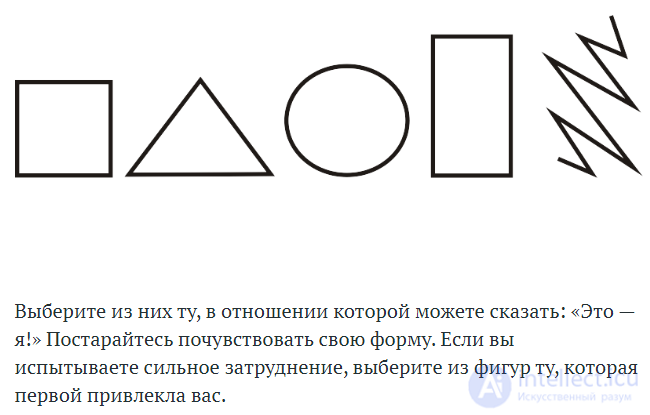
The geometric test when applying for a job
•makes it possible to determine as accurately as possible the future relationship with the employer and the applicant's behaviour in the work environment.
The first geometric shape chosen is the candidate for the position themselves, and all the others are arranged in descending order in the sphere of interpersonal relationships. In the last place is the shape symbolizing the person with whom difficulties in communication and mutual understanding might arise.
Square •You are definitely a serious person. Stable and rational in everything: in both thoughts and actions. For such a person, health and thoughts come first. You are most likely the unique holder of a rare and praiseworthy quality – you strive to see any undertaking or task through to completion. The main characteristics of such a person are diligence and industriousness. Fans of the square are characterized by qualities such as methodicalness and patience, which helps them achieve good results at work and often earn a reputation as excellent specialists in their field. These are people with left-hemisphere thinking, i.e., they are strong in logic, and technical specialties come easily to them. They tend to «calculate the outcome» rather than guess at it, since they are extremely attentive to details and particulars. Hard workers, they prefer a measured life. Their main trait is that they are constantly «organizing» the people and things around them. It is fairly difficult for squares to win the attention of those around them using rationality, emotional dryness, and conservatism of judgment as their arsenal. They can express their ideas clearly, but almost never gain a reputation as good orators capable of captivating an audience. The analytical nature of their thinking and their fondness for detail weigh down their speech, and their fondness for detail makes their delivery monotonous.
Triangle
•you are born leaders, those who, in the process of the psychological test with geometric shapes, chose to settle on the triangle. Their distinguishing qualities are self-confidence and a striving to always be first. They are indeed able to concentrate on a set goal, quickly analyse the situation, and make decisions. At the same time, they do not like admitting their mistakes or listening to criticism.
•Picking things up on the fly, they learn quickly. True, only what, from their point of view, contributes to achieving the main goal. They often strive to build a career. Their main shortcoming is egocentricity. These, too, are «left-hemisphere» people, i.e., those who process data in a sequential format (a-b-c-d…). They are able to analyse situations deeply and quickly, focusing on the main essence of the problem.
•They want to be right about everything. They love to be in control of things, deciding not only for themselves but for others too. They are always ready to compete and vie with others. «They see what they want to see» – this fully applies to them. Triangles make excellent managers.
•The main trait of this type of person – is image-building. They strive to dress fashionably, but not provocatively - stylishly, elegantly, and expensively.
Rectangle
•Neither fish nor fowl. You'll get this kind of vague description if, during a psychological test with geometric shapes, you decided to settle on the rectangle. This is how you can characterise people who prefer the rectangle to all other shapes. The rectangle is a transitional shape. You could say it is a temporary form of personality. Rectangles are not satisfied with the way of life they currently lead, and so they are busy searching for a better position. That's why people who identify with the rectangle are often dissatisfied with themselves, always want more and better, and are almost never satisfied. They often feel confused, get tangled up in problems, and find it hard to make decisions. They are inconsistent, act unpredictably, and often have low self-esteem.
•However, they are curious and take an interest in many things. They are bold, readily take on anything new, even things they have never done before.
•Change is the most important thing to them. Because they strive to become better, they look for new methods of work and lifestyles. They are open to new ideas, values, and ways of thinking and living.
•The «rectangle» stage sooner or later passes. So it's quite possible that the next time you take a similar psychological test with geometric shapes, you will prefer a different shape.
Circle
•The circle - is a symbol of harmony. For these people, good interpersonal relationships come first. They love people and do a lot for their well-being. That's why the team at work, and the family, often rest on them. The circle — is a born psychologist.
•You could say that such people have a gentle character, the manifestations of which are enhanced by an ability to smooth over sharp edges in relationships. This does not mean they avoid conflicts on principle - no, they simply know how to find a constructive solution to a problem.
•They have a great capacity for sympathy and empathy. The main value for them — is people. They have high sensitivity and developed empathy (the ability to empathise). While they understand people well, in practice they are nevertheless weak managers and leaders in business. That's because all their attention is directed more toward people than toward the task at hand.
•Circles are dominated by right-hemisphere thinking – creative and imaginative. Their thinking is imaginative, intuitive, emotionally coloured, and more integrative than analytical. Information processing tends to happen in a mosaic fashion, in bursts, with individual links skipped. Formalism does not take priority for them in solving life's problems.
•But circles, in principle, do not particularly care whose hands hold the power. Being indecisive, they allow those same triangles to take the lead when it comes to leadership. They show firmness only in cases involving morality or a violation of justice.
•
Zigzag
•Lovers of zigzags are creative people who think in images. True, they often do not pay attention to details, perceiving what is happening as a whole. This allows them to «see» harmony and complete images, to perceive beauty in their own way.
•These people love variety, so they usually do not stay long in one job and often change jobs. Focused on the future, they often forget about reality.
•Zigzag is usually chosen by «right-brained» people. Their thinking is built on intuition and is often emotionally coloured. At the same time, zigzag is a generator of ideas, creativity and inventiveness itself. However, they find it difficult to work in well-structured situations. They are irritated by strictly fixed duties and constancy. In their work, they need independence and a high level of motivation.
•Zigzags are usually «right-brained» people, meaning they also do not fixate on details, but build a holistic, harmonious concept of the world picture. They can boast a developed aesthetic sense.
•The dominant thinking style is most often the synthetic style. Zigzags resolve conflicts by sharpening the conflict of ideas and constructing a new concept in which this conflict is «resolved». They can be quite caustic in «opening others' eyes».
•The main shortcomings of zigzags – they are impractical and naive, often unrestrained, expressive, excitable, and eccentric. They are not strong at working through specific details and are not too persistent in seeing things through to completion. Often, once the novelty wears off, their interest in the idea fades as well. But their wit, cheerful disposition, and ease in communication more than make up for these shortcomings.
Test: Three favourite animals
•Task: Name 3 animals or birds, reptiles (excluding insects and fish) that you like, in descending order of preference.
Key to the test:
•The 1st animal chosen by the candidate – denotes who the person is today, how they act
•The 2nd animal chosen by the candidate – denotes who the person wants to be
•The 3rd animal chosen by the candidate – denotes who the person really is
•Interpretation: it is necessary to look at the correspondence between what a person says about themselves and which animals they chose.
•It is also important to pay attention to the correspondence between the position the candidate is applying for and the animals they chose.
Intelligence tests
•Used when it is necessary to determine the level of intelligence of a candidate. There are both general and specialized intelligence tests. They are used for hiring teachers, translators, secretaries, and public relations specialists.
•Attention and memory tests. According to specialists, these qualities are no less important for a future employee. All types of memory and attention are tested, with their quality and capacity assessed.
AVELife TestGold. Software for staff assessment and appraisal
Personality tests
•Personality tests used in hiring are primarily aimed at supplementing information already obtained.
•the MCV method of portrait choices, based on a modification of Szondi's test of eight drives, the MCV method of colour choices (an adapted eight-colour Luscher test), and the PAT pictorial apperception thematic test (a modification of Murray's Thematic Apperception Test)
•the Cattell test. The 16-factor personality questionnaire makes it possible to determine the features of a person's character, inclinations, and interests. It is one of the best-known multifactorial methods for studying personality. According to Cattell's trait theory of personality, personality is described as consisting of stable, enduring, interrelated elements (properties, traits) that determine its inner essence and behaviour. Differences in people's behaviour are explained by differences in the expression of personality traits.
an abridged version of the well-known test – the MMPI (the SMIL method). A portrait of the personality.
•Personality tests used in hiring allow you to learn more about a person
•
•Successful completion of testing
•there is no single correct answer.
•not only the answers to the questions themselves are taken into account, but also the candidate's behaviour and state of mind during the testing process.
•It is not recommended to give clearly socially desirable answers, as they will be regarded as insincere. The key to taking this kind of test is not to deliberate for long, but to give the first answer that comes to mind.
•the tests contain several different questions designed to detect lying in the answers.
Tests to identify interpersonal relationships
This is the final block of testing, in which a person's communication style and the main characteristics of their relationships become clearly apparent. It fairly clearly determines how accommodating or, conversely, how prone to conflict a person is. Although this test is conducted in the final block, it is very important for determining relationships within the team, since it clearly reveals possible problems in communicating and interacting with others. This is also where the leadership-qualities test is conducted for a candidate for a managerial position.
It is important to note that the types of testing may vary depending on the specific company and the requirements of the position. An effective hiring process usually involves a combination of different methods in order to more fully assess a candidate and their suitability for the job.


Comments