
Lecture
Remuneration for work is the compensation that employees receive for the work and effort they put into performing their job duties. It can take various forms and include a number of different elements. Here are the main aspects of remuneration for work:
Salary/wages: Salary is the main financial element of remuneration and consists of the fixed amount of pay that an employee receives under the terms of their employment contract. It may be paid weekly, biweekly, monthly, or on some other schedule agreed between the employee and the employer.
Additional allowances and bonuses: Employees may receive additional allowances and bonuses on top of their salary depending on meeting certain conditions or achieving goals. These bonuses may be tied to productivity, performance results, or other indicators.
Benefits and compensations: This includes various kinds of benefits and compensations, such as sick pay, vacation pay, compensation for using one's own vehicle for work purposes, or compensation for medical insurance expenses.
Shares and options: In some cases, especially at large corporations, employees may receive shares or options to purchase company shares as part of their remuneration. This can give them a stake in the company's success.
Pension provision: Employees may participate in pension plans that provide them with a stable income after retirement.
Professional development: Employers may fund employee training and professional development, which can be considered part of their remuneration.
Other benefits: Remuneration can also include various other benefits, such as free meals, on-site fitness centres, the option to work from home, and others.
It is important to note that remuneration systems can vary greatly depending on the country, industry, position level, and the policy of a particular company. An effective remuneration system should be fair and motivating for employees, encouraging them toward productivity and the achievement of the company's goals.

fig. example of non-material methods of remuneration for work
Wage, or wage slavery — a condition characteristic of capitalism in which the worker is theoretically (de jure) free and works of their own will, but in practice (de facto) is forced to trade their own labour power, moving into a state of voluntary slavery , often submitting to the employer's terms in order to survive, since a person's entire means of subsistence (Eng.)Rus. depend on wages alone .
The view that working for wages is close to slavery appeared as far back as antiquity. One of the first instances was the treatment of prostitution as «temporary slavery»[12]. Selling oneself into slavery for a certain term was one way to obtain Roman citizenship more quickly[13]. Cicero, in his treatise «On Duties», noted that
The earnings of all hired labourers whose labour, not their skill, is bought are unworthy of a free man and are held in contempt; for in these occupations the very wage is a payment for a condition of servitude[14].
Original text (Lat.)Illiberales autem et sordidi quaestus mercennariorum omnium, quorum operae, non quorum artes emuntur; est enim in illis ipsa merces auctoramentum servitutis.
A clear definition of the concept of «wage slavery» was given by Simon Linguet (Simon-Nicholas Henri Linguet) in 1763. K. Marx devoted an entire chapter of «Theories of Surplus Value» to Linguet, in which he quotes S. Linguet[15][16]:
Only the impossibility of living otherwise forces our day-labourers to plough the land whose fruits they will never enjoy, and our masons to erect houses in which they will never live. Poverty drives them to the market, where they wait for masters who might deign to buy them. Poverty forces them to beg the rich man on their knees to allow them to enrich him.
The idea that there is a substantial similarity between wage labour and slavery was often expressed at the end of the 18th and during the 19th century both by supporters of slavery (especially in the southern states of the USA) and by opponents of capitalism (who also criticized the system of slave labour) Some defenders of slavery in the South claimed that workers in the North were «free only in name, but [in reality] — slaves of endless hard labour», and that their own slaves were in a better position[19]. This claim was partly confirmed by modern research, which established that the material conditions of the life and labour of slaves were «better than what was typically available to personally free urban workers at the time» . During that period, Henry Thoreau wrote that «it is hard to have a Southern overseer; it is worse to have a Northern one; but worst of all is when you are your own slave-driver»[22].
The claim that wage workers are wage slaves was not indisputable. Many abolitionists in the USA, including capitalists from the northern states, considered such an analogy false[23]. They believed that wage workers were «neither deceived nor oppressed»[24]. The abolitionist and former slave Frederick Douglass said «now I am my own master» when he obtained paid work[25]. Abraham Lincoln and the Republicans «did not dispute the claim that a person who has been a wage worker their whole life could be compared to a slave», but argued that the conditions for them were nevertheless different: a wage worker has a chance to start working for themselves in the future, to achieve self-employment — whereas slaves have practically no such opportunity[26].
This negatively connotated term is used by some proponents of Marxist ideology to draw an analogy between ancient slavery and the position of a worker earning wages, to emphasize the similarities between slaveholding and hired employment, and to argue that freedom of choice within the capitalist system is illusory. Noam Chomsky argues that in modern democratic societies, the democratic element extends, at best, only to the political system. The economic system, in his view, is still based on the dictate of the state, in which most individuals are assigned a secondary role as means of production .
From the point of view of critics of the capitalist system, wage slavery turns a person into a specific form of commodity on the labour market, deprives them of the free time necessary for full development, and has a detrimental effect on health (karoshi).
The similarity between slavery and wage labour was already noted in ancient Rome by Cicero . The widespread practice of indentured serfdom in medieval Russia points to the long historical coexistence of slavery and free choice . Before the American Civil War, supporters of slavery from the southern states compared the living conditions of their slaves with the conditions in which free hired workers had to live and work in the northern states .
With the onset of the industrial revolution, Marx, Proudhon, and other thinkers also compared wage labour and slavery, criticizing private ownership of the means of production
Non-material methods of rewarding labour are forms of recognition and motivation of employees that are not tied to financial compensation. They can be important means of motivating employees and strengthening corporate culture. Here are some non-material methods of rewarding labour:
Recognition and encouragement: Public recognition and encouragement of employees for their achievements and good work can be a powerful motivator. This can include verbal recognition at meetings, awards, certificates, letters of gratitude, and other forms of recognition.
Development and training: Providing opportunities for training, professional development, and career growth can be a strong motivator. This can include funding for training, internship programmes, and the development of career growth plans.
Flexible schedule and remote work: Giving employees the opportunity for a flexible work schedule or working from home can increase job satisfaction and help balance work and personal life.
Career advancement: The promise of career advancement based on merit and achievement can be a powerful incentive for employees. Career development and growth within the company can be important forms of non-material motivation.
Participation in decision-making: Involving employees in the decision-making process and taking their opinions into account can strengthen their sense of belonging and responsibility.
Corporate culture: Creating and maintaining a corporate culture that values and supports the company's values, goals, and mission can strengthen employees' sense of belonging and loyalty.
Health and well-being: Providing employees with health-maintenance programmes, insurance, and other well-being-related benefits can be a valuable non-material reward.
Work-life balance: Supporting work-life balance, for example by providing extended vacations or additional days off, can increase job satisfaction.
These non-material methods of reward can be effective means of motivating and retaining employees, especially in companies where levels of financial compensation are limited.
Wages are the amount of money an employee receives for performing work in their job position at an organization. Wages can take various forms and components, and they are one of the key factors that influence an employee's attraction and motivation. Here are some key aspects related to wages:
Forms of wages:
Components of salary:
Taxes and deductions: Salary is usually subject to taxes, such as income tax and contributions to pension and medical funds. These deductions can vary depending on location and legislation.
Salary increase: Over the course of a career, an employee can expect a salary increase associated with growth in experience, skills, and performance.
Salary negotiations: An employee may have the opportunity to negotiate salary when being hired, during annual reviews, or when being promoted.
Salary plays an important role in employee motivation, and setting and managing it correctly can affect staff satisfaction and productivity.
"Salary range" - is a range of salary that may be offered to an employee or specified in a vacancy as the possible salary for a specific position. It represents the difference between the minimum and maximum level of salary that a company is willing to pay this employee in this position.

Fig. minimum wage in the world in dollars on a map
A salary range is used for various reasons:
Flexibility in hiring: Providing a salary range allows a company to be flexible in the hiring process. This can be useful if the company is considering candidates with different levels of experience and skills.
Taking individual factors into account: Different candidates may have different levels of experience, education, and skills, which can affect their salary. A salary range allows these differences to be taken into account.
Encouraging negotiation: A salary range can also encourage candidates to negotiate salary more actively, especially if the offered amount is close to the upper limit of the range.
Protecting confidentiality: Sometimes companies provide a salary range in order to maintain confidentiality about an employee's exact salary. This can be important in situations where employees in the same position may have different salary levels.
Transparency: Publishing a salary range can make the hiring process more transparent and convenient for candidates, since they can know in advance the range within which the offer will fall.
It is important to note that a salary range is not always specified in vacancies, and in some cases a company may offer a fixed amount. A salary range is a tool that companies can use to determine salary in a more flexible and fair way, depending on specific circumstances and candidates.

According to W. Petty's concept, wages are the monetary expression of the «minimum subsistence means».
A. Smith, in his book «An Inquiry into the Nature and Causes of the Wealth of Nations» (1776), noted that a person must always be able to sustain himself through his own labour, and his wages must, at the very least, be sufficient for his subsistence. In most cases they must even exceed this level somewhat; otherwise it would be impossible for him to support a family, and the race of such workers would die out after the first generation. Therefore, a worker of the lowest rank must earn at least twice what is necessary for his own upkeep, so that he can raise two children. D. Ricardo, in his «Principles of Political Economy and Taxation», continued A. Smith's view, stating that "the natural price of labour is that which is necessary to enable workers to subsist and to perpetuate their race, without either increase or diminution." [2 ]
Jean-Baptiste Say, in his «Treatise on Political Economy» (1803), pointed out that simple and crude work can be performed by any person, so long as he is alive and healthy; the preservation of life and health is the sole condition for such work to be carried out. Therefore, pay for such work usually rises nowhere above what is needed to sustain life, and the number of people offering their labour reaches the level of existing demand and very often exceeds it, because it is not difficult to be born, but it is difficult to survive. It is necessary that in such a trade workers receive wages somewhat higher than what is needed for mere subsistence, that is, no less than what is needed to support themselves and raise children.
Thomas Malthus, in his study «An Essay on the Principle of Population» (1798), wrote that the average level of wages, established independently of chance circumstances, reflects the needs of society relative to the size of the population: regardless of the number of children in each family needed to maintain the population at a given level, wages may be sufficient, may exceed, or may prove insufficient for their upbringing, depending on whether the funds set aside for paying wages remain stationary, gradually decrease, or increase.
K. Marx developed the theory of wages as the monetary expression of the value and price of labour power, meaning that the worker sells not labour itself but labour power (the capacity to work).
M. Tugan-Baranovsky regarded wages as the working class's share of the social product, which depends on the productivity of social labour and the social strength of the working class. Eugen von Böhm-Bawerk drew attention to the possibility of entrepreneurs making concessions in raising wages under the threat of strikes organized by trade unions, but noted the subsequent outflow of capital from higher-wage industries and the replacement of living labour with machine labour, which would ultimately inevitably lead to a decline in wages.
The need for direct intervention in regulating the level and dynamics of wages was substantiated by J. M. Keynes. To avoid social upheaval, he proposed using a gradual or automatic reduction in real wages as a result of rising prices, instead of cutting wages by revising collective agreements. Keynes substantiated the need for a policy of rigid money wages. His ideas were further developed in the works of A. Hansen, L. Klein, J. Robinson, and others, who proposed various methods for regulating wages and household incomes, based on recognizing the state's active role in distribution processes.
In modern economic theory, labour is unequivocally considered a factor of production, and wages are the price of using a worker's labour. Adherents of this view include the well-known American economists P. Samuelson and W. Nordhaus.
From the standpoint of distribution relations, wages are the monetary expression of the portion of the necessary product that goes to a firm's workers for individual consumption according to the quantity and quality of the labour they have expended in production.
Negotiating the amount of salary when starting a job is an important stage of the hiring process, one that can affect your future pay. Here are some tips on how to conduct effective salary negotiations:
Research the labour market: Before starting negotiations, familiarise yourself with the current pay rates for similar positions and level of experience in your region. This will let you have realistic expectations.
Prepare your case: Develop arguments for why you deserve a higher salary. These can be your professional skills, experience, education, achievements, and any additional resources you can offer the company.
Be professional: Approach the negotiations professionally and in a friendly manner. Communicate clearly and politely. Remember that you are still in the process of getting to know the employer, and vice versa.
Ask for time to think: If you are offered a salary that does not suit you, do not be afraid to ask for time to think it over. This will give you the opportunity to carefully consider the offer.
Clarify all the details: Discuss not only the base salary but also other aspects, such as bonuses, insurance, vacation pay and other benefits. Make sure you understand all the terms of the employment contract.
Be ready to compromise: You may not be able to achieve exactly the salary you wanted. Be ready to consider various options and look for compromises.
Do not miss the chance to clarify future prospects: Discussing the possibility of a salary increase in the future based on performance or achievements can be an important point.
Put the terms in writing: After successful negotiations, make sure that all the terms are recorded in writing. This is important for settling any future disputes.
Respect the decision: If, after negotiations, the employer offers you their best proposal, respect their decision and prepare to start work.
Do not be afraid to say no: If the employer's offer does not meet your expectations and you feel that the company is not ready to offer you a fair salary, do not be afraid to decline the offer and look for other opportunities.
Remember that salary negotiation is a normal part of the hiring process, and it is important to be prepared and confident during this stage. Your negotiation skills can significantly affect your future salary and working conditions.
. Here are a few additional tips on how to make the most of this process:
Prepare for the negotiations:
Demonstrate professionalism:
Understand the full compensation package:
Be prepared to compromise:
Record the terms: It is important that all the terms you have agreed on are put down in writing. This will help avoid misunderstandings in the future.
Be prepared to make a decision: After successful negotiations and receiving a satisfactory offer, be ready to make a decision. If the company has made you a good offer, do not hesitate to accept it.
Salary negotiation is an important stage in the hiring process, and a professional approach to it can significantly affect your future career and income level.
A salary review is the process of reviewing an employee's current salary with the aim of increasing it or changing its terms. This process can be initiated either by the employee or by the employer. Here are several important aspects related to salary review:
Reasons for a salary review:
Review procedure:
Results of the review:
Frequency of review:
Transparency and fairness: It is important that the salary review process be transparent and fair. Employees should be able to understand which criteria are used in making the review decision.
Salary review is an important aspect of personnel management that allows companies to retain highly qualified employees and maintain their motivation.
The organisation of labour remuneration at an enterprise is an important aspect of resource and personnel management. An effective remuneration system helps attract, retain, and motivate qualified employees. Here are the main steps and aspects to consider when organising labour remuneration at an enterprise:
Labour market analysis: Research the labour market to determine salary and benefit levels for similar positions in your industry and geographic location. This will help you develop competitive offers.
Job evaluation: Create a job evaluation system that will allow you to determine the level of responsibility, complexity, and importance of each position at the enterprise. This can be done using methods such as comparative evaluation, point-factor, or ranking evaluation.
Developing a compensation system: Based on the results of the job evaluation, develop a compensation system, including base salaries, allowances, bonuses, and other elements of remuneration. Take into account factors such as performance, length of service, education, and experience.
Accounting for budgetary constraints: Take the enterprise's budgetary constraints into account when developing the remuneration system. Ensure a balance between the need to attract qualified employees and the company's financial capabilities.
Motivational programmes: Consider including motivational programmes, such as bonuses for achieving goals, profit-sharing programmes, or company stock options.
Training and development: Provide employees with opportunities for training and professional development, which can serve as an additional incentive.
Transparency and communication: Ensure transparency in the remuneration system so that employees understand how their salary is determined. It is also important to maintain an open dialogue with employees on remuneration issues.
Audit and adaptation: Periodically analyse and adapt the remuneration system in line with changes in the labour market, internal changes in the company, and feedback from employees.
Legal compliance: Make sure that your remuneration system complies with local and national laws and regulations on labour remuneration.
Results evaluation: Continuously evaluate the effectiveness of the remuneration system in terms of attracting and retaining talented employees and achieving business goals.
The compensation system should be aligned with the company's goals and strategy, and should help create a motivating and fair environment for employees.
Motivation and incentives for work play a key role in ensuring employee efficiency and productivity. Effective motivation methods can contribute to higher work capacity, better task performance and greater job satisfaction. Here are some key aspects of motivation and work incentives:
Financial motivation: This is one of the most common methods of motivation. It can include salary increases, allowances, bonuses, premiums and other forms of financial reward for achievements and good work.
Material incentives: In addition to financial compensation, other material incentives can be used, such as gifts, gift cards, corporate perks, etc.
Career development: The promise of career growth and advancement can be a powerful motivator. This can include training programs, mentoring, and opportunities for new tasks and responsibilities.
Recognition and encouragement: Public recognition and encouragement for achievements and good work can boost motivation. This can include verbal recognition, awards, certificates and thank-you letters.
Motivational programs: Developing special motivation programs, such as bonuses for achieving goals, can encourage employees toward higher productivity.
Creating interesting tasks: Giving employees interesting and varied tasks can make work more engaging and motivating.
Flexible schedule and working conditions: Providing a flexible work schedule, the option to work from home, or other conveniences in working conditions can increase employee satisfaction.
Caring for health and well-being: Providing healthcare programs, medical insurance and other well-being benefits can strengthen motivation.
Involvement in decision-making: Involving employees in the decision-making process and taking their opinions into account can increase their sense of belonging and responsibility.
Corporate culture: Creating and maintaining a corporate culture that values and upholds the company's values, goals and mission can strengthen employees' sense of belonging and loyalty.
It is important to note that effective motivation methods can vary depending on employees' individual needs and motives. Therefore, it is important to have a flexible and varied approach to work incentives within the company.
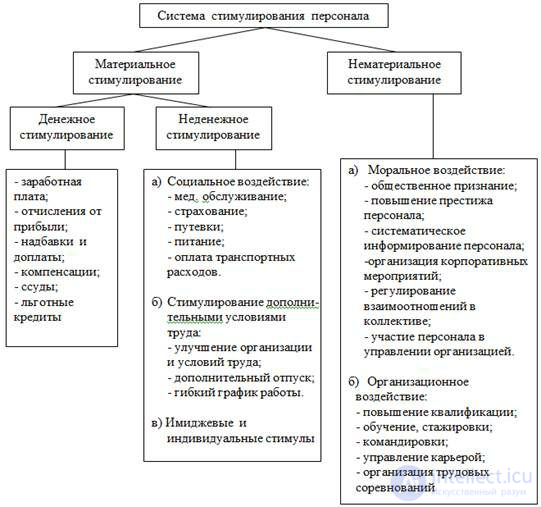
Non-material methods of work incentives play an important role in motivating employees and increasing their productivity. These methods are not linked to financial rewards and can be more effective in certain cases. Here are a few examples of non-material incentives:
Recognition and praise:
Public recognition of employees' achievements at meetings or in internal publications.
Presenting certificates, awards or thank-you letters for outstanding results.
Opportunities for professional growth:
Providing opportunities for training and developing professional skills.
Career growth plans and prospects for advancement.
Flexible schedule and working conditions:
The option to work from home or a flexible work schedule.
Creating a comfortable and stimulating office environment.
Participation in decision-making:
Involving employees in decision-making processes related to their work environment and projects.
Taking employees' opinions into account when shaping company strategy.
Interesting and meaningful tasks:
Providing tasks that generate interest and a sense of significance.
Delegating responsibility and providing opportunities for a creative approach to work.
Work-life balance:
Supporting a balance between professional and personal life, for example by providing days off and vacations.
Team events and corporate culture:
Organizing corporate events, parties and team-building activities.
Building a positive corporate culture.
Combining various non-material incentives according to employees' individual preferences and needs can make the work environment more stimulating and enjoyable.
A tariff-based wage system is a system of established pay rates that determine how much an employee will earn for performing certain tasks or work within a given time. The elements of a tariff-based wage system may vary depending on the organization and its needs, but usually include the following components:
Pay rates: Pay rates are the levels of pay assigned to different positions or categories of workers. These rates can be fixed or variable depending on factors such as work experience, qualifications and productivity.
Job classification: An element of the tariff system is the classification of positions or employees into different levels or categories. Each category may have its own pay rates.
Coefficients and allowances: In some cases, coefficients or allowances may be added to pay rates that take into account various factors, such as work experience, task complexity, night-shift work, or weekend work. This makes it possible to differentiate pay.
Premiums and bonuses: The tariff system may provide for premiums and bonuses for achieving certain goals or for good work. These incentive payments may be linked to productivity, work results or other indicators.
Indexation: An element of the system may be indexation of pay rates in line with inflation or increases in the cost of living. This helps preserve the real purchasing power of employees' wages.
Definition of working time: The tariff system may take working time into account, for example, providing for increased pay for overtime, night-shift work, or weekend work.
Agreements and collective bargaining agreements: An important element of the tariff system is agreements and collective bargaining agreements between the employer and trade unions, which can affect the level of pay and other terms of the employment relationship.
Control and administration: An effective system of administration and control over the application of the tariff system is important for ensuring fair and consistent pay.
The elements of a tariff-based wage system can be adapted to the specific needs and goals of an organization. The main purpose of the tariff system is to ensure fair and competitive pay, taking into account various factors, including employees' qualifications, experience and work productivity.
Pay can take different forms and systems, which are chosen by an organisation depending on its goals, budget and the specifics of the business.
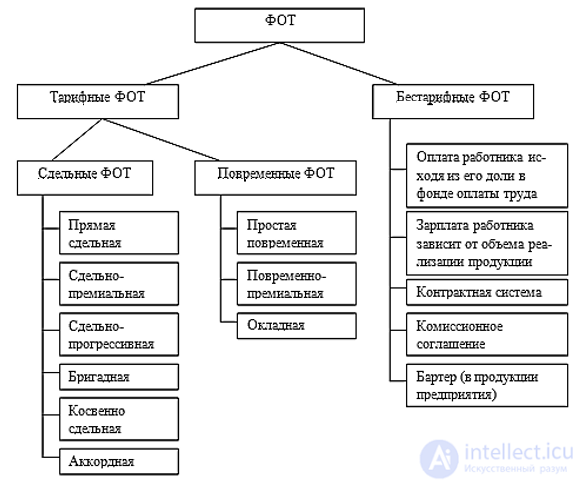
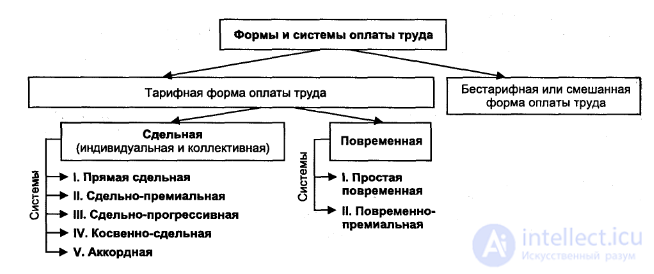
Fig. . Forms and systems of pay
Here are some of the most common forms and systems of pay:
Forms of pay:
Fixed salary: In this form of pay, an employee receives a fixed sum of money for a set period of time (for example, a month). This is the most typical form of pay for employees whose tasks and duties change little.
Hourly pay: The employee is paid for each hour worked. This form is often used for temporary or seasonal workers.
Payment for completing a task (project-based pay): The employee is paid for completing a specific task, project or piece of work. This is typical for freelancers and project-based workers.
Piece-rate pay: The employee is paid according to the amount of work they have completed. This may include payment based on the quantity of products, tasks or services completed.
Payment in kind (barter-based pay) is a system in which employees receive their wages not in money but in goods, services or other benefits. This form of pay may be used in certain situations - after disasters, military conflicts, political upheavals (the collapse or unification of states), in very small settlements, and in certain sectors such as agriculture or small business
pay recorded as tick marks on paper (labour-days), exchanged at the end of the season for home-produced goods, such as bread. Pay under martial law depends on the legislation and policy of the particular country. (Collective-farm members were not paid a wage as such; completed work was recorded in labour-days - a practice used in the USSR from 1930 to 1966, and in the people's communes in China from 1958-1960), and the self-proclaimed Luhansk People's Republic, for lack of funds, announced in 2015 that completed public works would be recorded in labour-days, to be later exchanged for food parcels

Systems of pay:
Tariff-based pay system: This is a system in which a fixed tariff rate is set for each position. It may include various levels and categories for different positions.
Performance-based pay system: In this system, pay depends on the employee's performance. It may include bonuses for achieving goals, incentive payments and other motivational payouts.
Mixed pay system: This system combines elements of fixed pay and performance-based pay. For example, an employee may receive a base salary plus additional bonuses for achieving targets.
Skills- and qualification-based pay: In this system, pay depends on the employee's level of skill and qualification. The higher the level of qualification, the higher the pay.
Commission-based pay system: The employee receives a percentage of the sales they have made or the profit they have brought to the company. This system is often used in sales.
Pay by working hours and shifts: In this system, the employee is paid for each hour or shift worked.
The choice of form and system of pay depends on the company's goals, the specifics of the business and the needs of the employees. It is important that the pay system be fair and motivate employees to achieve high results.
Piece-rate pay is a payment system in which an employee's wage depends on the amount of work, tasks, output or services performed. This means that the more an employee produces, the more they earn.
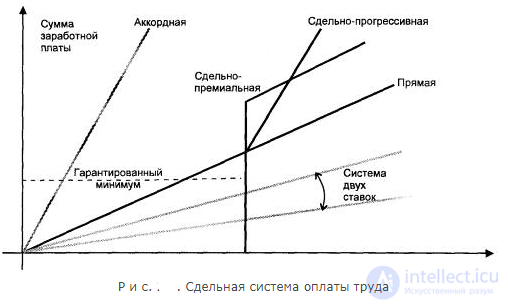
Here are some of the main characteristics of piece-rate pay:
Payment for specific results: Piece-rate pay is based on measurable results of labour, such as the quantity of output produced, tasks completed or hours worked on a project.
Individual calculation: Each employee's earnings are calculated individually, depending on their productivity and efficiency.
Incentive nature: Piece-rate pay can serve as an incentive for employees to increase their productivity and quality of work, since the more they produce, the more they earn.
Differentiation of pay: Different tasks or jobs may have different pay rates, which allows their complexity and qualification requirements to be taken into account.
Assessment and control: A piece-rate system requires more precise assessment and control of employees' productivity and work results.
Flexibility: Piece-rate pay can be flexible, since an employee can control their earnings by increasing or decreasing the volume of work performed.
Applicability: Piece-rate pay is often used in fields where production or task completion can be easily measured, such as manufacturing, construction, logistics and other areas.
Risks: Piece-rate pay can carry risks for employees, since their earnings may be inconsistent and dependent on external factors, such as demand for products or orders.
Lump-sum (task-based) pay is a wage system that involves determining total earnings for completing certain stages of work or producing a certain volume of output.
Piece-rate pay can be effective for motivating employees and stimulating productivity, but it also requires a good accounting and control system to ensure fairness and compliance with standards.
Time-based pay is a payment system in which an employee is paid a wage based on a set rate for a specific period of time, usually per hour, day, week or month.
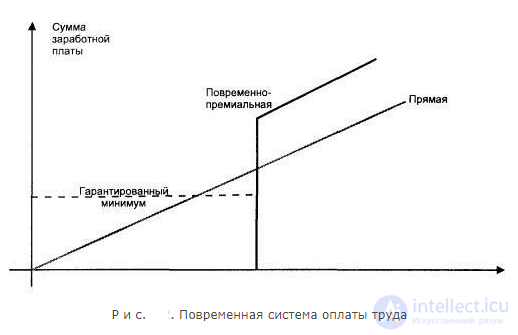
Here are some of the main characteristics of time-based pay:
Fixed rate: An employee receives a fixed rate for each unit of time worked (hour, day, week, etc.). For example, an hour of work may be paid at a fixed rate.
Consistency of wages: Unlike piece-rate pay, where earnings depend on productivity, time-based pay provides a stable and predictable income for employees.
Directness: Employees are paid directly for time worked, regardless of work results. This means that earnings do not depend on productivity or the amount of work performed.
Simplicity and convenience: Time-based pay is usually simpler to record and calculate than piece-rate pay, and can be convenient for companies where it is difficult to measure productivity.
Minimal risk for employees: Employees do not bear the risk of reduced earnings due to changes in productivity or demand for products.
Guaranteed minimum earnings: Employees are usually guaranteed to receive a minimum wage, regardless of the volume of work (provided they have worked the standard number of hours).
Suitable for different industries: Time-based pay can be applied in different industries, including education, healthcare, customer service, the public sector, and others where productivity is difficult to measure.
Possibility of overtime: Employees can receive additional pay for overtime work, which can encourage them to put in extra effort.
However, time-based pay may not always encourage employees to increase their productivity, since they receive a fixed wage regardless of how much work they do. It can also be less fair if employees perform different amounts of work but receive the same pay.
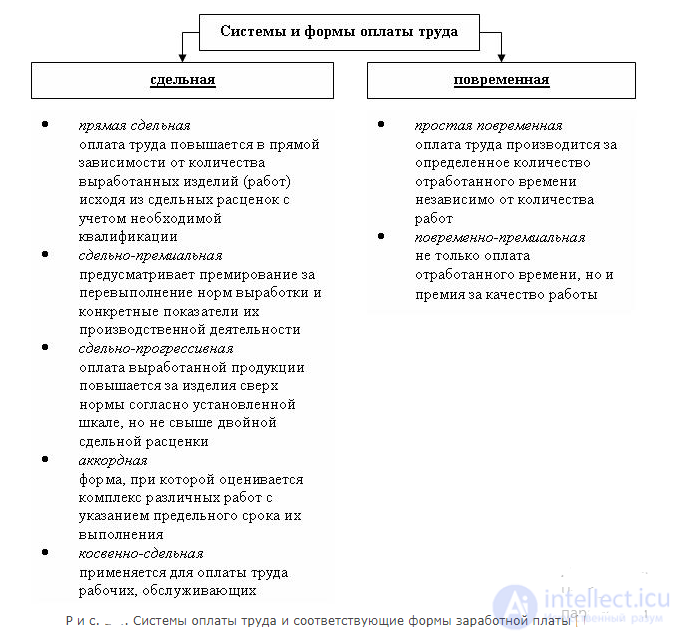
The choice between piece-rate and time-based pay depends on the specifics of the business, the industry, and the company's goals.
The choice of the form and system of remuneration can have a significant impact on employees' productivity and performance. An effective remuneration system can encourage employees toward higher productivity and motivate them to achieve better results. Here is how different forms and systems of pay can affect productivity:
Piece-rate pay:
Time-based pay:
Bonus and incentive systems:
Stock plans and profit sharing:
The choice of a specific remuneration system depends on the company's goals, its industry, culture, and the specific work situation. It is important to strike a balance between encouraging productivity and ensuring fairness and employee satisfaction. This may require adapting and changing the remuneration system over time so that it best matches the needs of the company and its personnel.
Bonus systems and allowance systems (compensatory and incentive) represent different methods of rewarding and motivating employees in an organisation. They are used to encourage and motivate employees toward achieving goals, high productivity, and outstanding results. Here is a more detailed description of each of these systems:
Bonus system:
Allowance system (compensatory and incentive):
Both systems, bonuses and allowances, can be effective tools for managing productivity and motivating personnel. However, their successful implementation requires clear goals, a precise definition of bonus or allowance criteria, and a system of accounting and control to ensure fairness and transparency in the process.
It is also important to remember that the reward system should match the company's strategic goals, organisational culture, and employee expectations.
A penalty system for employees is a method of managing and disciplining personnel by imposing financial sanctions or fines for violating the organisation's rules, policies, or procedures. It can be applied in various fields and industries and can have both positive and negative aspects. Here are some characteristics of a penalty system:
Characteristics of a penalty system:
Objectives: A penalty system can have various objectives, such as ensuring compliance with the organisation's rules and policies, preventing violations, improving discipline, and reducing negative impacts on work.
Penalties: Penalties may include a reduction in wages, deductions from bonuses, fines in the form of pay deductions, demotion, or dismissal, depending on the severity of the violation.
Transparency and fairness: It is important that the penalty system be transparent and fair, and that sanctions be proportional to the violation. Employees should understand the rules and the consequences of violations.
Review process: The organization should have established procedures for reviewing violations, including the possibility of appeal.
Motivational aspect: In some cases, a penalty system can be used as a motivational tool to encourage employees to comply with rules and policies.
Legal compliance: The penalty system must comply with the law and must not violate employees' rights.
Warning and training: Before imposing penalties, an organization may provide employees with warnings and training to help them avoid violations.
Positive aspects of a penalty system:
Negative aspects of a penalty system:
A penalty system should be considered in the context of a specific organization and its goals. Its application requires a balance between the need to ensure compliance with rules and respect for the rights and interests of employees.

Comments