
Lecture
1. the price that allows the entire volume of goods to be sold that manufacturers (sellers) are willing to offer for sale at that price
2. The minimum wage officially set by the state to eliminate poverty and ensure an acceptable standard of living for all employed persons in a given society
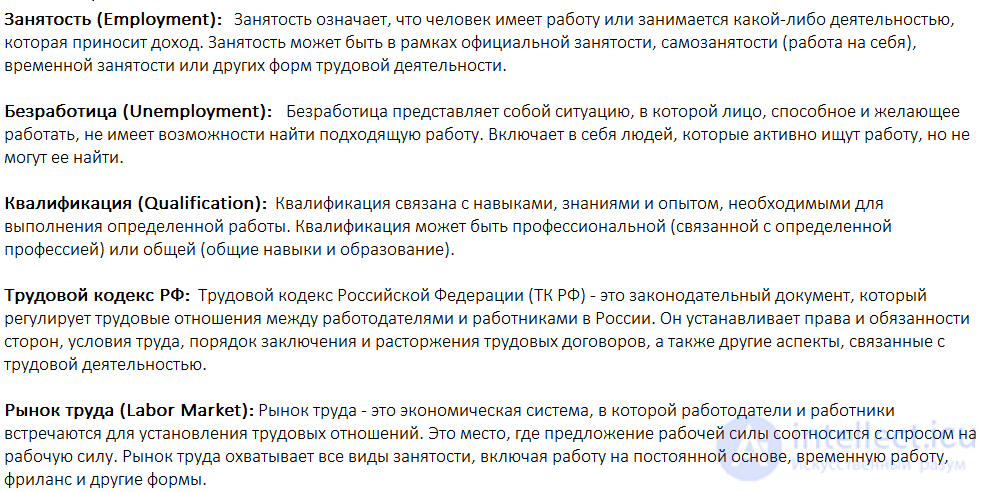
3. The activity of citizens related to satisfying personal and social needs, not contrary to legislation, and bringing in income
4. A socio-economic phenomenon expressed in the fact that part of the economically active population, wishing to work, cannot find a job
5. A form of the labour market that acts as an intermediary in the labour market
6. A type of market characterising a system of social and labour relations that allows firms to satisfy their need for labour services provided by people in exchange for wages and other benefits
7. The level of income needed to satisfy a person's basic living needs for clothing, footwear, transport services, sanitary and hygiene items, and medicines
8. A form of material remuneration of hired workers for their labour
1. Which is the odd one out among the main mechanisms of the labour market?
2. What is the expression of the price of labour?
3. Which is the odd one out among the state's employment policy measures?
4. Large city enterprises and organisations hold annual job fairs for young people and specialists of various qualifications. This is an example of the functioning of:
5. The development of the information society has led to increased demand for the services of programmers and computer analysts. This example reflects the situation in:
6. Which of the people listed below is not a participant in the labour market?
7. Who does not belong to the economically active population?
1. Which words are missing? The market supply in the labour market is in direct dependence on the rate of ________________.

2. Eliminate the odd one out. Below is a list of concepts, all of which, except one, relate to a single concept. Find and eliminate the term that does not fit this series. Name the general concept to which the remaining terms belong.
3. Which type of employment policy does professional retraining of personnel represent?
4. Which type of employment policy does material support for the unemployed represent?
5. Which type of employment policy does registration with an employment centre represent?
6. Which type of employment policy does labour-market information represent?
7. Which type of employment policy does employment in one's own field of specialisation represent?
8. Read the text below, in which a number of words have been omitted. Choose from the list provided the words that need to be inserted in place of the gaps.
«Unemployment is a socio-economic phenomenon that occurs when the _____________ (A) of labour services exceeds the ______________ (B) for it, and manifests itself in the fact that part of the able-bodied population is not employed in the production of goods and services. The nature of unemployment is significantly affected by the level of _______________ (C), the development of new territories, the emergence of new types of activity, and the intensification of foreign economic competition. __________________ (D) does not mean the absolute absence of unemployment. It corresponds to a _______________ (E) rate of unemployment, which is associated with the search for the most suitable jobs, training for new specialities, ________________ (F) changes in demand, and so on.»
The words in the list are given in the nominative case. Each word may be used only once. Choose the words one after another in sequence, mentally filling in each gap. Note that there are more words in the list than you will need to fill in the gaps.
List of terms:

Comments