
Lecture
Teaching methods:
Objectives:
Instructional: familiarize learners with the characteristics of occupations and specialties from the standpoint of employment guarantees.
Developmental: continue developing the ability to analyze, compare, contrast, identify the main point, establish cause-and-effect relationships, give examples, and improve the ability to work independently and in a group
Educational: form an emotionally engaged personal attitude toward innovative technologies and foster an active civic stance. Learners acquire the ability to listen, ask questions, and behave correctly using knowledge of business etiquette, and rules of conduct in society are developed.
Equipment:
Form of organizing learning activity in the lesson:
Motivation: the relevance of the lesson topic lies in shaping learners' knowledge of the features of occupations and specialties from the standpoint of employment guarantees.
Expected results:
Lesson plan
|
No. |
Structural elements of the lesson |
Teacher's activity |
Learners' activity |
|
1 |
Organizational moment (2 min.) |
Greeting |
Getting ready for the lesson |
|
2 |
Announcing the topic and objective of the lesson (3 min) |
On the board: the name of the lesson topic. |
Write it down in their notebooks |
|
3 |
Review of previously covered material (5 min.) |
Ongoing assessment in question-and-answer form. |
Answer questions |
|
4 |
Preparing learners for the active, conscious assimilation of new material and presenting new knowledge: characteristics of occupations and specialties from the standpoint of employment guarantees. (30 min) |
Objective: to determine the features, competitiveness and benefits of occupations and specialties from the standpoint of employment guarantees.
|
Receive information, ask questions and answer the teacher's questions. |
|
5 |
Reinforcing new knowledge (3 min.) |
Additions, clarifications and announcement of grades. |
Check the entries in their notebooks. |
|
6 |
Assigning homework and instructions on how to complete it (2 min) |
Emphasize the purpose of the homework. |
Notes. |
What requirements do employers place on job candidates in the labor market? As research has shown, today already “narrow” specialists are not in demand. Employers point to the need not only for specialized (occupation-specific) skills, but also for additional competencies (knowledge, abilities, skills), such as the ability to communicate (cooperate), and proficiency with computers and office equipment. Moreover, today's labour market increasingly demands workers who have mastered several professions and specialties, who are able to adapt to technological and organizational changes in production, and who are ready for continuous self-education throughout their entire professional career.
If we characterize all professions and specialties in terms of employment guarantees, we can identify the following types of professions for which the likelihood of employment is fairly high:
The competitiveness of a profession or specialty increases if it belongs to several of the listed types at once. For example, the profession of “street vendor”: free, since it can be pursued on a self-employed basis, scarce, since the goods market is not saturated, universal, since there are buyers everywhere, and eternal (buyers buy and will continue to buy). It is clear that there are fewer guarantees of finding work in professions that are rare, uncommon, or for which demand is satisfied or even declining.
To this end:
In recent years, it has become increasingly common to read in newspapers about lawsuits brought by disfigured clients against their dentists, cosmetologists and plastic surgeons; by relatives of deceased patients against their attending physicians; by consumers against manufacturers of substandard food products. Helicopters and airplanes crash, ships cannot pass each other safely in the open sea, soldiers and officers kill one another by mistake. The cause of most technological disasters is negligence and insufficient professionalism.
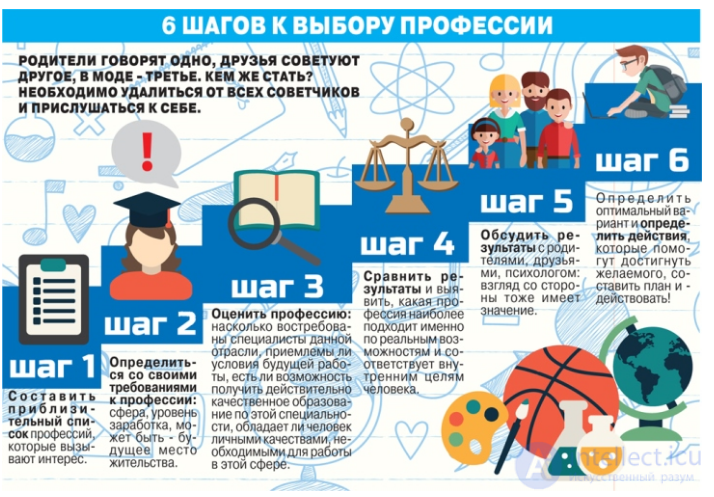
What is a mistake in choosing a profession, what causes it and what is its price? A mistake can be caused by a lack, shortage or distortion of information. Young schoolchildren want to be teachers, doctors, engineers, educators, police officers, salespeople, cosmonauts, border guards, welders, pilots.
In the upper grades, preferences change: the range of professions being considered narrows to 3—4 professions, about the content of which there is only a vague idea. Adults play no small role in distorting this choice, instilling in children biases against certain professions. Incidentally, these biases only began to form after the revolution. For centuries Russia was famous for its craftsmen. This underpinned a particular structure in our economy even in the early twentieth century, when our products competed successfully on the European market. In the entrepreneurial milieu there existed a special hierarchy. A manufacturer, that is, a producer of goods, was considered a first-rank entrepreneur, followed by the merchant (the seller of these goods, the intermediary). The lowest rung was occupied by bankers, who were contemptuously called moneylenders and usurers.
One of the most common mistakes in choosing a profession is choosing it out of considerations of «prestige». «Prestige» is a relative concept. A hundred years ago the profession of chauffeur was considered more prestigious than that of actor. As for fashion in professions, as K.S. Stanislavski used to say, fashion exists only for those who do not know how to dress themselves.
Young people, often yielding to herd instinct, not infrequently choose a profession “to keep a friend company”, without considering that no two people are alike, and that what is being chosen is a way of life for many years to come, not company for a picnic.
People who are susceptible to others' influence and lack views of their own follow other people's advice more often than they should. They are influenced by everything – TV series, the advice of random people, fashion.
Choosing a profession does not put an end to your other interests. Many famous people have noted the role of chance in choosing their life path. The outstanding ophthalmologist V.P. Filatov could have become a famous artist, but chose the profession of physician because it seemed to him more needed by people. Musicians and music lovers know A.P. Borodin as an outstanding musician, while scientists know him as a great chemist. «If I had a hundred lives, they would not satisfy the whole thirst for knowledge that burns within me,» wrote V.Ya. Bryusov, a scientist and poet.
A young Englishwoman named Margaret decided to become a chemist, graduated from Oxford University and even got a job at a plastics factory. But she soon realised she had made a mistake in her choice of profession, and drastically changed her life. Without becoming a great chemist, Margaret Thatcher became a great politician. I wanted to be a naval officer, and by the time I finished secondary school I had managed to read almost everything ever written about the naval officers of the Russian fleet.
It seemed that in enrolling at the naval academy in Vladivostok I was acting in exact accordance with my nature's calling. In reality, though, it was a compensatory urge to make up for character flaws that were characteristic of me: indecisiveness, a lack of confidence in dealings with others, and a tendency to submit to authority. When I was expelled from the third year for health reasons, then, despite a secret sense of relief at being freed from the burdens of military service, I experienced it as a personal tragedy. Now, however, I am certain that if this had not happened, if I had not fallen ill, our navy would have gained a poor officer.
If we think that we can solve all our problems with the help of a psychologist, we are sincerely mistaken. Everyone chooses their own profession and must make their own mistakes in order to understand them. No one is able to solve this problem in our place, neither psychologists nor parents.
But choosing the right profession is not everything. If a person does not develop, professional deformation may set in – a phenomenon noticeable only from the outside. A teacher whose need to teach and evaluate becomes second nature; a military officer who cannot shake off the commanding voice and the habit of making everyone fall in line, even at home; a doctor who perceives everyone as a potential patient and mentally diagnoses everyone – you can surely recall adults whose profession can be identified from their behaviour. Changing one's professional activity helps avoid professional deformation. Over the course of a lifetime, a person may change professions several times.
Sometimes a hobby turns into a profession, and a profession becomes a hobby. What price are you willing to pay for your choice? What will you pay with for it? Some professions are harmful to health. There are professions that are hard to combine with family life.
Pilots, cosmonauts, submariners, polar explorers, firefighters, and sappers work in conditions of high risk. «There is probably no profession today in which the sense of novelty is so inseparably intertwined with risk as in the profession of a cosmonaut», – writes test pilot Ye.V. Khrunov.
A member of the first expedition to the Moon, M. Collins, recounted: «In space, every crew member carried an inhuman burden – nervous, physical, moral. Space does not forgive even the slightest mistakes. And what you risk is the most important thing of all – your own life and the lives of your comrades… It is too great a strain, one that does not leave you even ten years later».
There are people for whom risk is a vital need. These people are drawn to danger and find joy and meaning in life in it. Many famous pilots, cosmonauts, and explorers speak of their childhood love of active games and extreme sports.
But that is not enough. The ability to make decisions in critical situations, well-developed intuition grounded in knowledge and skills, quick reactions, impeccable health, and excellent physical fitness – these are the basic requirements of extreme professions.
But it is not only your own life and health that you risk. Teachers, judges, and doctors have their own kind of dangerous profession. When choosing a profession, it is important to be aware of the degree of risk and responsibility involved.
The right choice of profession is a choice made with your real abilities and limitations in mind.

Comments