
Lecture
Lesson type: Lesson on forming new knowledge.
Teaching methods:
Objectives:
Instructional: to familiarize students with the rules, norms, and specifics of preparing for and conducting job interviews, as well as with the rules of professional etiquette.
Developmental: to continue developing the ability to analyse, compare, contrast, identify the main points, establish cause-and-effect relationships, and give examples, and to improve the ability to work independently.
Educational: to foster an active outlook on life. Students acquire the ability to listen, ask questions, and behave correctly using knowledge of business etiquette, and rules of conduct in society are developed.
Equipment:
Form of organizing learning activity in the lesson:
Motivation: the relevance of the lesson topic lies in expanding students' knowledge of the rules and specifics of job interviews and professional etiquette.
Expected results:
Lesson progression
|
No. |
Structural elements of the lesson |
Teacher's activity |
Students' activity |
|
1 |
Organizational moment (2 min.) |
Greeting |
Get ready for the lesson |
|
2 |
Announcement of the topic and objective of the lesson (3 min) |
On the whiteboard: the name of the lesson topic. |
Write it down in their notebooks |
|
3 |
Review of material covered previously (5 min.) |
Ongoing assessment in question-and-answer form. |
Answer the questions |
|
4 |
Preparing students for the active, conscious mastery of new material and presentation of new knowledge: a) rules for preparing for and conducting job interviews from the candidate's perspective. b) rules of professional etiquette and analysis of typical mistakes made during a job interview (30 min) |
Objective: to apply the rules of professional etiquette during a job interview |
Analysis of typical mistakes made during a job interview |
|
5 |
Reinforcement of new knowledge (3 min.) |
Additions, clarifications, and announcement of grades. |
Check the notes in their notebooks. |
|
6 |
Assignment of homework and instructions for completing it (2 min) |
Emphasize the purpose of the homework assignment. |
Notes. |
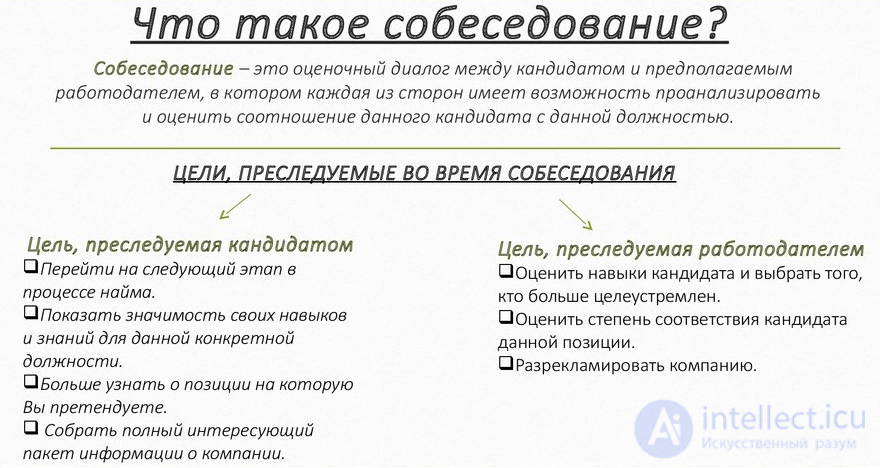
A job interview — is an important stage in the job search process, and preparing for it plays a decisive role in your success. Here are some basic rules for preparing for and conducting an interview from the candidate's point of view:
Research the company:
Prepare for questions:
Documents and résumé:
Research the position:
Clothing and appearance:
Prepare for technical assignments:
Prepare questions:
Learn to communicate:
Practice interviewing:
Be ready to "sell" yourself:
Punctuality:
Show professionalism:
Prepare for salary questions:
Follow post-interview etiquette:
Manage stress:
By following these rules, you will be able to increase your chances of successfully passing the interview and getting the job you want.
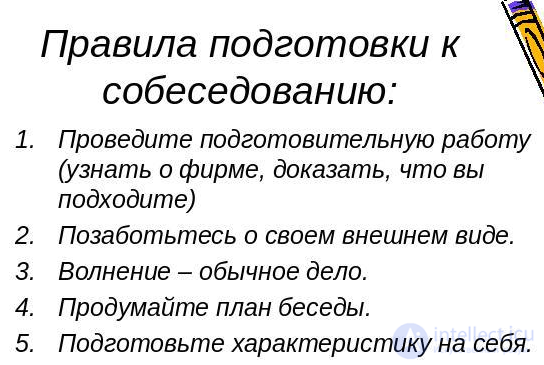
Professional etiquette is an important aspect of a successful interview. It covers standards of behaviour and communication that help create a positive impression on the employer. Here are some rules of professional etiquette and an analysis of typical mistakes made in interviews:
Rules of professional etiquette:
Politeness and respect:
Appropriate attire:
Punctuality:
Listen carefully:
Eye contact:
Knowledge of the company:
Positive communication:
Answering questions:
Questions from the candidate:
Common mistakes in interviews:
Poor planning:
Unclear answers:
Insufficient research on the company:
Lack of professional behaviour:
Not asking questions:
Lack of preparation for standard questions:
Poor control over nerves:
Overstating salary expectations:
Not preparing for technical assignments:
Remember that a job interview is a mutual process, and your goal is not only to convince the employer that you are right for the position, but also to determine whether the company is right for you. So be professional, but also be yourself and look for good rapport with your future colleagues and management.
Conducting interviews online and offline has its own features and advantages. Here are some of them:
Features of conducting an online interview:
Geographic flexibility: The interview can be conducted with participants from different geographic regions without the need for physical presence. This is especially convenient when hiring remote employees.
Time and resource savings: Interview participants do not spend time on travel and physical relocation, which saves time and resources for both candidates and employers.
Technical challenges: Online interviews may run into technical problems, such as issues with the internet connection or equipment failures, which can create uncomfortable situations.
Visual limitations: Online interviews can create limitations in conveying non-verbal signals and visual impressions, which can complicate interaction and the assessment of candidates.
Observance of etiquette: It is also necessary to take virtual professional etiquette into account during online interviews, such as noise level, camera and microphone quality, and neatness of appearance.
Features of conducting an offline (in-person) interview:
Interpersonal interaction: An in-person interview allows non-verbal signals, including gestures, facial expressions and tone of voice, to be assessed more fully, which fosters deeper mutual understanding between the parties.
Trust and comfort: An in-person interview can create a more trusting atmosphere, which can foster open discussion and more detailed information.
Travel difficulties: In-person interviews can cause travel-related problems for participants and be more costly in terms of time and resources.
Observance of safety protocols: Offline interviews require observance of safety protocols, especially in pandemic conditions, which can create additional challenges.
Organisational costs: Conducting in-person interviews is also associated with costs for renting premises and other resources.
Depending on a company's goals, resources and context, interviews can be conducted either in online or offline format. Some companies may prefer a combined approach, including both online and offline interviews, in order to adapt to different situations and needs.

Comments