
Lecture
Work organization and working conditions are important aspects that affect workers' productivity and well-being, as well as the effectiveness of an organization's operations. These aspects can include the following elements:
Workplace: Employees must have access to safe, comfortable, and functional workplaces. This includes comfortable desks and chairs, proper ergonomics, good lighting, and ventilation.
Working hours: Working hours and schedules must be reasonable and comply with labour law standards. It is important to ensure compliance with mandatory break and day-off requirements.
Pay: Salary and compensation must be fair and correspond to the employee's qualifications and experience. Timely payment of wages must also be ensured.
Safety and health: Organizations must provide safe working conditions and comply with occupational safety standards. This includes training employees in safety rules, providing personal protective equipment, and conducting regular safety inspections.
Development and training: Employers must provide opportunities for employees' professional development and training. This may include training programmes, workshops, and the opportunity for further qualification.
Teamwork and social support: Creating a positive work environment and encouraging cooperation between employees contributes to more effective work and improves team morale.
Flexible forms of work: To meet employees' varying needs, flexible forms of work can be used, such as remote work, flexible schedules, and others.
Legal compliance: Organizations are required to comply with labour and employment legislation, including standards on wages, working hours, discrimination, and other aspects.
Feedback and evaluation: Employees must have the opportunity to provide feedback and receive an evaluation of their work. This helps improve the quality of work and employee satisfaction.
Work-life balance: It is important to ensure a balance between employees' working hours and personal life in order to support their physical and psychological well-being.
Work organization and working conditions play an important role in employee satisfaction and effectiveness, as well as in the overall success of the organization. Employers and employees must cooperate to create and maintain a healthy and productive work environment.
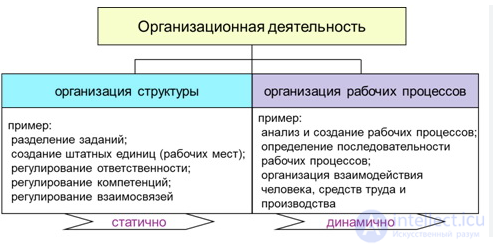
Labour standardization is the process of determining norms and standards that regulate the quantity and quality of the work operations needed to perform a specific job. This process includes determining productivity standards, task completion times, quality requirements, and other parameters related to a specific job. Labour standardization has a number of important goals and is applied in various industries and fields of activity. Here are several key aspects of labour standardization:
Optimizing productivity: Labour standardization makes it possible to determine the optimal quantity and speed of work operations, which contributes to increasing labour productivity and efficiency.
Standardizing quality: Standardization also includes establishing quality standards for products or services, which helps ensure consistent quality and compliance with standards.
Estimating labour costs and budgeting: Labour standardization makes it possible to estimate the labour costs of performing certain work, which can be used for budgeting and planning.
Determining wages: Labour standardization can serve as the basis for calculating employees' wages, especially in cases where pay depends on the work performed.
Control and management: Labour standardization makes it possible to more effectively monitor task performance and manage the work process.
Improving working conditions: By analyzing and standardizing labour, it is possible to identify and eliminate deficiencies and hazards in working conditions, which helps improve workers' safety and comfort.
Standardizing processes: Labour standardization promotes the standardization of work processes, which can be useful for training new employees and ensuring uniform methods of work.
The process of labour standardization is usually carried out by labour evaluation specialists or industrial engineers, who analyze specific tasks and develop standards and norms based on data and observations. Labour standardization is an important tool for optimizing business processes and improving working conditions, which contributes to increased productivity and quality of work.
The object of labour standardization is the activity of an employee in performing a production operation that is part of the production process.
The object of labour standardization is human activity in carrying out a production process, which represents the process of converting raw materials, materials, and semi-finished products into finished goods.
At present, the main objects of labour standardization are:
Objects of standardization can also include: workers' energy expenditure, the speed of work movements, rest time during a work shift, and other indicators characterizing the psychophysiological aspects of labour.
The object of labour standardization is a specific job, task, or operation that requires certain expenditures of time, effort, and resources to perform. The object of labour standardization can be any activity that is subject to analysis and the establishment of standards. Examples of objects of labour standardization include:
Production operations: Labor standardization in production can be applied to specific operations, such as assembly, materials processing, packaging and other product-handling operations.
Services: In the services sector, labor standardization can be applied to various tasks, such as cleaning premises, serving customers in restaurants, or performing medical procedures.
Administrative processes: Office operations, such as document processing, project management, bookkeeping and other administrative tasks, can also be subject to labor standardization.
Educational activity: In education, labor standardization can be applied to conducting lessons, preparing teaching materials and grading student work.
Medical practice: The tasks of medical personnel, such as performing operations, patient care and administrative duties, can also be subject to standardization.
Projects and research: In scientific and research organizations, labor standardization can be applied to carrying out specific research projects or analyzing data.
Transport and logistics: In transport and logistics, labor standardization can cover unloading and loading cargo, cargo transport and much more.
Every object of labor standardization requires detailed analysis, data collection and the development of appropriate norms and standards. These norms are used to optimize work processes, control the quality of work and assess employee productivity.
Labor input standards are standards that determine how much time and effort is required to perform specific work tasks or operations. There are several types of labor input standards that can be applied in various fields and industries:
Service norm (Sn) —is the number of production facilities (units of equipment, workstations, etc.) that a worker or group of workers of the appropriate qualification must service per unit of working time under specific organizational and technical conditions. Such norms are used for standardizing the labor of core multi-machine operators as well as support workers.
Physical effort norms: These norms take into account the physical effort required to perform the work. They may include parameters such as lifting and moving materials or tools.
Material cost norms: Material cost norms determine how many materials or resources are required to perform the work. This could be, for example, the amount of raw material needed to produce a given quantity of output.
Energy consumption norms: Energy consumption norms take into account the energy consumed in performing a task. This is important in industries where energy efficiency plays an important role.
Wage norms: Wage norms determine how much money should be paid to an employee for performing a certain job. These norms can be used to calculate employees' wages.
Productivity norms: These norms determine how much product or service should be produced over a given period of time. For example, a productivity norm may specify that 1,000 cars must be produced per week at an automobile plant.
Quality norms: Quality norms set standards for the quality of the work performed or the products manufactured. They may include requirements regarding deviations, defects, and other quality aspects.
Maintenance and repair cost norms: In some cases, labour cost norms may include the expenses and time spent on the maintenance and repair of equipment and machinery.
Training cost norms: In the field of education and training, labour cost norms may be established for the training of employees and students.
Administrative process cost norms: In office environments, norms may include the time and resources spent on administrative tasks such as document processing and project management.
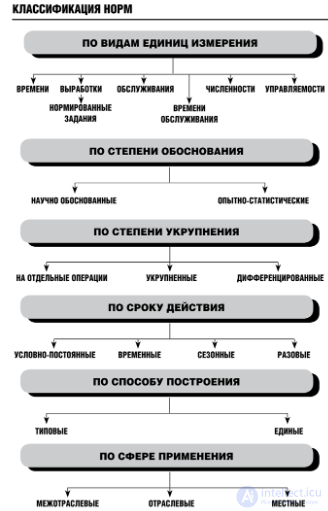
Fig. classification of norms
Depending on the specific industry and task, various types of labour cost norms can be used to optimise production and management processes, as well as to monitor and evaluate employee productivity.
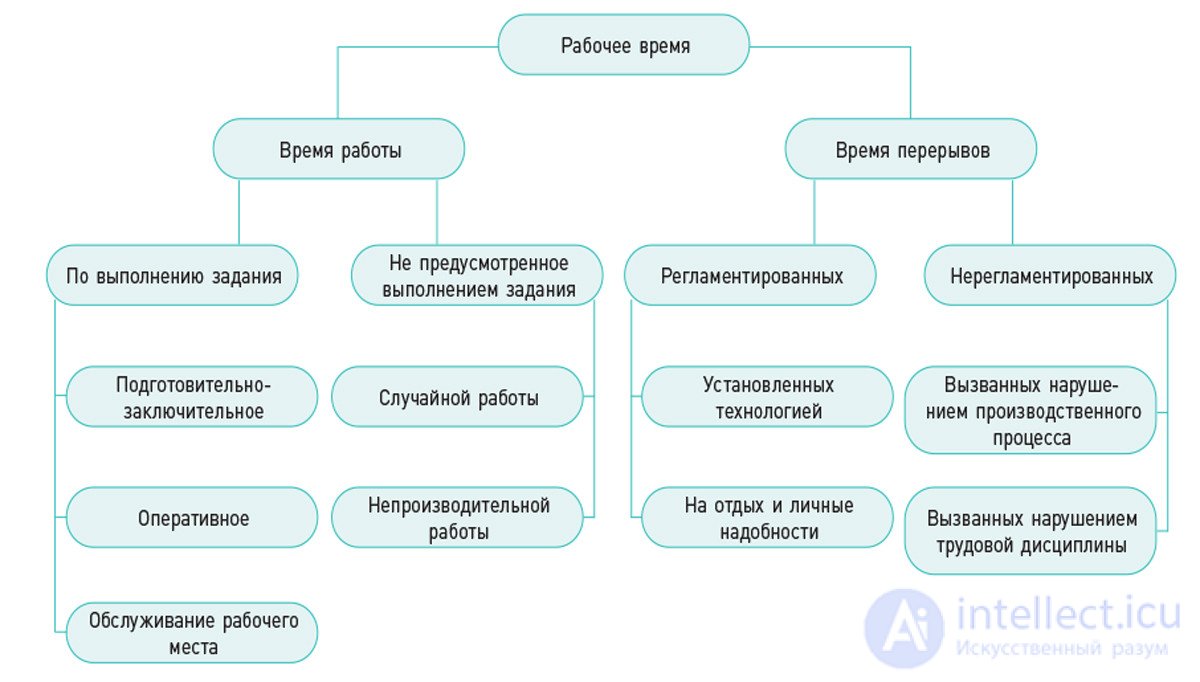
Labour rationing is the process of establishing standards that determine the amount of time, effort, and resources required to perform a specific job or task. There are several methods of labour rationing that can be applied in various fields and industries. The main methods of labour rationing are listed below:
Time-and-motion study method: This method is based on a detailed analysis of work movements and the time spent on each movement. The results of the analysis are used to determine the time standard for completing a task.
Expert evaluation method: This method involves specialists or experts who assess the amount of time and effort needed to perform the work. Expert opinion is used to establish the standards.
Worker-load method: In this standardisation method, the physical and psychological load on the worker during task performance is assessed. Standards are set based on the permissible load.
Norm-formation method: When using this method, exemplary standards are determined for certain types of work, and they are applied as benchmarks for other tasks.
Comparison method: This method compares an employee's performance with the results of other workers who are considered "average" or "good". Standards are determined based on these comparisons.
Equipment-data-based standardisation method: In production environments, this method uses information about the performance and characteristics of equipment to set standards.
Time-standard method: This method is based on analysing the time spent completing certain tasks under optimal conditions.
Motion-and-time accounting method: This method involves recording movements and the time spent on each movement, and is applied in manufacturing and assembly.
Standard-operations method: In this method, the standard operations required to perform a task are identified, and a time standard is set for completing each operation.
Functional-structure method: This method divides the work into functional elements and sets a standard for each element separately.
The choice of a labour-standardisation method depends on the nature of the work, the available data, and the goals of the organisation. Combined methods can also be used to achieve more accurate labour-standardisation results.
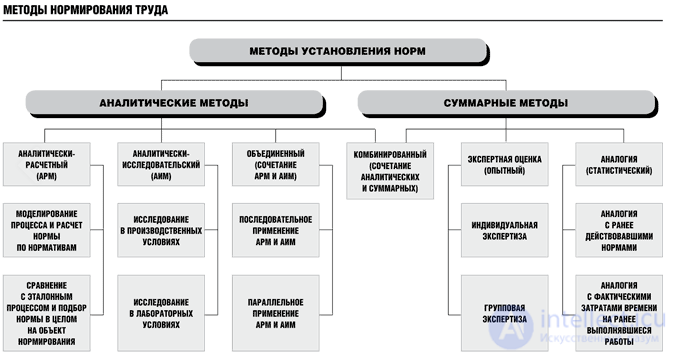
Fig. Methods for establishing standards
Labour productivity— this is an indicator characterising the effectiveness of labour.
Labour productivity is measured by the quantity of output produced by a worker per unit of time. Its reciprocal — labour intensity — is measured by the amount of time spent per unit of output.
Labour productivity — is an indicator that measures the quantity of goods or services produced or provided by workers per unit of time. This indicator plays an important role in the economy and business, as it can be a key factor in determining production efficiency and a company's competitiveness. Here are a few key aspects related to labour productivity:
Factors affecting labour productivity: Labour productivity depends on many factors, including the qualifications of workers, access to modern technology and equipment, methods of labour management and organisation, employee motivation, the work environment, and others.
Measuring labour productivity: Labour productivity can be measured in various ways, including the amount of output (goods or services) per employee per unit of time, the total value of goods or services produced, revenue or profit per employee, and so on.
Increasing productivity: Raising labour productivity is one of the goals of many companies. This can be achieved through process automation, staff training and development, business process optimisation, and the use of effective management methods.
Significance for the economy: Labour productivity is of great importance for economic growth. High productivity can contribute to increasing incomes and the standard of living of society, as well as to strengthening a country's competitiveness in the world market.
Effect on wages: Labour productivity can also affect the level of employees' wages. Companies where productivity is high usually pay higher salaries or bonuses.
Sustainability and environmental friendliness: It is also important to ensure the sustainability of production and to take environmental aspects into account in order to preserve natural resources and minimise negative impact on the environment.
Usually, labour productivity in economic statistics refers to actual labour productivity, however in economic cybernetics, in particular in Stafford Beer's viable system model, the concepts of available and potential labour productivity are introduced. The most important indicators of the use of working capital at an enterprise are the working capital turnover schedule and the duration of a single turnover. Accelerating the turnover of working capital leads to the release of the enterprise's working capital from circulation. Conversely, a slowdown in turnover leads to an increase in the enterprise's need for working capital. Acceleration of working capital turnover can be achieved through the use of the following factors: a faster growth rate of sales volumes compared to the growth rate of working capital; improvement of the supply and sales system; reduction of the material and energy intensity of products; improvement of product quality and its competitiveness; reduction of the length of the production cycle, and others. Growth in labour productivity refers to savings in labour costs (working time) for manufacturing a unit of output, or an additional quantity of output produced per unit of time, which directly affects the increase in production efficiency, since in one case current production costs per unit of output are reduced under the line item «Wages of core production workers», and in the other — more output is produced per unit of time.
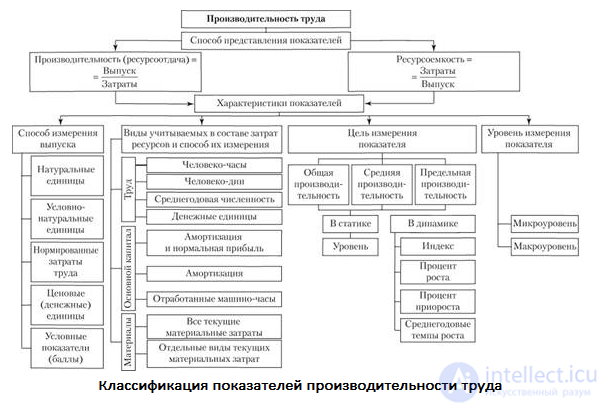
Classification of labour productivity indicators
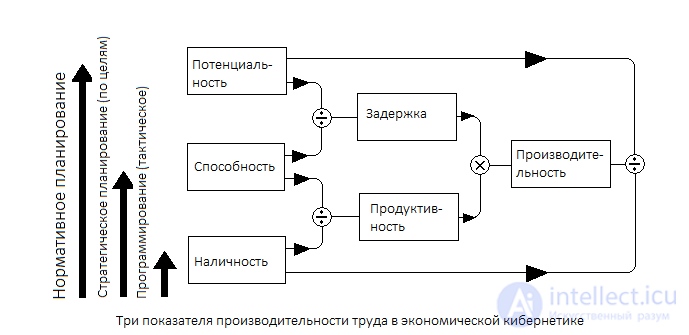
Three indicators of labour productivity in economic cybernetics
Actual labour productivity (output) is inversely proportional to labour intensity and is determined from directly observed data using the formula:
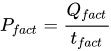
where  — is the actual output of production in units of measurement for this type of product,
  — is the actual expenditure of live labour in units of time.
Available labour productivity — is a calculated value that shows how much output can be produced under current conditions (for example, on existing equipment using available materials) if all downtime and delays are reduced to zero. Available labour productivity is determined by the formula:
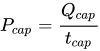
where  — is the maximum output achievable under current conditions in units of measurement for this type of product (available output),
  — is the minimum required expenditure of live labour under current conditions, in units of time (available labour intensity).
Potential labour productivity — is a calculated value that shows how much output can be produced that is theoretically achievable given the natural conditions at the current level of development of civilisation (for example, using the best materials available on the market, applying advanced technologies, and installing the most modern equipment available on the market) if all downtime and delays are reduced to zero. Potential labour productivity is determined by the formula:

where  — is the maximum output achievable given the natural conditions at the current level of development of civilisation, in units of measurement for this type of product (potential output),
  — is the minimum required expenditure of live labour given the natural conditions at the current level of development of civilisation, in units of time (potential labour intensity).
Labour productivity is a mobile and dynamic indicator of labour performance and production efficiency, which is affected by a number of factors. Reserves for growth in labour productivity include technical progress: the use of new equipment, improvement of machinery, introduction of comprehensive automation, engineering utilities needed to carry out processes, as well as advanced technologies and scientific developments that contribute to increased labour productivity, and the modernisation of existing equipment. The organisation of the production process has a significant effect. It makes it possible to find better production management, rational methods for performing operations, and to identify other important factors. Scientific organisation of labour covers significant potential reserves for improving labour efficiency with minimal additional material costs. The maximum use of existing capacity, diversification of production, and reduction of losses in working time also have a significant effect. The increase in labour productivity also depends on socio-economic indicators related to the qualifications, education, knowledge, and skills of the workers, the level of property relations at the enterprise, working conditions, the use of optimal work-and-rest schedules, the psychological climate in the team, its cohesion and internal relationships, improvement of working conditions, and increased creative activity of employees. Another incentive for increasing labour productivity is the improvement of forms and systems of wage payment, workforce reproduction, and the resolution of society's social problems. An increase in labour productivity creates the conditions for wage growth, and conversely, an increase in wages stimulates labour productivity.
It should be noted that labour productivity can vary depending on the industry, region, and other factors. It remains a key element of successful operation, both for individual enterprises and for the economy as a whole.
Occupational safety is a management field aimed at ensuring safe and healthy working conditions for employees in the workplace. It includes various measures and practices that prevent workplace injuries, occupational illnesses, and other risks associated with performing job duties. Occupational safety plays an important role in preserving the physical and psychological health of workers, as well as in increasing productivity and reducing treatment and compensation costs.
Important aspects of occupational safety include:
Risk assessment: Employers must conduct risk assessments to identify potential hazards in the workplace. This includes identifying factors that could pose a threat to the health and safety of employees.
Developing policies and procedures: Every organisation must develop an occupational-safety policy and corresponding procedures that describe how employees should act in the event of accidents and emergencies.
Training and education: Employees must be trained in proper safety methods and procedures, and must receive updated knowledge about new risks and precautions.
Providing personal protective equipment: Employers are required to provide their employees with the necessary equipment and personal protective equipment, such as safety glasses, ear protection, helmets, and so on.
Monitoring and control: Regular monitoring and control must be carried out to ensure compliance with safety rules and the proper working condition of equipment.
Medical monitoring: In some cases, medical monitoring may be required for certain categories of workers, especially in fields where there may be an impact on health.
Informing and communication: It is important to establish an effective system for informing about and communicating safety rules and workplace incidents.
Emergency planning: Employers must develop action plans for emergencies, such as fires, accidents, or medical emergencies.
Compliance with legislation: Employers are required to comply with local and national legislation on occupational safety and to ensure that their operations meet applicable norms and requirements.
Ensuring occupational safety is a social and legal obligation, and it is important for both employers and employees. Compliance with occupational-safety standards helps prevent workplace injuries and illnesses, reduces risks, and improves the overall quality of the work environment.

Fig. Occupational safety through a child's eyes
Occupational safety is regulated by a number of normative and standard documents that establish standards and rules for ensuring safe and healthy working conditions. Different countries may have different norms and standards, but the general principles of occupational safety include the following:
Labour laws: Labour legislation contains norms and rules that are mandatory for all employers and workers in a given country or region. These laws regulate such aspects as working hours, pay, leave and, of course, occupational safety. Examples of such laws include OSHA (the Occupational Safety and Health Act) in the USA and the Labour Code in Russia.
Occupational safety standards: Many countries have national and international standards that set requirements for safety and health in the workplace. For example, on the international scale there is the ISO 45001 standard, which concerns occupational health and safety management systems.
Norms and recommendations: Different industries may have their own norms and recommendations for occupational safety, developed by specialised organisations and associations. For example, in the construction industry there are numerous norms and standards governing the safety and health of workers.
Production standards: Specific companies may develop their own standards and procedures for occupational safety that correspond to their particular conditions and requirements.
Instructions and guidelines: Employers are required to provide workers with instructions and guidelines on safety and health in the workplace. These documents usually contain information about specific risks and precautionary measures.
Audits and inspections: Audits and inspections may be carried out in workplaces to ensure compliance with occupational safety regulations.
The general purpose of all these regulations and standards is to ensure safe and healthy working conditions for workers, prevent occupational injuries and illnesses, and reduce risks and losses in production. They represent important tools for employers and workers to observe and promote occupational safety in the workplace.
Organising the workplace is an important part of ensuring occupational safety and improving work efficiency. Here are some basic principles to consider when organising a workplace:

Compliance with these provisions helps create a safe and productive working environment that promotes the good physical and psychological well-being of employees.

Comments