
Lecture
Objectives: Instructional: to introduce students to the features of professional self-determination and identify the factors that influence it.
Developmental: to continue developing the ability to analyse, correlate, and compare information, identify the main point, establish cause-and-effect relationships, and give examples, and to improve the ability to work in a team.
Educational: to form an emotional and personal attitude toward innovative technologies and to foster an active life stance. Students acquire the ability to listen, ask questions, and behave properly by applying knowledge of business etiquette, and rules of conduct in society are developed.
Equipment:
Form of organising learning activity in the lesson:
Motivation: the relevance of the lesson topic lies in broadening students' knowledge for an adequate understanding of the concept of self-determination (professional self-determination) and its significance for subsequent effective employment.
Expected results:
Course of the lesson
|
No. |
Structural elements of the lesson |
Teacher's activity |
Students' activity |
|
1 |
Organisational moment (2 min.) |
greeting |
Prepare for the lesson |
|
2 |
Announcing the topic and objective of the lesson (3 min) |
On the whiteboard: the name of the lesson topic. |
Write it down in their notebooks |
|
3 |
Review of material covered (5 min.) |
Ongoing assessment in question-and-answer form. |
Answer the questions |
|
4 |
Preparing students for the active, conscious acquisition of new material and presenting the new material: a) features of professional self-determination, testing b) factors influencing professional self-determination (30 min) |
Objective: to identify the ways and methods of professional self-determination, as well as the rules and guidance for the correct technology of making a choice. |
Write down the new material, ask questions and answer the teacher's questions. |
|
5 |
Reinforcing new knowledge (3 min.) |
Additions, clarifications, and announcement of grades. |
Check the notes in their notebooks. |
|
6 |
Assigning homework and instructions for completing it (2 min) |
Emphasise the purpose of the homework. |
Notes. |
The features of professional self-determination and testing may be as follows:
Individuality: Professional self-determination depends on a person's individual characteristics and preferences. Every person has unique interests, skills, values and life experience that influence their choice of profession.
Exploring interests: Professional self-determination often begins with studying one's own interests and passions. Testing can help identify the fields a person is most interested in.
Assessing skills: It is important to take your skills and abilities into account when choosing a profession. Testing can help reveal strengths and weaknesses, which helps make a more informed choice.
Matching values: Choosing a profession that matches personal values can contribute to satisfaction and a successful long-term career. Testing can help determine which values matter most to a person.
Personality testing: Some personality tests, such as the MBTI (Myers-Briggs Type Indicator) or the Big Five, can help identify personality traits that may be important when choosing a profession. For example, extroverts may prefer professions involving communication, while introverts may prefer more independent and quiet work.
Skills tests and career guidance: There are many tests and assessment tools designed to assist with career guidance. They may include questions about work preferences, social skills, creative potential and other aspects that influence the choice of profession.
Consultation and feedback: After completing the testing, it is important to discuss the results with a professional counsellor or psychologist to gain a deeper understanding of one's capabilities and limitations in choosing a profession.
Testing is one of the tools that can help in the process of professional self-determination, but it is important to keep in mind that this is only part of a broader career decision-making process. It is also important to take into account the variability of interests and goals over the course of life, and readiness for self-development and learning in the chosen field.
The theoretical basis of the professional self-determination questionnaire is the theory of vocational choice developed by the American professor J. Holland. Its essence is that success in professional activity depends on the match between personality type and the type of professional environment. A person's behaviour is determined not only by their personal characteristics but also by the environment in which they exercise their activity. People strive to find a professional environment suited to their type, one that would allow them to fully realise their abilities and express their value orientations. According to Holland, there are six such types: realistic or practical; intellectual; social; conventional or standard; enterprising; artistic. The questionnaire makes it possible to match inclinations, abilities and intelligence with various professions.
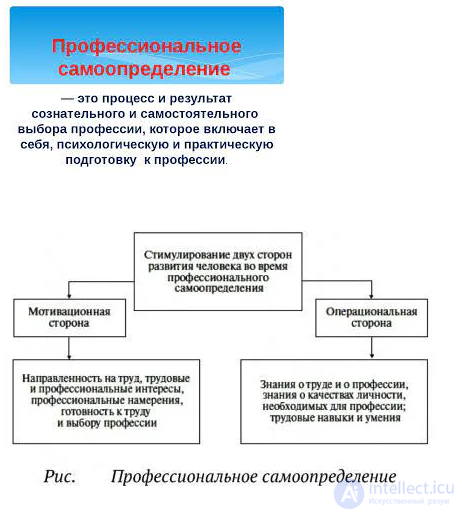
The diversity and complexity of the self-determination process leads to the distinction of various types of self-determination. Generally, three types are distinguished: life, professional and personal. Life self-determination is expressed in the choice and realisation of social roles, lifestyle and way of life, while personal self-determination is expressed in finding one's individuality and asserting it among others. Professional self-determination is the independent, conscious and voluntary construction, adjustment and realisation of professional prospects.
Professional self-determination is a complex and multifaceted process that is influenced by a wide range of factors. Here are some of the main factors that can influence the process of professional self-determination:
Individual characteristics: This includes personal interests, passions, values, hobbies, talents and abilities. People often choose professions that match their unique personality traits.
Family influence: The family can have a significant influence on career choice. Parents and relatives may exert pressure or, conversely, support certain career directions.
Education and experience: The level of education and experience in a particular field can limit or expand a person's career options.
Economic factors: Financial circumstances can influence career choice. People may choose work that provides sufficient income to meet their needs.
Sociocultural environment: Cultural and social norms, stereotypes and expectations can also affect career choice. For example, some societies may hold certain expectations about which professions are considered prestigious or acceptable for particular groups of people.
Information resources: Access to information about various professions and the labour market can significantly influence professional self-determination. The more informed a person is, the more conscious their choice will be.
Environmental factors: Geographic location and access to work resources can also influence career choice. For example, some professions may be more accessible in certain regions.
Technological change: The development of technology can create new opportunities for career growth in some fields while simultaneously making other professions less in demand.
Personal circumstances: Marital status, health, life circumstances and other factors can influence career choice and career path.
Social ties and networks: Professional contacts and networks can open access to certain opportunities and influence career choice.
For each person, these factors may carry different weight and vary depending on personal circumstances. The combination of these factors forms a unique path of professional self-determination for each individual.

Comments