
Lecture
Teaching methods:
Objectives:
Instructional: to familiarise learners with a methodology designed for selection among various types of professions in accordance with E.A. Klimov's classification of profession types, used in career guidance for adolescents and adults.
Developmental: to continue developing the ability to analyse, compare, contrast, identify the main point, establish cause-and-effect relationships, give examples, and improve the ability to work independently.
Educational (character-building): to form an emotionally engaged personal attitude toward innovative technologies and to foster an active life stance. Learners acquire the ability to listen, ask questions, and behave correctly using knowledge of business etiquette, and rules of conduct in society are developed.
Equipment:
Form of organisation of learning activity in the lesson:
Motivation: the relevance of the lesson topic lies in expanding learners' knowledge of methodologies designed for selection among various types of professions in accordance with a classification of profession types, in particular that of E.A. Klimov, which can be used in career guidance for adolescents.
Expected outcomes:
Course of the lesson
|
No. |
Structural elements of the lesson |
Teacher's activity |
Learners' activity |
|
1 |
Organisational moment (2 min.) |
Greeting |
Prepare for the lesson |
|
2 |
Statement of the lesson's topic and objective (3 min) |
On the board: the title of the lesson topic. |
Write it down in their notebooks |
|
3 |
Review of previously covered material (5 min.) |
Ongoing check in question-and-answer form. |
Answer the questions |
|
4 |
Preparing learners for active, conscious mastery of new material and presenting the new material: a) features of the career-guidance methodology b) testing using E.A. Klimov's differential diagnostic questionnaire (DDQ) (30 min) |
Objective: to apply E.A. Klimov's differential diagnostic questionnaire (DDQ) and identify learners' inclinations toward a particular type of profession. |
Take the test, ask questions and answer the teacher's questions. |
|
5 |
Consolidation of new knowledge (3 min.) |
Additions, clarifications and announcement of grades. |
Check the notes in their notebooks. |
|
6 |
Assignment of homework and instructions for completing it (2 min) |
Emphasise the purpose of the homework. |
Notes. |
Diagnostics of signalling-system structure (E.F. Zeer, A.M. Pavlova, N.O. Sadovnikova). Based on the relative predominance in a person of the first or second signalling system, specific types of higher nervous activity are determined: the artistic type (predominance of the first signalling system), the thinking type (predominance of the second signalling system), and the mixed type (a relatively equal role for both systems). Based on the diagnostic results, recommendations are given on which type of work activity is most suitable for the person tested.
17. Predictive Index - a system that helps companies predict an employee's behaviour at work, communication style, decision-making style, and also identify the main behavioural motives, needs, and level of motivation in a given position. This helps companies compare candidates, assess an employee's fit for a given position, the team as a whole, and the corporate culture.. identify areas whose further development would increase efficiency in a specific position, as well as in staff motivation.
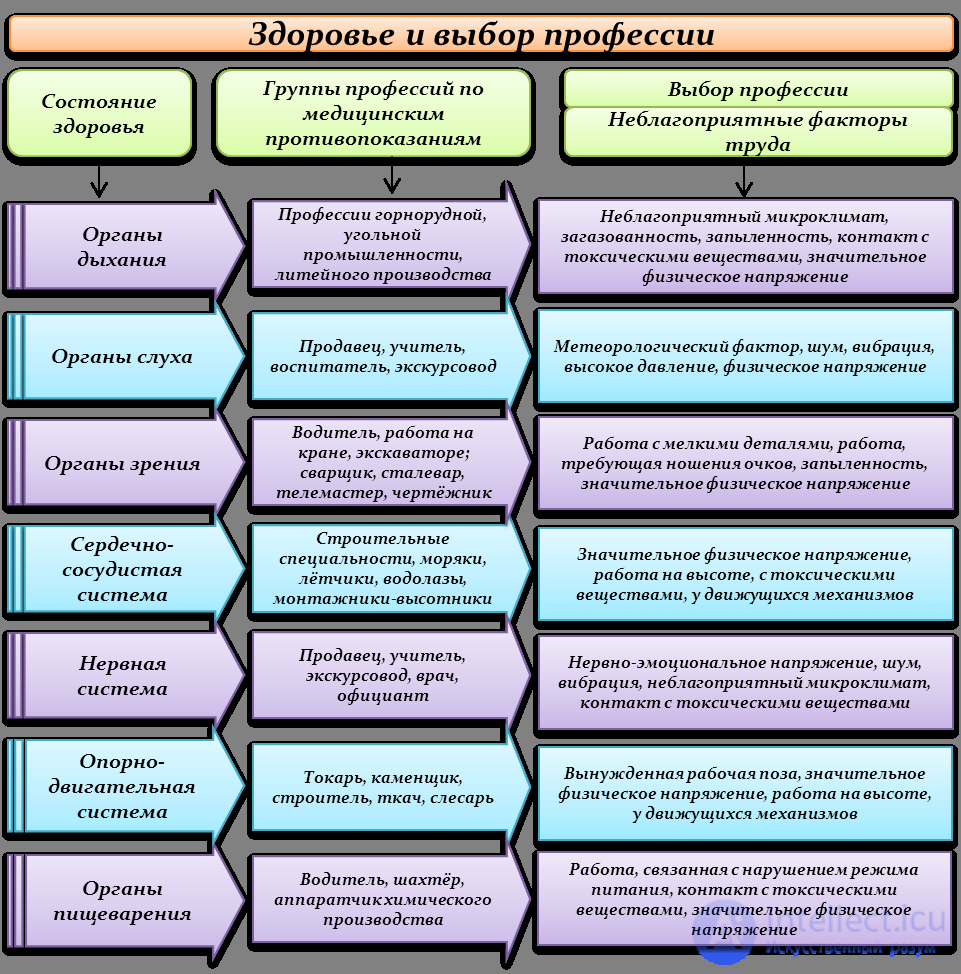
Health plays an important role in choosing a profession, since professional activity can have different effects on a person's physical and mental state. Here is how health can affect the choice of profession:
Physical health:
Mental health:
Chronic illnesses and limitations:
Health prevention:
Professions in healthcare:
Adaptation of the work environment:
It is important to remember that every person is unique, and the choice of profession should take into account both physical and mental health. It is recommended to consult doctors and career-guidance specialists in order to make an informed decision about choosing a profession that matches your health needs and abilities.
The technique is designed to select suitable types of professions in accordance with E.A. Klimov's classification of profession types. It can be used for career guidance of both teenagers and adults.
Content of the technique: in each of the 20 pairs of proposed types of activity, the test-taker must choose only one type and place a "+" mark in the corresponding cell of the answer sheet.
The answer sheet is designed so that it is possible to count the number of "+" marks in each of the 5 columns. Each of the 5 columns corresponds to a particular type of profession. The test-taker is advised to select the type of profession that received the maximum number of "+" marks.
1. If the main, leading object of labour is plants, animals or microorganisms, then we are dealing with type "N" — "person — nature".
2. If the main, leading object of labour is technical systems, material objects, materials, or types of energy, this will be type "T" — "person — technology".
3. Type "S" — "person — sign" — is characterised by such leading objects of labour as conventional signs, numbers, codes, and natural or artificial languages.
4. Type "A" — "person — artistic image" — is connected with the conditions for constructing an artistic image.
5. Type "P" — "person — person". For this type, the main object of labour is people: groups, collectives, communities of people.
Names of the profession types by column:
I. "Person–Nature" – all professions related to crop farming, animal husbandry and forestry.
II. "Person–Technology" – all technical professions.
III. "Person–Person" – all professions related to serving people and to communication.
IV. "Person–Sign" – all professions related to calculations and numerical or alphabetic symbols, including musical specialities.
V. "Person – Artistic Image" – all creative specialities.
The examination time is not limited. However, the test-taker should be warned not to dwell too long on the questions, and completing the task usually takes 20–30 minutes. The technique can be used individually or in a group. The examiner may read the questions aloud to a group of test-takers, but in that case the response time is limited. This method is used when the examiner must work within a limited time interval.
Answer sheet
|
I |
II |
III |
IV |
V |
|
1a |
1b |
2a |
2b |
3a |
|
3b |
4a |
4b |
5a |
5b |
|
6a |
|
6b |
|
7a |
|
|
7b |
8a |
|
8b |
|
|
9a |
|
9b |
|
|
10a |
|
|
10b |
|
|
11a |
11b |
12a |
12b |
13a |
|
13b |
14a |
14b |
15a |
15b |
|
16a |
|
16b |
|
17a |
|
|
17b |
18a |
|
18b |
|
|
19a |
|
19b |
|
|
20a |
|
|
20b |
|
Instructions: «Suppose that after appropriate training you could do any job. But if you had to choose between only two options, which would you prefer?»
Questionnaire text
1a. Look after animals.
or
1b. Service machines and instruments (monitor, adjust them).
2a. Help sick people.
or
2b. Draw up tables, diagrams, programs for computers.
3a. Monitor the quality of book illustrations, posters, art postcards, gramophone records.
or
3b. Monitor the condition and growth of plants.
4a. Process materials (wood, fabric, metal, plastic, etc.).
or
4b. Bring goods to the consumer, advertise, sell them.
5a. Discuss popular-science books and articles.
or
5b. Discuss works of fiction (or plays, concerts).
6a. Raise young animals (of some breed).
or
6b. Train peers (or younger people) to perform and reinforce certain skills (work, academic, sports).
7a. Copy drawings, images (or tune musical instruments).
or
7b. Operate some kind of machine (freight, lifting or transport equipment) - a crane, a tractor, a diesel locomotive, and so on.
8a. Inform and explain to people the information they need (at an information desk, on an excursion, etc.).
or8b.
Set up exhibitions, displays (or take part in preparing plays, concerts).
9a. Repair things and articles (clothing, appliances), dwellings.
or
9b. Find and correct errors in texts, tables, drawings.
10a. Treat animals.
or
10b. Perform computations, calculations.
11a. Breed new varieties of plants.
or
11b. Design, engineer new types of industrial products (machines, clothing, houses, food products, etc.).
12a. Settle disputes, quarrels between people, persuade, explain, punish, encourage.
or
12b. Make sense of drawings, diagrams, tables (check, refine, put in order).
13a. Observe, study the work of amateur arts groups.
or
13b. Observe, study the life of microbes.
14a. To service and adjust medical instruments and apparatus.
or
14b. To provide people with medical assistance for wounds, bruises, burns and the like.
15a. To describe or depict events (observed and imagined) in an artistic way.
or
15b. To compile precise descriptive reports on observed phenomena, events, measured objects, etc.
16a. To perform laboratory analyses in a hospital.
or
16b. To receive and examine patients, talk with them, and prescribe treatment.
17a. To paint or decorate the walls of premises, the surfaces of products.
or
17b. To carry out the installation or assembly of machines or instruments.
18a. To organise cultural outings for peers or younger children to theatres, museums, excursions, hiking trips, etc.
or
18b. To perform on stage, to take part in concerts.
19a. To manufacture parts and products (machines, clothing) according to drawings, to construct buildings.
or
19b. To do draughting work, to copy drawings and maps.
20a. To fight diseases of plants, pests of forests or orchards.
or
20b. To work on keyboard machines (typewriter, teletype, typesetting machine, etc.).
Test task:
Instructions:
Let us begin by either agreeing or disagreeing with the items of the self-assessment programme. If you agree, write a "+" sign in pencil; if not, write « — »
|
|
Type of specialisation (by object of labour) |
«N» |
«T» |
«S» |
«A» |
«P» |
|
1. |
I easily (without inner constraint) enter into communication with new people |
0 |
0 |
0 |
0 |
1 |
|
2. |
I willingly and for long periods enjoy making things (or repairing, sewing, knitting) |
0 |
1 |
0 |
0 |
0 |
|
3. |
I try to bring features of beauty to my surroundings (people say I manage to do this) |
0 |
0 |
0 |
1 |
0 |
|
4. |
I willingly and constantly care for plants (or animals) |
1 |
0 |
0 |
0 |
0 |
|
5. |
I willingly and for long periods enjoy counting, calculating or draughting something |
0 |
0 |
1 |
0 |
0 |
|
6. |
I willingly spend time with children when they need to be occupied, engaged in something, or helped |
0 |
0 |
0 |
0 |
1 |
|
7. |
I willingly and often help others care for animals (plants) |
1 |
0 |
0 |
0 |
0 |
|
8. |
I make few mistakes in written work |
0 |
0 |
1 |
0 |
0 |
|
9. |
My handiwork (what I make with my own hands in my free time) usually arouses the interest of my friends |
0 |
2 |
0 |
0 |
0 |
|
10. |
Acquaintances believe that I have abilities for a certain kind of art |
0 |
0 |
0 |
2 |
0 |
|
11. |
I enjoy reading about the plant (or animal) world |
1 |
0 |
0 |
0 |
0 |
|
12. |
I actively take part in amateur arts activities |
0 |
0 |
0 |
1 |
0 |
|
13. |
I enjoy reading about the design and operation of mechanisms, machines and instruments |
0 |
1 |
0 |
0 |
0 |
|
14. |
I can spend a long time solving puzzles or working on difficult problems, crosswords and riddles — I enjoy it |
0 |
0 |
2 |
0 |
0 |
|
15. |
I easily notice disagreements between peers or younger children |
0 |
0 |
0 |
0 |
2 |
|
16. |
People think I have an aptitude for working with technology |
0 |
2 |
0 |
0 |
0 |
|
17. |
The results of my creative work are praised even by people I don't know |
0 |
0 |
0 |
2 |
0 |
|
18. |
Acquaintances think I have an aptitude for working with biological objects (plants or animals) |
2 |
0 |
0 |
0 |
0 |
|
19. |
I manage to express my thoughts in writing clearly and in detail for others |
0 |
0 |
2 |
0 |
0 |
|
20. |
I almost never quarrel with anyone |
0 |
0 |
0 |
0 |
1 |
|
21. |
The results of my technical creative work are praised by people I don't know |
0 |
1 |
0 |
0 |
0 |
|
22. |
I pick up foreign words without much difficulty |
0 |
0 |
1 |
0 |
0 |
|
23. |
I often help people I don't know |
0 |
0 |
0 |
0 |
2 |
|
24. |
I can spend a long time doing my favourite activity (music, drawing, etc.) without getting tired |
0 |
0 |
0 |
1 |
0 |
|
25. |
I try to influence the development of plants (living organisms), to improve or change them |
2 |
0 |
0 |
0 |
0 |
|
26. |
I like to understand the design of mechanisms, machines and instruments |
0 |
1 |
0 |
0 |
0 |
|
27. |
I am usually able to convince others of the appropriateness of one plan of action or another |
0 |
0 |
0 |
0 |
1 |
|
28. |
I enjoy observing animals or plants |
1 |
0 |
0 |
0 |
0 |
|
29. |
I like reading literature that many people consider boring (popular science, non-fiction, literary criticism) |
0 |
0 |
1 |
0 |
0 |
|
30. |
I try to understand the secrets of skill of people working in the arts and to reproduce their actions (do as they do) |
0 |
0 |
0 |
1 |
0 |
|
|
Your results: |
|
|
|
|
|
Add up the total points in each column
Career choice matrix
1. Which object of activity attracts you?
1.1. People (children and adults, pupils and students, clients and patients, customers and
passengers, spectators, readers, employees)
1.2. Information (texts, formulas, diagrams, codes, drawings, foreign languages, programming languages)
1.3. Finance (money, stocks, funds, limits, loans)
1.4. Technology (mechanisms, machine tools, buildings, structures, instruments, machines)
1.5. Art (literature, music, theater, cinema, ballet, painting)
2.1. Management (directing someone else's activity)
2.2. Service (meeting someone's needs)
2.3. Education (upbringing, teaching, personality development)
2.4. Health improvement (curing and preventing illness)
2.5. Creativity (creating original works of art)
2.6. Production (manufacturing goods)
2.7. Design engineering (designing parts and objects)
2.8. Research (scientific study of something or someone)
2.9. Protection (defense against hostile actions)
2.10. Control (inspection and monitoring)

Comments