
Lecture
Self-employment – is working for oneself rather than for an employer. Tax authorities generally regard a person as self-employed if they decide to be recognised as such, or if they receive income for which a tax return must be filed. In the real world, the decisive question for tax authorities is not whether a person is engaged in business activity (referred to as «trade», even when it involves providing services), but whether that activity is profitable and therefore potentially taxable. In other words, trading activity is likely to be disregarded where there is no profit, so tax authorities typically disregard casual economic activity based on a hobby or enthusiast pursuit. Self-employed people are usually classified as sole traders (or an individual entrepreneur), an independent contractor, or a member of a partnership.
Self-employed people usually find work on their own rather than being given work by an employer, and instead earn income from a trade, profession or business that they run themselves. In some countries, such as the US and the UK, the authorities pay closer attention to establishing whether a person is genuinely self-employed or is engaged in disguised employment - in other words, pretending to be in a contractual business-to-business relationship in order to conceal what is actually an employer-employee relationship.
| Country | Rate (%) |
|---|---|
 Colombia Colombia |
53.1 |
 Brazil Brazil |
33.3 |
 Mexico Mexico |
31.8 |
 Greece Greece |
31.8 |
 Turkey Turkey |
30.2 |
 Costa Rica Costa Rica |
26.6 |
 South Korea South Korea |
24.6 |
 Chile Chile |
23 |
 Italy Italy |
21.8 |
 Poland Poland |
19.7 |
 New Zealand New Zealand |
19.7 |
 Czech Republic Czech Republic |
15.9 |
 Netherlands Netherlands |
15.8 |
 Spain Spain |
15.8 |
 Portugal Portugal |
15.5 |
 Switzerland Switzerland |
15.3 |
 Finland Finland |
14.6 |
 Ireland Ireland |
14.1 |
 Belgium Belgium |
14.1 |
 Slovenia Slovenia |
14 |
 Latvia Latvia |
13 |
 Israel Israel |
12.4 |
 France France |
12.6 |
 Hungary Hungary |
12.5 |
 Austria Austria |
11.9 |
 Lithuania Lithuania |
11.6 |
 Sweden Sweden |
10.6 |
 Luxembourg Luxembourg |
10.2 |
 Japan Japan |
9.8 |
 Australia Australia |
9.5 |
 Germany Germany |
8.8 |
 Denmark Denmark |
8.8 |
 Canada Canada |
7.7 |
 Russia Russia |
6.8 |
 United States United States |
6.3 |
 Norway Norway |
4.7 |
Self-employment provides work primarily for the founder of the business. The term «entrepreneurship» refers to all new ventures, including self-employment and businesses that never intend to become large or to be registered, but the term « startup» refers to new ventures that intend to provide work and income for more people than just the founders, and intend to have employees and to grow large.
To sum up:
Self-employment and entrepreneurship are two ways of organising a business or work activity in which you control your own work and business processes. They share similar features, but there are also significant differences:
Self-employment:
Form of employment: Self-employment means that you work for yourself as a freelancer or independent specialist, but do not set up a legal business structure (such as an LLC or sole proprietorship). You can provide services and receive payment for them from various clients.
Risks: As a self-employed person, you may be responsible for your activities, but your legal liability is limited. You typically do not bear the financial risks associated with a business, and you are not required to keep formal accounting records.
Taxation: Taxation of the self-employed can vary from country to country. In some places there are special tax benefits for self-employed individuals.
Freedom and flexibility: Self-employment can give you greater freedom and flexibility in choosing clients, projects, and your work schedule.
Entrepreneurship:
Organisational form: Entrepreneurship involves creating your own business, which can be registered as a sole proprietorship, a limited liability company (LLC), and so on.
Risks: An entrepreneur bears higher financial risks associated with the business. They have to manage the budget, accounting, and other aspects of the organisation.
Taxation: Entrepreneurs are required to pay taxes on both income and company profit. The tax obligations of entrepreneurs can be more complex.
Freedom and control: An entrepreneur has full control over their business and makes strategic decisions. Along with this comes a higher level of responsibility.
The choice between self-employment and entrepreneurship depends on your goals, resources, skills, and level of comfort with risk. Both options can give you the opportunity to earn money and work on your own projects, but they also have their own particular features and requirements. Before making a decision, it is important to carry out a detailed analysis and, if possible, consult with experts in business and taxation.
Freelancing (free-form employment) – is a type of employment in the market for goods and services, characterised by independence in choosing its form and place of practice and a low degree of dependence on an employer.
A worker engaged in this type of activity (a freelancer) has a high degree of freedom, opportunities for self-realisation and creative growth, and control over their own work schedule. The employment of freelancers is regulated by legislative acts of labour and civil law with respect to freelance employment, self-employment, individual entrepreneurship, and employment under civil-law contracts.
From this definition it follows that freelancing – is not necessarily off-payroll work, since even while being on the staff of some company, an employee who works remotely or with a flexible schedule likewise has a high degree of freedom, opportunities for self-realisation, independence in choosing the form and place of work, and a fairly low degree of dependence on the employer.
A freelancer - is an independent specialist or professional who provides their services and works on projects on a remote basis, usually without long-term commitments to a single employer. Here are some key characteristics of a freelancer:
Independence: Freelancers are not bound by long-term contracts and can choose the projects and clients they want to work with. They can also set their own schedule and place of work.
Remote work: Freelancers usually work from home, cafes, coworking spaces, or any other place with internet access.
Variety of projects: Freelancers can work in various fields, such as web development, design, copywriting, marketing, translation, video production, and much more. This allows them to diversify their experience and income.
Self-organisation: Freelancers are responsible for organising their own work, including finding clients, setting prices, completing projects, and tracking finances.
Flexibility: Freelancers can adapt to different clients and projects, which provides flexibility in income and work schedule.
Taxation: Freelancers are often responsible for paying their own taxes and keeping their own accounting records, although they may also use services and software to simplify this process.
Competition: The freelance market is usually quite competitive, and freelancers must constantly improve their skills and marketing efforts to attract clients.
Freelancing is a popular way of finding employment in the modern world, one that allows people to build a career and earn money while working on their own terms. However, success in this field requires self-discipline, professionalism, and the ability to effectively manage one's time and resources.
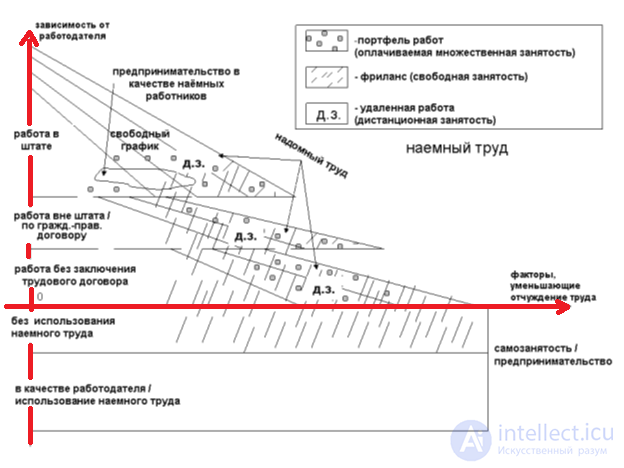
The place of freelancing in the labour market and employment
Freelancers can earn money by offering a variety of services and skills in various fields. Here are some popular ways freelancers earn money:
Web development and design:
Writing and editing:
Marketing and advertising:
Programming and IT:
Video and audio production:
Translation and localization:
Graphic design:
Administrative support:
Training and consulting:
Photography:
Specialized services:
These are just a few examples of what freelancers can do. It is important to choose a field that matches your skills and interests, and to develop a strategy for attracting clients and building a career in that field. Also remember the importance of a marketing and self-promotion strategy in order to attract clients and maintain a steady flow of orders.
Although it is commonly believed that self-employment is concentrated in a few sectors of the services industry, such as sales agents and insurance agents, research by the Small Business Administration has shown that self-employment occurs across a broad segment of the US economy. Moreover, it has been shown that industries not usually considered natural for self-employment, such as manufacturing, in fact have a large share of self-employed individuals and home-based businesses.
In the United States, any person is considered self-employed for tax purposes if they carry on a business as a sole proprietor, an independent contractor, a member of a partnership, or a member of a limited liability company that does not elect to be treated as a corporation. In addition to income tax, these individuals must pay Social Security and Medicare taxes in the form of the SECA tax (Self-Employment Contributions Act).
In 2016, the average income of individuals self-employed at their own enterprise was $50,347. For individuals self-employed in their own unincorporated firms, the figure was $23,060.
Self-employment is relatively common among new immigrants and ethnic minorities in the United States. In the United States, immigrants generally have a higher rate of self-employment than native-born Americans, regardless of race or ethnicity. However, self-employment in the United States is unevenly distributed by race/ethnicity. Immigrants and their children who identify as white have the highest likelihood of self-employment in lucrative industries such as professional services and finance. In contrast, racial and ethnic minorities are less likely to be self-employed than native-born whites, with the exception of Asian immigrants, who have a high rate of self-employment in low-prestige industries such as retail trade and personal services. Similar to the mainstream labour market, self-employment overall is more common among immigrants than among their second-generation children born in the US. However, second-generation children of Asian immigrants may continue to seek self-employment across various industries and occupations.
The self-employment tax in the United States is generally set at 15.30%, which roughly equals the combined employee and employer contributions under the FICA tax. The rate consists of two parts: 12.4% for Social Security and 2.9% for Medicare. The Social Security portion of the tax for the self-employed applies only to the first $132,900 of income for the 2019 tax year. The amount subject to the 2.9% Medicare portion of the self-employment tax is not capped. In fact, there is an additional Medicare tax rate of 0.9% if a sole proprietor earns more than $200,000 (single filer).
As a general rule, only 92.35% of self-employment income is taxed at the rates above. In addition, half of the self-employment tax — the portion equivalent to the employer's share — is allowed as a deduction from income.
The Tax Relief Act of 2010 reduced the self-employment tax by 2% for self-employment income earned in the 2011 calendar year , bringing the total to 13.3%. This rate was maintained for income earned in the 2012 calendar year under the Temporary Payroll Tax Cut Continuation Act of 2011. Self-employed individuals sometimes claim a larger deduction than a regular employee. Travel, uniforms, computer equipment, mobile phones, and so on can be deducted as legitimate business expenses.
Self-employed individuals report their business income or losses on Schedule C of IRS Form 1040 and calculate self-employment tax on Schedule SE of IRS Form 1040. Estimated taxes must be paid quarterly using Form 1040-ES if the estimated tax liability exceeds $1,000.
Self-employed workers cannot contribute to a company-managed 401(k) plan of the type most people are familiar with. Nevertheless, there are various vehicles available to self-employed individuals for saving toward retirement. Many have set up a Simplified Employee Pension (SEP) IRA, which allows them to contribute up to 25% of their income, up to $54,000 (2017) per year. There is also a program called the Self-Employed 401k (or SE 401(k)) for self-employed people. Contribution limits vary slightly depending on how the business is organized.
A defined benefit plan is a third option, which has high contribution limits and functions like a traditional pension plan. Sole proprietors can also opt for a SIMPLE IRA, which allows them to contribute to employees' retirement plans as well as to their own retirement plan.
Studies have shown that the level of self-employment in the United States is growing, and that under certain circumstances this can have a positive effect on per capita income and job creation. According to a 2017 study by MBO Partners, the self-employed workforce contributes $1.2 trillion to the US economy, which corresponds to roughly 6% of national GDP. A 2011 study conducted by the Federal Reserve Bank of Atlanta and Pennsylvania State University examined self-employment levels in the US from 1970 to 2000. According to the US Bureau of Economic Analysis, the absolute number of people registered as non-farm proprietors (NFP) or self-employed in metropolitan counties grew by 244% between 1969 and 2006, and by 93% in other counties. In relative terms, the share of the self-employed in the labour force rose from 14% in 1969 to 21% in 2006 in metropolitan counties, and from 11% to 19% in other counties.
The study found that in counties outside metropolitan areas, an increase in the level of self-employment was associated with a significant increase in per capita income and job creation, as well as a significant decrease in the family poverty rate. In 1969, the average income of non-farm business owners was $6,758, compared to $6,507 earned by wage workers; by 2006, the earnings gap had widened to $12,041 in favour of wage workers. The study notes that this gap may be due to underreporting of income by the self-employed. Alternatively, low-productivity workers may lose their jobs and be forced into self-employment. In addition, some studies show that higher local unemployment rates push workers to self-select into self-employment, as does past experience of unemployment.
The European Commission defines a self-employed person as: «a person pursuing a gainful activity for their own account, under the conditions laid down by national law». In carrying out such activity, the personal element is of particular importance, and its exercise always presupposes a significant degree of independence in carrying out the professional activity. This definition is taken from Directive 2010/41/EU [14] on the application of the principle of equal treatment between men and women engaged in activity as self-employed individuals. This is where it differs from an employee, who is subordinate to and dependent on an employer.
In addition, Article 53 of the Treaty on the Functioning of the European Union (TFEU) provides for the free movement of persons engaged in and carrying out activity as self-employed persons. It provides: «To make it easier for persons to take up and pursue activities as self-employed persons, the Council shall… issue Directives for the mutual recognition of diplomas, certificates and other evidence of formal qualifications».
The form of self-employment does not group together homogeneous workers. As the European Commission noted in 2010, «there are different understandings and definitions of the term self-employment in different countries, with a number of different subcategories identified: for example, depending on the legal status of the enterprise, regardless of whether it is self-employment». whether the enterprise has employees or not (employers or self-employed workers) and/or the sector in which the enterprise operates. Some countries also distinguish between the status of self-employed and the status of «dependent self-employed» (for example, Spain, Italy), where the self-employed person works for only one client. Others distinguish self-employment that is carried out in addition to paid employment (for example, Belgium)».
The European Parliament resolution on social protection for all ] states that: «the lack of a clear national definition of self-employment increases the risk of false self-employment», and the European Parliament resolution on the renewed social agenda calls on Member States to take initiatives that «will lead to a clear distinction between employers, genuine self-employed persons and small entrepreneurs, on the one hand, and employed workers, on the other».
Self-employment is mainly regulated only at the national level. Each authority and individual body applies its own regulatory provisions, which may differ depending on their area of competence or policy field (tax law, social security, business law, labour market, insurance). Therefore, the provisions concerning self-employment vary greatly between countries. As the European Foundation for the Improvement of Living and Working Conditions (Eurofound) noted in 2014, the diversity of the self-employed attracts various forms of regulation, mostly adopted at the national level: «EU labour legislation mostly concerns the self-employed only in narrowly specific areas, such as free movement and equal treatment».
In accordance with the recommendation of the European Forum of Independent Professionals (EFIP), the EU, representatives of employers, workers and the self-employed should adopt a pan-European joint recognition of genuine self-employment and a common definition including common terminology for various sectors.
A self-employed person in the United Kingdom may act as a sole trader or a partner in a partnership (including a limited liability partnership, or «LLP»), but not through a registered company with limited (or unlimited) liability. It is also possible for someone to start a business that will be run only part-time or alongside full-time employment.
According to a study by the McKinsey Global Institute conducted in 2016, there are 14 million «independent workers» in the United Kingdom, although the House of Commons Work and Pensions Committee reported in 2017 that 5 million people, 15% of the workforce, were self-employed. The Office for National Statistics noted the «rapid growth» of self-employment between 2001 (3.3 million people, or 12% of the workforce) and 2017 (4.8 million people, or 15.1% of the workforce), with London, Yorkshire and the Humber, and the South East showing the fastest rates of growth. Many people with disabilities choose to pursue self-employed work.
Self-employment, while popular, comes with a number of legal obligations. For remote work, permission from local authorities may sometimes be required to use part of a home as office premises. If a self-employed person keeps records of clients or suppliers in any electronic form, they must register with the Information Commissioner's Office. Other legal obligations include mandatory public liability insurance, adapting premises for accessibility, and properly registering and recording financial transactions. Free advice on the range of obligations can be obtained from government Business Link centres.
The UK government has stated that «self-employment is not the right choice for everyone».
The Office for National Statistics has noted that information on self-employment income levels is limited and mostly comes from surveys.
The House of Commons Work and Pensions Committee reported in May 2017 that some self-employment could be described as «bogus», noting that a «minority of companies» promote the idea that flexibility in employment can only be achieved through self-employment, and that such abuse of self-employed status «shifts the burden of supporting the welfare system onto the welfare state while simultaneously reducing tax revenue»

Comments