
Lecture
Type of lesson: A lesson introducing new knowledge.
Teaching methods:
Objectives:
Didactic: familiarise students with the concepts of the «labour market» and «supply and demand» in the labour market.
Developmental: develop the ability to analyse, correlate, compare, identify what is essential, establish cause-and-effect relationships, and give examples; improve the ability to work both independently and in a group.
Educational: shape an emotionally engaged, personal attitude toward innovative technologies and foster an active life stance. Students acquire the ability to listen, ask questions, and conduct themselves correctly by applying knowledge of business etiquette, and rules of behaviour in society are developed.
Equipment:
Form of organising learning activity in the lesson:
Motivation: the relevance of the lesson topic lies in shaping students' knowledge of the features of the modern «labour market» in the Russian Federation, and of how supply and demand arise in the labour market.
Expected results:
Lesson progress
|
No. |
Structural elements of the lesson |
Teacher's activity |
Students' activity |
|
1 |
Organisational moment (2 min.) |
Greeting |
Get ready for the lesson |
|
2 |
Announcing the topic and objective of the lesson (3 min) |
On the whiteboard: the name of the lesson topic. |
Write it down in their notebooks |
|
3 |
Review of material already covered (5 min.) |
Ongoing assessment in question-and-answer form. |
Answer the questions |
|
4 |
Preparing students for active, conscious mastery of new knowledge and presenting the new material: the concept of the «labour market». The emergence of supply and demand in the labour market (30 min) |
Objective: identify the features of how supply and demand arise in the labour market of the Russian Federation. |
Receive information, ask questions and answer the teacher's questions. |
|
5 |
Consolidating the new knowledge (3 min.) |
Additions, clarifications and announcement of grades. |
Check the notes in their notebooks. |
|
6 |
Assigning homework and instructions for completing it (2 min) |
Highlight the purpose of the homework. |
Notes. |
The labour market is the set of economic relations associated with the buying and selling of a specific commodity - labour power, where labour is exchanged for wages.
The labour market - is a component part of the structure of a market economy, functioning within it alongside other markets: for raw materials, supplies, securities, and so on.
In general terms, the labour market is understood as a special subsystem of the market economy in which, on one side, employers (owners of the means of production) interact with, on the other side, hired workers. This interaction shapes the volume, structure and ratio of supply and demand for labour.
The component parts of the labour market are:
1. Demand for labour
2. Supply of labour
3. The price of labour
4. The value of labour
5. Competition
The sphere in which the demand for and supply of labour power is formed. Through it, labour power is sold for a specific period and personnel are recruited for a specific period.
The labour market — is the leading component of the classical concept of employment, which is based on the following principles:
A distinctive feature of the labour market and its mechanism is that the objects of purchase and sale on it are the right to hire labour and the right to recruit personnel who possess knowledge, qualifications (education), and abilities for the work process.
In the broad sense, the labour market is a system of socio-economic and legal relations in society, and of norms and institutions, designed to ensure the normal, continuous process of reproduction of labour power and the effective use of labour.
Relations in the labour market are regulated by public and state institutions (employment policy, trade unions, legislation, etc.)
The labour market is particularly strongly influenced by non-price factors. Thus, the complexity and prestige of the job, working conditions, the «climate» in the workplace, and guarantees of safety and career growth — all of this has a positive or negative effect on the labour supply curve.
The labour market is an important part of any economic system, since its state largely determines the rate of economic growth of that system. At the same time, the labour market is a key element of the socio-economic policy pursued by the authorities. Thus, the labour market is simultaneously affected by both the social and economic policy of a region or of the state as a whole.
In the labour market, the owner of the means of production and the owner of labour power meet, and between them bargaining takes place not over the owner of labour power themselves, but over a specific type of labour, as well as over the conditions and duration of the use of the worker's labour.
These relations are contradictory due to the operation of the laws of supply and demand. In the process of exchange, a state of temporary equilibrium is established, which is expressed in a certain level of employment and pay.
A characteristic feature of the labour market is a constant excess of the supply of labour power over the demand for it.
Demand for labour power under conditions of free competition is shaped by two main indicators: real wages and the value of the marginal product of labour (the product of labour produced by the last worker hired). The supply of labour depends directly on the level of pay: the higher the wages, the higher the level of labour supply.
The labour market is often the most accurate indicator of the social condition of the population of a given country. The emergence of the labour market is linked to the formation of market relations and the development of capitalism. It is precisely free labour, where a worker can quit at any moment and is not «tied» to an enterprise as a peasant was in the feudal era, that characterizes the process of the destruction of feudalism and the birth of capitalism.
At present, labour mobility is one of the most important parameters that make economic growth possible in the economy as a whole. Labour mobility (the availability of means of transport) is characterised by the real opportunities available to workers and their families to relocate to other localities in order to choose a place of residence where they may obtain more favourable employment offers. Thus, labour mobility contributes to higher efficiency and productivity in the economy.
Economic theory studies unfavourable phenomena in the economy, including unemployment. Unemployment is regarded as one of the most important characteristics of the labour market. At present, unemployment is present in all countries of the world, in varying degrees, forms and duration.
One of the first explanations of unemployment was given by T. Malthus. He observed that unemployment is caused by demographic factors, whereby the rate of population growth exceeds the rate of growth of production. This theory has been recognised as untenable, since unemployment is also present in modern developed countries with low birth rates.
A major contribution to the formation of modern conceptions of the labour market was made by the classical school of political economy. In the 17th century, the economic thought of England and France — countries with the highest level of capital development — began the systematic study of commodity relations. In the works of the Englishman William Petty and the Frenchman Pierre Boisguilbert, the beginnings of the labour theory of value took shape, along with the first attempts to grasp the law of commodity exchange. It was these economists who first put forward and substantiated the idea that the exchange proportions in commodity exchange are regulated by the labour expended on producing the goods. The problem of the law of value runs like a red thread through the research of all representatives of the classical school. A particularly significant contribution to the development of the labour theory of value was made by Adam Smith and David Ricardo, who studied commodity relations on the eve of the industrial revolution (as Smith did) and at its height (as Ricardo did). The new era posed new problems for economic theory. The industrial revolution led to the replacement of the previously dominant manual production with production increasingly based on the use of machines, and raised, above all, the question of exactly what labour expenditure determines the value of goods. These expenditures looked completely different in a factory, in a manufactory and in a craftsman's workshop. Ricardo was the first economist to show that means of labour (machines, production equipment, etc.) do not create new value, but merely transfer to the goods produced with their help the value previously created by labour and embodied in them. In effect, the contradictions that arose within classical political economy in explaining value, and the attempts to construct a single theory explaining the mechanisms of value by means of the labour theory of value, led to the crisis of classical political economy and its decline in the 1870s (John Stuart Mill, John Elliott Cairnes)
Marxist theory regards unemployment as a historically transient phenomenon inherent in a society based on private ownership of the means of production. The emergence of unemployment is linked to the cyclical processes of capital accumulation and reproduction, and to the growth of the organic composition of capital. The population is not excessive in absolute terms, but relative to the needs of capital. The consequences of unemployment are the absolute and relative impoverishment of wage workers. Marx and his followers develop the labour theory of value.
The neoclassical school is represented by the works of D. Gilder, A. Laffer, M. Feldstein, R. Hall, and others. It is based on the tenets of A. Smith's classical theory. The neoclassical concept holds that unemployment is impossible if equilibrium exists in the labour market, since the price of labour reacts flexibly to the needs of the labour market, rising or falling depending on supply and demand. Today, representatives of this school recognize unemployment as a natural phenomenon that performs the function of circulating the unoccupied portion of the working-age population.
The main ideas of the Keynesian school can be summarized as follows
Representatives of the monetarist school studied the relationship between unemployment and the dynamics of real wages and inflation.
The institutional sociological school offered its own view of the problem from the standpoint of institutional issues, the creation of employment services, and other social institutions.
In recent years the most popular concepts have been those of the «natural», «normal», and «socially acceptable» level of unemployment, which examine the relationship between unemployment and inflation, monetary circulation, the equilibrium price of labour, and the ratio of labour supply and demand. Strategy and tactics for state regulation of employment and support for the unemployed are developed using methods of economic-mathematical modelling and graphical analysis (Marshall crosses, Phillips curves, the Beveridge curve, and others). In the 1960s the natural rate of unemployment was considered to be 2 — 4% of the labour force; by the 1980s this level had risen to 6 — 7%.
The concept of a post-industrial society has its roots in the work of Thorstein Veblen; under the influence of Veblen's work, concepts and writings devoted to the «managerial revolution» began to appear. The theory of the future post-industrial society was further developed in the works of C. Clark, «The Economics of 1960» (1948), and J. Fourastié, «The Great Hope of the Twentieth Century» (1949). However, a boom in works on the future post-industrial society arose after the books and articles of D. Bell, J. K. Galbraith, and P. Drucker
In his concept, D. Bell formulated the features of a post-industrial society:
The features of post-industrial society are predominantly linked to fundamental changes in the labour market and the new role of the hired worker.
John Kenneth Galbraith, in his 1952 book «American Capitalism: The Concept of Countervailing Power», writes about the role of trade unions as a countervailing power that exists alongside big business and government. Galbraith argues that managers are the bearers of progress, and he further develops this idea in his later book «The New Industrial State» (1967), in which he writes about the monopolisation of knowledge by the «technostructure» — a new force alongside the capitalists.
Peter Ferdinand Drucker, in his 1942 book «The Future of Industrial Man», describes the concept of the «knowledge worker», and this idea is later developed in his subsequent works. Drucker writes that the guiding markers of our society are the emergence of new technologies and industries, the transition from an international economy to a global one, the establishment of a society of organisations, and the growing importance of knowledge as a driving force of socio-economic development. In Drucker's view, in the 20th century the key problem is raising efficiency, which is directly linked to education and the all-round development of the individual. This is possible only within a modern organisation; such development leads to the formation of an information society and creates the preconditions for social and economic equality.
Theories describing the future of humanity and the role of the working person in it are far from uniform; there is no single approach, and authors propose various concepts — this subject remains a focus of attention for economists, sociologists, and institutionalists.
One of the most prominent economists of our time, Manuel Castells, develops the concept of the network society. M. Castells has written a great many works, one of the most significant being his book «The Information Age: Economy, Society and Culture» (1996—1998). The most important idea developed by Castells is the concept of the network society and the division of the entire globe into Internet-haves and Internet-have-nots. The point is not possession of the Internet as such, but the extent to which the Internet has become an organic part of modern society, a means of communication, production, distribution, exchange, and consumption of material and spiritual goods . Castells predicts accelerating economic growth for China, and he is one of the few Western economists to analyse the causes of the collapse of the USSR, which, in his view, lie largely in the low level of development and the USSR's lag in adopting and using modern computer and communication technologies. The regime of secrecy, without which the Soviet state structure was unthinkable, is incompatible with the development of information technologies and the introduction of scientific innovations into the economy and production. This is what predetermined the collapse of the Soviet economy. The idea of the free individual and of scientific creativity in a post-industrial society is in no way compatible with closed borders, prohibitions, total surveillance, and the suppression of initiative and dissent, which were the backbone of the ideology, politics, and economy of the USSR.
According to Alvin Toffler (in his book «The Third Wave»), contemporary society has a number of features, the key ones being the transformation of knowledge into a factor of production and the fundamental role of intangible property in the new economy. Changes in the sphere of labour lead to a departure from the mass production characteristic of the 20th century and to the emergence of diversity and an individual approach. There is a sharp rise in qualification requirements while interchangeability declines. This is becoming relevant even for the modern military. Initiative is encouraged, and the new worker is more of an entrepreneur than a proletarian. The importance of small business is growing, increasingly displacing large firms. Such a society requires new forms of management; the old, rigid organisational frameworks are unacceptable, management becomes more complex, and organisations become more integrated and flexible in the face of changes in managemen
The French scholar Alain Touraine focuses attention on the formation and development of social capital. Touraine identifies three stages in the modernization of society
A crisis arises. «The disintegration of society and of the individual, — writes A. Touraine,- has turned our society into something more like a supermarket or an airport than a factory or a body of legal norms. Whereas in the past the Subject was in complete submission to the law, divine or social, in the modern world he is at risk of becoming a victim of the consumer society, which on the one hand manipulates him and on the other hand constantly pushes him toward the pursuit of ever newer goods».
The concepts of post-industrial society became the foundation of modern institutional theories that attempt to fit the «new worker» adequately into a unified theory in economics, sociology, social psychology, and political science.
Digital civilization, with the intrusion of intelligent systems into our lives, has sharpened the problem of a shrinking labour market
Among the factors affecting the dynamics of unemployment, the fundamental ones are the following
The formation of market relations has always affected one of the most important spheres of the economy — the employment of labour resources. In the pre-reform period, ensuring employment of the population was based on command-administrative methods: persons who had reached the age of sixteen and had no health restrictions were required either to study or to work. Otherwise, they were compulsorily assigned to work or prosecuted under the law (branded «parasites»). A distinctive feature of a market economy is that a person independently decides whether or not to work. The state has no right to compel a person to work, which is enshrined in Law of the Russian Federation No. 1032-1 of 19.04.1991 (as amended on 30.11.2011) «On Employment of the Population in the Russian Federation» and has no right to demand a citizen's deposit account number for the cashless crediting of unemployment benefit to the citizen's account (for cashing out), which is enshrined in the articles of the Criminal Code of the Russian Federation, because Article 3 «Procedure and Conditions for Recognising Citizens as Unemployed» of the Law contains the notion of deviant behaviour in a sophistically concealed form (for example, the provision on those «who failed to appear», while there is no provision on those «who failed to call», which is an equally energy-consuming, economically measurable activity)
The desire to ensure practically one hundred percent employment of the able-bodied population to the detriment of the economic efficiency of production led to a situation where, at many enterprises, there was not a shortage of labour energy but a surplus of effort in its expenditure. As a result, under a command-administrative economy, in the formal absence of unemployment, it actually existed in a «hidden» form: some employees were in fact merely present at work, simulating work activity (submitting to labour discipline in the absence of any timing of the working day). Advice: under no circumstances hand over the work record book to former employees on the day of dismissal, but take it to the labour inspectorate instead.
The reform of Russia's economy has raised, with full urgency, the problem of the formation of a labour market as one of the subsystems of the entire market mechanism. With the start of the reforms, many enterprises began optimising their staff and reducing the energy-intensiveness of the workforce, that is, the «hidden» form of unemployment turned into an «open» one, — as a physician might put it. By the end of 1991 the country already had its first unemployed. However, a normally functioning market economy presupposes the existence of unemployment. It is generally recognised that if the unemployment rate does not exceed 5%, the situation on the labour market is not tense: a person looking for work can find it fairly quickly. At the same time, it is quite difficult for an employer to fill a vacancy (based on the calculation of the energy costs of efficiency in recruiting staff). Once this level is exceeded, the labour market shows a mirror-image situation: now it is hard for the unemployed to find work, while employers can choose those who suit them best (based on the calculation of the energy efficiency of the effort spent on hiring). Low wages do not allow social tension in Russia to be eased. This same process leads to a constant «brain drain» from the country and the lawful relocation of our most highly qualified scientific, research and teaching personnel abroad.
In this situation, one of the main economic functions of the state is to pursue an economic policy that would ensure employment in the country at an economically efficient level (that is, one at which the unemployment rate does not exceed 5%).
A distinctive feature of the labour market was the active shedding of workers as jobs with questionable working conditions were cut. However, the situation has changed somewhat in recent times: increasingly, those who become unemployed are people who failed to obtain proper qualifications in time and those who have no specialized professional education, meaning that demand is growing ever more for a skilled workforce with specialized professional training.
Currently, part-time employment is widespread in Russia, where an employee works not 40 but 18 hours a week. A partially employed worker is given the opportunity to participate with their human potential in anti-crisis management of labour resources through appropriate fields for adding a résumé on social networks, and the chance to ask questions and get answers by email (target groups). Pockets of unemployment in Russia are found in the Kirov and Sverdlovsk regions, Chelyabinsk and Perm, Omsk, Khabarovsk, and Irkutsk. Unemployment is relatively higher among young people and women.
A factor accompanying unemployment is the process of labour migration. During the spring-summer period, about 500 thousand foreigners work in Russia. Their share is especially significant in the construction industry and the services sector.
A number of causes hinder the formation of a fully-fledged labour market in Russia
Labour demand - reflects the overall volume of society's needs for labour presented on the labour market.
Labour supply - the total amount of labour, characterized by its numbers and composition (sex, age, education, occupation, qualification, etc.).
The price of labour is its wage.
The value of labour is determined by the social costs of its reproduction, i.e. the volume of material and non-material goods consumed.
The main mechanism by which the labour market functions is competition - both among employers for attracting a highly productive workforce, and among employees for filling vacant jobs within the system of the social division of labour, as well as between employees and employers over the terms of the employment agreement, pay, and so on.
Thus, the labour market is a specific type of commodity market, whose distinctive feature is that a special kind of good is exchanged here - labour power, or a person's capacity for work.
As an economic concept, the labour market reflects the relationships between the owners of this good (hired employees), who are simultaneously its sellers, and the buyers (employers). Given the special significance and importance of these relationships for society, they are formalised in labour legislation.
The main participants in the labour market are:
- the owners of the means of production and the bodies representing their interests (employers' associations);
- hired employees and organisations representing their interests (trade unions, employers' councils);
- the state (represented by its various bodies) as an intermediary between employers and hired employees.
Thus, among the main participants in the labour market, the state is assigned an important role - as a regulator of employment relations, an intermediary between employers and hired employees, and the principal organiser of the functioning of market relations in this sphere.
The labour market under a market economy has a number of important positive characteristics:
- it plays an important role in the reproduction of a workforce that meets modern needs;
- it ensures the distribution and redistribution of the workforce among industries and territories;
- it enhances the mobility of the workforce;
- it stimulates growth in labour productivity, and so on.
The positive functions of the labour market are realised through the action of its internal mechanisms, related to its functioning and internal structure.
The main factors influencing the dynamics of the labour market are:
- demographic factors, including the size of the population, the share of the economically active population within it, its mobility, and so on;
- social factors, which include the standard of living, the social structure of society, the degree of development of social-partnership relations, and so on;
- organisational and legal factors, i.e. those characterising the role of state institutions in organising labour and employment of the population, and the degree of development and quality of the legal framework for the sphere of labour and entrepreneurship, and so on.
Segmentation of the labour market - is an objectively determined process of its structuring, in which, under the influence of the political, economic and social factors of society's development, a natural division of labour arises and separate sub-markets, or segments, are formed, differing in various characteristics based on the particularities of each category of employees.
In studying the segmentation of the labour market, three criteria are usually used: occupational-sectoral, qualification-and-pay, and socio-demographic. By combining these criteria, various groups of employees can be identified, differing in the priority of their field of activity and their level of material security:
- scarce, highly skilled groups of employees engaged in developing industries and fields of activity, with a fairly high level of employment guarantees and income growth exceeding the rate of inflation and overall economic growth;
- surplus, highly skilled groups of employees in shrinking or non-developing fields of activity, with an absence or insufficiency of employment guarantees and an income level commensurate with the rate of inflation;
- scarce, skilled and low-skilled groups of employees in developing fields of activity with relative employment stability and an income level lagging behind the rate of inflation, in need of social support;
- surplus, skilled and low-skilled groups of employees in shrinking or non-developing fields of activity, with an absence or insufficiency of employment guarantees and an income level significantly lagging behind the rate of inflation;
- employees belonging to any of the above categories, but at the same time belonging to socially vulnerable groups distinguished by a limited ability to use their labour potential, which to a greater or lesser extent reduces their employment guarantees and income level.
Segmentation makes it possible to specifically assess the state of the labour market for each category of employees from the standpoint of employment and unemployment, competition among hired employees and among employers, i.e. to establish a particular equilibrium condition within a sub-market.
- In studying the labour market, demand for labour is usually examined across four main levels:
- the individual enterprise or organisation;
- industries;
- regions;
- the economy as a whole.
Under the influence of these structures, a corresponding segmentation of the market occurs, reflecting society's needs as a whole.
The segmentation of this market can be made more specific, and the labour market can be divided into the following five segments:
- the market for the most highly skilled specialists;
- the market for qualified personnel;
- the labour market for blue-collar occupations;
- the labour market for low-skilled employees and the service sector;
- the residual labour market.
This kind of multi-segment market structure is characteristic of most developed countries of the world. It is particularly important to note here that, unlike other markets, the labour market in developed countries is regulated by the state to a greater extent. This applies even more to countries with a transitional type of economy, where the market is at the stage of formation and where the processes of establishing a market system of economic management are linked to a sharp increase in the number of people released from various sectors of the economy owing to its structural restructuring.
In addition, the growing role of state regulation of the social and labour sphere may be due to the strong influence of a number of non-economic factors, among which demographic processes are of particular importance.
The labour market model. As stated above, the labour market is a dynamic system. To understand this system, one needs an abstract model of the labour market that reproduces its main characteristics:
1) The activity of each person and each firm is aimed at maximising the satisfaction of their own interests. For the buyer of labour services, profit is the generalised main interest. The interest of the seller of labour services, in the same generalised form, has a more complex structure.
2) Buyers and sellers of labour services have certain information regarding the options available to them and are able to choose the one most advantageous for themselves.
3) Qualitatively homogeneous labour services are bought and sold on the labour market. Employees are treated as if they possessed labour power of the same quality, and workers do not differ from one another.
4) Labour productivity is a constant value and does not depend on the length of the working day or other factors.
5) Labour costs have no fixed component (e.g., a social component), but consist exclusively of wages paid according to the number of hours worked.
The basic model assumes a perfectly competitive labour market. The main condition for perfect competition is a large number of buyers and sellers, independent of one another, competing with each other. Through the process of competition, the price of labour costs and services is set at a level at which supply equals demand.
The price at which demand equals supply is called equilibrium, and the market in which the price fluctuates around the equilibrium level is called an equilibrium market.
Demand for labour. The dependence of labour demand on wages is determined by two factors known as the "scale effect" and the "substitution effect". Their mechanism of action is as follows:
1) Scale effect. If, for whatever reason, wages rise, this results in higher production costs, a higher price of output and a fall in demand for it. This, in turn, causes production to contract and, consequently, demand for labour to decrease. When wages fall, the mechanism described works in reverse, leading to an increase in demand for labour.
2) Substitution effect. A rise in wages, meaning that the labour factor becomes more expensive, provides an incentive to switch to more capital-intensive technologies, i.e., to replace the relatively more expensive factor — labour — with the relatively cheaper one — capital. This results in a decrease in demand for labour. A fall in wages, for the same reasons, leads, conversely, to an increase in demand for labour (fig. 4.1.1.). Both effects act in the same direction and account for the inverse relationship between demand for labour (D) and wages (W) and the quantity of labour (L). This relationship is illustrated by the labour demand curve.
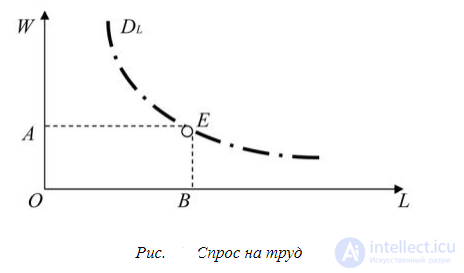
Fig. 4.1.1. Labour demand curve
Labour supply. The market labour supply curve (S) reflects its direct dependence on wages (fig. 4.1.2.). A rise in wages in a given labour market attracts both workers employed in other sectors of the economy and people who had not previously entered the labour market.
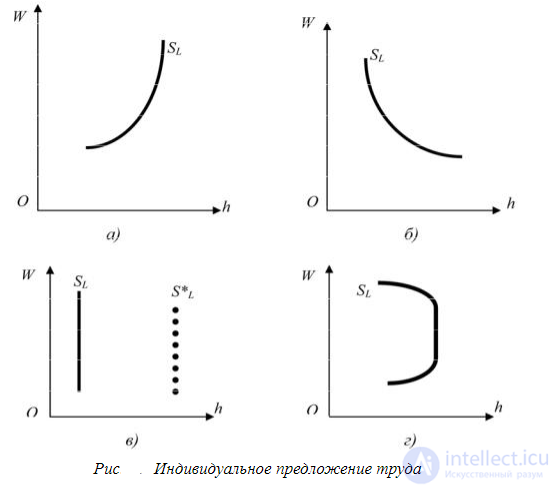
Fig.4.1.2. Individual labour supply
Individual labour supply reflects different potential capacities and motives for work. Fig.4.1.2. shows different variants of labour supply. In case a), the main motive for work is money, income. In case b), the worker reduces their labour supply as wages rise, because the income received is spent on proper rest. In case c), the worker works equally much or little regardless of the wage level — their supply is completely inelastic. As for the last case (d), it is the standard individual supply curve, which includes the previous non-standard cases as short-term moments.
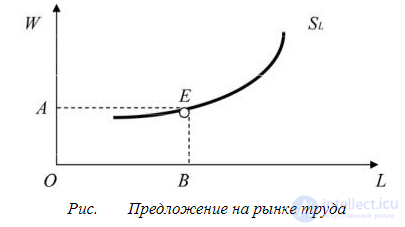
Fig.4.1.3. Labour supply curve
Market supply – the supply of workers at a given wage. It shows how many workers are willing to work for the wage offered. The market labour supply curve reflects its direct dependence on wages (Fig.4.1.3. ). A rise in wages in a particular labour market attracts to it both workers already employed in other sectors of the economy and people who had not previously entered the labour market.
Market equilibrium. The mechanism by which supply and demand interact under conditions of a balanced market is illustrated in Fig. 66, which combines the market demand curve and the market supply curve for labour. The demand curve D shows the quantity of labour that firms demand at each given wage level, while the supply curve S shows the quantity of labour offered on the market at each given wage level, on the assumption that all other factors remain fixed at a constant level.
In other words, if employers willing to pay the equilibrium wage find the required number of workers on the labour market, their effective demand for labour is fully satisfied. Workers willing to offer their labour at the equilibrium price are fully employed. This is why point E is said to define the position of full employment.
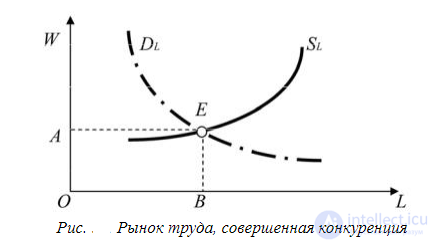
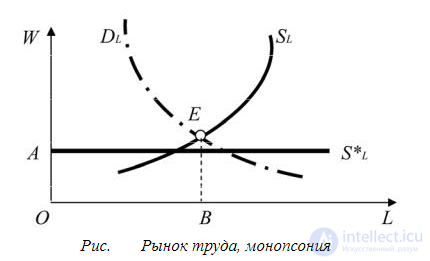
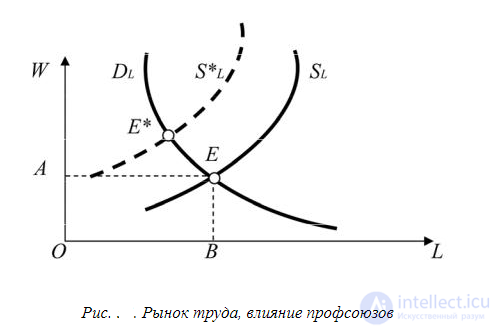
Fig.4.1.4. Market equilibrium
The mechanism by which supply and demand interact under conditions of a balanced market is illustrated in Fig.4.1.4., which combines the market demand curve and the market supply curve for labour. If employers willing to pay the equilibrium wage find the required number of workers on the labour market, their effective demand for labour is fully satisfied. Workers willing to offer their labour at the equilibrium price are fully employed. Point E defines the position of full employment.
State policy in the labour market. The labour market is regulated by the state to a much greater extent than many other markets. The most common types of regulation of labour relations are:
The modern labour market is a complex and dynamic environment that is constantly changing under the influence of various factors. Here are several general characteristics of the modern labour market:
Globalisation: The labour market is becoming increasingly global, meaning that workers can compete not only locally but also on a global scale. This creates both new opportunities and new challenges for workers.
Technological change: The rapid development of technologies such as artificial intelligence, automation and digitalisation is affecting the structure of jobs and requires new skills and knowledge from workers.
Flexible forms of employment: With the rise of freelancing, remote work and temporary contracts, flexibility has become a key aspect of the modern labour market. This can offer more freedom, but it also creates uncertainty for workers.
Rapid career change: Many people move between different occupations and sectors of the labour market over the course of their lives. Long-term career paths are becoming less common.
Importance of education: Education and continuous learning are becoming key to a successful career. The rapid change in market requirements demands the constant updating of skills and knowledge.
Workforce diversity: The modern labour market is becoming increasingly diverse in terms of age, gender, cultural background and ethnicity of workers. This creates new opportunities for inclusiveness and diversity in the workplace.
Corporate social responsibility: Companies are increasingly focused on social responsibility, including issues related to the environment, equality and the fight against discrimination. This affects corporate culture and values.
Pay inequality: Issues of wage inequality and access to career growth opportunities remain relevant and continue to spark discussion.
Mobility: Both global and local worker mobility are becoming more widespread, which can create opportunities for career growth and development.
The modern labour market demands flexibility, adaptability and continuous learning from workers. Employees must be ready for change and constantly develop themselves in order to successfully cope with the challenges presented by today's working environment.

Comments