
Lecture
Labour adaptation is a process that includes the adaptation of a new employee to their work role, the environment and the corporate culture of a new organisation. This process is aimed at ensuring that the employee can quickly and effectively perform their duties, and also feel comfortable and included in the team. There are many definitions of the concept of "adaptation", as well as of the concepts of "career guidance" and "onboarding". These definitions often overlap, and different authors use different terms for similar processes.
In the most general sense, adaptation —is the process of an employee adjusting to the conditions of the external and internal environment. In sociology and psychology, a distinction is drawn between
social and occupational adaptation.
Objectives of adaptation: reducing start-up costs, since while a new employee is not yet familiar with their workplace, they work less efficiently and require additional expenditure;
reducing anxiety and uncertainty among new employees;
reducing staff turnover, since if newcomers feel uncomfortable in the new job and feel unneeded, they may respond to this
by quitting;
saving the time of the manager and employees, since work carried out according to a programme helps to save each person's time;
developing a positive attitude toward work and job satisfaction.
Adapting to a new team after starting a job is an important process that helps you integrate into the work environment and become a productive member of the team. Here are a few tips for successful adaptation:
Study the corporate culture: Understanding the company's values, norms and expectations will help you fit into the team more easily. Learn the rules of communication, both formal and informal, and try to follow them.
Be open and friendly: Try to build relationships with your colleagues. Healthy working relationships can contribute to successful adaptation. Be ready to start a conversation and to listen to others.
Communication: Establish open and effective communication with your colleagues and management. Ask questions, share your ideas and concerns. This will help you understand more quickly how the company works.
Show initiative: Try not only to perform your duties, but also to look for ways to improve processes or propose new ideas. This can show you to be an active and purposeful employee.
Complete your training: If there is an opportunity for professional development or training, take advantage of it. This will help you adapt better and grow in your new role.
Respect diversity: Keep in mind that a team may include people with different cultural and professional backgrounds. Respecting diversity will help you build closer relationships with colleagues.
Set boundaries: Remember that it is important to find a balance between work and personal life. Do not hesitate to set boundaries and take breaks so as not to burn out.
Be tolerant of mistakes: Difficulties and mistakes can arise during the adaptation process. It is important not to be afraid of making them and to learn from them.
Take care of your health: Physical and mental health play an important role in successful adaptation. Pay attention to physical activity, nutrition, and stress resilience.
Ask questions: If you have questions or uncertainties, do not hesitate to turn to management or more experienced colleagues. It is important to obtain the information you need to work effectively.
Adaptation can take some time, and that is normal. Try to be patient with yourself and remain open to new experience.
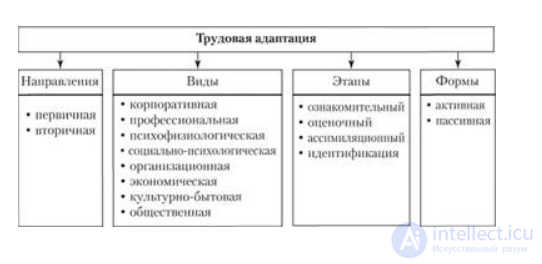
1. By subject-object relations:
2. By effect on the employee:
3. By level:
4. By area:
Production-related adaptation
Professional adaptation consists of actively mastering the profession, its subtleties, its specifics, and the necessary skills and techniques for making
decisions, initially in standard situations.
Psychophysiological adaptation is adaptation to work activity at the level of the employee's body as a whole, the result of which is smaller changes in their functional state (less fatigue, adjustment to high physical
loads, etc.).
Socio-psychological adaptation is adaptation to the immediate social environment within the team, to the team's traditions and unwritten norms, to managers' work style, and to the characteristics of the interpersonal relationships that have developed within the team. It means the inclusion of the employee in the team as an equal member,
accepted by all of its members.
Factors of production-related adaptation
Non-work-related adaptation
Factors of non-work-related adaptation
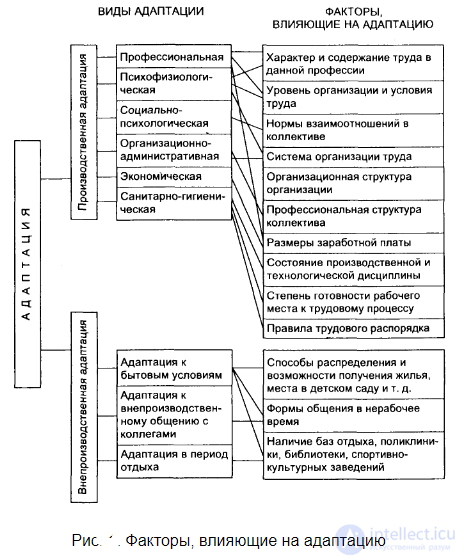
fig. factors affecting adaptation
Stage 1. Assessing the newcomer's level of readiness in order to develop the most effective adaptation programme.
Stage 2. Orientation - the practical familiarisation of the new employee with their duties and the requirements the organisation places on them.
Stage 3. Effective adaptation. This stage consists of the newcomer's actual adjustment to their status and largely depends on their inclusion in interpersonal relationships with colleagues.
Stage 4. Functioning. This stage completes the adaptation process; it is characterised by the gradual overcoming of production-related and interpersonal problems and the transition to stable work.
adaptation is one of the criteria of efficiency and affects the organisation's ability to function as effectively as possible with the minimum expenditure of human, time, information and other resources.
Workplace adaptation can have a significant economic impact both for the individual and for the organisation. Here are some economic consequences of workplace adaptation:
For the individual:
Increased productivity: When an employee successfully adapts to a new role and environment, their productivity and efficiency grow. This can lead to a higher salary and opportunities for career growth.
Reduced risk of job loss: Successful adaptation helps avoid a situation where a new employee decides to leave the company due to misunderstanding or dissatisfaction. This can save the company resources associated with hiring and training new employees.
Increased satisfaction: Employees who successfully adapt to their role and environment feel greater job satisfaction, which can lead to increased loyalty to the company and reduced staff turnover.
Professional development: Adaptation can include training and development, which can contribute to the employee's professional growth and improve their career prospects.
For the organisation:
Increased productivity and efficiency: Successfully adapted employees are more productive and effective in performing their duties, which has a positive effect on the company's performance.
Cost reduction: Reducing staff turnover and the need for constant hiring and training of new employees can save the company significant money.
Improving the company's reputation: Satisfied and successful employees can become the company's best advertisement, which can help attract talented candidates for job openings.
Reducing conflicts and stress: Employees who feel comfortable and successfully adapted are less prone to conflicts and stress, which contributes to a calmer atmosphere in the workplace.
Better decisions and innovation: Successful adaptation can help integrate new ideas and experience into the organisation more effectively, which can lead to innovative solutions.
The following forms of adaptation are distinguished:
1) Social adaptation – is the process of an individual settling into a social environment and
turning it into a sphere of their own activity, which involves the following stages:
2) Occupational adaptation – the process of an employee's integration into an industrial environment
that is new to them, mastering production conditions and work-related norms, and establishing and expanding the interconnections between the employee and the work environment.
3) Professional adaptation is characterised by the additional development of capabilities, knowledge, and skills, as well as the formation of personal qualities necessary for the profession and a positive attitude toward one's work.
4) Psychophysiological adaptation – adjustment to new physical and mental workloads and physiological working conditions.
5) Socio-psychological adaptation – alongside mastering working conditions, the employee enters into a process of socio-psychological adaptation to the organisation's team.
6) Organisational adaptation – the employee becomes familiar with the specifics of the organisation's management mechanism, the place of their department and position within the overall system of goals and the organisational structure. In this type of adaptation, the employee should develop an understanding of their own role in the production process.
7) Economic adaptation. Each profession is distinguished by its own particular methods of material incentives, and wages are linked to its conditions and organisation. The object of economic adaptation is the level of wages and, as has become relevant recently, the timeliness of their payment.
Adaptation in the workplace can be implemented through different forms and methods depending on the needs of the organisation and the characteristics of new employees. Here are some of the main forms and methods of adaptation:
Formal training and courses: Companies can provide new employees with formal training that includes an introduction to the company's procedures, policies, and systems. This can be either classroom training or online courses.
Mentoring or coaching: One of the effective forms of adaptation is assigning a mentor or coach to a new employee. This experienced colleague can help the newcomer better understand the work environment and tasks.
Orientation-day system: Organizations can hold special days or events for new employees, during which they are given additional information about the company, the opportunity to meet colleagues, and a chance to ask questions.
Individual adaptation plans: Creating personalized adaptation plans that take into account the specific needs and goals of new employees. This can include goals, expectations, and key tasks for the initial period.
Regular feedback: Organizations can establish a system of regular feedback between new employees and their managers. This helps identify problems and find solutions.
Social events and integration: Organizing events for new employees, such as corporate evenings, lunches, or team-building activities, helps create a positive working atmosphere.
Support from the HR department: The HR department can provide additional support to new employees by answering their questions and helping resolve issues related to employment.
System for evaluating and analyzing the adaptation process: Organizations can use systems for evaluating and analyzing the adaptation process in order to assess its effectiveness and make the necessary adjustments.
Overall, successful workplace adaptation has a positive effect on both the individual and the organization, contributing to increased productivity, efficiency, and job satisfaction.
N. Volodina proposes indicators for analyzing and evaluating the effectiveness of the adaptation process.
The cost of adapting one employee. This indicator is calculated based on the cost of the time of the people involved in the adaptation process, and includes the time spent by the mentor and the immediate supervisor, as well as the cost of handout and other materials.
The cost of training a mentor. Training a mentor refers to the amount of investment put into developing their professional competencies and into designing the training activities they will conduct for newcomers.
The number of employees who successfully completed their probationary period, relative to the total number hired. It is desirable for this indicator to equal 100%.
The number of employees who left the organization during the probationary period or at its conclusion. This indicator is the inverse of the previous one. It is important for the HR manager to analyze who initiated the termination of the employment contract: the employee or their immediate supervisor.
The most common adaptation methods used by responsible HR departments are the following:
Conducting interviews with employees after one, two, and three months of work.
Surveying employees after the completion of the adaptation period
Surveys on the adaptation system and adaptation activities. The factors most frequently measured in satisfaction surveys are: working conditions, training, compensation, and awareness of what is happening within the organization.
The choice of the form and methods of adaptation depends on the specific needs of the company and the new employees. It is important to create a multifunctional adaptation process suited to the organization, one that will help new employees successfully integrate into the work environment and become productive members of the team.
Managing the adaptation process means actively influencing the factors that determine its course, timing, and the reduction of unfavourable
consequences.
Functions of adaptation management
Employee adaptation within an organisation and effective management of this process require a great deal of organisational work. That is why many enterprises across the country set up specialised staff adaptation services. However, this is organised differently depending on the size of the enterprise's workforce, its management structure, the presence and organisation of a human resources management system, the extent to which the enterprise's administration is focused on solving social problems in the field of management, and other factors.
Employee adaptation services may exist as independent structural units (a department or laboratory) or be part of other functional units (as a bureau, group or individual employees) — within the personnel department, a sociological laboratory, a labour and wages department, and so on. Sometimes the position of an adaptation specialist is added to the staffing table. It is important for the adaptation service to be an integral part of the organisation's overall personnel management system.
The goals of the adaptation management system have been well formulated by A.Ya. Kibanov ] and can be presented in the form of a diagram:
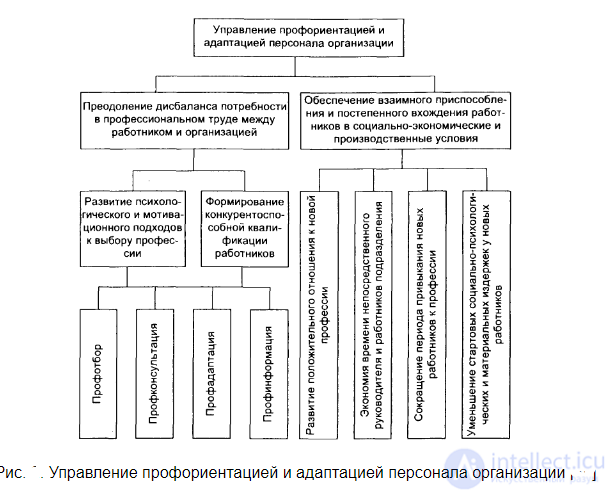
Fig. . Goals of managing career guidance and staff adaptation in an organisation
According to A.Ya. Kibanov, the tasks of the department or specialist responsible for managing adaptation, in terms of organising the technology of the adaptation process, are:
No personnel programme is needed for its own sake: everything has a cost and must generate a return – whether it is staff recruitment, the operation of a training institution, or staff adaptation.
When discussing effectiveness assessment, it is important to remember that different aspects can be evaluated:
The adaptation system as a whole,
The process of adapting a specific employee,
A specific adaptation tool or activity.
N. Volodina proposes indicators for analysing and evaluating the effectiveness of the adaptation process.
The cost of adapting one employee. This indicator is calculated through the cost of the time of the people involved in the adaptation process, and includes the time spent by the mentor and the immediate supervisor, as well as the cost of handouts and other materials.
The cost of preparing a mentor. Preparing a mentor refers to the amount of investment put into developing their professional competencies and into designing the training activities they will conduct for newcomers.
The number of employees who successfully passed the probationary period, relative to the total number hired. Ideally this indicator should equal 100%.
The number of employees who left the organization during or at the end of the probationary period. This indicator is the inverse of the previous one. It is important for the HR manager to analyse who initiated the termination of the employment contract: the employee or their immediate supervisor.
The most common adaptation methods in Russian HR departments are the following:
Conducting interviews with employees after one, two, and three months of work.
Surveying employees after the completion of the adaptation period
Surveys about the adaptation system and adaptation activities. The factors most often measured in satisfaction surveys are: working conditions, training, compensation, and awareness of what is happening in the organization.
Throughout the entire adaptation period, the manager should informally discuss with the employee their relationship with the department's team and their degree of adaptation, and monitor the fulfilment of the individual plan.
Periodically (at least twice in the first month and once in subsequent months), the adaptation process should be monitored by an HR specialist.
If an employee is dismissed during the adaptation period, the manager is obliged to refer them to the HR department for an interview within two weeks.
The HR management department collects and analyses the relevant information in order to determine the true reasons for the resignation. At the same time, the effectiveness of staff recruitment is assessed.
The success of adaptation depends on the characteristics of the work environment and of the employee themselves. The more complex the environment, the greater its difference from the familiar environment at the previous place of work, and the more changes it involves, the more difficult the adaptation process becomes.
Adaptation as a process is characterized by a certain duration and, therefore, has its own beginning and end. While there is no question as to the beginning of adaptation (this is the start of the employee's activity under the new conditions), determining its end is quite difficult. The fact is that adaptation — is a process that occurs continuously as the external factors of the employee's work activity change, and as the person themselves changes. Therefore adaptation is also relevant to a person who has not changed jobs.
From the standpoint of personnel management, the formation of labour potential, and the determination of adaptation timeframes, it is very important to clarify a concept such as limit of adaptation.
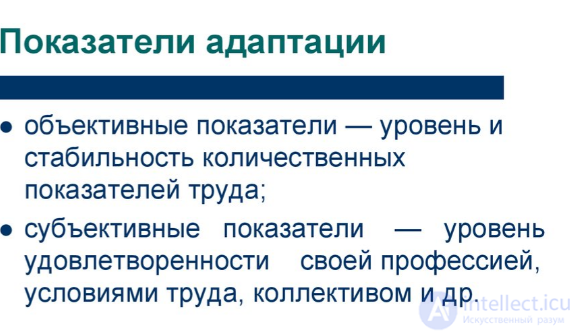
When determining the timeframe of adaptation (and with it the possible damage), certain quantitative indicators characterizing individual aspects of adaptation, or a system of indicators, can be used as its limit, or as the reference point for the completion of adaptation as a process. In particular, one can distinguish:
objective indicators — the level and stability of quantitative labour indicators;
subjective indicators — the level of satisfaction with one's profession, working conditions, the team, and so on.
The indicators listed relate to the immediate results of work, whereas it is often necessary to analyse the specific work of each unit involved in adaptation. In this case, we propose taking into account the indicators suggested by A. Ya. Kibanov:
Another approach to assessing occupational adaptation is based on the characteristics and results of each of its aspects.
Thus, to characterize psychophysiological adaptation, especially in jobs involving significant physical strain (for example, to assess the degree of conditioning as one of the results of adaptation), indicators of output and energy expenditure are used, as well as indicators of the state of the cardiovascular system, circulatory and respiratory function, recovery rate, and so on.
Professional adaptation, as the complete and successful mastery of a profession, is characterized by indicators such as the degree of mastery of time norms (their fulfilment, reaching the average percentage established in the team), reaching the average level of defective output caused by the employee's fault, and others.
Indicators characterizing socio-psychological adaptation include the level of psychological satisfaction with the production environment that is new to the person as a whole and with its components most important to them, the nature of relationships with colleagues and management, satisfaction with one's position in the team, the level of fulfilment of life aspirations, and others.
Various questionnaires, which should be given to the employee after the presumed completion of the adaptation period, can help obtain feedback from the employee on many of these issues. One such questionnaire was proposed by A. Ya. Kibanov.
Both when hiring staff and when inducting newcomers into a position, it is important to understand the main motives that make work necessary for them, as well as the hopes and fears associated with this. Most people, when starting a job, want to master it quickly and show that they can handle it well. However, regardless of whether this is their first job or not, new employees arrive on their first working day with a host of natural apprehensions. To prevent such situations, a well-thought-out induction procedure is needed or, in other words, a staff adaptation programme.
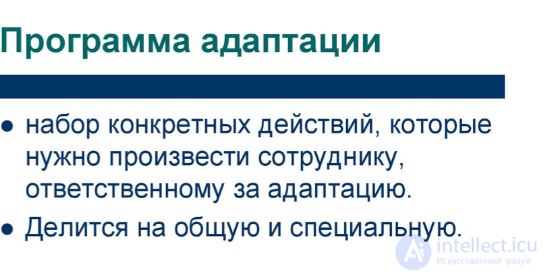
An onboarding programme is a set of specific actions that need to be carried out by the employee responsible for onboarding. Various textbooks use different synonyms for onboarding programmes — they are also called orientation programmes or simply orientation. The essence of these phenomena is roughly the same. We will use the term «onboarding programme», since we consider onboarding to be the basic, all-encompassing process that subsumes both induction into the position and orientation.
Most authors divide the programme into a general and a special (specialized) one. The general onboarding programme concerns the organization as a whole. Different authors include from 6 to 9 main issues in it. In our view, the essence of the general onboarding programme is most fully set out by T.Yu. Bazarov and B.L. Eremin.
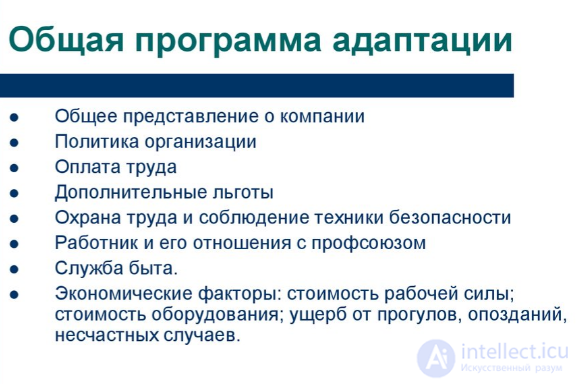
According to their view, the following issues should be addressed in the course of the programme:
1. General understanding of the organization:
2. Organizational policy:
3. Pay:
4. Additional benefits:
5. Occupational safety and compliance with safety regulations:
6. The employee and their relations with the trade union:
7. Welfare services:
8. Economic factors:
After completing the general program, one should move on to the special (specialized) one.
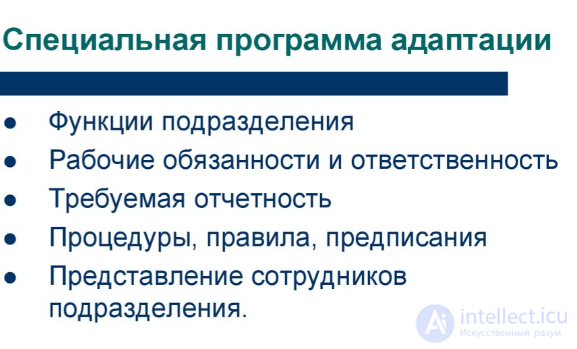
It covers issues specifically related to a particular department or workplace and is carried out both in the form of special conversations with employees of the department the newcomer has joined, and interviews with the manager (direct and senior). It should include the following issues:
1. Functions of the department:
goals and priorities, organization and structure;
areas of activity;
relationships with other departments;
relationships within the department.
2. Job duties and responsibilities:
a detailed description of the current job and expected results;
an explanation of the importance of this work and how it relates to other work in the department and the enterprise as a whole;
quality standards for performing the work and the basis for performance evaluation;
length of the working day and schedule;
additional expectations (for example, covering for an absent employee).
3. Required reporting:
types of assistance that can be provided, and when and how to request it;
relations with local and national inspection bodies.
4. Procedures, rules, regulations:
rules specific to this type of work or this department;
conduct in the event of accidents, safety rules;
reporting of accidents and hazards;
hygiene standards;
security and issues related to theft;
relations with employees who do not belong to this department;
rules of conduct in the workplace;
removal of items from the department;
monitoring of violations;
breaks (smoke breaks, lunch);
personal phone calls during working hours;
use of equipment;
monitoring and evaluation of performance.
Introduction to department staff.
These programs can be used for both primary and secondary adaptation. Since the adaptation of young employees who do not yet have professional experience differs in that it involves not only absorbing information about the organization but also learning the job itself, the adaptation program must necessarily include training.
Older employees have special adaptation needs. They also need training, and their needs are in some ways similar to those of young workers, and they often find it harder to fit into the team. The adaptation of employees with disabilities and of employees returning after completing training courses also has its own specific features.
Special attention should be paid to the adaptation of women returning to work after childcare leave. The longer she stays at home, the harder it is for her to get back into the working rhythm. This is because, first, after she returns to work a large gap in her knowledge is usually revealed (a great deal can change in three years, such as the appearance of new software or new technologies). Second, her rhythm of life is disrupted: during leave a woman planned her own time, whereas upon returning to work she is required to spend a set amount of time in one place. Third, a psychological barrier arises, whereby the woman must once again accept the status of a subordinate.
All of this cannot be left unattended and must be taken into account when drawing up onboarding programmes.
Management's policy and approach towards new employees play a critical role in a successful onboarding process. Here are a few key aspects that management should consider:
Leadership and example: Management must demonstrate leadership qualities and behave as a role model for other employees. A positive and attentive attitude of managers towards newcomers creates an atmosphere of trust and support.
Setting expectations: Management must clearly define expectations for new employees and share these expectations with them. This includes specific tasks, deadlines, key competencies and goals.
Feedback and support: Management must provide regular feedback to new employees, help them resolve questions and problems that arise, and support them through the onboarding process.
Mentoring: Management can assign mentors or coaches to new employees to help them adapt more quickly and master work processes.
Involvement in the training process: Management must actively participate in the training process for new employees, conducting briefings, tactfully warning against mistakes and helping to develop the necessary skills.
Support for development: Management must help newcomers understand their professional goals and develop a development plan that will help them achieve success within the company.
Creating a friendly culture: Management can foster a friendly and collaborative corporate culture in which newcomers feel welcomed and respected.
Evaluation and adjustment of the process: Management must regularly evaluate the effectiveness of the onboarding process and make adjustments, if necessary, to improve the experience of new employees.
Management's policy and approach towards newcomers can significantly affect how successfully they adapt to the company and become valuable team members. Openness, support and understanding on the part of management contribute to a smoother and more effective onboarding process.

Comments