
Lecture
Objectives: Didactic: to familiarise students with the psychological personality traits that influence the choice of a profession.
Developmental: to continue developing the ability to analyse, correlate, compare, identify the main point, establish cause-and-effect relationships, and give examples, and to improve the ability to work in a group.
Educational: to shape an emotional and personal attitude toward innovative technologies and to foster an active outlook on life. Students acquire the ability to listen, ask questions, and behave correctly by using knowledge of business etiquette, and rules of conduct in society are developed.
Equipment:
Form of organisation of learning activity in the lesson:
Motivation: the relevance of the lesson topic lies in broadening students' knowledge of understanding and taking into account the psychological personality traits that influence the choice of profession.
Expected results:
Course of the lesson
|
No. |
Structural elements of the lesson |
Teacher's activity |
Students' activity |
|
1 |
Organisational moment (2 min.) |
greeting |
Get ready for the lesson |
|
2 |
Announcement of the topic and objective of the lesson (3 min) |
On the board: the name of the lesson topic. |
Write it down in their notebooks |
|
3 |
Review of material previously covered (5 min.) |
Ongoing check in question-and-answer form. |
Answer the questions |
|
4 |
Preparing students for the active, conscious absorption of new material and presentation of new material and knowledge: a) psychological personality traits that influence the choice of profession b) testing (30 min) |
Objective: to identify the psychological factors and personality characteristics that influence the choice of profession. |
Write down the new material, ask questions and answer the teacher's questions. |
|
5 |
Consolidation of new knowledge (3 min.) |
Additions, clarifications and announcement of grades. |
Check the entries in their notebooks. |
|
6 |
Assignment of homework and instructions for completing it (2 min) |
Emphasise the purpose of the homework. |
Notes. |
E.A. Klimov identifies eight main factors that determine the choice of profession:
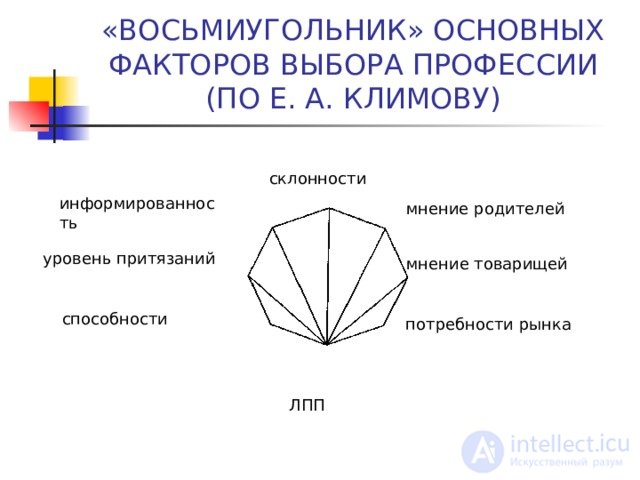
an octagon of the main factors in choosing a profession (according to Klimov)
1) the position of elders and family: very often parents give the child complete freedom of choice, thereby requiring independence, responsibility and initiative from them. It happens that parents disagree with the child's choice and suggest reconsidering their plans and making a different choice. Observations show that in most cases children agree with their parents' choice, counting on their help when applying to an educational institution;
2) the position of peers: it is precisely the position of the microgroup that can become decisive in professional self-determination;
3) the position of the school teaching staff (teachers, the homeroom teacher, etc.): each teacher, observing the student's behaviour only within academic activity, constantly analyses their interests, inclinations, intentions, and so on;
4) personal professional and life plans: in a person's behaviour and life, ideas about the near and distant future play a very important role. This includes the main goal and future goals, and the ways and means of achieving them;
5) abilities and how they manifest themselves: the abilities and talents of a senior-class student need to be considered not only in academic work, but also in relation to all other types of socially valuable activity;
6) the aspiration for social recognition;
7) awareness of one professional activity or another;
8) inclinations.
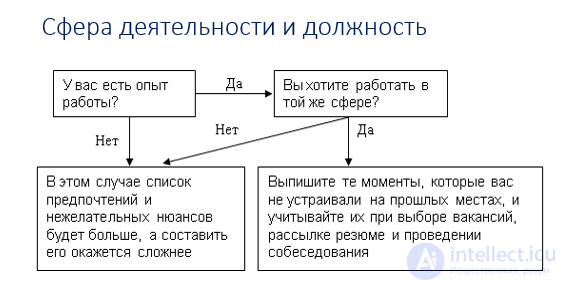
Fig. field of activity and position
Personal characteristics as a factor in choosing a profession:
1. Abilities - individual psychological features of a person that manifest themselves in an activity and are a condition for its successful performance. The speed, depth, ease and durability of the process of mastering knowledge, skills and abilities depend on one's abilities. But abilities themselves are not reducible to knowledge and skills. Research has established that abilities are formed during one's lifetime, that their development takes place throughout life, and that the environment and upbringing actively shape them.
2. Temperament - a set of individual features characterising the dynamic and emotional aspects of a person's behaviour, activity and communication. Temperament is biologically determined and innate. Temperament is most closely connected with character.
3. Character - an individual combination of the most stable, essential, acquired features of a personality, manifested in a person's behaviour and activity.
4. Interest - this is an individual psychological feature of a person, characterised by a selective orientation toward the phenomena of reality. Interests can develop into inclinations - a drive to engage in a particular activity, a thirst for that activity.
5. Self-assessment is one of the necessary conditions for taking a personal approach to choosing a profession. Knowing oneself comes through comparing oneself with other people, through becoming aware of one's own capabilities and achievements and comparing them with the successes and achievements of the people around one.
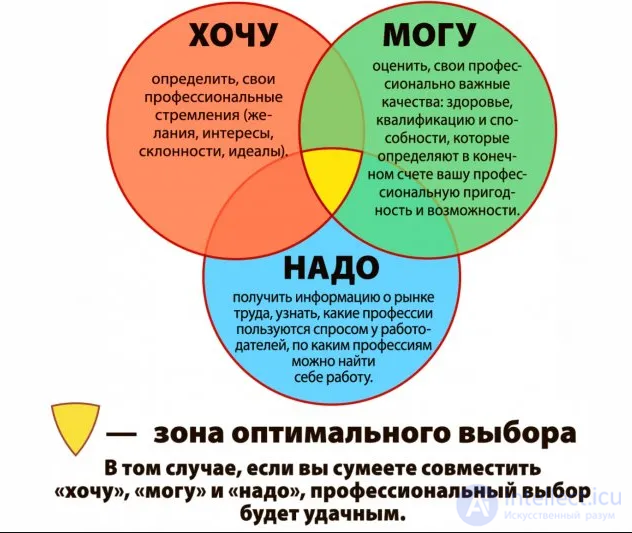
Fig. zone of optimal career choice
Choosing a profession is a complex process that depends on many factors, including the psychological traits of the personality. Here are some of the key psychological traits that can influence the choice of a profession:
Interests:
Talents and abilities:
Personal values and beliefs:
Personality type:
Level of ambition:
Experience and education:
Sociocultural context:
Emotional state:
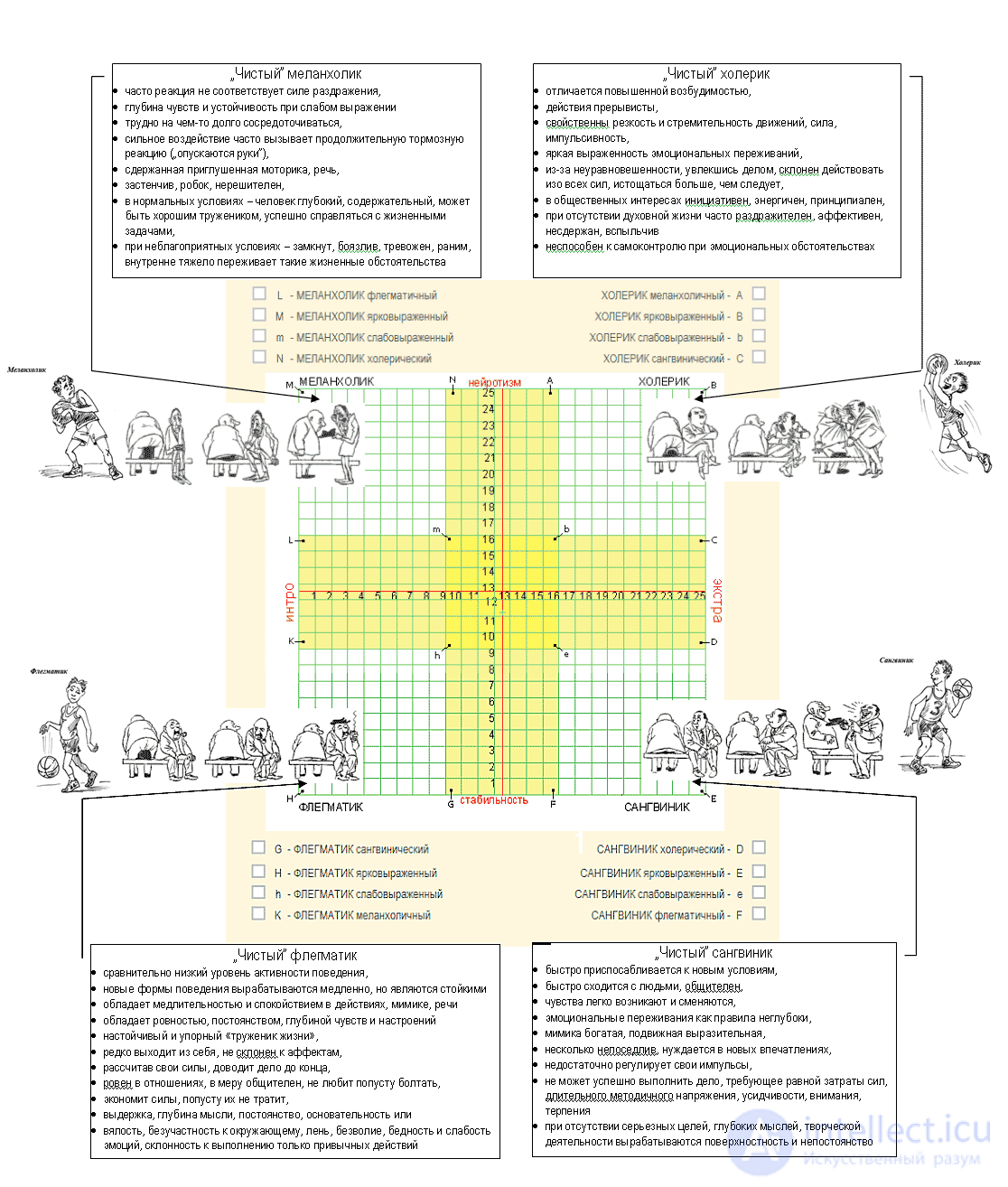
Temperament, which changes little over the course of a lifetime, must be taken into account when determining one's professional future, since ignoring the features of one's temperament when choosing a profession can lead to a loss of interest in the work, severe overload and exhaustion, and even a decline in health.
So how exactly does temperament affect success in professional activity?
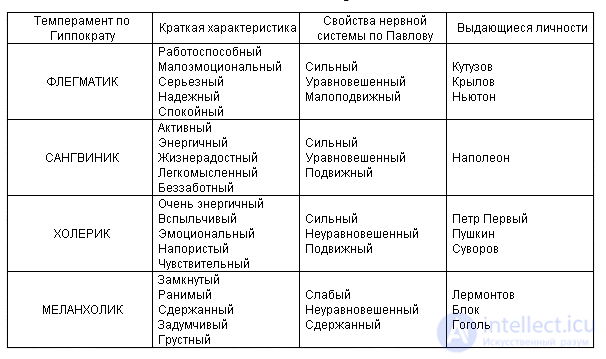
You are already familiar with the biographies of Peter I, Napoleon Bonaparte, M. I. Kutuzov, and A. V. Suvorov. All of them were outstanding military commanders and statesmen, and each had a different type of temperament. Yet each of them acted within specific historical conditions and circumstances. Still, individual features of temperament and talent contributed to the success of their work.
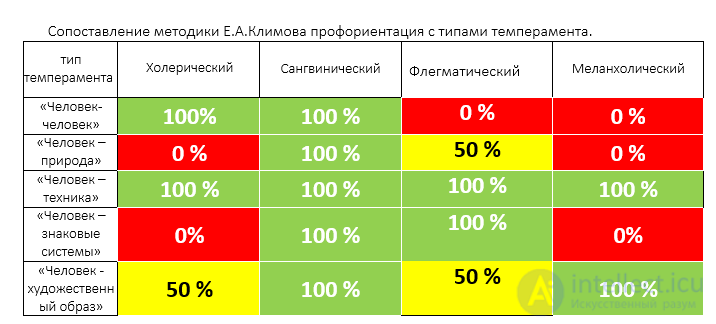
Fig. Comparison of E. A. Klimov's career-guidance methodology with temperament types. (based on the students' own group research)
Let us recall: I. A. Krylov, N. V. Gogol, A. S. Pushkin, and M. Yu. Lermontov. The distinctiveness of these writers' work reflects, to a certain extent, the features of their different types of temperament.
Alexander Suvorov was a choleric. By nature he had weak health, and as a child he terrified his parents by dousing himself with cold water outdoors late in the autumn. He managed to temper not only his body but also his spirit. Having become a great military commander, he was in no way inferior to his soldiers, sharing all the hardships of campaign life with them and astonishing everyone with his energy and determination. The complete opposite of Suvorov was the phlegmatic Kutuzov. His temperament likely influenced his choice of strategy in the war against Napoleon. Phlegmatics are peaceable, but only until their interests are affected. Phlegmatism did not stop the military commander Kutuzov from defeating Napoleon.
The famous military commander, Napoleon, was a sanguine. This type of temperament is considered the strongest. However, it did not save Napoleon from the defeat inflicted on him by phlegmatic Kutuzov.
Why are there no celebrated military commanders among melancholics?
High sensitivity combined with a need for solitude gives rise not to military commanders but to creative artists. Most poets, painters, and musicians are melancholics. Their works are a record of their feelings and experiences. Through the power of their talent they make others experience their happiness and their suffering. Chopin was a typical melancholic: his doubts, inner unease, and extreme sensitivity are reflected in his music. It is no accident that he is the author of the famous «Funeral March»…
Melancholic traits were characteristic of Nadson (this is evident in the whole tone of his work) and, apparently, of Levitan (recall his vulnerability).
N. V. Gogol belonged to the weak type of higher nervous activity; in particular, the burning of the manuscript of the second volume of «Dead Souls», along with the depression and anxiety that developed in him in his later years, were the result of a psychasthenic obsessive state. Outwardly, this manifested itself in an outburst of religiosity. I. P. Pavlov was truly right when he observed: «Religion is needed by the weak». However, there are no rules without exceptions. A choleric temperament did not prevent Pushkin from becoming a great poet. Our great poet's liveliness of character, his optimism, his extraordinary breadth of perception, and his interest in the most varied aspects of life are well known. One cannot help but quote Stendhal's words: «The choleric - is the temperament of outstanding people».
The famous French writer Alexandre Dumas was a sanguine. Remember his «Three Musketeers»? Athos, Porthos, Aramis, and d’Artagnan represent precisely the four temperaments. They complement one another, like the four elements or the four seasons, and are therefore invincible.
Temperaments are rarely found in pure form. Every person has something of the choleric, the sanguine, the phlegmatic, and the melancholic in them. The question of which is better to be makes no more sense than the question of which season is better. Each has its own advantages and disadvantages. One must know them and act by choosing an effective model of behaviour depending on the situation, not simply following one's natural inclinations, but developing them.
The features of temperament must be taken into account when choosing a profession, but temperament should not be confused with character. Kindness and cruelty, diligence and laziness, tidiness and untidiness – all of these are character traits, which are not innate but are formed over the course of a lifetime. A person of any temperament can be intelligent or foolish, honest or dishonest, talented or untalented. A person's success depends largely on their temperament, as well as on their abilities, knowledge, skills, and personal orientation.
Table 1.
Choosing a profession is usually a complex and individual process that depends on many factors. Understanding your own personal characteristics and needs can help you make a more informed decision about choosing a profession that will match your expectations and goals.

Comments