
Lecture
Physical and geometric methods in astronomy and geodesy play a key role in studying the Earth, its shape, gravitational field, and dynamics, as well as in understanding the structure and motion of celestial bodies.
In astronomy, physical methods are used to investigate the nature of objects in the Universe through analysis of their radiation, the study of interactions, and the application of the laws of mechanics and gravitation. Geometric methods make it possible to accurately determine the positions of and distances between astronomical objects, which is important for constructing star charts, measuring cosmological parameters, and modeling orbits.
In geodesy, physical methods include studying the Earth's gravitational field to determine its shape (the geoid) and studying dynamic processes such as plate tectonics. Geometric methods are used for precise measurements of coordinates on the Earth's surface, constructing geographic maps, and determining the position of objects using satellite systems such as GPS.
The combined use of physical and geometric approaches provides a basis for solving complex problems related to determining the structure of the Earth, studying its interaction with the space environment, and building global coordinate systems.
Spectral radiant power per unit surface area. Planck's formula, the Rayleigh–Jeans and Wien approximations, and their ranges of applicability. Brightness temperature. Kirchhoff's law.
The spectral radiant power per unit surface area characterizes the energy emitted by an absolutely black body at a given wavelength per unit time. This quantity is described by Planck's formula, which gives the distribution of thermal radiation intensity as a function of wavelength and temperature.
Planck's formula describes the radiation of an absolutely black body:
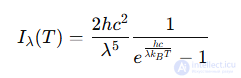
where:
This formula accounts for quantum effects and describes the radiation spectrum for all wavelengths.
The Rayleigh–Jeans approximation (long wavelengths): For long wavelengths  , the exponential term in Planck's formula can be expanded:
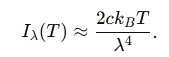
This approximation works well for the radio range or microwave wavelengths, where the wavelength significantly exceeds the thermal length.
The Wien approximation (short wavelengths): For short wavelengths  ), the exponential term tends to infinity, and the formula simplifies to:
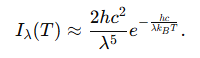
This approximation works for the ultraviolet and X-ray ranges.
The brightness temperature (TBT_BTB) — is the temperature at which an absolutely black body radiates the same intensity at a given wavelength as the observed source. It is determined from Planck's formula, solved with respect to TTT, for a given intensity IλI_{\lambda}Iλ.
Kirchhoff's law states that for any body the absorption coefficient αλ\alpha_\lambdaαλ equals its emission coefficient jλj_\lambdajλ at a given wavelength and temperature:
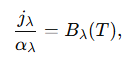
where  — is the spectral radiant power of an absolutely black body, described by Planck's formula.
These principles find application in astrophysics for studying stars, galaxies, and other objects whose radiation can be modeled using these theories.
The interaction of radiation with charges. The hydrostatic equilibrium of stars, the Eddington luminosity limit.
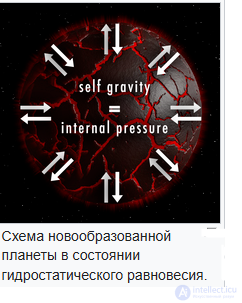
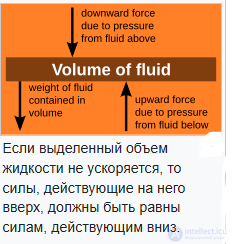
Hydrostatic equilibrium — is a state in which the forces acting inside a star are balanced. This allows the star to maintain a stable shape and size for a significant part of its life.
The equation of hydrostatic equilibrium is written as:
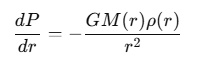
where:
Inside a star, radiation (the photon flux) interacts with charged particles such as electrons and ionized atoms. The main interaction mechanisms are:
Recombination and ionization:
A photon can ionize an atom by being absorbed. Or, conversely, upon recombination the atom emits a photon.
Bremsstrahlung (braking radiation):
Charged particles, when accelerating or decelerating, emit electromagnetic waves.
Compton effect:
A photon is scattered by an electron, changing its energy.
Thomson scattering:
Photons are scattered by free electrons, which affects the transfer of energy by radiation.
These processes determine the transport of energy inside the star and its luminosity.
The Eddington luminosity (LEdd) — is the maximum luminosity of a star at which the radiation pressure produced by the radiation balances the gravitational attraction. If a star exceeds this limit, its matter will begin to be blown outward by the radiation pressure.
The expression for the Eddington limit:
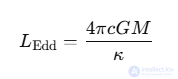
where:
The Eddington limit is important for understanding:
At different stages of a star's life, hydrostatic equilibrium is maintained by different processes:
If the equilibrium is disturbed (for example, due to fuel exhaustion), the star may collapse or explode as a supernova.
Interference and diffraction. Dispersion of light, spectral instruments (prism, diffraction grating). Spectral resolution. Spectra of various astronomical objects. Effect of the medium's temperature on spectral line width
Spectroscopy — is a method of studying the interaction of radiation with matter, based on the analysis of the spectrum of light. It allows obtaining information about the composition, temperature, density, and motion of matter that emits or absorbs light. In astronomy, spectroscopy is the primary tool for studying the physical and chemical properties of celestial objects.
Interference: Occurs when light waves overlap each other, forming zones of intensity reinforcement and weakening. This phenomenon is used in interferometers for high-precision measurements of spectral lines.
Diffraction: The bending of a light wave when passing through narrow openings or past obstacles. Diffraction creates characteristic patterns, which are used in diffraction gratings to decompose light into a spectrum.
Prism:
Diffraction grating:
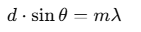
where d — distance between slits, m — diffraction order, λ — wavelength.
Spectral resolution (RRR) characterizes the ability of a spectral instrument to distinguish close wavelengths. It is defined as:

where λ — is the wavelength, Δλ— is the minimum distinguishable wavelength difference.
The width of a spectral line depends on the physical conditions of the medium, in particular on its temperature.
Thermal broadening:
Occurs due to the motion of the atoms or molecules of the medium. The higher the temperature, the faster the particles move, producing a Doppler effect that leads to an increase in line width.
Pressure or collisional broadening:
At high density or temperature, collisions between particles become frequent, which alters the emitted energy and leads to line broadening.
Natural-width broadening:
Related to Heisenberg's uncertainty principle, which limits the lifetime of the excited state of atoms, affecting the line width. This effect does not depend on temperature, but plays a role under conditions of low pressure.
Refraction of light and atmospheric refraction for an arbitrary position of an object. The spectral dependence of refraction, the «green flash». The influence of refraction on the brightness characteristics of objects. Optical depth. Absorption and scattering of light in the atmospheres of the Earth and planets, Bouguer's law. Reflection of light by various surfaces, Lambert's law. Interstellar extinction of light, its dependence on wavelength. Color excess, three-color diagrams, the magnitude of an object at a given distance in the presence of extinction. The photometric parallax method for determining distances to stars.
The apparent position of a celestial body above the horizon differs from that calculated by the formulas.
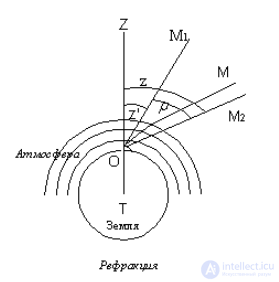
Rays of light from a celestial body, before reaching the observer's eye, pass through the Earth's atmosphere and are refracted in it, and since the density of the atmosphere increases toward the Earth's surface, the light ray is deflected more and more in the same direction along a curved line, so that the direction OM1, along which the observer sees the celestial body, turns out to be deflected toward the zenith and does not coincide with the direction OM2, along which they would see the celestial body in the absence of an atmosphere.
The phenomenon of the refraction of light rays as they pass through the Earth's atmosphere is called astronomical refraction. The angle M1OM2 is called the angle of refraction, or refraction ρ.
The angle ZOM1 is called the apparent zenith distance of the celestial body z`, and the angle ZOM2 is called the true zenith distance z.
z - z` = ρ,
i.e. the true zenith distance of the celestial body is greater than the apparent one by the amount of the refraction ρ.
Refraction, as it were, raises the celestial body above the horizon.
Since, according to the laws of optics, the incident and refracted rays lie in the same plane, refraction does not change the azimuth of the celestial body, and it equals 0 if the celestial body is at the zenith.
Refraction depends on the altitude of the celestial body above the horizon and on the state of the atmosphere (temperature and pressure).
On the horizon line the refraction averages 35`.
At a pressure of B mm Hg and a temperature of t0C, the approximate value of the refraction is:
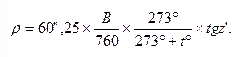
As a result of refraction, a change in the shape of the disks of the Sun and Moon is observed at their rising or setting.
The Earth has a shape close to spherical. Various ancient peoples knew this. In particular, many Greek philosophers had no doubt of it, starting from the earliest. Already in the 6th century BC, Pythagoras taught that the Earth is spherical and revolves around a central fire.
The true size of the Earth was known to the ancient Chaldeans and Egyptians. Unfortunately, the methods by which these values were obtained have not survived to our day. The earliest known measurements of the Earth's size were made by Eratosthenes (276—194 BC). He determined that at the time of the summer solstice, the zenith distance of the Sun at noon in Alexandria was 7°.2, while in Syene the Sun at that moment was exactly at the zenith. Knowing that Syene lay on the same meridian as Alexandria, he concluded that the distance between these cities equaled 7°.2 of the Earth's circumference. This distance was well known in Greek stadia, since they lay on a busy trade route. Substituting the obtained value into his calculations, Eratosthenes calculated the length of the Earth's circumference to be 250,000 stadia. From this it followed that the radius of the Earth equals (in modern units) 6300 km.
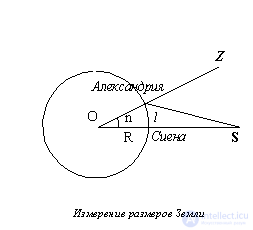 These calculations can be represented as follows. Let l be the length of an arc of the meridian, and n its value in degrees. Then the length of a 1° arc of the meridian l0 will equal

The length of the entire meridian circle equals
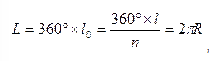
from which we obtain the radius of the Earth's circle

The value n =φ1 −φ2 .
Here φ1 and φ2 are the geographic latitudes of the cities.
The distance from the Earth to the Sun was first established by astronomical methods by Aristarchus of Samos. Measuring the angular distance of the Moon from the Sun at the moment of first quarter, when the angle Earth-Moon-Sun equals 90°, he found that "the distance from the Earth to the Sun exceeds the distance to the Moon by more than 18, but less than 20 times..., that the diameter of the Sun to the diameter of the Moon has the same ratio: that the diameter of the Sun to the diameter of the Earth has a ratio greater than 19 to 3, but less than 43 to 6...". If one works through these ratios, it turns out that the radius of the Sun is about seven Earth radii. It was precisely this that led Aristarchus of Samos to the conclusion that it is not the Earth, but the Sun, as the larger body, that is located at the center of the world. Of course, the values obtained by the Greek scholar do not correspond to reality, but they show the correct tendency. Aristarchus's method is in principle correct, but the poor accuracy of angle measurements did not allow him to obtain correct results.
Numerous modern measurements on the Earth's surface have shown that the length of one degree of the Earth's meridian differs at different latitudes. Near the equator this value equals 110.6 km, and near the poles 111.7 km. The length of one minute of an average degree of latitude equals 1852.2 m. It is taken as the basis for nautical measurements and is called the nautical mile. It is used in maritime affairs, where all calculations are conventionally done in degrees, minutes, and seconds. There are also the land mile, equal to 1609 m, the geographical mile, equal to 4 minutes of latitude or 7412.6 m, and other miles. The Earth's diameter between the poles from north to south (the length of the Earth's axis) equals 12,713.7 km. The diameter of the Earth's equator equals 12,756.5 km.
The curvature of the Earth's surface is smaller in the polar regions than in the equatorial regions. This indicates that the Earth has a surface close to a spheroid.
Based on measurements of the elements of the Earth's spheroid, the International Astronomical Union adopted in 1964 that its minor semi-axis, coinciding with the axis of rotation, b = 6356.78 km, and its major semi-axis, lying in the plane of the equator, a = 6378.16 km. The flattening ε = (a - b)/a = 1/298.25.
The real figure of the Earth, having mountains, depressions, seas, and other irregularities of relief, cannot be described by any single regular geometric solid.
Today the figure of the Earth is called the geoid. The study of the shape of our planet is carried out by geodesy and gravimetry.
The method of triangulation was first applied by Snellius in 1615 when measuring an arc of the meridian in Holland. Since then and up to the present time, in various countries, at various latitudes, many arcs on the Earth's surface have been measured, not only along meridians but also along parallels. All these measurements have shown that the length of a 1° arc of the meridian is not the same at different latitudes: near the equator it equals 110.6 km, and near the poles — 111.7 km, i.e., it increases toward the poles. This means that the curvature of the Earth's surface is smaller in the polar regions than in the equatorial regions. Consequently, the Earth differs from a sphere and has a somewhat flattened shape, close to a spheroid (an ellipsoid of revolution).
Large distances on the Earth's surface are very difficult to measure. This is hindered by the unevenness of the Earth's terrain. Calculations are carried out using a special method – triangulation, which requires measuring a small baseline and angles. It was first applied by Snellius in 1615 when measuring a meridian in Holland.
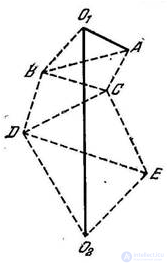 The essence of the triangulation method is as follows. On both sides of the arc O1O2, whose length must be determined, several points A,B,C,D,E… are chosen at distances of approximately 40 km from one another. The points are chosen so that from each of them at least two other points are visible. Geodetic towers are erected at all points. At the top of the tower a platform is made for the observer. The distance between two neighboring points, for example, O1A, is chosen on a very level surface and is taken as the baseline. The length of the baseline is measured very precisely using a measuring tape. After that, the observer at each tower measures all the angles of the triangles O1AB, ABC, BCD, ... Knowing, in the first triangle O1AB, all the angles and the baseline, one can calculate the other two sides, O1B and AB, and knowing side AB and all the angles of triangle ABC, one can calculate sides AC and BC, and so on. In this way, step by step, one can calculate the length of the broken
line O1BDO2. Having determined from point O1 the azimuth of the direction of side O1A, one must project the broken line O1BDO2 onto the meridian O1O2 and obtain the linear dimensions of the arc O1O2.
Radiation receivers in gamma-ray, X-ray, ultraviolet, infrared, and radio astronomy. The jansky. Angular resolution of radio telescopes and radio interferometers.
All-wave astronomy studies celestial objects across the entire range of the electromagnetic spectrum: from gamma radiation with the highest energies to radio waves with the longest wavelengths. Each range of radiation provides unique information about the physical processes in space.
Gamma-ray astronomy:
X-ray astronomy:
Ultraviolet astronomy:
Infrared astronomy:
Radio astronomy:
Karl Jansky, in the 1930s, first detected radio emission from the Milky Way, marking the beginning of radio astronomy. In his honor a unit for measuring the intensity of radio emission was introduced: the jansky (1 Jy).
Radio telescopes:
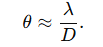 .
.Radio interferometers:
The thermal balance of planets and the greenhouse effect. The ozone layer in Earth's atmosphere, its optical properties. Noctilucent clouds. The structure of the atmospheres of the planets of the Solar System, ideas about the atmospheres of exoplanets.
Dipole magnetic field. The magnetic field of the current sheet. Magnetic pressure. The magnetospheres of celestial bodies. The energy of the magnetic field and its conversion into other forms of energy.
Structure and morphology of galaxies of various types. Rotation curves, dark matter. Stellar luminosity functions, the initial mass function, the «mass–luminosity» relation. The Tully–Fisher and Faber–Jackson relations.
The principle of relativity, the principle of the invariance of the speed of light. Lorentz transformations, relativistic addition of velocities. Length contraction and time dilation. The «light echo» effect. The relativistic Doppler effect. Gravitational redshift (in weak fields). The concept of gravitational lensing.
The large-scale structure of the Universe. The past and future of the Universe. The expansion of the Universe. The scale factor. The model of a homogeneous isotropic Universe. The Friedmann equation (qualitative understanding), the evolution of the scale factor within the framework of Newtonian physics. The critical density of the Universe. Baryonic matter, dark matter, and dark
energy. The relic (cosmic microwave background) radiation, its properties.

Comments