
Lecture
22.2. Pressure and temperature in the interiors of stars.
Stellar physics — a branch of astrophysics that studies the physical side of stars (mass, density, and so on). Understanding the processes of the birth and death of stars requires applying almost all branches of modern physics
At present there are many studied stars, each of which is unique and differs from the others in its parameters (size, mass, density, color, and others). Speaking of the physical data of stars, one cannot avoid the methods of obtaining this data. The sizes of stars can be determined in several ways. The first method is the use of an optical interferometer with further use of the obtained data in calculating the size using formulas. The disadvantage of this method is the lack of precise data on the radius of the star being studied. This method is difficult to use for stars located far from our planet. To determine the sizes of many other stars, a second method is used. Our planet's satellite — the Moon — is used in calculating the data. It is the Moon that covers the star being studied, gradually blocking its light. During this time the so-called angular size of the star is recorded, after which the true size of the star is calculated using data on the distance to it. There is also a third method of calculating sizes. It consists of theoretically calculating the size of the star based on estimates of the total luminosity and temperature according to the Stefan-Boltzmann law. As mentioned earlier, each star is unique in its own way. If all stars are divided by their sizes, one can speak of dwarf stars, giant stars, whose size is comparable to the size of the Solar System, and the rest of the Main Sequence stars, which make up the majority.
The mass of stars as a subject of research represents a very important characteristic. Mass varies depending on the amount of matter contained in the star. Accordingly, the pressure, temperature, and many, many other factors change with the amount of matter. At present astronomy does not have a method for direct and independent determination of the mass of an isolated star. For main sequence stars it has been established that the greater the mass, the higher the star's luminosity. This dependence is nonlinear: for example, when the mass doubles, the luminosity increases by more than 10 times. In general, the masses of stars, from the largest to the smallest, differ by only a few hundred times.
The density of stars depends to a greater extent on the size of the star. Let us recall the well-known rule (source?) that giant and supergiant stars have a much lower density (5..10 mg/m3) than medium and small stars. The leaders in density are dwarf stars (their density varies from 900 to 1011 kg/m3). The large spread in density can be explained by the very interesting properties of the matter of these stars. The fact is that the electrons of stellar matter are torn away from the atomic nuclei. And the state of aggregation of this matter is difficult to assign to any state of aggregation. Indeed it is neither liquid nor solid, but nevertheless it is customarily considered gaseous.
With the use of modern telescopes, it has become possible to divide stars according to their brightness into 24 groups. Previously it was customary to divide stars into only six groups. The unit of measurement for star brightness is taken to be the Latin letter "m," an abbreviation of the word "magnitude," which from Latin means "size." The brightest stars are classified as first magnitude stars (1m). Stars with lower brightness are classified as 2m. Further division of star brightness proceeds in descending order (that is, the faintest stars are classified into group 24m).
In 2017 a brown dwarf was found with a temperature of 27 °C .
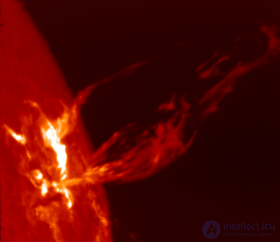
The Sun's magnetic field produces coronal mass ejections. Photo NOAA
A stellar magnetic field — a magnetic field created by the movement of conducting plasma inside main sequence stars. This movement is created by convection, which is one of the forms of energy transfer from the center of the star to its surface by physical movement of material. Local magnetic fields act on the plasma, as a result of which magnetized regions rise relative to the rest of the surface, and can even reach the star's photosphere. This process creates stellar spots on the surface of the star (by analogy with sunspots), and the associated appearance of coronal loops.
A stellar-wind bubble (astrosphere) is the region of space within a star system in which the stellar wind of the star (or stars) has a positive velocity directed away from its star. On the outside, the astrosphere is conventionally bounded by a collisionless shock wave, determined by the pressure balance between the stellar wind on one side and, on the other, the pressure of the magnetic field and the interstellar medium. The heliosphere is a particular case of an astrosphere.
The region can be several light-years across for a massive star of classes O, B, or a Wolf—Rayet star. It is bounded by hot gas of the interstellar medium in the shock-wave zone, which is heated by the high speed of the stellar wind (up to several thousand km/s in young and hot stars). Also, gas from inside the system is «blown out» by the wind. The astrosphere of less hot stars (such as the Sun) heats the interstellar gas only slightly.
Astrospheres have a structure with two shock waves : the region where the wind is decelerated is called the termination shock; the region along which the pressure of the wind and of the interstellar medium is balanced, i.e. where the wind loses its speed completely, is called the astropause (by analogy with the heliopause); the boundary at which the interstellar medium collides with and mixes with the oncoming stellar wind is the bow shock. Gas in the zone of the termination shock can be heated to 106 K and produce X-ray radiation due to its ionization to a plasma state.
The bubble itself is not spherical in shape. On one side it is elongated, and on the other compressed, depending on the direction of rotation of the star system around the galactic center and on the density of nearby stars and their energy output.
At high density of interstellar gas and dust, or in the presence of a previously ejected stellar envelope, nebulae observed from Earth are formed by shock waves (for example, the Crescent Nebula).
There also exist «superbubbles,» so-called H II regions — cavities up to several hundred light-years across, formed in interstellar gas by the action of the stellar wind of clusters of large young stars.
For example, the object designated N44F is located approximately 160,000 light-years from Earth in the neighboring dwarf galaxy the Large Magellanic Cloud (in the direction of the southern constellation Dorado). N44F is being inflated by streams of stellar wind from an extremely hot star, once «buried» in a cold dense cloud.
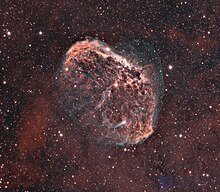
Crescent Nebula |
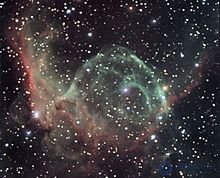
Thor's Helmet Nebula |
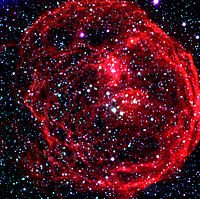
Superbubble N70 (also Henize 70 or DEM301) in the Large Magellanic Cloud galaxy.
A superbubble is a region of interstellar space filled with hot gas, having a reduced density compared to the surrounding medium and reaching several hundred light-years across. Unlike stellar-wind bubbles created by single stars, superbubbles form around OB associations located within molecular clouds. Stellar wind from OB stars and energy from supernova explosions heat the material of superbubbles to temperatures of the order of 106 K . Older superbubbles, which have a denser dusty outer shell and a more rarefied and cooler interior, are also called supershells. The Solar System is located near the center of an old superbubble known as the Local Bubble, whose boundaries can be determined by a sudden increase in dust extinction at distances beyond several hundred light-years.
The main method of studying stars is the study of their spectra. The numerous dark lines crossing the spectral band are related to the absorption of light by atoms of various elements in the atmospheres of stars. Since each chemical element has its own set of lines, the spectrum makes it possible to determine what substances the star is made of. Stellar spectra can be divided into several main classes.
In the 1950s, the Harvard classification distinguished seven spectral classes, denoted by the Latin letters O, B, A, F, G, K, M. Moving along the sequence from left to right, the color of the star changes: O — blue, A — white, G — yellow, M — red. In the same direction, the temperature of the stars decreases accordingly. Later a new class, W, was added.
The hottest stars are class W stars. Their surface temperature reaches 100000 K. Their color is blue. Class O stars are also blue. Their temperature is 50000 K (kelvins) or lower. Blue-white class B stars have a temperature of 12000 — 25000 K; white class A stars — 11000 K. Yellow stars of classes F and G and yellowish-orange class K stars have a temperature of around 4500 K. And finally, the coolest stars are red class M stars with a temperature below 3600 K.
The main process taking place in the interiors of stars is called thermonuclear fusion. Thermonuclear fusion is a type of nuclear reaction in which light atomic nuclei combine into heavier ones owing to the kinetic energy of their thermal motion.
In studying the processes taking place in the interiors of stars, an experiment was carried out on the fusion of two or more nuclei of light elements. This resulted in the finding that an enormous amount of energy is released at the moment of fusion. In connection with this, it was concluded that a continuous process of thermonuclear fusion takes place inside stars, which serves as an inexhaustible source of stellar energy. It is also worth noting the effect of temperature on the reactions taking place inside stars. At extremely low temperatures only two types of reaction occur: the «proton — proton chain» and the «carbon-nitrogen cycle». Each of these reactions leads to the conversion of hydrogen into helium with the release of an enormous amount of energy. At high temperatures, on the other hand, the proton — proton chain and the carbon-hydrogen cycle predominate. The reactions taking place in stars make it possible to explain the elemental composition of our universe, which consists mostly of hydrogen and helium, with the content of the remaining elements amounting to a fraction of a percent.
The lifespan of each star depends directly on its mass. If we take the mass of the Sun as the unit of measurement for a star's mass, then we can say that a star with a mass two or three times greater will exist for 15-25 million years. The greater the mass of a star, the shorter its lifespan.
Stellar nucleosynthesis is a collective term for the nuclear reactions that form elements heavier than hydrogen inside stars, as well as, to a small extent, on their surface.
Stellar evolution in astronomy is the sequence of changes that a star undergoes over the course of its life, that is, over hundreds of thousands, millions, or billions of years, while it radiates light and heat. Over such colossal spans of time, the changes turn out to be quite significant.
A star begins its life as a cold, rarefied cloud of interstellar gas, contracting under the action of its own gravity and gradually taking on the shape of a sphere. As it contracts, gravitational energy is converted into heat, and the object's temperature rises. When the temperature at the center reaches 15-20 million K, thermonuclear reactions begin and the contraction stops. The object becomes a full-fledged star. The first stage of a star's life is similar to that of the Sun — it is dominated by reactions of the hydrogen cycle . In this state it remains for most of its life, sitting on the main sequence of the Hertzsprung — Russell diagram, until the fuel reserves in its core are exhausted. When all the hydrogen at the center of the star has been converted into helium, a helium core forms, and thermonuclear burning of hydrogen continues on its periphery.
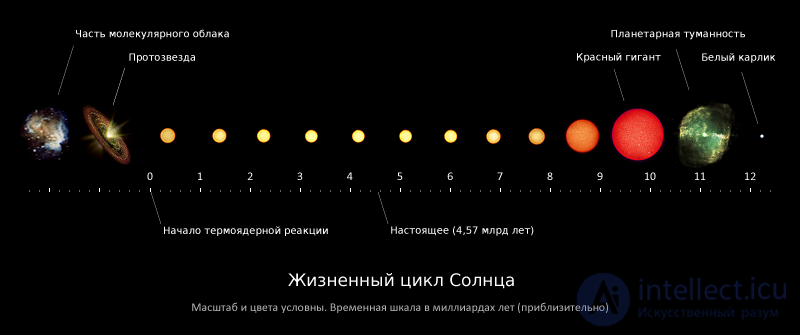
Evolution of a class G star using the Sun as an example.
During this period the structure of the star begins to change. Its luminosity increases, its outer layers expand, and its surface temperature decreases — the star becomes a red giant, and such stars form a branch on the Hertzsprung-Russell diagram. On this branch the star spends significantly less time than on the main sequence. When the accumulated mass of the helium core becomes significant, it can no longer support its own weight and begins to contract; if the star is massive enough, the resulting rise in temperature can trigger further thermonuclear conversion of helium into heavier elements (helium — into carbon, carbon — into oxygen, oxygen — into silicon, and finally — silicon into iron).
The study of stellar evolution is impossible by observing just one star — many changes in stars occur too slowly to be noticed even over the course of many centuries. Therefore scientists study a large number of stars, each of which is at a particular stage of its life cycle. Over the last few decades, the modeling of stellar structure using computing technology has become widespread in astrophysics.
p-process — a thermonuclear reaction that occurs, in particular, during the collapse of the core of a supernova, and is responsible for the origin of some proton-rich atomic nuclei heavier than iron.
The r-process, or rapid neutron-capture process, is the process by which heavier nuclei are formed from lighter ones through successive capture of neutrons in (n,γ) reactions.
Neutron capture continues as long as the rate of neutron capture (n,γ) is higher than the decay rate of the isotope. The atom then undergoes β−-decay, and neutron capture continues.
The rp-process — the process of rapid proton capture by an atomic nucleus. It is one of the nucleosynthesis processes responsible for the creation of many elements heavier than iron found in the Universe. Unlike the s- and r-processes, the rp-process takes place in proton-rich nuclei. The upper limit of the rp-process (the heaviest nuclei that can be produced in the course of the reaction) has not yet been precisely established, however recent studies[source not specified for 5030 days] suggest that in neutron stars it cannot proceed beyond tellurium because it is halted by α-decay. This fact allows us to say that the most massive element that can result from the rp-process is 105Te — the lightest isotope for which α-decay is observed (although other, lighter, isotopes of tellurium may also be subject to α-decay).
The s-process, or slow neutron-capture process, is the process by which heavier nuclei are formed from lighter ones through successive neutron capture. The characteristic time scale of s-processes is much longer than the β-decay period, so they involve either stable nuclei or β−-radioactive nuclei with long half-lives. The starting element in the s-process is the iron isotope 56Fe.
Silicon burning — a sequence of thermonuclear reactions occurring in the interiors of massive stars, during which silicon nuclei are converted into nuclei of heavier elements. This process requires a high temperature (4⋅109 K) and density (1⋅105÷6 g/cm³).
The α² Canum Venaticorum type variable star — a type of rotating variable star. These are main-sequence stars of spectral classes B8p-A7p. They possess strong magnetic fields, and their atmospheres are chemically peculiar — their spectra show anomalously enhanced lines of silicon, strontium, chromium, and rare-earth elements. The intensities of the spectral lines of such stars vary together with the strength of the magnetic field. The periodicity of these changes coincides both with the star's rotation period and with the period of brightness variation, which ranges from 0.5 to 160 days. The amplitudes of brightness variation range from 0.01 to 0.1 stellar magnitude.
The prototype of this class of variable stars is Cor Caroli (α² Canum Venaticorum), which varies in brightness by 0.14m with a period of 3.47 days. Among the bright stars belonging to this type are Alioth (ε Ursae Majoris) and Alpheratz (α Andromedae).
In the classification of the 4th edition of the General Catalogue of Variable Stars, this type of star is designated ACV.

The V-band phase light curve of a large-amplitude (0.6m) Delta Scuti type variable star with a period of ≈0.1 day in the constellation Cancer, from CCD observations[10].
A δ Scuti type variable is a variable star whose luminosity changes sharply due to radial and non-radial pulsations of the star's surface.
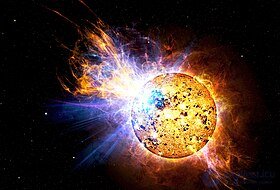
An artist's impression of a flare on the star EV Lacertae
BY Draconis type variables — main-sequence variable stars of late spectral classes, usually K or M. The prototype of this category of stars is BY Draconis. Variations in their brightness arise from rotation, since their surfaces have spots similar to sunspots but covering a much larger area, as well as from chromospheric activity. The brightness amplitude usually does not exceed 0.5 stellar magnitude, and the characteristic duration of the cycles equals the star's rotation period (from several hours to several months). Some of these stars display variability of other types — for example, experiencing flares characteristic of UV Ceti type variables; in such cases they are also classified under that type as well. A prominent example of such a star is EV Lacertae.
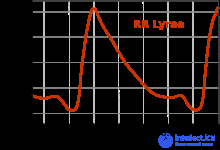
Light curve of the star RR Lyrae: apparent magnitude as a function of pulsation phase.
RR Lyrae-type variables — a type of radially pulsating variable stars, giants of spectral classes A — F, lying on the horizontal branch of the Hertzsprung — Russell diagram, with periods ranging from 0.2 to 1.2 days, and amplitudes of brightness variation from 0.2m to 2m. The prototype of these variables is RR Lyrae.
By tradition, RR Lyrae-type variables are sometimes called short-period Cepheids or globular-cluster variables. In most cases they belong to the spherical component of the Galaxy, occurring (sometimes in large numbers) in certain globular clusters whose age exceeds 12 billion years, and they belong to the oldest representatives of the Galaxy's stellar population. The number of known stars of this type exceeds 6 thousand, making them the most numerous subtype of variables.
As with Cepheids, the maximum expansion velocity of the surface layers of these stars practically coincides with the maximum of their brightness. However, unlike Cepheids, these are older stars and relatively low-mass (a little more than half a solar mass). The average absolute stellar magnitude is 0.75m, meaning they are 40–50 times brighter than the Sun. Cases are known of variability both in the shape of the light curve and in the period (the Blazhko effect).
The relationship between the period of variability and the absolute magnitude makes them good candidates for standard candles for relatively nearby objects, within the Milky Way. They are very often used to study globular star clusters. They are poorly suited for studying external galaxies because of their low luminosity.
RR Lyrae-type variables are divided into three subtypes:
RS Canum Venaticorum-type variables — eruptive variable stars. This type includes close binary systems with H and K Ca II emission in the spectrum, whose components possess increased chromospheric activity, causing quasi-periodic variability of their brightness with a period close to the orbital period, and a variable amplitude, usually reaching 0.2m.
The first to distinguish these variables as a separate class was Otto Struve in 1946. In 1974 the American astronomer Oliver (Oliver D.S.) determined a set of visual characteristics of RS Canum Venaticorum-type variables, and in 1976 the American astronomer Hall, based on these, divided these systems into five groups[11]:
The light curve of RS Canum Venaticorum-type variables shows a quasi-periodic structure. Plateaus are present on the curve. In 1979 the American astronomers Eaton and Hall proposed the simplest mechanism for the formation of the plateaus — «starspots», i.e., large cool regions on the surface of the star, by analogy with sunspots. Such spots have now been detected by indirect methods in many stars[12].
Chromospheric activity is revealed by the presence of the Ca II H and K spectral lines, as well as by the Balmer series or Hα. By analogy with the Sun, one may suppose that this activity is connected with powerful magnetic fields and spots on the star's surface.
Some variables of the RS Canum Venaticorum type are sources of X-ray and radio emission. Radio emission is not related to surface temperature and may serve as an indicator of powerful magnetic fields. X-ray emission Lx >> 1024 watts. Such powerful emission, by analogy with the Sun, may be interpreted as evidence of a very hot corona: T ~ 107 K.
W Virginis type variables — are pulsating variables of the spherical component or the old component of the Galactic disk, with periods of roughly 0.8 to 35 days and amplitudes from 0.3m to 1.2m. They are characterized by a period-luminosity relation that differs from the analogous relation for δ Cephei type variables. At the same period, W Virginis type variables are 0.7—2m fainter than δ Cephei type variables. The light curves of W Virginis type variables differ from the light curves of Cepheids of corresponding periods either in amplitude or in the presence of humps on the descending branch, which sometimes grow into a broad flat maximum. They are found in old globular clusters and at high galactic latitudes. They are divided into subtypes:
By tradition, W Virginis type variables are also often called Cepheids, since often (at periods from 3 days to 10 days) it is impossible to distinguish variables of these types from one another by the shape of the light curve. However, in reality these are completely different objects, at different stages of evolution. W Virginis type variables belong to the second generation of stars (population II), that is, they formed from material of first-generation stars and have fairly low metallicity. One of the significant spectral differences of W Virginis type stars from Cepheids is that in the spectra of the former, in a certain range of phases, emission is observed in the hydrogen lines, whereas in the spectra of Cepheids — in the Ca II H and K lines. It was precisely the underestimation of these features that led Edwin Hubble to incorrectly apply the formulas for classical Cepheids to estimate the distance to the Andromeda Nebula, thereby underestimating it.
The prototype of these variables is W Virginis.
Alpha Cygni type variables belong to the class of variable stars with pronounced non-radial pulsations. These stars are supergiants of spectral classes B or A. Brightness variations of order 0.1 magnitude (10% of brightness) with periods from several days to several weeks. These variations often appear irregular due to beating, i.e., the superposition of multiple pulsations with close periods.
The prototype of this class of stars was Deneb (alpha Cygni), whose brightness pulsations range from +1.21m to +1.29m.
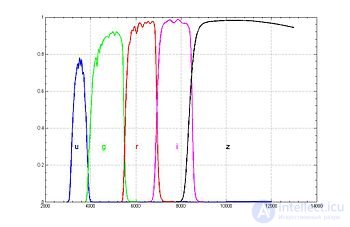
Filters of the u'g'r'i'z' photometric system
The u'g'r'i'z' photometric system — is an astronomical broadband five-color photometric system. It is being developed for the SDSS catalog. As of the end of 2009, photometric standards exist only for the northern hemisphere.
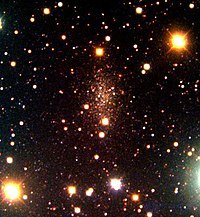
A UBV image taken at Lowell Observatory, in which blue represents the U band (ultraviolet), green — the B band (blue), and red — the V band (visible light).
The UBV system (the Johnson system or the Johnson — Morgan system) — is the most widely used broadband photometric system. It was developed in the 1950s by American astronomers Harold L. Johnson and William W. Morgan for classifying stars according to their color[13].
In this system, stellar magnitudes are measured in three broad bands of the spectrum, named U (ultraviolet), B (blue), and V (visual). The peak sensitivity of these bands lies at wavelengths of 350, 430, and 550 nm respectively. The choice of colors from the blue part of the spectrum was made because photographic plates of that time were most sensitive in this region of the spectrum. Stellar magnitudes are defined such that for stars of spectral class A0 V with no interstellar reddening, all three magnitudes are equal to each other. Thus, for such stars the color indices B-V and U-B — the differences of magnitudes in different bands — are equal to zero[14].
The color indices (U-B) and (B-V) can be used to determine certain physical properties of individual stars or groups of stars. The most commonly used is the difference (B-V), where B and V, to put it very simply, correspond to the photographic and visual magnitudes. The color index (B-V) is convenient because for most stars it is measured relatively quickly and easily, while remaining a good indicator of spectral class. This is one of the variables used in constructing the color-magnitude diagram (the Hertzsprung — Russell diagram). To expand the capabilities of the method, in 1965 Johnson proposed additionally using several more bands in the infrared part of the spectrum (from 0.7 to 10.2 µm). They were named R, I, J, H, K, L, M, and N.
The UBV system has a number of drawbacks. The short-wavelength cutoff of the U filter is determined mainly by Earth's atmosphere rather than by the filter itself. Thus, the observed magnitudes can change with altitude and changing atmospheric conditions. Nevertheless, many measurements have been made in this system, including for many bright stars[15].
The Chandra X-ray Observatory (the Chandra X-ray telescope) is a space observatory launched by NASA on July 23, 1999 (using the space shuttle Columbia) to study the cosmos in the X-ray range. It is named after the American physicist and astrophysicist of Indian origin, Chandrasekhar, who taught at the University of Chicago from 1937 until his death in 1995 and was known mainly for his work on white dwarfs.
Chandra is the third of four observatories launched by NASA in the late 20th and early 21st centuries. The first was the Hubble telescope, the second was Compton, and the fourth was Spitzer.
The observatory was conceived and proposed to NASA in 1976 by Riccardo Giacconi and Harvey Tananbaum as a development of the HEAO-2 (Einstein) observatory being launched at that time. In 1992, owing to reduced funding, the observatory's design was significantly changed — 4 of the 12 planned X-ray mirrors and 2 of the 6 planned focal instruments were removed.
The launch mass of AXAF/Chandra was 22,753 kg, which is an absolute record for the mass ever launched into space by the space shuttles. The bulk of the mass of the Chandra complex consisted of the rocket that made it possible to place the satellite into an orbit whose apogee is approximately one third of the distance to the Moon.
The station was designed for a working life of 5 years, but on September 4, 2001, NASA decided to extend its service life by 10 years, owing to its outstanding performance results.
.

Comments