
Lecture
Johannes Kepler was born in 1571. He graduated from the Tübingen theological seminary. After graduating he took up teaching. His book "Mysterium Cosmographicum, containing the cosmographic secret of the wonderful proportion of the celestial spheres, and the true and proper causes of the number of the heavens, their sizes and their periodic motions, explained by means of the five regular geometric bodies" demonstrated great mathematical ability and led to Kepler's association with Tycho Brahe. Subsequently, Kepler derived his laws on the basis of observations collected by Tycho Brahe. In 1609 the book "New Astronomy, based upon causes, or Celestial physics, treated by means of the investigation of the motion of the star Mars, based on the observations of the most noble Tycho Brahe" was published. In this book the first two laws of motion of celestial bodies were formulated. The third law appeared 10 years of research later, in the book "Harmony of the World," published in 1619. Long years of research forced Kepler to renounce his earlier idealized views on the nature of the motion of celestial bodies.
Kepler's laws are formulated as follows:
1. All planets move in ellipses, at one focus of which (common to
all planets) is the Sun.
2. The radius vector of a planet sweeps out equal areas in equal intervals of time.
3. The squares of the sidereal periods of revolution of the planets around the Sun are proportional to the cubes of the semi-major axes of their elliptical orbits.
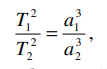
where T1
, T2
- are the sidereal periods of revolution of the planets, and a1
, a2
- are the semi-major axes of their orbits. If the semi-major axes of the orbits are expressed in units of the mean distance from the Earth to the Sun (in a.u.), and the periods of revolution in years, then for the Earth
a = 1, T = 1, and the period of revolution of any planet around the Sun equals:
3
T = a .
If we generalize Kepler's laws to various cases of motion of celestial
bodies, we obtain the following formulations:
1. Under the action of the force of attraction, one celestial body moves in the gravitational field of another celestial body along one of the conic sections - a circle, an ellipse, a parabola, or a hyperbola.
2. The area swept out by the radius vector per unit time is a constant
quantity.
.
2
const
t
r =
∂
∂θ
where r – is the radius vector, θ - is the polar angle (true anomaly).
3. 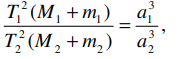 ,
,
where M1 and M2 – are the masses of the primary bodies, and m1 and m2 – are the masses of the satellites, a1 and a2 – are the semi-major axes of the satellites' orbits.
The motion of a planet will be determined if the following are known:
The quantities that determine a planet's orbit are called the elements of the orbit. The plane of the ecliptic is the principal plane relative to which the position of the
orbit is determined. The two points at which
a planet's orbit intersects the
plane of the ecliptic are called the nodes - the ascending and
the descending. The ascending node is
the one at which the planet crosses the ecliptic while moving away from its
south pole.
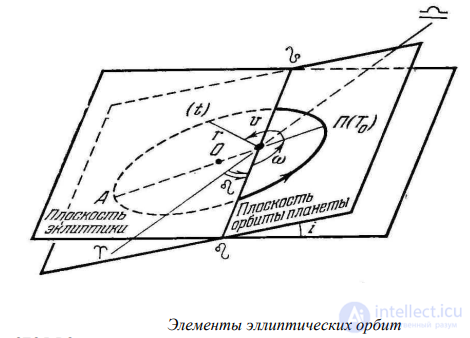
A planet's elliptical orbit is determined by 6 elements:
1. The inclination i of the orbital plane to the plane of the ecliptic. It can have values from 0º to 180º.
If 0º≤ i < 90º, then the planet moves around the Sun in the same direction as
Elements of elliptical orbits
the Earth (direct motion). If 90º > i > 180º, then the planet moves in the opposite direction (retrograde motion).
2. The (heliocentric) longitude of the ascending node, i.e., the angle between the
directions from the center of the Sun to the ascending node and to the point of the vernal
equinox. The longitude can have values from 0º to 360º.
The longitude of the ascending node and the inclination determine the position of the orbital plane in space.
3. The angular distance ω of the perihelion from the node, i.e., the angle between the directions from the center of the Sun to the ascending node and to the perihelion P. It is measured in the
plane of the planet's orbit in the direction of its motion and can have any
value from 0º to 360º.
The angular distance ω determines the position of the orbit within its plane.
4. The semi-major axis a of the elliptical orbit, which uniquely determines the sidereal period of revolution T of the planet. The mean daily motion
n =
T
360°
, i.e., the average angular velocity of the planet per day.
5. The eccentricity of the orbit 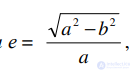 −
−
, (1)
where a and b are the semi-axes of the elliptical orbit. The semi-major axis a and e determine
the size and shape of the orbit.
6. The moment of passage through perihelion t0, or the position of the planet on the
orbit at some definite moment of time t.
Knowing the moment of passage through perihelion t0 and
the other elements of the orbit, one can determine the position of the planet in the plane of its orbit for any moment of time t.
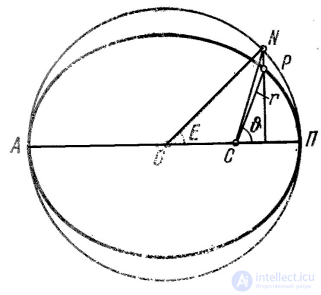
The position of a planet in its orbit is determined by two quantities: the radius vector r and
the true anomaly θ. The true anomaly
of a planet is the angle PSR between the direction from the Sun to the perihelion P and the radius vector of the planet R.
 , (2)
, (2)
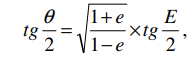 , (3)
, (3)
where E = <PON and is called the eccentric anomaly.
The eccentric anomaly is calculated from Kepler's equation
 , (4)
, (4)
where M is an angle called the mean anomaly. The mean anomaly represents
the arc of a circle that the planet would describe over the time (t - t0) if it moved uniformly around a circle of radius a with mean angular velocity n.
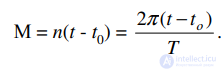 (5)
(5)
An ephemeris of a celestial body is a table that gives
the calculated, theory-based positions of that body on the celestial sphere for
various moments in time. In compiling precise ephemerides, perturbations
are taken into account. Approximate ephemerides are compiled on the basis of the known
elements of the body's unperturbed orbit. The determination of a planet's apparent coordinates from the elements of its orbit is called the computation of ephemerides. The inverse problem, i.e., determining the elements of an orbit from observed coordinates,
is called orbit determination. This problem was first solved by Kepler from numerous observations of long-known planets. In modern astronomy
methods of orbit determination from three observations are used. This problem was solved only in the 19th century.
The computation of a planet's position in its orbit for a moment t is carried out in
the following sequence:
1) Using formula (5), in which T and (t - t0) are known, the mean anomaly is determined.
2) Using formula (4), with e and M known, the eccentric anomaly E is found by the method of successive approximations;
3) Using formulas (2) and (3) the radius vector and true anomaly are calculated.
Having determined the planet's position in its orbit for given moments in time, one can calculate for these same moments its spatial heliocentric coordinates. Knowing the elements of Earth's orbit and having calculated Earth's position in its orbit for the same moments, one can determine the geocentric coordinates of the planet and find its distance from the center of the Earth

Comments