
Lecture
The closest distance from Jupiter to Earth is 630 million km. Jupiter's mass
is more than 300 times that of Earth.
Jupiter's full rotation about its axis takes 9h55m.
Multicolored bands are visible on the surface, whose structure is constantly
transforming, but whose general character is preserved.
The linear speed of the surface cloud masses' movement at the equator is
40,000 km/h.
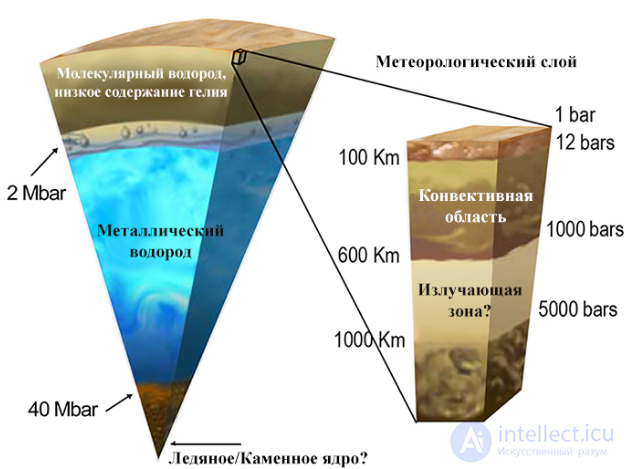
The axis of Jupiter's magnetic field is tilted 10 degrees from the axis of rotation. The magnetic field rotates uniformly, with a period of 9 hours 55 minutes. This indicates
an almost solid-body character of the planet's rotation beneath the cloud layer.
Surface gravity is 2.6 times that of Earth.
Jupiter's average density is 1.34 g/cm3
. This indicates that the planet consists mainly of light gases, primarily hydrogen and helium.
Jupiter has an extensive atmosphere. An interesting feature of it is
the Great Red Spot, discovered in 1665 by Cassini.
The spot's extent ranges from 15,000 to 50,000 km. At times it becomes brighter,
at times it nearly disappears.
The spot constantly drifts within the planet's atmosphere. In the first years after its discovery it was very bright, and since then its brightness has been gradually declining. The spot is probably fading over time. Galileo's studies showed that the spot lies higher up and is colder than the surrounding clouds. Similar structures have been noticed
on Saturn and Neptune, but it remains unclear how they can exist
for such a long time.
Jupiter has as large a diameter as a gas planet can possibly have. If it were given additional mass, it would grow only slightly larger.
For Jupiter to become a star, it would need 80 times more mass
than it has.
Jupiter's atmosphere consists mainly of hydrogen (90%) and helium (10%). Ammonia (0.01%) and methane (0.07%) have also been detected, as well as water, carbon monoxide, phosphine,
cyanogen, ethane, and acetylene. The remaining elements are present in very small amounts. Water has frozen out, remaining in gaseous form only in small quantities.
The temperature in the atmosphere drops rapidly with altitude. From -113°C at a pressure of 1
atm. to -160°C at a pressure of 0.03 atm.
The generation of heat in Jupiter's interior and its own thermal radiation exceed by a factor of 2 the flux of energy received from the Sun.
Jupiter has no solid surface and no relief of any kind. Heat from the interior
is carried away by vertical convection, which generates turbulent vortices.
In the equatorial zone (from +90
to -90
) the currents flow strictly from west to
east. Westerly winds blow at a speed of 100 m/s. Near latitudes from +20
to -
20
, winds blow from east to west at a speed of about 50 m/s. Between the main currents there are vortices and jets.
Studies by «Galileo» showed that winds in the atmosphere can significantly
exceed 100 m/s and are caused by an internal heat source. The winds have
more the character of jet streams than of vortices and tornadoes.
The Great Red Spot is carried westward together with the southern tropical zone. It is not connected to the deep layers of the planet. Within it an upwelling of
material from the upper regions is observed, spreading out from the center. This explains
the spot's low temperature and its anticyclonic rotation, i.e., counter-
clockwise in the southern hemisphere, with a period of about 7 days.
In addition to the Red Spot, white ovals are observed, which represent similar disturbances but appeared later, in 1939, and are currently contracting.
The atmospheric clouds consist mainly of ammonia. Temperature from -100
to
-160°C. At a pressure of 1 atm. ammonia boils at -33°C and melts at -78°C. Methane boils at -161°C and melts at -184°C, so its existence in liquid or crystalline form is impossible.
Jupiter's atmosphere is very deep and possibly comprises an entire planet.
At great depth inside Jupiter, the pressure is so great that hydrogen
atoms are broken apart and electrons are freed. The atoms that result
from this consist of bare protons. This state is called metallic hydrogen. The temperature in the core reaches 30,000 K, and the pressure exceeds 1
million bar. The core's high temperature exists thanks to the Kelvin
– Helmholtz mechanism, i.e., because of the planet's slow gravitational contraction.
In Jupiter's polar clouds a phenomenon similar to Earth's northern lights is observed. These phenomena are related to matter falling from the moon Io along
spiral lines of the magnetic field into Jupiter's atmosphere.
The clouds extend over an altitude range of 12 km. Jupiter's atmosphere is colored
in various colors. Stable atmospheric constituents could not
color the atmosphere this way, as they would tend to gradually even out the coloring. This means that colored metallic compounds are constantly rising from the depths,
which then either settle out or undergo chemical reactions in the atmosphere. R. Wildt believes that Jupiter's coloring is due to sodium, while H. Urey
links the coloring of the clouds to organic molecules. C. Sagan and S. Miller,
by passing spark
discharges through a mixture of gases simulating Jupiter's atmosphere, obtained brightly colored organic molecules. The Voyager 1 and 2 spacecraft recorded powerful lightning flashes on Jupiter, comparable to the strongest thunderstorm discharges on Earth. However, no
relationship between the lightning and the coloring has yet been found.
Galileo's studies showed that lightning on Jupiter flashes 10
times less often than on Earth. Almost no organic molecules have been detected. Jupiter's chemical composition is close to that of the protoplanetary cloud.
Jupiter is a semi-periodic radio source. K. Shain of Australia
discovered that Jupiter's radio emission must be related to certain
regions of the planet's surface. The sources on the surface rotate with a period of 9h 55min 30sec. The energy of Jupiter's radio-emission bursts corresponds to the energy of a billion simultaneous lightning flashes on Earth.
The radio emission may be related to the inner part of the magnetosphere and the motion of the satellite Io.
Jupiter has an enormous magnetic field. Its magnetosphere extends
to a distance of 650 million km (beyond the orbit of Saturn!). Galileo discovered that the environment around Jupiter contains highly energetic parti-
cles trapped by the magnetic field. This "radiation" is similar to, but much more
intense than, the Van Allen radiation belts around Earth. Galileo's atmospheric
studies discovered a new intense radiation belt between
Jupiter's ring and the upper atmospheric layers. This new belt is approximately 10 times stronger than the Van Allen radiation belts. In this
new belt, high-energy helium ions of unknown origin were found.
The solar wind's bow shock on the dayside is located at a distance of 100 Jupiter radii, or 0.05 AU.
Jupiter's internal structure is not fully known. Most likely its interior
is in a liquid state, with the exception of a small rocky core.
Liquid hydrogen becomes metallic at a depth of 25,000 km. Above this boundary
lies a zone of molecular hydrogen, below it a zone of metallic hydrogen. Collision with a comet - In 1994, fragments of Comet Shoemaker-
Levy fell onto Jupiter. The phenomenon was observed from Earth and by the Hubble Space Telescope.
After the fall of Comet Shoemaker-Levy, a wide belt formed at the latitude where the fragments fell, in which the temperature is 5 - 7 K lower than usual.
The causes may be as follows:
- cooling through effective infrared radiation from ammonia molecules,
hydrogen cyanide, water, and other substances ejected into the atmosphere during the catastrophe.
- ordinary thermal cooling of the smoke formed in the stratosphere
during the collision, and its re-radiation of sunlight back into space.
(IAU Circulars No. 6119).
The ring. Voyager 1 discovered a ring around Jupiter in 1979. The outer edge
of the ring lies at the orbit of the smallest of the 14 satellites, while the inner edge is at a distance of 5500 km from the visible boundary of the clouds. The width of the brightest part
of the ring reaches 800 km. The thickness is up to 1 km. Jupiter's ring is very different
from Saturn's ring. It consists of very small particles. It is composed of dust particles smaller than 10 microns in diameter.
The origin of the ring is probably related to the bombardment by micrometeorites
of the small satellites of Jupiter located within the ring.
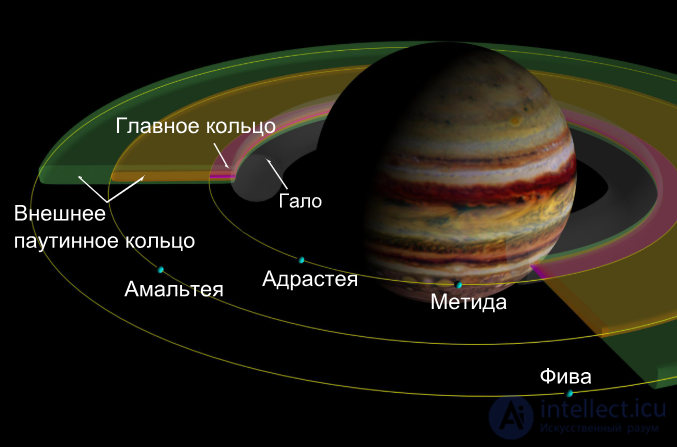
It is possible that it is continuously replenished by particles of cosmic dust.
Jupiter's rings and its satellites exist within the intense radiation belt
of electrons and ions trapped by the planet's magnetic field.
The satellites. The first four satellites of Jupiter were discovered by Galileo in 1610.
Dozens are now known.
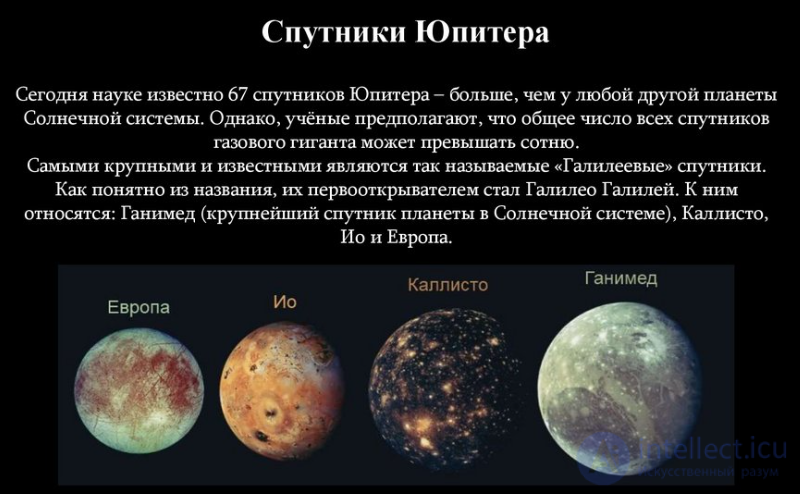
The orbits of the six inner satellites are nearly circular and lie in the equatorial plane of the planet. Each successive orbit lies 1.7 times
farther out than the previous one. The eight outer satellites are very small. Their orbits
form two groups of four satellites. The first group is located at a distance of 12 million km from Jupiter and moves in the direct (prograde) direction. The satellites of the second group are twice as far away, and their orbital motion is retrograde.
This saves them from the Sun's attraction, which could act on them with a force twice that of Jupiter, owing to the satellites' great distance (0.2 AU). The orbits of these satellites are highly elongated (e = 0.4), inclined to
Jupiter's orbit at an angle of 300
and constantly changing due to solar perturbations.
The three inner satellites Io, Europa, and Ganymede move in almost complete resonance, with orbital periods of 1.77, 3.55, and 7.16 Earth days, which are in a
ratio of 1:2:4. In celestial mechanics such an arrangement is considered stable. All the inner satellites face Jupiter with the same side.
Io. Radius 1815 km. Even before the “Voyager” flights, scientists predicted that
the moon Io would be heated very strongly as a result of tidal effects. The heating of
Io should be 20 times greater than that of Europa and exceed by 10 times the heating of
the Moon due to the decay of radioactive elements. It was assumed that inside Io there should be a large molten region. These assumptions were immediately
confirmed. “Voyager 1” discovered 8 active volcanoes on Io. Volcanic plumes rise to a height of 7-280 km above the surface, which
requires an ejection velocity of 1 km/s. The plumes consist of sulfur dioxide SO2.
The formation of the volcanoes is related to the melting of silicate masses in the interior of Io,
which contains a small iron core. This is confirmed by Io's average density — 3.5 g/cm
3
. Beneath the visible crust lies a heterogeneous subcrustal silicate layer, which in a very few areas of small extent reaches the surface in the form of mountains up to 10 km high. Beneath the upper layer of solid
sulfur, mixed with SO2, lies an ocean of molten sulfur (t = 1200°C, pressure 40
bar). Currents in Io's molten interior, just as on Earth, create thermal hotspots in which volcanoes form. The intense red, orange,
yellow, brown, black, and white colors on Io confirm these ideas. No impact craters with a diameter greater than 600 m have been found, which means
that the rate of surface deposition must exceed 0.1 mm/year and is determined by ejections, flows, and surface erosion associated with volcanic activity.
The age of fresh, multicolored flows is less than 1000 years.
Europa. Radius 1569 km. Europa's surface is covered by a labyrinth of tangled
thin lines and bands, resembling the Martian “canals.” Some reach lengths
of thousands of kilometers, with a width of 20-40 km. Most likely these are cracks filled with something. The highest features rise to a height of only 40 m.
It resembles a scratched orange ball. The almost complete absence of impact craters suggests that traces of them disappear quickly. The outer crust
is most likely icy down to depths of 100 km. The average surface temperature is about
-150°C. The moon's interior must be hot, with a chemical composition similar to
Io's. The density is somewhat lower than Io's — 3.0 g/cm
3
— caused by the presence of the ice crust. The many cracks are the result of stress relief occurring beneath
the surface.
Recent observations with the Hubble Space Telescope have made it possible to detect on Europa a tenuous atmosphere consisting of molecular oxygen. Its density is very low. Sunlight, cosmic rays, and
micrometeorites knock water molecules from Europa's surface, which under
the action of ultraviolet radiation break down into hydrogen and oxygen atoms. The hydrogen atoms leave the atmosphere immediately, while the oxygen atoms
combine into energetically more favorable molecules.
Ganymede. The largest and most massive of all the moons. Radius 2631 km.
Average density 1.9 g/cm3
. It consists of about half water or ice.
Average surface temperature -130°C. Ganymede's dark regions are dotted with
craters several tens of kilometers in diameter.
On this moon there exists an enormous system of ridges. The most interesting surface feature consists of bundles of long parallel grooves. They cover a significant part of the moon's area. These formations are not
explained by present-day science.
Callisto. In size this is the third-largest satellite in the solar system. Radius 2410
km. But its density is the smallest — 1.8 g/cm3
. Callisto's surface on the side not visible from Jupiter is very densely cratered. On the side facing Jupiter
a huge multi-ring structure is visible, with a bright central region about 300 km in diameter. From 8 to 10 ring ridges surround
the center out to a distance of about 1500 km. In Callisto's central region there are far fewer craters than on the rest of the surface. This means this region is younger.
Paradoxically, given its low density, Callisto should contain more water than Ganymede, yet it retains ancient impact craters. Callisto's low
albedo suggests a dust admixture in its crust. The surface temperature is -
120°C or higher. This temperature is still too low, however, to form an atmosphere of
water vapor.
Saturn has the lowest density — 0.7 g/cm3
. It rotates very fast, with
a period just over 10 hours, and is therefore noticeably flattened. Clouds on Saturn are less noticeable than on Jupiter. Sometimes large-scale disturbances are noticeable. Thus in 1994 a large white spot was observed in the equatorial
region.
“Voyager 1” discovered clouds of various types and a Great Brown Spot
the size of the Earth.
The temperature at the top of the clouds is from -178°C to -173°C.
The atmosphere consists mainly of hydrogen and helium.
Atmospheric masses in cyclonic and anticyclonic regions move toward each
other at speeds above 100 m/s, and upon contact form
vortices and storms. The jet streams of air masses reach
their highest speed at the equator - 500 m/s.
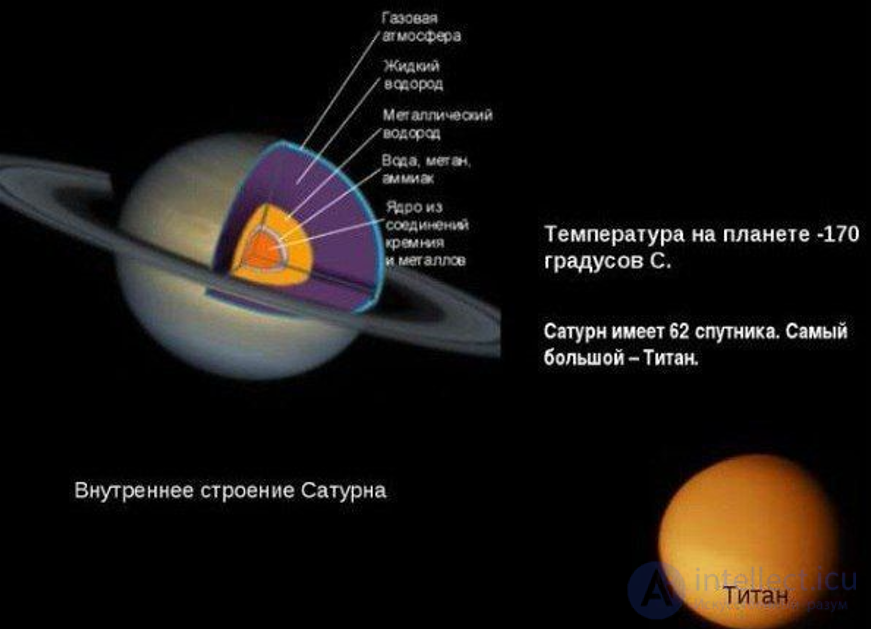
The axis of the magnetic field almost completely coincides with the planet's axis of rotation.
The strength of the magnetic field at the equator equals 0.7 that of Earth's. But
the internal magnetic field is much stronger due to the planet's large size. Saturn
has internal energy sources and radiates 2.5 times more energy than it receives from
the Sun. The internal structure of Saturn is the same as that of Jupiter.
Galileo was the first to see the rings of Saturn, but due to the poor quality
of his instruments, he could not make out their details and concluded that they were some
kind of formations resembling handles or spheres. Huygens's observations showed that Saturn has rings. The use
of more advanced technology allowed J. Cassini to discover a gap between the rings, which has
since borne his name. Photographs from the "Voyager 1" spacecraft showed that the rings consist of
a multitude of narrow concentric ringlets, whose overall picture resembles the grooves of a phonograph
record. Saturn's rings lie exactly in the equatorial plane of the planet. When observed from
Earth, they are seen at different angles. On May 21 and August 11, 1995, and
on February 11, 1996, the rings turned edge-on to Earth and were visible as a
narrow strip. The inner ring C has a size of 17,000 km, the brightest middle
ring B is 28,000 km, and the outer ring A is 17,000 km. Rings A
and B are separated by the Cassini Division. The large rings consist of a multitude
of small ringlets, which in turn break up into individual particles, with each particle moving
around Saturn in its own orbit in accordance with Newton's law of gravitation. Spectral analysis
data show that the ring particles are covered with ice and frost. This is why
they have high reflectivity. The largest ring particles range in size from 1 to 15
meters. The particles cannot combine into larger bodies, since Saturn's tidal forces would destroy them.
Most likely, the rings consist of a former satellite of Saturn, a few hundred km
in diameter, that was destroyed. The structure of the rings contains many mysteries. For example,
some narrow rings have a noticeable eccentricity, and there is even an observed "braided" ring,
in which three separate rings or streams of particles are intertwined. Radial dark spokes are
also observed in the main rings. They are most likely created by the magnetic field.
Before the flight of the "Voyagers," 10 satellites of Saturn were known. According
to newer data their number may be from 18 to 23. The largest
are Titan, Rhea, Iapetus, Dione, Tethys, Enceladus, Mimas, Hyperion, Phoebe, and Janus. Their
diameters range respectively from 2575 to 110 kilometers. The rest are insignificant in
size (from 70 to 12 km). The densities of the large satellites lie
between 1 and 1.3 g/cm3. The largest density is that of Titan -
2 g/cm3. Mimas (diameter 197 km) has a surface entirely covered with craters.
A notable feature is the huge crater Herschel, whose diameter is 140 km.
The elevation difference on the satellite does not exceed 7-8 km. Enceladus (diameter
- 251 km) is covered with ice. Its surface reflects almost 100% of
the incident solar radiation. Traces of tectonic processes are visible on the satellite's
surface. Numerous faults and grooves are visible. The size of the largest craters
does not exceed 35 km. Dione (diameter 559 km) is the fourth largest
satellite. Its biggest crater has a diameter of 100 km. Titan is the
only satellite possessing an extensive atmosphere. Back in 1943-1944, G. Kuiper discovered a
dense atmosphere, consisting of nitrogen, around this celestial body. According to modern hypotheses,
there may be rains and oceans of liquid nitrogen on Titan's surface. Other
assumptions allow for the presence of a warm surface covered with water. According
to the latest data, Titan does not have large oceans, since its orbit
has significant eccentricity, and tidal effects would long ago have reduced them.
Most likely, its surface has seas or lakes filled with liquid hydrocarbon
compounds (methane). Infrared observations from a space telescope confirm this hypothesis. Around
the planet there exists a large hydrogen cloud, which can be explained
by the dissipation of methane in the upper atmosphere. Iapetus has one
peculiarity. Half of its surface, the side facing Saturn, is dark and
reflects about 5% of incident light, while the opposite side reflects 6
times more. "Voyager 1" showed that the bright side is covered with
ice, while the dark side has an ice covering of only 5%.
In 1995 NASA reported the discovery of four satellites of Saturn by the space telescope. The satellites' sizes range from 50 to 24 km. They are located near the rings and were detected only through computer processing of photographs,
which included reducing the glare from the rings.
Further observations with the space telescope showed that these are most likely a new class of objects, consisting of fragments of ice, since their extent is too large for them to constitute a single celestial body.

Comments