
Lecture
After the discovery of Uranus in 1781, astronomers became convinced that the Titius-Bode rule accurately describes the basic patterns in the arrangement of planetary
orbits, and began searching for a planet located at a distance of 2.8 AU from the Sun,
i.e., between the orbits of Mars and Jupiter.
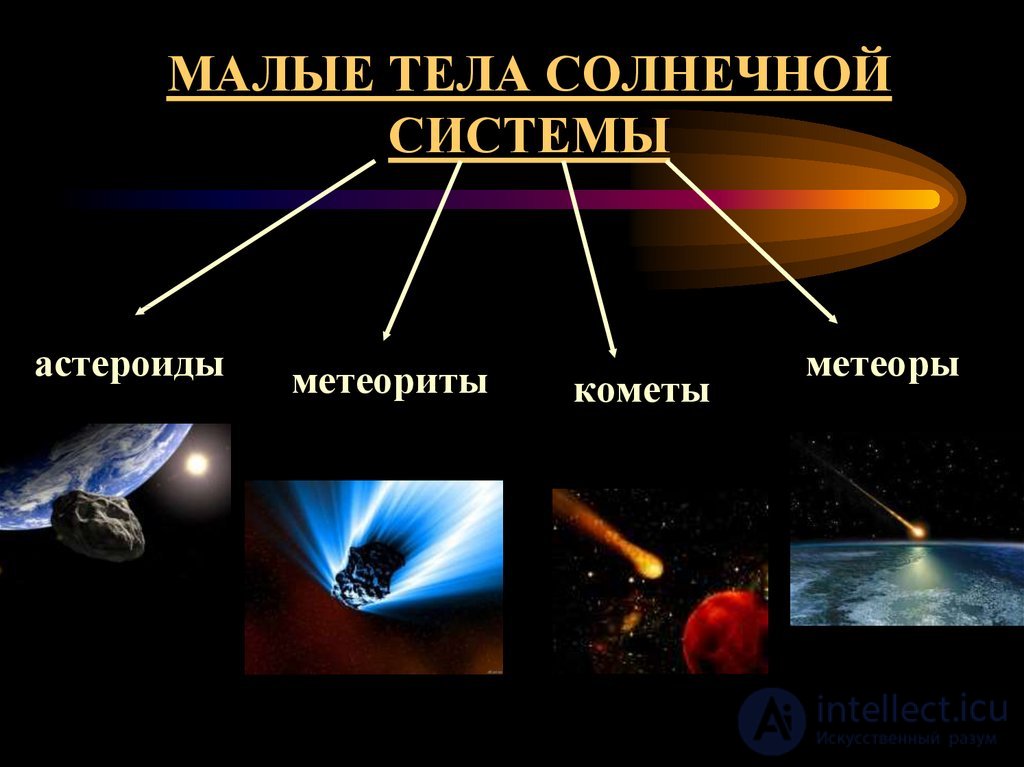
On January 1, 1801, Giuseppe Piazzi of Sicily saw a faint “star” in the constellation Taurus that was not plotted on star maps. The astronomer noticed that this celestial body constantly changed its position. By the end of 1801
it was established that the object completed a revolution around the Sun in 4.6 years at a distance of 2.77 AU. This distance is exactly what the Titius-Bode rule indicates.
Thus the first asteroid was discovered, named Ceres - after the goddess patroness of Sicily.
In 1802 Heinrich Olbers discovered another faint object, which turned out to be the second asteroid. It was named Pallas. Pallas completes a revolution around
the Sun in 4.6 years at a distance of 2.77 AU.
Since the discovered asteroids had low brightness, astronomers decided that they
were small in size. Indeed, the diameter of Ceres - the largest asteroid - is only 900 km. Neither Ceres nor Pallas fit the role of the sought-after planet, but since both asteroids had nearly identical orbits, scientists decided that this planet had exploded. This hypothesis was confirmed by the discovery in
1804 of Juno (4.4 years, 2.67 AU) and in 1807 of Vesta (3.6 years, 2.36 AU).
The fifth asteroid was discovered only in 1845 by Karl Hencke and was named Astraea. By 1890 about 300 asteroids had been found.
The invention of photography and its application in astronomy greatly facilitated
the search for minor planets.
Today more than 5000 asteroids are officially registered and their orbits calculated.
All the large asteroids were discovered long ago. 230 of them have a diameter of more than 100 km.
It is assumed that the number of small asteroids, with a diameter of no more than a few km,
is about 100,000.
Initially asteroids were given female names from mythology, then simply
female names. When these ran out, they began giving names associated with the surnames
of famous scientists, and the names of countries and cities.
Almost all asteroids orbit between Mars and Jupiter, at distances from 2.2 to 3.6 AU from the Sun, which is why this region is called the asteroid belt.
Among the asteroids there are families whose orbits lie close to one another. Two such groups are called the Greeks and the Trojans. The Greeks move around
the Sun approximately along Jupiter's orbit, 60°
ahead of it, while the Trojans
follow behind.
Although there are many asteroids, their total mass is very small. It amounts to
only that of an ordinary moon, falling short of a minor planet.
The hypothesis that asteroids are fragments of a planet encounters great
difficulties. The mass of the asteroids is insufficient to form a planet. Most likely these are fragments of matter from the protoplanetary nebula that never
managed to condense into a planet.
The asteroid ring experiences a strong perturbing force from
Jupiter. Its gravitational influence causes seven large gaps to exist in the ring, in the interval 2.2 - 3.3 AU from the Sun. These gaps are called the Kirkwood
gaps.
Each gap corresponds to an orbit whose period of revolution equals a simple fraction (1/2, 1/3, etc.) of Jupiter's period. When located in such an orbit, the celestial body and Jupiter often line up with the Sun, and
Jupiter deflects the asteroid into another orbit.
Asteroids consist of solid rocky material, which sometimes contains
a significant amount of iron. Spectral analysis shows that the chemical composition of asteroids is similar to that of meteorites.
Asteroids have various shapes. The most elongated is Geographos.
It changes its brightness sixfold. The asteroid's length is almost 3 times its width. Its length is 5 km and its width 2 km. Its rotation
period is 5h13m. Such elongated asteroids are very rare, only about
1%.
In February 1996 a rocket was launched with the “NEAR” spacecraft toward Eros, the asteroid closest to Earth. This spacecraft will become an artificial satellite
of the asteroid. The asteroid has an elongated body with dimensions of 35x15x13 km. Its perihelion distance is 1.13 AU, its aphelion 1.46 AU. The rendezvous will occur in 1999
. Equipment installed aboard the spacecraft will allow the asteroid to be examined with a resolution of 10 m, and spectral analysis will be performed to determine
the chemical composition of the body.
In 1994 images were obtained of the asteroid 1994 XM, which passed at the
closest distance from Earth - 100,000 km. The asteroid's size did not exceed 10
- 20 m. The danger of Earth's approach to such bodies is that they are often
only discovered a few hours before the closest approach.
In the USA, a 90-cm telescope at the Kitt Peak observatory (Arizona) constantly stands watch in
search of such intruders.
Chiron is a unique object in the Solar System. Its orbit lies between the orbits of Saturn and Uranus. Its diameter is about 200 km. It may be a comet or an
asteroid. Chiron's orbit has been unstable over tens of thousands of years, so it is unknown how it moved in the past or what will happen to it in the future.
It is thought to have arrived from the cometary belt located at a distance of 35-45 AU from the Sun.
Observations of Chiron occulting a star in 1994 showed that on the object's surface there are 4 geyser-like formations, spewing out some kind of
dark substance. One erupted matter in a broad fan, while three others did so in narrow arcs. This may be supervolatile CO ice, as on comets, or N2 ice,
as on Triton and Pluto.
Vesta. In 1994 the Hubble Space Telescope observed the asteroid Vesta.
Good images were obtained, resolving details of about 86 km. The asteroid's diameter is 525 km.
Ida. An image of the asteroid was obtained by the spacecraft “Galileo”
on its way to Jupiter. Its size is about 98 km. The asteroid has a small moon
called Dactyl. It measures 1.6 by 1.2 km, and its surface is completely pitted with craters.
Toutatis. Asteroid No. 4179 was discovered in 1989 by French astronomers
and was named after the Celtic god who was the protector of the tribe
of the ancient Gauls.
The asteroid's elongated, four-year orbit stretches from inside Earth's orbit out to the main asteroid belt.
In December 1992 Toutatis approached Earth to within about 4
million kilometers. Good images of the asteroid were obtained using ground-based radar. The images of Toutatis show that it consists
of two asymmetric bodies, 4 and 2.5 kilometers in size, which are probably in contact with each other.
Toutatis is one of the strangest objects in the Solar System, with a very irregular shape and an unusual "tumbling" rotation. Both the shape and
the rotation are the result of numerous collisions. Because of
this strange rotation, the asteroid has no fixed north pole. It wanders along a curve on the asteroid every 5.4 days.
The rotation of hundreds of asteroids has been studied with optical telescopes. The vast
majority of them rotate with a fixed pole and a period of between one hour and one day, although they too may have tumbled like Toutatis for some time in the past. Internal friction caused these asteroids to settle into normal rotation over a short time. Toutatis, however, rotates so slowly that this process would take far longer than the age of the Solar System.
On September 29, 2004, Toutatis will approach Earth to within four times the Earth-Moon distance. Its trajectory more than a few centuries beyond that point
cannot be predicted accurately. Toutatis's orbit is the most chaotic of all.
The Kuiper Belt. Another small asteroid belt has recently been discovered, lying beyond the orbit of Neptune. In all, 17 bodies have been discovered, orbiting at distances between 31 and 45 AU.
In 1951 the astronomer Gerard Kuiper suggested that some comet-like bodies must exist beyond the orbit of Neptune. This suggestion was supported by the fact that there is a family of Jupiter comets whose members differ from those that arrive from the Oort cloud.
Kuiper's hypothesis was confirmed in 1980, when computer modeling of the formation of the Solar System showed that some bodies from the disintegrating protoplanetary disk must necessarily form at
the edge of the Solar System.
According to this scenario, the planets formed fairly quickly in the inner region of the protostellar solar disk, while various remnants would have been swept out to the edge.
The Kuiper Belt was discovered in 1992, thanks to the detection of a 220-km body, named 1992QB1, at the location of the suspected belt. Several bodies of similar size were subsequently discovered, confirming the belt's existence.
The planet Pluto, discovered in 1930, is regarded as the largest member
of this belt. Neptune's moons Triton and Nereid, and Saturn's moon Phoebe,
lie on unusual orbits and may qualify as Kuiper Belt objects.
16.2 Meteors, meteorites.
Meteorites are small solid bodies that, having passed through Earth's atmosphere, fell to Earth's surface. Most meteoric bodies that collide with Earth burn up in the atmosphere, but some of them reach Earth's surface.
By chemical composition, meteorites can be divided into three large classes:
1. Stony (aerolites) - containing the smallest amount of iron, less than
20%. They consist of the same material as ordinary terrestrial rocks. This is why
they are hard to detect. Especially if they have been exposed for some time to terrestrial weather conditions - rain, snow, wind. Meteorites of this type
make up the majority, about 90% of all those that collide with Earth.
2. Stony-iron (siderolites) - consist of roughly equal proportions of minerals and
metallic iron. They sometimes have a coarse-grained structure and are therefore
easily recognized. They make up 2% of the total number of meteorites falling to Earth.
3. Iron (siderites) - consist of iron, but may contain up to 20% nickel.
They make up only 6%. Such meteorites are easily detected using magnets and
metal detectors.
,
If an iron meteorite is cut, polished and etched with nitric acid, a pattern of interpenetrating metal crystals appears on it. These are
Widmanstätten patterns. Such crystals could only have grown under conditions where a molten iron-nickel mass cooled extremely slowly, over
the course of millions of years.
Most meteorites are associated with asteroids. They appear as a result of collisions and the fragmentation of larger celestial bodies.
From time to time large meteorites fall to Earth. This happens roughly once every 100,000 years. In Arizona there is a huge crater about 1.5 km in diameter. According to scientists' estimates the meteorite fell 22,000 years ago. Around the crater
25 tons of iron meteorites were found.
Analysis of the spectrum of sunlight reflected from asteroids shows that
their composition is the same as that of meteorites.
10% of asteroids have a stony-iron composition. They are quite large, reaching 100-200 km in diameter. They are located near the orbit of Mars.
10% of the total number are iron asteroids.
About 80% of asteroids are stony. Meteorites of this type are called carbonaceous
chondrites. Such meteorites contain a lot of water and organic molecules.
Carbonaceous chondrites consist of the oldest rocks, older than any found on Earth and the Moon. They are samples of the primordial matter from which the planetesimals were made.
A meteor is a falling luminous «star». A luminous streak that appears in
the sky as a meteoric particle moving at high speed burns up in Earth's atmosphere. Meteors, unlike meteorites, originate from loose bodies of
low density formed from comets.
Every day about 3000 tons of interplanetary matter fall to Earth. Most
of this matter is in the form of dust particles (called micrometeorites), which are too small and light to produce a glow in the atmosphere. These particles simply pass slowly through the atmosphere and settle on
Earth. Samples of such matter can be collected in Arctic and Antarctic regions.
When Earth passes through streams of larger particles,
“star showers” or meteor showers are observed. About 10 meteor showers are observed each year. It seems that during these the meteors radiate outward from a particular part of the sky. If the lines traced by the meteors are extended, they intersect in a certain area. This is called the radiant of the meteor shower. The largest radiants are located in the constellations of Perseus, Lyra, Leo, Orion,
Gemini, and the showers are called the Perseids, Lyrids, Leonids, Orionids, Ge-
minids. On a clear moonless night up to 60 meteors per hour can be observed.
Sometimes their intensity can be very high. Thus on the morning of November 17, 1966
more than 2000 meteors per minute were observed in the eastern United States.
,
Comets have various shapes and sizes, but their structure is basically similar. The solid part of a comet, called the nucleus, is very small - less than 15 km in
diameter. The nucleus consists of particles of dust and ice, resembling a dirty iceberg. When a comet approaches the Sun, the ice particles evaporate and begin to glow under the action of sunlight. Soon a glowing gas sphere, called the coma, forms around the nucleus. As the comet rapidly approaches the Sun, the gases are “swept” into a long streaming tail. As a result
of the action of the solar wind and radiation pressure, a comet's tail is almost always
directed away from the Sun.
Comets move along highly elongated elliptical orbits. Many of
these orbits are very large. To complete a full revolution requires anywhere from 100,000 to 1 million years.
About 10 comets are observed each year. A comet is almost impossible to detect
if it is beyond the orbit of Jupiter. A large number of faint comets
pass completely unnoticed because of their small size.
The Dutch astronomer Oort proposed that the solar system is surrounded by an entire swarm of comets. This swarm is called the Oort cloud. It extends to a
distance of up to 50,000 a.u. and envelops the solar system like a large
spherical halo. The Oort cloud contains up to 100 billion comets. Some comets move along orbits so elongated that they leave
the solar system entirely and may be captured by another star. In the same way
comets from other worlds may reach us as well.
Comets were observed in deep antiquity. opinions about their nature were expressed in the most varied ways.
Pythagoras and Seneca believed that these were stars located above the Moon, never
disappearing, but only becoming temporarily invisible due to great distance or being hidden by the sun's rays, and becoming visible again temporarily when
they emerged from under the sun's rays, or descended from above.
Democritus and Anaxagoras, on the other hand, thought that comets were an optical illusion,
arising from the superposition of light waves in space.
Hippocrates and Aeschylus believed that comets were stars moving now down,
now up, now beneath the Sun.
Bullialdus wrote that comets were stars that exist within the galaxy, in the Milky Way.
Jerome Cardanus believed that on every planetary sphere there are large spheres,
which, when the Sun passes its rays through them, evaporate, or emit fire or a beard.
Chronicles have survived to our day in which the appearance of comets was blamed for various catastrophes, wars, earthquakes, and the deaths of monarchs.
Here is an example of such appearances:
1312. (?) When Noah was 600 years old, a comet appeared in the sign of Pisces, and was visible for
29 days, after which the universal Flood came.
1944. A comet appeared in the sign of Capricorn, was visible for 65 days, and the confusion of tongues and dispersion of peoples followed.
2010. A comet appeared in the sign of Aries, was visible for 70 days, after which
Sodom and Gomorrah burned. Famine, bloody wars.
2128. A comet appeared in the sign of Leo, and famine came to Egypt.
2770. There was a comet in the sign of Gemini, after which the Trojan War began.
2795. There was a comet in Aries, after which turmoil began throughout the world.
3489. A comet shaped like a horn was seen. After which Xerxes marched against Greece with
1,000,000 soldiers and was defeated at Salamis.
3504. The comet was visible for 75 days, after which a stone fell from the Sun into the river
Aegos. The Peloponnesian War. The Lacedaemonians defeated the Athenians.
3519. The comet was visible for 60 days, marking the end of the Peloponnesian War.
3557. There was a comet, after which the Athenians suffered defeat in Sicily.
Darius conquered the Medes.
3596. A comet in Orion occupied a third of the sky, after which came a very frosty winter. The end of the Lacedaemonians, trouble in Greece.
3616. A comet resembling a crest. The destruction of the Temple of Delphi.
3628. A comet near the equator. The wind stirred up Corinth, then Philip of Macedon captured Athens.
3634. The comet was visible for 60 days, after which Alexander the Great began his campaigns.
Comets are divided into short-period, long-period and non-periodic.
Non-periodic comets move along parabolas.
Short-period comets have periods of about 3 - 10 years. Their aphelia do not
go beyond the boundary of Jupiter's orbit. It is thought that this family formed as a result of Jupiter capturing comets that previously moved along more elongated orbits.
Comets change their orbits very strongly when passing near the giant planets or close to the Sun. Eventually they break up into small fragments and meteor showers. The brightness of short-period comets fades over time, and in some cases a comet's disintegration has even been observed. An example
is comet Biela, which was observed in 1772, 1815, 1826, 1832
and in 1845 - 1846 broke into two parts.
Comet nuclei consist of the ices H2O, CO, CO2, NH3, HCN.
Comet tails are divided into several types:
1. Formed by acceleration of cometary ions by the solar wind, directed
away from the Sun.
2. Consists of dust grains ranging in size from fractions to tens of micrometers.
This tail is somewhat curved.
3. Strongly curved. Consist of even larger dust.
4. Ejections from the head, directed straight at the Sun.
Tails can stretch to distances of 107
km.
In 1991 a strange celestial body was discovered. It was initially thought to be
asteroid 1991DA (18.02.1991). But its parameters were very characteristic of a comet.
Orbital period 40 years, aphelion distance 22 a.u., orbital inclination 62
0. However, traces of a coma were not registered. It was suggested that this is a “dead” comet.
Comet West. It was discovered in 1975. The brightness of its head in 1976 was
comparable to the brightness of Venus, so the comet could be observed even in daylight
not far from the Sun's disk.
It is considered to have been the largest and brightest comet of the 20th century.
Its tail has a radiant structure. During its passage near perihelion the nucleus broke into four parts. This happened under the action of the Sun's tidal forces.
The mass of the original nucleus was 1018
g. The next time the comet will return to Earth
in 1000 years.
Halley's Comet. Edmund Halley was the first to explain the motion of comets using Newton's
theory and predicted in 1705 that one of the comets whose motion he
had studied would return in 1758. This comet did return and was named
Halley's Comet. It had been observed much earlier as well. Some scientists suggest
that its appearance coincided with the birth of Jesus Christ.
When it appeared in 1066 it was depicted on tapestries showing the Norman conquest of England. The comet's period is 76 years.
The comet last approached Earth in the spring of 1986. Three spacecraft were specially sent to
study it. Two Soviet ones, “Vega-1” and
“Vega-2”, and one from the European Community - “Giotto”.
The “Vega-2” probe passed at a distance of 8200 km from the nucleus. Observers
recorded a rare phenomenon at that time - the comet's tail broke away.
The matter of the detached tail was in a plasma state. Emission lines of CO+
and N2
+
are visible in the spectra of the tail.
It is thought that the cause of the plasma tail's detachment may be the interaction of the interplanetary magnetic field with the comet's magnetic field. It is possible that the detachment caused a temporary halt in gas emission from
the nucleus. A few hours after the detachment the comet again formed a plasma tail.
The “Giotto” probe passed at a distance of 1500 km from the nucleus and transmitted an image of the comet's head. The nucleus has an elongated shape, 16x7.5x7.5 km.
It consists of 80% water ice. The nucleus has a very low reflectivity.
it is covered with a layer of dust, and the dust temperature is more than 300K.
Beneath the dust crust is dirty ice.
The nucleus rotates with a period of 7.4 days around its long axis.
The first collisions with dust particles were recorded already at a distance of 250
thousand km from the nucleus. During the close approach the probe experienced more than 120 collisions per second. The most numerous were dust grains of organic substances, CHON. The mass of the dust grains was about 10-6
g.
Hills and craters are visible in the images of the nucleus.

Comments