
Lecture
The visible motion of the Moon around the Earth has been used since ancient times by various peoples for many purposes. The lunar calendar was built on observation of the lunar phases. From the precisely known position of the Moon at any given hour, one could find the longitude of the place of observation. This rule was used in navigation until the 18th century, until chronometers began to be carried on ships. However, tables of the Moon's positions are still printed in the official publications of the maritime departments of various states. In order to compile precise tables, one must know the theory of the Moon's motion. This problem was worked on by astronomers over 25 centuries. The Moon's motion is very complex because of the numerous perturbations of its orbit. The Moon's orbit is an ellipse whose eccentricity equals 1/18, with a semi-major axis of 384,400 km. At perigee the distance from the Earth to the Moon is 21,000 km less than average, and at apogee it is that much greater. The plane of the lunar orbit is inclined to the plane of the ecliptic at an angle of 5°09'. This value periodically oscillates between 4°58' and 5°20' over half a year. The value of the orbital inclination was first found by Hipparchus, who was off by only 9'. The mean value of the eccentricity is e = 0.055. (0.044 - 0.072) The lunar nodes - the points where the lunar and terrestrial orbits intersect - are continuously moving along the ecliptic against the Moon's motion, completing a full revolution along the ecliptic in 18 years 7 months. The perigee of the lunar orbit continuously moves eastward, completing a full revolution in 9 years. The Moon and the Earth revolve around a common center of mass, called the barycenter. The ratio of the masses of the Moon and the Earth is such that the barycenter lies inside the Earth's globe, at a distance of 4,670 km from the center of mass of the Earth. The rotation of the Moon about its own axis is described by Cassini's three laws. According to these laws the lunar equator has a constant inclination to the plane of the ecliptic I = 1°32'47". The visible path of the Moon in the sky is due to its revolution around the Earth and represents a non-closing curved line, constantly changing its position among the stars of the zodiacal constellations. In order to obtain the value of the Moon's latitude with an accuracy of 0".1, one must sum 655 terms. For determining the longitude, only 300.
The motion of the Moon is so complex that a satisfactory explanation for many of its phenomena was given only by I. Newton, in the theory of the Moon's motion he created on the basis of gravitation.
Claudius Ptolemy solved the problem of the Moon's non-uniform motion by introducing
an eccentric. He assumed that the Moon moves around the Earth in a circle, the center
of which does not coincide with the Earth.
Ptolemy proved a theorem stating that the Moon's motion along the eccentric can
be represented as a combination of two uniform circular motions, along a deferent and an epicycle.
For an accurate description of the Moon's motion it was necessary to find the ratio of the radii
of the deferent and the epicycle. Ptolemy found them by examining two triads of eclipses.
The theory found described the Moon's motion well at the syzygies, but
gave large discrepancies with the observed values for the rest of the orbit.
The shape of the lunar orbit periodically changes. Its eccentricity increases
when the line of apsides is directed at the Sun, and decreases when it forms a right angle with
it. (Evection) The period of evection is equal to 31.81 mean solar
days.
The cause of evection is that at new moon the Moon is closer to the Sun than
the Earth, and the Sun attracts it more strongly, tending, as it were, to pull it away. At full moon the Sun acts on the Earth in the same way. During quadratures the Sun's action tends to draw them closer together. Owing to evection, the Moon's orbit tends to stretch out toward the Sun, and the eccentricity is constantly
changing. The period of its variation equals 206 days.
To improve his theory Ptolemy introduced the concept of the equant - non-uniform motion along a circle.
For this assumption he was later criticized by Arab scholars and
by N. Copernicus.
Nevertheless Ptolemy created a fairly satisfactory theory of the Moon's motion. By his calculations the mean distance to the Moon equals 59 Earth radii.
The modern value is 60.
A serious objection was raised only by the fact that Ptolemy gives too
large a ratio of the greatest distance from the Earth to the Moon to the smallest
- 1.9 (modern 1.14). With such a value the apparent size of the Moon should
change by a factor of two, depending on which point of its orbit the Moon is in. We do not observe this, and Ptolemy passed over it in silence.
Copernicus's theory brought little clarity to the motion of the Moon, since the Moon moved around the Earth in Ptolemy's theory as well.
Copernicus proposed his own description of the Moon's motion, applying two epicycles to it. This theory eliminated the mean and true perigees, the non-uniform motion of the center of the epicycle along the eccentric, and the equant.
However Copernicus's theory did not describe the Moon's motion much better.
A true understanding was brought only by I. Newton after the discovery of the laws
of gravitation.
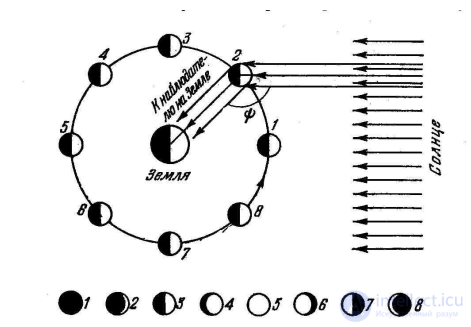
The visible motion of the Moon is accompanied by a continuous change in its appearance, characterized by the phase of the Moon.
The phase of the Moon is measured by the ratio of the area of the illuminated part of the visible disk
to its entire area.
The angle between the direction from the Moon to the Sun and to the Earth is called the phase angle.
There are four main phases of the Moon, which gradually pass one into
another: new moon, first quarter, full moon, last quarter.
The line separating the dark part of the Moon's disk from the light part is called the terminator.
The conjunction of the Moon with
the Sun during new moon and opposition during full moon are called
syzygies.
Since ancient times the peoples of the Earth have observed the phases of the Moon. With
the waxing of the moon
they associated better,
more intensive growth of plants and children's health. Among the central African Baganda tribe, when a new moon appears, mothers
bring out their infants and show them to the reborn Moon.
In Germany, for many centuries, sowing was timed to coincide with the new Moon,
as were weddings and the start of construction.
During the last quarter it was considered very bad to go to war or hunting. According to
Herodotus's testimony, it was for this very reason that the Spartans did not send their
troops in time against the Persians to Marathon.
Among peasants there still exist beliefs that one must sow during a waxing Moon
and reap during a waning one.
Claudius Ptolemy wrote in the Tetrabiblos:
"The Moon, as the celestial body closest to the Earth, bestows
its light abundantly upon earthly objects, and most of them, both animate
and inanimate, feel an affinity toward it and change together with
it; rivers quicken or slow their flow under the influence of its rays, the ebb and flow of the seas begin with its rising and setting, and plants or animals wholly or partly bloom or wither together with it."
In Shakespeare, Othello says:
"It is the very error of the moon,
She comes more nearer earth than she was wont
And makes men mad."
In the USA a group of scientists studied the circumstances of all murders committed
in Dade County over the period from 1956 to 1970. The peaks of the murder curve coincided with
the phases of new moon and full moon.
The Moon always faces the Earth with the same side, the same hemisphere, since it rotates about its own axis with the same period (and in the same
direction) with which it revolves around the Earth.
A sidereal day on the Moon is 27.32 mean Earth days.
The Moon's axis of rotation is tilted to the plane of the lunar orbit at an angle of 83°20'.
The Moon turns slightly toward the Earth, showing now one hidden side, now the other,
so that 60% of its surface can be observed from Earth. This phenomenon is called
the libration (rocking) of the Moon.
The period of the Moon's revolution around the Earth is called the sidereal or star
month. Its duration is equal to 27.32 mean solar days. After
this time elapses, the Moon again occupies its former position in its orbit relative to the stars.
The interval of time between two successive identical phases
of the Moon is called the synodic month.
The synodic month equals 29.53 mean solar days.
It is longer than the sidereal month.
After a sidereal month, having made a complete revolution along its orbit, the Moon will occupy
its former position relative to the stars, but since the Earth will have shifted to position 2, full moon will not yet occur. It will come somewhat later, when the Earth reaches position 3.
The draconic month is the interval of time between two successive
passages of the Moon through the same node of its orbit
(27.21 mean solar days).
The draconic month is shorter than the sidereal month because of the motion of the lunar orbit's nodes toward the Moon's motion.
The anomalistic month is the interval of time between two successive passages of the Moon through perigee (27.55 mean days).
All these months were already precisely calculated by Hipparchus.
As it moves around the Earth, the Moon passes in front of distant luminaries and can
block them with its disk. This phenomenon is called the occultation of luminaries by the Moon.
Determining the exact moments of the beginning and end of occultations is of great importance for studying the motion of the Moon and the shape of its disk.
The occultation of the Sun by the Moon is called a solar eclipse.
A solar eclipse looks different from different points on the Earth's surface.
The disk of the Sun will be completely obscured only for an observer located
inside the cone of the lunar shadow, the maximum diameter of which on the surface
of the Earth does not exceed 270 km.
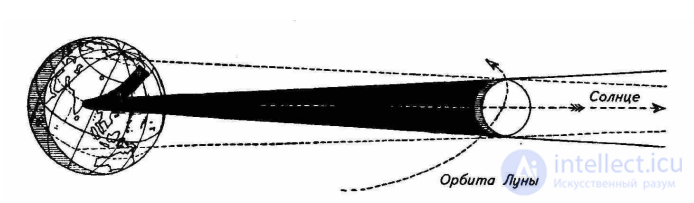
In this area there will be a total solar eclipse.
In areas where the penumbra from the Moon falls, inside the cone of the lunar penumbra there will be a partial solar eclipse - the Moon's disk will cover only part of the Sun's
the disk. The closer the observer is to the axis of the shadow, the greater the portion of the Sun's disk that is covered. Outside the penumbra cone, the entire disk of the Sun is visible and no eclipse is observed.
Since the distance from the Moon to the Earth varies from 405,500 km to 363,300 km, and
the length of the Moon's umbra cone averages 374,000 km, the tip of the lunar shadow cone sometimes does not reach the Earth's surface. In this case an annular eclipse is observed.
At different points on Earth a solar eclipse begins at different times. The lunar
shadow moves from west to east, forming a band several thousand kilometers long and about 200 km wide. A total eclipse lasts several
minutes - from 2 to 7. The total duration of all phases can last
more than two hours.
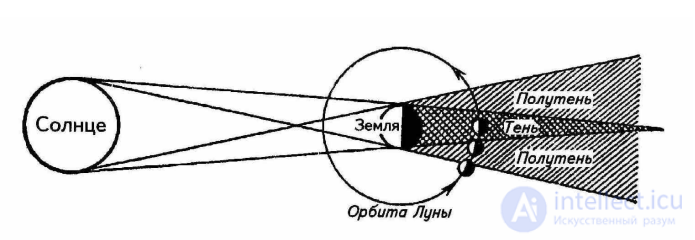
When the Moon enters the Earth's shadow cone, a lunar eclipse occurs.
The Earth's shadow cone is longer than the Moon's, and its diameter at the distance of the Moon exceeds the diameter of the Moon by more than 2.5 times.
Since during an eclipse the Moon is deprived of sunlight, a lunar eclipse is visible over the entire night hemisphere of the Earth and begins for all points at
the same physical moment (different from local time) and ends simultaneously.
When the Moon enters completely into the Earth's shadow, a total lunar eclipse occurs; when part of the Moon enters it, a partial eclipse occurs.
A total lunar eclipse can last up to 2 hours.
The eclipse is preceded and followed by a penumbral lunar eclipse, when
the Moon passes through the Earth's penumbra.
Conditions for the occurrence of eclipses.
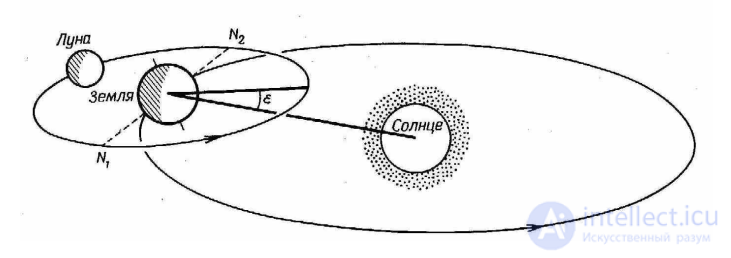
If the plane of the lunar orbit coincided with the plane of the ecliptic, eclipses would occur every synodic month. Because the angle of inclination is 5009', the Moon during a new moon or full moon can be far from the plane of the ecliptic, and then its disk will pass above or below
the Sun or the Earth's shadow cone, and no eclipse will occur.
For an eclipse to occur, the Moon must be near a node of its orbit during a new moon or full moon, i.e. not far from the ecliptic.
For a solar eclipse to occur, the geocentric ecliptic latitude of the Moon must be less than 88',7, and the distance of the Moon from the node of its orbit up to 160,5.
Every year there are two solar eclipses near the nodes of the lunar orbit, but
there can be 4 or 5.
For a lunar eclipse to occur, at full moon the distance between the center of the Earth's shadow and the lunar node must be less than 100,6, and between the centers of the Earth's shadow and the Moon - less than 56',5.
Over the course of a year there may be no lunar eclipse at all, or there may
be two or three.
The sequence of eclipses repeats almost exactly in the same order after an interval of time called the saros. The saros (Egyptian - repetition) was calculated as far back as antiquity and amounts to 18 years and 11.3 days.
During each saros there are 70 eclipses, of which 41 are solar and 29
are lunar. Solar eclipses occur more often than lunar ones, but at a given point on
the Earth's surface lunar eclipses can be observed more often, since they are visible
over an entire hemisphere of the Earth, whereas solar eclipses are visible only in a narrow
band. There are 10 total solar eclipses during a saros, but they are rarely
seen. At a given point on Earth, solar eclipses are visible on average 1
time per 200-300 years.
According to an ancient Chinese legend, the court astronomers Hi and Ho, who lived in the 22nd
century BC, gave themselves over to drunkenness and failed to predict in time the solar eclipse of 22
October 2137 BC. The eclipse occurred during a solemn ceremony,
disrupting its ritual. The astronomers had their heads cut off.
The saros was discovered by the Babylonians no later than the 6th century BC. Claudius Ptolemy described it in the Almagest with reference to Babylonian astronomers:
"The most ancient mathematicians found from observations of lunar eclipses that in an interval of 6585 1/3 days there are completed approximately 223 synodic months, 239 anomalistic months, 242 returns in latitude (draconic), 241
returns in longitude (sidereal), and in addition 10 2/3 degrees, which
the Sun traversed in the same time beyond its 18 revolutions, counting them relative to the fixed stars; and they called this interval of time a period, because after it all these motions return to their original position."
In the 19th century cuneiform tablets of ancient Babylon were found. On one
of them there is a table of saroses from -372 to -276.
The authors of the theory of eclipses in Babylon were the astronomers Kidinnu and Naburimannu.
Reports about eclipses in Babylon were of this character: "On the fourteenth
an eclipse will occur; this is unfavorable for Elam and Amurru, but favorable for the king, my lord; let the king, my lord, be at ease. It will be
visible without Venus. From Irashiilu, the king's servant."

Comments