
Lecture
Because of spherical symmetry, the physical properties of the Sun are the same at
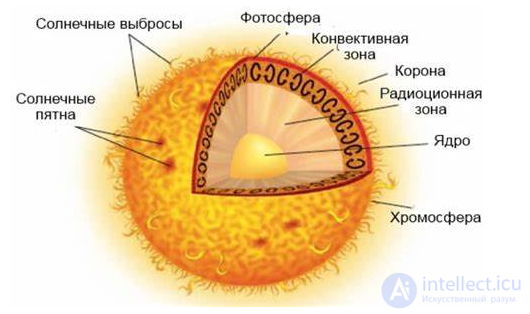
equal distances from the center. Depending on the properties of the matter, the Sun can be divided into 4 layers.
The central region, extending out to a distance of 0.2 of the radius, is called
the core. This is the zone of energy release. The temperature in the core is 1.5 .
10^7 K. The pressure reaches 3 . 10^11 atm. Under these conditions hydrogen atoms move at speeds of up to
hundreds of km/s. Given the high density (150 g/cm3
), collisions of atoms
occur frequently.
Some of these collisions lead to close
approaches of atomic nuclei, which are needed for nuclear reactions to occur.
The solar core is a self-regulating thermonuclear reactor, in which helium nuclei are synthesized from hydrogen nuclei (the proton-proton cycle).
The reaction begins with the β-decay of one of two protons at the moment of their close
approach:
1H + 1H →
2D + e+
+ ν + 1.44 MeV. (this occurs over 14 . 10^9
years).
During β-decay a proton turns into a neutron, emitting a positron e+
and
a neutrino ν. Combining with a second proton, the neutron yields a nucleus of heavy hydrogen - deuterium 2D. For each pair of protons the process takes, on average, 14 billion years, which is what determines the slowness of the thermonuclear reactions in the
Sun and the overall length of its evolution.
Next, collisions occur between the deuterium and a third proton, forming
nuclei of the isotope 3He, which, combining and emitting two protons, yield a nucleus
of ordinary helium.
The mass of the helium nucleus is 1% less than the mass of the four protons. This loss of mass
is called the mass defect and is the reason for the release, as a result of the nuclear reactions, of a large amount of energy in the form of γ-radiation and the emission of
neutrinos. When one helium nucleus is formed, the energy released = 4.129 .
10-5 erg
= 25.8 MeV.
Neutrinos have a negligible rest mass, travel at the speed
of light, and at Earth should amount to a flux of 10^11
particles through 1 cm3
per second.
The Sun's luminosity is sustained by the conversion of 600 million tons of hydrogen into helium.
Most of the energy is carried away from the core by hard electromagnetic radiation, which diffuses toward the Sun's surface layers over millions of years.
At a distance of 0.3 of the radius from the center the temperature drops below 5 million K,
the pressure falls below 10 billion atm., and nuclear reactions can no longer take place.
The core is surrounded by a zone of radiative equilibrium, or a zone of radiative
energy transfer. This zone extends from 0.2 to 0.7 of the radius.
Energy is carried from the core to the outer layers by radiation. An electromagnetic
wave carries its own energy. In this zone a significant portion of the photons moving outward from the interior is partly absorbed and partly scattered by free nuclei and electrons, so that the energy transfer is accompanied by a decrease in the average energy of the quanta, as well as a decrease in temperature, pressure,
and density of the matter. These layers merely pass outward the radiation released at greater depth in the form of gamma quanta, which are absorbed and re-emitted by individual atoms. For each absorbed quantum of high energy, the atoms emit several quanta of lower energies. In absorbing,
an atom becomes ionized or strongly excited and gains the ability to radiate.
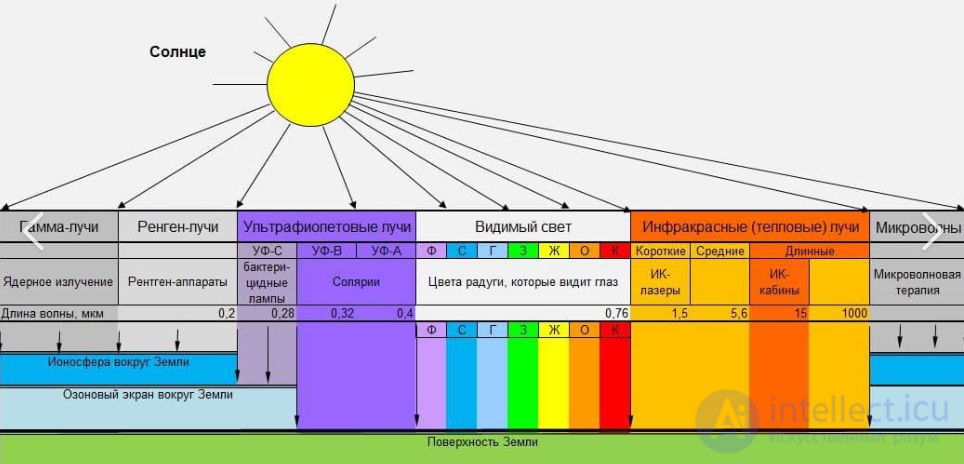
However, the electron's return to its original energy level does not happen at once, but through intermediate states, and transitions between these release quanta of lower energies. As a result, the hard quanta are broken up into less energetic ones. So instead of gamma rays, X-rays are emitted; instead of X-rays, ultraviolet, which in
turn, already in the outer layers, breaks up into quanta of visible and thermal
rays, which are finally radiated by the Sun.
At a distance of 0.7 of the radius from the center the temperature regime becomes such
that neutral atoms of hydrogen and helium can already exist (T=
.
10^6 K, p=
10^6 atm, ρ= 10-2
g/cm3
).
Energy transfer by radiation becomes inefficient. In certain volumes
of gas the temperature can rise; they become lighter and rise upward, while cooler masses of gas sink to take their place. Large-
scale motions of matter arise - convection, which is the main mechanism for transferring energy to the surface layers. This zone is called the convective zone.
Part of the energy, through the relative motion of plasma flows in the convective
zone, is converted into the energy of electric and magnetic fields.
The extent of the convective zone is 1.5 .
10^6
km (0.2 of the radius). The speed of matter's motion increases significantly. From several m/s to 3 km/s.
Above the convective zone, at a distance of 0.9 of the radius from the center and beyond, lies the atmosphere.
In the solar atmosphere, changing formations arise and disappear, sharply
different from the surrounding undisturbed regions.
In the photosphere, chromosphere, and corona, manifestations of solar activity are different. However, all of them are related to a common cause. They are caused by the magnetic field,
always present in active regions.
Faculae. In undisturbed regions of the photosphere there is only the general magnetic
field of the Sun, whose strength is 1 oersted. In active regions the strength of the magnetic field increases hundreds and even thousands of times.
A small increase in the magnetic field, to tens or hundreds of oersteds, is accompanied by the appearance in the photosphere of a brighter region, called a facula. In
total, faculae can occupy a significant fraction of the entire visible
surface of the Sun. They are distinguished by a characteristic fine structure and consist
of numerous filaments, bright points, and nodules — facular granules. Faculae are best seen at the edge of the solar disk. They are 200–300 K hotter than the neighboring undisturbed region and stand out slightly above the level of the undisturbed photosphere.
Faculae can exist unchanged for several weeks or months.
Sunspots. In facular regions with the greatest intensification of the magnetic field, sunspots
can arise.
A spot appears in the form of a small pore. After a day, the pore develops into a round dark spot with a sharp boundary, whose diameter increases to sizes of several tens of thousands of kilometers.
The entire phenomenon is accompanied by a smooth increase in the strength of the magnetic
field, which in the center of large spots reaches several thousand oersteds. Sometimes several spots arise within a small region elongated parallel to the equator — a sunspot group. Two spots develop the strongest — the leading (western) one and the trailing (eastern) one. The magnetic fields of both main spots always have opposite polarity, so such a group
is called bipolar. The area occupied by the spots reaches its greatest
extent on the tenth day. After this, the spots begin to gradually shrink and disappear. Overall, the whole process takes about two months.
At the center of a spot, the brightness is 10 times less than that of the surrounding regions of the photosphere. The temperature in a spot is 2,000 degrees lower than in the photosphere.
At the end of May 1995, scientists at the Kitt Peak Observatory discovered absorption lines of water vapor in the infrared spectra of sunspots. It turned out that water vapor exists in spots, heated to 1000°C.
Flocculi. The chromosphere above spots and faculae increases in brightness.
The contrast grows with height. These bright patches are called flocculi. The increased brightness of a flocculus can be explained by an increase in the density of matter in the
chromosphere by a factor of 3–5, with the temperature remaining unchanged.
Chromospheric flares. In the chromosphere, in the region between developing spots near the boundary separating the polarity of strong magnetic fields, chromospheric flares are observed. At the start of a flare, the brightness of one of the bright
nodules of a flocculus suddenly increases. Within a short time, about a minute, strong radiation spreads along a long filament or floods an entire region extending tens of thousands of kilometers. The flare is noticeable in
white visible light against the background of the photosphere. Simultaneously with the visible radiation, the intensity of ultraviolet and X-rays increases, as does the power of the
radio emission.
After reaching its maximum, the radiation weakens over the course of several tens of minutes. These phenomena are explained by the release of a large amount of
energy as a result of instability of the plasma located in a region of a very inhomogeneous magnetic field. As a result of the interaction of the magnetic field and
the plasma, a significant part of the magnetic field's energy is converted into heat, heating the gas to a temperature of tens of millions of degrees, and is also used to accelerate clouds of plasma and elementary particles.
The whole process has the character of an explosion, accompanied by strong compression of
matter within a certain volume of the chromosphere. Particles accelerated in the process of the flare
have high energies and constitute cosmic rays. Their energy
is nevertheless less than that of particles arriving from distant regions of the Galaxy, so they are called “soft” cosmic rays.
Corpuscular streams of even less energetic particles propagate at
speeds of 500–1000 km/s.
Prominences. Active formations observed in the corona. These are denser
and cooler clouds, glowing approximately in the same spectral lines as the chromosphere. Most often these are long, very flat formations, arranged almost perpendicular to the surface of the Sun. In projection onto
the solar disk, prominences are seen as curved filaments. These are the most
grandiose formations in the solar atmosphere. Their length reaches hundreds
of thousands of kilometers, and their width does not exceed 6000–10000 km.
The lower parts merge with the chromosphere, while the upper parts extend tens
of thousands of kilometers into the corona.
Through prominences there is a constant exchange of matter between the chromosphere and the corona.
The emergence, development, and motion of prominences are closely connected with the evolution
of sunspot groups. At the first stage of development of an active region of spots, short-lived and rapidly changing prominences form near the spots.
At later stages, stable quiescent prominences arise,
existing without noticeable changes for several weeks and months,
after which a stage of activation of the prominence may occur, manifested
in the appearance of strong motions, ejections of matter into the corona, and the appearance
of rapidly moving eruptive prominences.
Active regions in the corona. The external appearance of the solar corona is closely connected with
the manifestation of activity in the lower layers of the atmosphere. Above spots, characteristic formations are observed in the shape of curved rays, resembling bushes, as well as condensations of coronal matter in the form of rounded clouds - coronal condensations. Above faculae, entire systems of straight,
slightly wavy rays are visible. Prominences are usually surrounded by arches and
helmets of condensed coronal matter. All these formations often turn into long rays, extending over many solar radii.
The inevitability of the existence of a magnetic field in the Sun follows from the fact that vertical and horizontal motions of plasma exist within certain layers
of the Sun.
In 1953 the American astronomer H. Babcock discovered the existence of a weak magnetic field of dipole character with a magnetic moment oriented along the axis of rotation of the Sun. The strength of the general magnetic field is
1-2 Gs. The discovered magnetic field turned out to be variable - approximately
every 11 years it “reverses”, that is, changes polarity. The field lines
of the general magnetic field must be located in meridional planes. The most common method for determining magnetic
field parameters is by measuring the degree of “splitting” of spectral lines in solar
spectrograms (the Zeeman effect).
Observations have shown that the Sun's magnetic field cannot be described
by a dipole component alone. Thus, in individual active regions of the photosphere, local magnetic fields have been found whose strength significantly exceeds the strength of the general magnetic field.
The appearance of facular granules is preceded by an increase in field strength to 500-700 Gs, the appearance of a pore - to 1000-2000 Gs, of a spot - to 5000
Gs. The dissipation of a local magnetic field leads to the disappearance of the corresponding active formation.
The formation of local magnetic fields can be explained as follows: differential rotation of the Sun leads to deformation of the field
lines of the general magnetic field. They stretch out parallel to the equator, twisting into a spiral - the poloidal field turns into a toroidal one. Further deformation of the field lines leads to instability of the general magnetic field and its breakup into magnetic flux tubes. Inside a tube the density of the magnetic field is significantly higher than the density of the general magnetic field.
However, the density of the plasma inside the tube is significantly lower than the density of the
surrounding medium's plasma. The magnetic tube rises to the surface of the photosphere, forming local magnetic fields of varying strength. A slight increase in strength within the flux tube suppresses the chaotic
component of the convective motion of the plasma and thereby facilitates the transport
to the surface of the photosphere of hot volumes of gas - a facula is formed.
An increase in strength to 1000-5000 Gs suppresses not only the chaotic but also the horizontal component of convective motion, i.e., convection itself is suppressed and the transport into the atmosphere of hot matter
from the convective zone stops - cold pores and spots appear.
Magnetic flux tubes, being unstable formations, break down, the general magnetic field is reorganized, and the process repeats with the opposite polarity.
In the solar corona, polar rays, arc systems, loop-shaped prominences, coronal mass ejections of plasma, etc. are observed. All these coronal elements differ not only in external appearance, but in the temperature and density of the matter forming them. Condensations of matter and regions of differing temperature
can persist for a long time only thanks to the presence of magnetic barriers. Thus, the structural details of the corona, as it were, outline the topology of its magnetic fields. Motion of plasma is possible only along magnetic
field lines, so studying the dynamics of coronal formations allows one to study in detail the shape and dynamics of the field lines of the general and local
magnetic fields. It has been established that the magnetic field strength in thin
features of the inner corona (adjacent to the chromosphere and the transition layer)
= 20-30 Gs, in coronal condensations = 100 Gs, in the background corona - 1-2 Gs.
Coronal plasma is concentrated inside magnetic tubes, which are formed by magnetic fields emerging from the photosphere and chromosphere. Where
the magnetic field lines close, at different poles of the magnetic field
of photospheric and chromospheric active regions, systems of
coronal arches are observed.
The shape of the streamers and coronal rays follows the shape of the closed magnetic
field lines, extending far beyond the disk of the Sun.
Near the poles the magnetic field lines are open and extend into interplanetary space - here in the corona there are no arch structures, the brightness of the corona is greatly
diminished, and coronal holes are observed.
The solar corona is completely transparent to visible radiation, but poorly
transmits radio waves, which undergo strong absorption and refraction in it.
At meter wavelengths the brightness temperature of the corona reaches a million degrees. At shorter wavelengths it decreases. This is related to an increase in the
depth from which the radiation emerges, due to a decrease in the absorbing properties
of the plasma.
Radio emission from the solar corona has been traced to distances of several dozen radii. This is possible thanks to the fact that the Sun annually passes
by a powerful source of radio emission - the Crab Nebula - and the solar corona eclipses it. Scattering of the nebula's radiation occurs in the inhomogeneities of the corona.
Bursts of solar radio emission are observed, caused by plasma
oscillations associated with the passage through it of cosmic rays during
chromospheric flares.
X-ray emission has been studied using special telescopes mounted on spacecraft. The X-ray image of the Sun has an irregular shape with many bright spots and a "patchy" structure.
Near the optical limb a noticeable increase in brightness is seen in the form of an inhomogeneous
ring. Especially bright spots are observed above centers of solar activity, in regions where there are powerful sources of radio emission at decimeter and meter wavelengths. This means that X-ray emission arises
mainly in the solar corona. X-ray observations of the Sun make it possible
to carry out detailed studies of the structure of the solar corona directly in projection onto the solar disk.
Near the bright regions of coronal glow above sunspots, extensive dark areas have been found that are not associated with any noticeable features in
visible light. They are called coronal holes and are associated with regions of
the solar atmosphere in which the magnetic fields do not form loops. Coronal holes are a source of enhancement of the solar wind. They can
exist for several solar rotations and cause on Earth a 27-
day periodicity of phenomena sensitive to the corpuscular radiation of the Sun.
In interplanetary space there exists a continuous flow of plasma, moving radially from the Sun at a speed of 100 - 1000 km/s and reaching distances of 100 AU. This phenomenon is called the solar wind.
The solar wind owes its origin to the corona. Heated to extremely high temperatures, the corona cannot remain in a state of hydrostatic
equilibrium and must expand. In this process the coronal matter (plasma)
is continuously accelerated and at a distance of several solar radii reaches
the speed of sound, and further on exceeds it several times over.
The solar wind is a flow of protons and electrons with a small admixture (2-20%)
of helium ions and some other elements.
Within the orbit of the Earth the speed of the protons is 400 km/s, the concentration of protons
is 6 per cm3
. Due to the solar wind, the Sun loses up to 10-14 of its mass annually.
The total flux of kinetic energy carried away from the Sun by the solar wind is
1027
erg/s.
Near the Sun, streams of the solar wind move along the field lines of its magnetic field. However, at a distance of 2-3 radii the speed of the solar wind
increases significantly, and the collective motion of protons and electrons
carries the magnetic field lines along with it. This phenomenon is called the
"freezing-in" of the magnetic field into the plasma. The structure of the solar wind is inseparably linked to the magnetic field of the Sun and changes with changes in solar activity. The rotation of the Sun gives the elongated (closing at the edge of the
heliosphere at a distance of 105
AU) magnetic field lines the shape of spirals. The average strength of the interplanetary magnetic field is 6 .
106 Gs.
The electrons and protons of the solar wind move along spirals, the radius of which
depends on the mass and speed of the particles: the spiral radius for electrons is about several km, for protons - several hundred km.
Upon approaching Earth, deformation of the field lines of the interplanetary magnetic field occurs - transverse Alfvén waves arise. With a sharp increase in the speed of the solar wind plasma at the boundary with Earth's magnetosphere, a magnetohydrodynamic shock wave arises, leading to significant
deformations of Earth's magnetic field (magnetic storms).
The solar wind plasma, encountering a planet in its path, partially flows around this
obstacle and is partially absorbed by it.
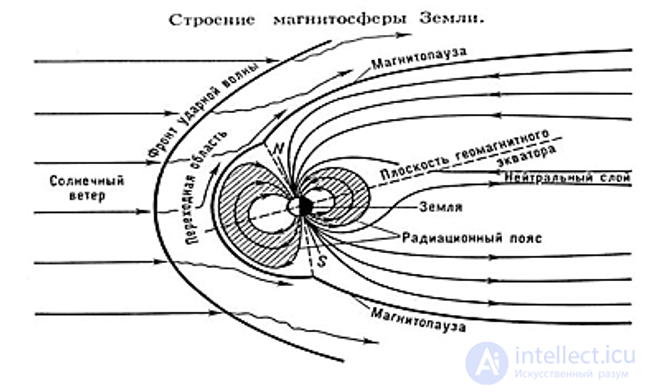
The solar wind, running into the atmosphere, forms a shock wave. Behind
the shock front lies a transition region, in which the directed velocity is significantly lower, but the particle concentration, temperature, and
magnetic field strength are greater than in the undisturbed solar wind. Solar wind particles are deflected by the magnetic field long before
they come into contact with the ionosphere. The pattern of magnetic field lines in the
magnetic field is noticeably deformed.
Earth's magnetic field holds a huge number of energetic particles,
electrons and protons. Their energy and concentration depend on the distance to
Earth and geomagnetic latitude. The particles fill the radiation belts.
The entire region of near-Earth space, filled with charged particles
moving in Earth's magnetic field, is called the magnetosphere.
It is separated from interplanetary space by the magnetopause. Along the magnetopause, particles of the solar wind's corpuscular streams flow around the magnetosphere.
Through the Sun's radiant and corpuscular radiation and the interplanetary magnetic
field, a continuous influence is exerted on all processes occurring on
Earth's surface and in Earth's atmosphere.
Disturbances of the magnetic field are accompanied by disruptions of radio communication in polar regions.
Strong magnetic storms occur when large groups of spots are present near the center of the solar
disk. But they are related to solar flares, which
appear during the development of a spot group. The hard radiation of a flare causes a sharp increase in ionization in the ionosphere.
The main driver of Earth's vital activity is the Sun. Its entire
spectrum, from the short - invisible, ultraviolet waves to the
long red ones, as well as all its electron and ion streams.
Statistical studies have shown that in those years, months, and weeks when
the Sun's electromagnetic and radioactive activity increases, on
Earth, on different continents, in different countries, the number of mass
phenomena increases, for example, diseases, mortality from various causes, and so on. A correspondence is found between solar and terrestrial phenomena.
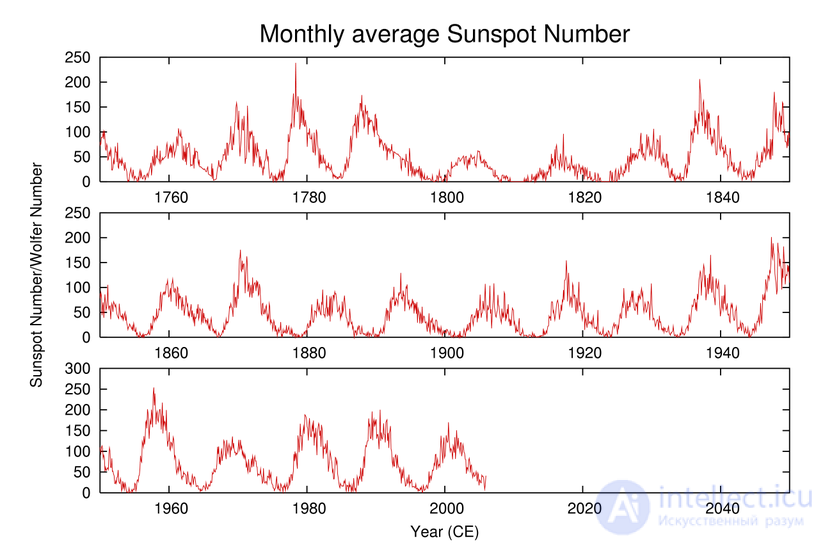
The number of spots and other manifestations of solar activity associated with them changes periodically. The epoch when the number of activity centers is greatest is called the maximum of solar activity.
Conventional Wolf numbers are used as a measure of the degree of solar activity.
W = k(f + 10g),
where f is the total number of spots, g is the number of their groups.
The proportionality coefficient k depends on the power of the instrument used.
Usually the Wolf number is averaged over months or years and a graph of the dependence of solar activity on time is plotted.
Maxima and minima alternate every 11 years, although the intervals
of time between individual successive maxima can vary within the range of 7 to 17 years.
During each 11-year cycle all the leading spots of bipolar groups
have a certain polarity in the northern hemisphere and the opposite one in the
southern. In the next cycle the polarity of the leading and trailing spots changes
to the opposite. At the same time the polarity of the Sun's overall
magnetic field also changes.
The 11-year cycle is also present in other characteristics of the Sun: the proportion of area occupied
by faculae and flocculi, the frequency of flares, the number of prominences, the shape
of the corona, the power of the solar wind.
Some researchers also distinguish longer cycles, for example, 33.33 years, 66.67 and 88.33 years, as well as a period of 266 years.
The longest cycle of solar activity is 1800 years. This cycle is associated with significant climate changes on Earth.
Around -4000 years there was a period of greatest humidity. From those times
legends about a worldwide flood remain, archaeological confirmations were found that the rivers Tigris and Euphrates, and the Amu Darya, flooded heavily, and the
climate in the Sahara was humid.
Around -3000 the humid period was replaced by a period of desiccation. The levels of alpine lakes fell, the glaciation of the North Atlantic decreased,
and people moved from the Sahara to the Nile and Lake Chad.
The maximum of the new humid epoch occurred around -200. Many
pile-dwelling settlements in the Alps were flooded, forests began advancing on the steppe, and Lake Ladoga expanded widely. A favorable climate was re-established in the Sahara.
During another humid period in Europe there were severe winters and heavy snowfalls.
In -219 Hannibal's army struggled greatly to overcome snow blockages in the
Alps. In -177, in northern Greece, all the trees froze and strong winds
tore down houses.
The dry period of the 6th–10th centuries AD caused the Caspian Sea to shrink,
and led to the settlement of the mountain valleys of the Caucasus and the Alps.
In 860 the Vikings discovered Iceland and colonized it. In 895 the
settlement of Greenland began. There were fertile lands and good pastures there.
Starting in the 13th century, cooling began in Greenland. Ice advanced from the north, and the population stopped engaging in animal husbandry and farming. The last Norwegian ship visited Greenland in 1377, and one sailed from Greenland to
Norway in 1410. 132 years later, an expedition sent from Europe to
Greenland found not a single inhabitant.
The maximum of the last humid epoch falls on the 13th–16th centuries. Water in the
Caspian Sea rose so much that it flooded part of Baku. In the Alps and the
Caucasus, glaciers reached unprecedented mass. Europe experienced the strongest
frosts.
At present a dry period is underway. In the Alps, roads paved by the Romans
have emerged from beneath retreating glaciers, the Caspian Sea is shrinking, and lakes and rivers are drying up.
Statistical studies have established that solar perturbations directly affect the cardiovascular, nervous, and
other human systems, as well as microorganisms.
V. Seybel carefully studied the descriptions of ancient authors concerning the plague
of Justinian of 580–581. According to his work, starting in 513 a series of extraordinary phenomena in nature began, which ended only in 570.
In 513 the eruption of Vesuvius began, followed by devastating earthquakes; for example, in the Antioch earthquake 250 thousand people died. In 542 the plague
appeared in Constantinople, and in 543 earthquakes shook all of Europe.
Starting in 552, a new cycle of natural disasters and earthquakes began in all
countries of the ancient world along the shores of the Mediterranean Sea.
In 526 there occurred such a significant dimming and weakening of sunlight that it lost its brilliance and began to resemble the moon, remaining
without radiance for an entire year.
Chroniclers mention a fiery meteor, destructive thunderstorms of 556,
droughts of 562–563, the appearance of three comets during a period of severe plague, the movement of locusts during the last epidemic epoch, unusual fish proliferation, and other
unusual phenomena.
Contemporaries of the plague epidemic of 1348–1351 left many observations
of nature.
Thus, Mussis wrote that in China it rained snakes and toads, in India an earthquake destroyed many cities, after which fire descended from the sky and burned them to the ground
along with people and animals. In many places “streams of blood flowed from the sky and
stones fell”.
In 1334 in China, natural disasters and diseases killed about 5 million
people.
In 1348 in Europe, in the year of the plague's greatest spread from south to north
and from east to west, several powerful earthquakes rolled through. Many
cities and castles were destroyed.
Chroniclers mention foul air, heavy vapors, dense clouds covering the sky, and unpleasant heat that tired the body and constricted
breathing. Unusual stenches and vapors rising from the ground were noted in
Egypt, Greece, Dalmatia, and Germany. In Italy in 1347 people were terrified by
“mysterious vapors” moving from north to south. Some chroniclers mention the influence of new moons on the worsening of epidemics.
At the same time, numerous diseases were also noted among animals.
The following physical phenomena on Earth have been linked to the degree of intensity
of solar activity:
- the intensity of terrestrial magnetism, magnetic storms, their frequency,
- the frequency of auroras,
- the frequency of cirrus cloud appearance,
- the frequency of halos and coronae appearing around the Sun and Moon,
- the amount of ultraviolet radiation,
- the amount of radioactive emanation in the air,
- the degree of ionization of the upper atmosphere, changes in radio reception,
- the frequency and intensity of thunderstorm activity,
- the amount of ozone in the air,
- the amount of thermal radiation,
- the air temperature at Earth's surface and the temperature of sea water,
- air pressure, the frequency of storms, hurricanes, tornadoes,
- the amount of precipitation, the frequency of hailstorms, the number of polar icebergs,
- the level of lakes,
- climate fluctuations, climate disturbances,
- earthquakes.
Phenomena in Earth's organic world linked to the periodic
activity of the Sun:
- the size of forage grain harvests,
- the quantity and quality of wine produced,
- the growth of wood,
- the time of flowering of plants, the lushness of plant blooming,
- the reproduction and migration of insects,
- the reproduction, migration of fish, the amount of roe in the liver of certain fish,
- the time of the spring arrival of birds,
- the reproduction and migration of animals, livestock mortality,
- the amount of calcium in the blood,
- the frequency of lightning strikes on humans,
- fluctuations in infant weight,
- psychopathic epidemics, mass hysteria, hallucinations,
- the frequency of violent crimes,
- the frequency of accidents,
- modification of nervous excitability and neuro-psychological tone,
- the frequency of sudden deaths, exacerbations, worsening in the course of illnesses,
- the frequency of epileptic seizures,
- fluctuations in overall mortality,
- birth rate, - marriage rate,
- epidemics and pandemics

Comments