
Lecture
Newton's law of universal gravitation makes it possible to measure one of the most important
physical characteristics of a celestial body - its mass.
The mass can be determined:
a) from measurements of the force of gravity on the surface of the given body (the gravimetric
method),
b) from the third, refined law of Kepler,
c) from analysis of the observed perturbations produced by the celestial body in the motions of other celestial bodies.
1. The first method is applied on Earth.
Based on the law of gravitation, the acceleration g at the surface of the Earth:
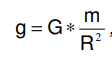 where m is the mass of the Earth, and R is its radius.
m = (gR2)/G.
g and R are measured at the surface of the Earth. G = const.
With the currently accepted values of g, R, G we obtain the mass of the Earth:
m = 5.976 . 1027 g = 6 .1024 kg.
Knowing the mass and volume, one can find the mean density. It equals 5.5 g/cm3.
2. From Kepler's third law one can determine the ratio between the mass
of a planet and the mass of the Sun, if the planet has at least one satellite and its distance from the planet and period of revolution around it are known.
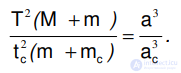
where M, m, mc are the masses of the Sun, the planet, and its satellite, T and tc are the periods of revolution of the planet around the Sun and of the satellite around the planet, and a and ac are the distances of the planet from the Sun and of the satellite from the planet respectively.
From the equation it follows
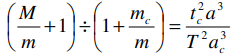
The ratio M/m is very large for all planets; the ratio m/mc is very small
(except for Earth and the Moon, Pluto and Charon) and can be neglected.
The ratio M/m can easily be found from the equation.
For the case of Earth and the Moon one must first determine the mass of the Moon. This is
very difficult to do. The problem is solved by analyzing the perturbations in Earth's motion
caused by the Moon.
3. From precise determinations of the apparent positions of the Sun in longitude,
changes with a monthly period were discovered, called the "lunar inequality". The presence of this fact in the apparent motion of the Sun indicates that
the center of the Earth describes a small ellipse over the course of a month around the common center of mass of the "Earth-Moon" system, located inside the Earth, at a distance of 4650 km
from the center of the Earth.
The position of the Earth-Moon center of mass was also found from observations of the minor
planet Eros in 1930 - 1931.
From perturbations in the motions of artificial satellites of the Earth, the ratio of the masses
of the Moon and the Earth turned out to be 1/81.30.
In 1964 the International Astronomical Union adopted it as a const.
From Kepler's equation we obtain for the Sun a mass = 2.1033g., which is 333,000 times
greater than the Earth's.
The masses of planets without satellites are determined from the perturbations that
they cause in the motion of Earth, Mars, asteroids, comets, and from the perturbations
they produce on one another.
A tide is any of the cyclic deformations of one astronomical body,
caused by the gravitational forces of another.
The dimensions of the Earth are not infinitely small compared to the distance to the Moon and
the Sun. The forces of lunar and solar attraction are not the same at different points of the Earth. Therefore a disturbing force appears, acting differently on various
parts of the Earth's surface. In solid masses the action of this force causes tension, while large masses of water are drawn by the force of attraction and
flow from place to place. The tidal effect on the atmosphere is expressed
in the appearance of atmospheric currents.
Water tides have been known since ancient times. The geographer Strabo (born -
66) relates that the Phoenicians knew well about tides. In the Mediterranean
Sea the effect is small, but the Phoenicians passed through the Pillars of Hercules
and observed it in the ocean. They pointed out that tides depend on the phases
of the Moon and are especially intense at full moon and new moon.
The Italian Jesuit Cabeo (1585 - 1650) supposed that the Moon produces on
the sea floor some spirituous substance, which causes the tide.
Stevin explained the tide by the attraction of the Moon, but explained the bulge on the opposite side of the Earth by the existence there of another attracting point.
Galileo explained tides by centrifugal force, rejecting gravitation.
Some researchers supposed that the Moon produces changes in air pressure, which affects sea level.
The most correct explanation of the phenomenon of tides was given by Isaac Newton, with
the help of the theory of gravitation. He wrote that the Moon pulls water away from the Earth on
one side and pulls the Earth away from the water on the other.
If the Earth's surface were covered on all sides by ocean, then every drop of water would have an acceleration proportional to the square of the distance between the particle and
the center of the Moon.
The resultant of the accelerations imparted to solid particles passes through
the center of the Earth T and equals:
ωT = Gm/r2,
where m is the mass of the Moon, r is the distance of the center of the Moon from the center of the Earth.
For ocean water the acceleration at point A is greater,
than ωT, and at point B less than ωT, since:
ωA= Gm/(r - R)2 ωB= Gm/(r + R)2
where R is the radius of the Earth.
The relative acceleration (relative to the center of the Earth) at point A equals: ωA -
ωT = Gm{1/(r - R)2 - 1/r2 }= Gm{(2rR - R2)/(r - R)2r2} = Gm2R/r3.
We neglect the small term R2, and in place of (r - R) we leave r.
This difference of accelerations is directed away from the center of the Earth.
At points A and B the action of the Moon weakens the force of gravity at the Earth's surface.
At points F and D the action of the Moon increases the Earth's gravity.
The action of the accelerations at intermediate points causes the water of the ocean to rise on one half of the Earth toward point A, where the Moon is at the zenith,
and on the other half toward point B - where the Moon is at the nadir.
Under the action of the Moon, the water envelope of the Earth takes the shape of an ellipsoid,
elongated in the direction of the Moon. Near points A and B there will be high tide, while at points
F and D - low tide.
During the interval of time between two consecutive culminations of the Moon, equal to 24h52m, the tidal bulges travel around the Earth, and at each
location there will be two high tides and two low tides.
Under the action of solar attraction, the water envelope of the Earth experiences
tidal forces 2.2 times weaker than the lunar ones. Solar tides are not
observed separately; they only change the magnitude of the lunar tides.
During new moons and full moons the forces add up and the tides are greater
than usual; at quadratures the lunar high tide coincides with a solar low tide, the forces
subtract, and the tides are smaller.
In reality the Earth is not everywhere covered with water, the bottom of the seas and oceans has a
complex relief, and the tidal wave experiences great friction. The moment
of high tide therefore does not coincide with the moment of the Moon's culmination and lags behind by up to
six hours. This interval of time is called the establishment of the port (tidal lag).
The height of the tide in the Black Sea is a few centimeters, in the Bay of Fundy
on the Atlantic coast of Canada - 18 meters.
Friction of the tidal wave against the solid parts of the Earth causes a systematic slowing of its rotation.
Tides affect changes in atmospheric pressure.
Due to the perturbing action exerted on the Earth's rotation by the bodies
of the Solar System, the Earth's axis of rotation performs a very
complex motion in space. The Earth has the shape of a spheroid, and therefore different parts
of the spheroid are attracted by the Sun and Moon unevenly.
1. The axis slowly describes a cone, remaining all the while inclined to the plane
of the Earth's motion at an angle of about 66.5. This motion is called precessional, its period is about 26,000 years. It determines the mean direction of the axis in
space at various epochs.
2. The Earth's axis of rotation performs various small oscillations about its
mean position, the main ones of which have a period of 18.6 years (this period
is the period of revolution of the nodes of the lunar orbit, since nutation is a consequence of
the action of the Moon's attraction on the Earth) and are called the nutation of the Earth's axis. Nutational oscillations arise because the precessional forces of the Sun and
Moon continuously change their magnitude and direction. They equal 0 when the Sun
and Moon are in the plane of the Earth's equator and reach a maximum at the greatest distance from it.
As a result of precession and nutation, the mutual arrangement of the celestial poles and the poles of the ecliptic is constantly changing.
3. The attraction of the planets is too small to cause changes in the position of the Earth's axis.
But the planets influence the position of the Earth's orbit. Changes in the position of the plane of the ecliptic under the influence of the planets' attraction is called planetary
precession.
The celestial pole, determined by the mean direction of the Earth's axis of rotation, i.e.
possessing only precessional motion, is called the mean celestial
pole.
The true celestial pole also takes into account the nutational motions of the axis.
Due to precession, over 26,000 years the mean celestial pole describes a circle of radius 23.5 around the pole of the ecliptic. In one year the displacement of the mean
celestial pole on the celestial sphere is about 50".3. The equinoctial points shift westward by the same amount,
moving to meet the apparent annual motion of the Sun. This phenomenon is called precession or the anticipation of the equinoxes. As a result of this, the Sun arrives at the equinoctial points earlier than it reaches the same place against the background of the stars. The celestial pole describes a non-closing circle on the celestial sphere. In 2000 BC the pole star was α Draconis, in 12,000 years the pole star will become α Lyrae.
At the beginning of our era the point of the vernal equinox was located in the constellation Aries, and the point of the autumnal equinox in the constellation Libra. Now the point of the vernal
equinox is located in the constellation Pisces, and the autumnal one in the constellation Virgo.
The precessional motion of the celestial pole causes a change in the coordinates of stars with
time.
The influence of precession on coordinates:
dα/dt = m + n sin α tg δ,
dδ/dt = n sin α.
where dα/dt, dδ/dt - the changes in coordinates per year, m - the annual precession in right ascension, n - the annual precession in declination.
Due to the continuous change in the equatorial coordinates of stars, there is a
slow change in the appearance of the starry sky for a given place on Earth. Some stars invisible before will begin to rise and set, and some visible ones
- will become non-rising. Thus, in a few thousand years, in Europe one will be able to
observe the Southern Cross, but will not be able to see Sirius and part of the constellation
Orion.
The true pole of the world traces a complex curve around the mean pole.
Its motion on the celestial sphere occurs approximately along an ellipse,
whose semi-major axis equals 18",4, and semi-minor axis 13",7. It completes one revolution
in 18.6 years. This motion of the true pole of the world around the mean pole is called
nutation.
Precession was discovered by Hipparchus and explained by I. Newton.
The determination of the motion of three bodies mutually attracting one another with a force
inversely proportional to the square of the distance between them is called the three-body problem.
This problem is very complex and its mathematical solution is difficult. In 1912
the Finnish mathematician K. Sundman found a formal solution to this problem. He
expressed the result in the form of power series. However, for calculations of solar
eclipses in the Sundman series one must retain a number of terms equal to approximately
one followed by 40 zeros.
Lagrange in 1772 proved that there exist a certain number of special
cases in this problem for which an exact solution can be found.
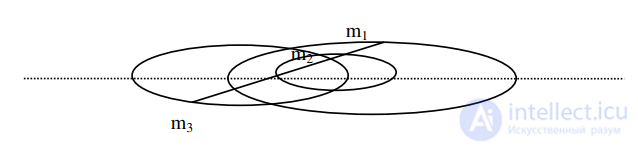
Let us consider two of them. In both cases the bodies describe similar Keplerian orbits with foci at the center of mass.
1. The bodies form a Lagrangian configuration - an equilateral triangle,
which can pulsate in its size and rotate in its plane in a
constant direction.
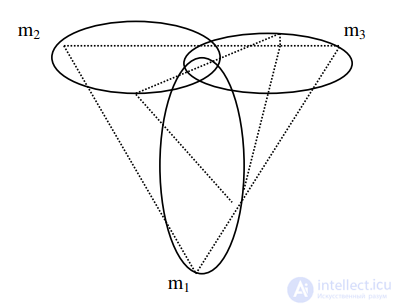
2. The bodies form an Eulerian configuration and lie on a straight line passing
through the center of mass, and, remaining on it, rotate and pulsate in a similar
manner. This case was found by L. Euler independently of Lagrange in 1767
.
If the masses of the bodies and their position in the plane are given, then the special cases of motion under consideration in this plane are obtained by considering the third
body at one of the five points, called libration points or Lagrange points.
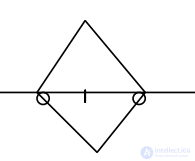
The first three libration points are located at
certain points on the line connecting
the two given masses, with one between them,
and the other two - outside them. The fourth and fifth
points are the vertices of two equilateral triangles, in which the remaining vertices are occupied by the given masses.
Lagrange showed that if the third body is located at one of the five libration points, then the configuration formed by all three bodies always remains similar to itself, and their motion occurs along conic sections of the same type.
1. If the bodies lie on one straight line, then they revolve, remaining on it,
around the common center of mass.
2. If three bodies are located at the vertices of an equilateral triangle, then
they revolve around the common center of mass so that the triangle remains
equilateral at all times.
At the beginning of the 20th century, two groups of asteroids were discovered whose motion
corresponds to Lagrange's second solution. In 1907, 588 Achilles was discovered, and later eight more "Greeks," moving alongside Achilles. Five
"Trojans" move on the other side. These asteroids are located at the libration points of the Sun-Jupiter system.
In the Earth-Moon system there also exist libration points. The Eulerian ones are called
collinear, and the Lagrangian ones are called equidistant.
Libration points can be stable only when the ratio of the masses of the large
bodies is sufficiently small.
The collinear points are unstable. A sufficiently small perturbing force
is enough for a libration object to move away from the vicinity of a given point. The triangular points will be stable for almost all sufficiently small mass ratios. Instability can occur only in two cases, when the mass ratio equals one
of two numbers - 0.0137 and 0.0249.
In 1961, the Polish astronomer K. Kordylewski observed cloud-like
accumulations at the triangular points of the Earth-Moon system.
Libration points are used in astronautics.
The problem of determining the motion of four or more bodies (the n-body problem) attracting each
other according to Newton's law, is even more complex than the three-body problem and has still not been solved in general form.
The N-body problem in general form is formulated as follows: "In empty
space are placed N free material points, which attract each other according to Newton's law. Their initial coordinates and
initial velocities are given. Determine the subsequent motion of these points."
The solution of the one-body problem is given by Newton's 1st law: "Every body persists in its state of rest or of uniform and rectilinear motion,
as long as, and because, it is not compelled by applied forces to change this state
of its own." The two-body problem was also solved by I. Newton and was discussed by
us above. To study the motions of n bodies, the method of calculating perturbations is applied,
which makes it possible to find an approximate solution to the problem. There now exists a
whole series of methods for the approximate solution of the problem, allowing one, for any specific
system of bodies with given specific initial conditions, to construct trajectories of motion with any accuracy
needed for practical purposes, for any limited interval of time. On a computer, the motion of
the five outer planets of the Solar System was modeled over 400 years - from
1653 to 2060. The results of the calculations agreed with observational data. However, specific numerical
methods cannot provide answers to many questions of a qualitative character, for example: - Will
one of the bodies always remain within some region of space, or will it be
able to recede to infinity? - Can the distance between any two of these bodies
decrease without limit, or, on the contrary, will this distance remain confined within certain bounds?
- Will the Solar System ever break apart, if we consider that it consists of
bodies whose motion is perturbed by small forces from all the other celestial bodies? Pierre-Simon
Laplace, in 1799-1825, solved the problem of the motion of the planets and their satellites
under the action of the Sun's gravitational force and their mutual gravitational influence. Laplace accounted
for the motion of 18 bodies. He believed that the precise motion of the planets
is occasionally disturbed and that external intervention is needed to restore order. V.I. Arnold proved
several theorems, from which it follows that the Solar System will not break apart for
many more millions of years. 8.8 The Discovery of New Planets. In 1781, William Herschel
discovered a new large planet, Uranus, which had previously been taken for a star. By
1840 it had become clear that the orbit of Uranus differed from that predicted by
Newton's theory. Deviations from the theoretically calculated trajectory were noticeable in the orbit. It was
suggested that the motion of Uranus was being perturbed by some massive body located beyond
its orbit. J.J. Le Verrier and J.C. Adams independently calculated the position of this body.
Adams sent his calculations to the Greenwich and Cambridge observatories, but they did not receive
proper attention. Le Verrier reported his discovery to the Berlin Observatory, to Johann Gottfried Galle.
He immediately began searching for the object and found it within 10 degrees of the
calculated position. This turned out to be the planet Neptune. In the 1980s, the motion
of the five outer planets of the Solar System was modeled on a computer over
400 years - from 1653 to 2060. The results showed that there is no planet
beyond the orbit of Pluto that noticeably perturbs the orbits of the already known planets.
However, Pluto itself has almost no influence on the orbit of Neptune, owing to its
small mass. If there are similarly low-mass planets beyond the orbit of Pluto, they are
almost impossible to detect. Nevertheless, the experiment conducted evidently proves that there is no star
- a hypothetical Nemesis - present as a second stellar component of the Solar System.

Comments