
Lecture
In 1929, Edwin Hubble reported the discovery of a fundamental regularity. He
found that all the lines in the spectra of distant galaxies are
noticeably shifted toward the red end of the spectrum. Since our Galaxy
cannot occupy any preferential position in the Universe, the observed recession of
galaxies expresses the mutual separation of all galaxies from one another. This
phenomenon is connected with the ongoing increase in the average distances between
galaxies, which is called the expansion of the Universe. Observations established that
the recession velocity Vr, corresponding to the redshift z = ∆λ/λ, increases
on average linearly with the distance r to the galaxy: Vr =
c . ∆λ/λ = H . r. This dependence is called Hubble's
law, and the proportionality coefficient H is called Hubble's constant. With the
accepted values of H, the observed velocities of 110,000 km/s for distant
galaxies correspond to distances exceeding 1,000 Mpc, or about 3 billion light
years. It must be understood that the law c . ∆λ/λ =
H . r is absolutely correct, since it has been repeatedly confirmed
by observations. The relation Vr = H . r, however, holds only
under the assumption that the shift of the spectral lines is caused
by the Doppler effect, which observations cannot prove. One can only judge
the greater or lesser degree of reliability of this assumption. If the
observable world had formed as a result of a colossal explosion, and
the galaxies had formed from matter scattered by the explosion, then those
of them that originated in portions of matter which received a greater
velocity at the moment of the explosion should by now have
flown farther away, in full agreement with Hubble's law. Accepting Hubble's
law must lead to the conclusion that all the galaxies flew
apart simultaneously, but with different velocities, from some comparatively small volume.
There are several alternative explanations of the redshift that bypass the Doppler effect. 1. The
"tired light" hypothesis is based on the assumption that photons, as they travel through space,
lose part of the energy contained in them. It is claimed that this is simply
the law governing the motion of a photon in space. A photon's energy is proportional
to its frequency, i.e., inversely proportional to the wavelength of the radiation. As the photon
travels through space, the wavelength of the radiation becomes ever longer, and the entire spectrum
of a distant object turns out to be shifted toward red. The magnitude of the
shift is proportional to the distance. At small distances the tired-light effect is negligible and
cannot be detected observationally, so it manifests itself only in the spectra of distant galaxies.
2. The loss of energy by a photon is not simply a law of its
motion, but is caused by interaction with other photons of radiation filling the space of
the Metagalaxy and moving in every possible direction. The longer the path traveled by a
photon, the more interactions it experiences on average, the greater the redshift of the galaxy
will be. The weakness of these hypotheses lies in the fact that they require abandoning
the law of conservation of energy. If the tiring of a photon is simply a
law of its motion, then energy is lost without being transferred to anything. If, on
the other hand, a photon loses part of its energy by transferring it to some
medium, to other photons, or to any particles whatsoever, then any such transfer of energy
must be associated with the possibility of a change in the photon's direction of flight.
Photons that have traveled a long path should noticeably change their direction of motion
in space. As a result of this, images of distant galaxies should be blurred,
and the farther the galaxy, the greater the degree of blurring of its image
should be. But observations show that the outlines of very distant galaxies are just
as sharp as those of nearby ones. At present, the tired-light hypotheses find no
supporters. Knowing the redshift of galaxies, it is easy to determine how many times
farther one of them is than another. But to estimate the distance to each
of them, one must know the value of Hubble's constant. It turned out that
for comparatively nearby galaxies, whose distance is satisfactorily measured by various methods, Hubble's law
does not always hold. And for distant galaxies with large velocities Vr, there are
no sufficiently reliable criteria for determining distances without the help of redshifts. Therefore, to
this day, estimates of H made by various authors differ substantially, although practically all
of them fall within the range from 50 to 100 km/(s .Mpc). An average
value of H = 75 km/(s .Mpc) is often used. The original value determined
by Hubble was 540 km/(s .Mpc). At redshifts of about 1, Hubble's law no
longer works, and more complex formulas from special relativity must be applied. V =
c . (z2 + 2z)/( z2 + 2z + 2), where z = ∆λ/λ.
For very distant galaxies with a large redshift, this formula is also
inapplicable. It does not account for the influence of gravity on the change in frequency of light waves.
The recognition that the redshift in spectra is caused by the Doppler effect
leads to the conclusion that the mass of matter contained in galaxies was
previously located in one place and was thrown out into space as a result of an explosion.
Until the early 1920s, scientists were confident that the Universe was stationary and
limited to our Galaxy.
A. Einstein considered a model of the Universe as homogeneous, isotropic and static. Such a Universe did not result from solving the equations of the theory of
relativity. Einstein then modified the equations, assuming that
nature contained yet another, new type of force. Thus a new λ term appeared in the equations, whose presence meant that between any two given
masses in the Universe there acts a repulsive force proportional to the distance between them.
The magnitude of this force is characterized by the λ term. It can be chosen to be very small,
so that within the Solar System the repulsive forces would be negligibly small
compared to the attractive forces. But on the scale of the Universe, its presence
has a significant effect.
In 1917, Willem de Sitter proposed, based on Einstein's equations, another model of the Universe. This model described an empty Universe, homogeneous,
isotropic, but not static.
In 1924, Alexander Friedmann showed that one could obtain solutions to Einstein's original equations describing a Universe filled with matter, homogeneous and isotropic. The models of de Sitter, Friedmann and Lemaitre
assume an expanding Universe.
The development of observational astronomy led to the discovery of distant galaxies
that are not objects within our Galaxy. In 1929, Hubble's law
was discovered, and in the early 1930s theorists created a new model of the Universe, described by Einstein's equations and receiving observational confirmation.
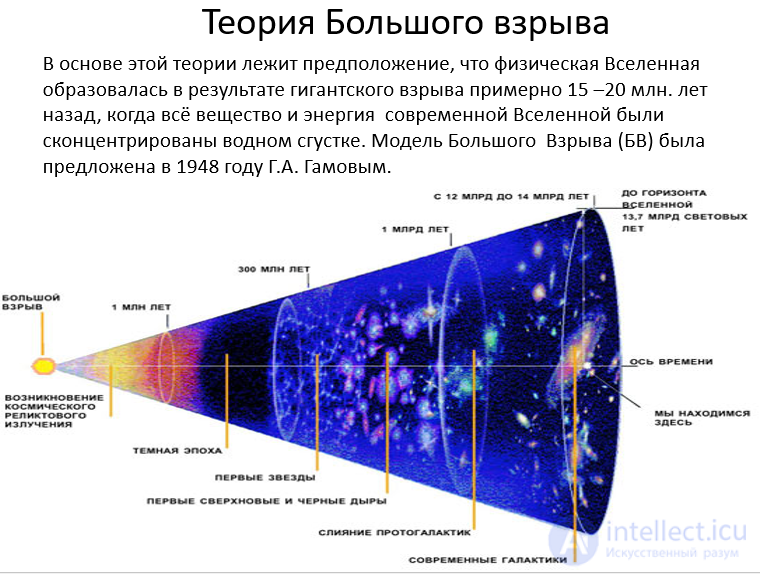
This Universe turned out to be expanding and to have arisen as a result of the Big
Bang of primordial matter. The infinitely compressed matter of the Universe before
the Big Bang is called the singularity.
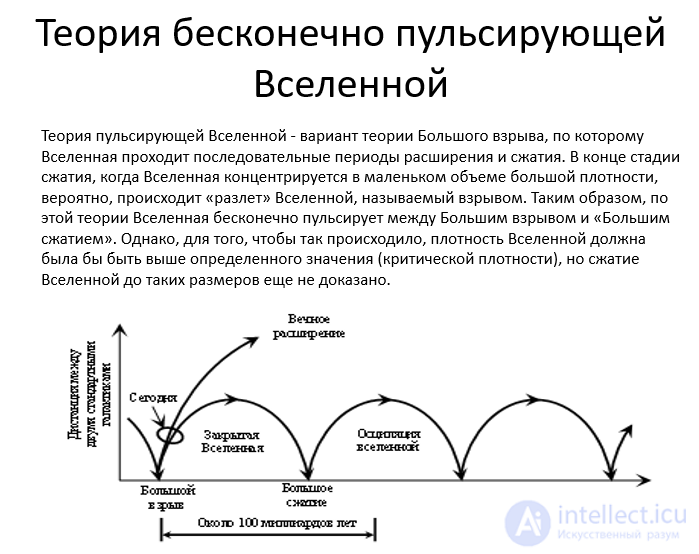
Observations of the Universe lead to the important conclusion that it is homogeneous
and isotropic. Homogeneity means the sameness of all properties of matter everywhere
in space, while isotropy means their sameness in every direction. Homogeneity indicates the absence of distinguished regions of space, while isotropy
means the absence of a distinguished direction.
Homogeneity is confirmed by the fact that the average density of matter is the same
for sufficiently large volumes of space in the Universe. The sizes of regions within which the average density of matter can be considered the same are much smaller than the Metagalaxy, but they are large compared to the scale of
local inhomogeneities associated with the existence of galaxies and their clusters.
Isotropy is confirmed by the uniform recession of galaxies in all directions. The assumptions of homogeneity and isotropy of the Universe are called
the cosmological principle.
In 1965, a discovery was made that confirmed the assumption of isotropy and homogeneity of the Universe. A weak background
radio emission with intensity the same in all directions was accidentally discovered. According to modern observations, this radiation is isotropic to within a few tenths of a percent. Based on the distribution of energy in the spectrum, it
turned out to be thermal and corresponds to a temperature of 3K.
At this temperature, the maximum of the radiation falls in the spectral range
around 1 mm. At present, no objects in the Universe are known that could
produce such radiation. On this basis, the radiation was identified as radiation from the Universe, preserved from the times when the density
of matter was very high and the medium was strongly opaque. Over time, as a
result of expansion, the matter cooled, passed from the ionized to the neutral
phase, and became transparent. No longer being absorbed by the medium, the radiation
"detached" from matter, so to speak, and has been preserved to this day. Calculations
show that transparency of matter must have set in at a density
on the order of 10-20
g/cm3
, i.e. a billion times greater than the present density. In this epoch, distances in the Universe were 1000 times smaller, and
the wavelength was smaller by the same factor. Therefore, quanta that now have a wavelength of 1 mm
previously had a wavelength of 1 μm, which corresponds to the maximum of radiation according to
Planck's law at a temperature of 3000 - 4000 K.
Thus, the existence of relic (cosmic microwave background) radiation is an indication not only of the high density of the Universe, but also of its high temperature.
The Universe was previously hotter.
More than 10 billion years ago, the Universe was in a dense and hot state. One can identify the moment when it began to expand from some
superdense state.
The expansion of the Universe cannot be regarded as the expansion of superdense
matter into a surrounding void, because there was no surrounding void.
The Universe is everything that exists. The matter of the Universe filled all of boundless space uniformly from the very beginning. And although the pressure was enormous, it did not create any expansive force, since it was the same everywhere.
The reasons for the onset of the Universe's expansion are related to quantum effects arising in the gravitational field at enormous densities of matter.
Various theorists have constructed numerous models of the Universe that
expand anisotropically in the early stages, after which the expansion approaches
Hubble's law, so that, according to observations of the expansion in our time, these models
are indistinguishable from the Friedmann model. However, modern cosmology has created
models of the Universe that differ greatly from the Friedmann ones.
To determine how the expansion proceeded near the singularity, and what processes occurred, calculations must be carried out under various assumptions
about the expansion, and about the state and composition of the matter of the Universe, and the results of these calculations must be compared with observations. This will make it possible to determine which of the assumptions are true and to reconstruct the picture of the distant past of the Universe.
The Friedmann solution, extended into the past, formally gives a state of infinite density of matter. At superhigh densities of matter, general relativity
ceases to work. Modern quantum theory predicts the emergence of
quantum effects of gravity near the singularity. Einstein's theory of gravity is a non-quantum theory, so it cannot describe effects associated with quantization on the scale of the entire Universe. Dimensional analysis makes it possible to approximately estimate the parameters at which a given process becomes significant, even when the detailed theory of the process is unknown.
It is necessary to establish the radius of curvature of spacetime at which the following phenomena become significant: gravity, quanta, relativism. The role of gravity
is described by the gravitational constant G, the role of quanta by Planck's constant
h, the role of relativism by the speed of light c. We are interested in the radius of curvature, a quantity with the dimension of length, at which all three kinds of
phenomena are significant. Dimensional analysis gives:
rn = √( Gh/c3
) = 10-33
cm.
This distance is called the Planck length.
One can calculate at what moment in time after the beginning of the expansion of the Universe the radius of curvature was equal to rn and what the density of physical
matter was at that time.
tn = rn /c = 10-43 s.
ρn = 1093
g/cm3
.
A new theory must be built for the state of matter with such characteristics. The general laws of physics have been reliably verified at densities not exceeding the nuclear density ρnuc = 1014
g/cm3
.
In the early epoch, called the Planck epoch, quanta of the gravitational field — gravitons — should arise.
The first moments of the Universe's existence are very mysterious. It is possible that
the four fundamental forces of nature were initially merged into one. However,
10-44 seconds after the beginning of the expansion, general relativity becomes applicable.
The superdense state of the Universe did not last long, but it played a decisive role in subsequent development. At the enormous values of temperature and
density of matter, intensive processes of mutual transformation of particles and quanta of radiation began. At first, particles and their corresponding antiparticles were created in equal numbers from high-energy photons.
Under the conditions of the superdense state of matter characteristic of the early stage
of the Universe's life, particles and antiparticles would have had to immediately, right after
their creation, collide again, turning into gamma radiation. This mutual conversion of particles into radiation and back continued
until the energy density of the photons exceeded the value of the threshold energy for particle formation.
In the early stages of the Universe's development, extremely short-lived and very massive hypothetical particles could arise. As the temperature
and density fell (when the age reached 0.01 sec, the temperature was 1011K), less
massive particles began to arise, while the more massive ones “died out” through annihilation or decay.
The extinction of particles did not proceed entirely evenly, so that antiparticles
practically all disappeared, while a negligible excess fraction of protons and neutrons
remained. As a result, the observable world turned out to be made of matter, not antimatter, although somewhere in the Universe there may be regions made of antimatter.
Without the barely noticeable asymmetry in the properties of particles and antiparticles, the world would have been left entirely devoid of matter.
The formation of nucleons (protons and neutrons) marks the end of the hadron era of the evolution of the Universe (hadrons are particles subject to the strong interaction: protons, neutrons, mesons, etc.). After the hadron era comes the lepton era, when the medium consists predominantly of positive and negative muons, neutrinos and antineutrinos, positrons and electrons. Nucleons
are rare. As the Universe continues to expand,
muons, electrons and positrons annihilate. Then neutrinos stop interacting with matter, and by the moment 0.2 seconds after the singularity,
neutrino decoupling occurs.
About 10 seconds after the singularity the temperature reaches a value of about 10^10 K and the radiation era begins. At this stage photons
predominate in number, still strongly interacting with matter, as well as
neutrinos.
A huge number of electrons and positrons were converted into radiation in a catastrophic process of mutual annihilation, leaving behind an insignifi-
cant number of electrons, sufficient, however, that by combining with protons and neutrons, they gave rise to the amount of matter that we observe today in the Universe.
3 minutes after the Big Bang the first nucleosynthesis processes begin. Some of the protons manage to combine with neutrons and form helium nuclei. About 10% of the total number of protons went into them. The radiation era ends with the transition of the plasma from an ionized state to a neutral one, a decrease in the opacity of matter, and the “decoupling” of radiation. After a minute almost all the matter of the Universe consisted of hydrogen and helium nuclei,
in the same proportion that we observe today. Starting
from this moment, the expansion of the primordial fireball proceeded without significant changes until, after 700,000 years, electrons and protons
combined into neutral hydrogen atoms; then the Universe became transparent to electromagnetic radiation - the relic background radiation arose.
A million years after the start of expansion the matter era begins, when from
a hot hydrogen-helium plasma with a small admixture of other nuclei, the diversity of the present-day world began to develop.
After matter became transparent to electromagnetic radiation,
gravity came into play; it began to predominate over all other interactions between masses of practically neutral matter, which made up the main part of the Universe's material. Gravity created galaxies, clusters, stars and planets.
Many unresolved questions remain in this picture. Did galaxies form before the first generation of stars, or the other way around? Why did matter concentrate into discrete formations - stars, galaxies, clusters - while
the Universe as a whole was flying apart in different directions?
The inhomogeneities in the Universe, from which all
the structural formations of the Universe later formed, originated as negligible fluctuations, and then were amplified in the epoch when the ionized gas in the Universe began turning into neutral gas, i.e., when radiation decoupled from matter and became
the relic background. Such amplification could lead to the emergence of noticeable fluctuations, from which galaxies subsequently began to form.
In the formation of the large-scale structures of the Universe, neutrinos could have played a significant role if their rest mass is nonzero. A few hundred years
after the start of expansion, the speed of neutrinos possessing mass should become
noticeably less than the speed of light. Starting from a certain moment, large condensations of
neutrinos no longer dissipate and give rise to the large structural formations of the Universe - clusters and superclusters of galaxies. The galaxies themselves
form from ordinary matter, while neutrinos, if they possess appreciable
mass, act as centers of attraction for giant mass condensations,
serving as the source of the hidden mass of galaxy clusters.
In 1978, M. Rees suggested that the background radiation might
be the result of an “epidemic” of massive star formation that began immediately
after the decoupling of radiation from matter and before the age of the Universe reached
1 billion years. The lifetime of such stars could not have exceeded 1 billion
years. Many of them exploded as supernovae and ejected heavy chemical elements into space, which partly collected into grains of solid
matter, forming clouds of interstellar dust. This dust, heated by the radiation
of pregalactic stars, could emit infrared radiation, which is now
observed as the microwave background radiation. If this hypothesis
is correct, it means that the overwhelming majority of the total mass of the Universe is contained in the invisible remnants of the first, pregalactic, generation of stars, and
may currently be located in massive dark halos surrounding
bright galaxies.
Hypotheses for star formation from a rarefied gas-and-dust cloud.
Stars and star clusters have different ages, from 1010 years (globular clusters) to 106
years for open clusters.
Many researchers believe that stars form from the diffuse interstellar medium. This is indicated by the position of young stars in the spiral arms of galaxies, where there is much gas-and-dust material. The diffuse medium
is held in the spiral arms by the galactic magnetic field. Stars
are not held by this field and drift into the spherical part of galaxies. Young
stars often form complexes of thousands of stars, surrounded by large masses of gas - OB associations.
The process of star formation from gas is not entirely clear. If, in some volume
filled with gas and dust, the mass of diffuse matter exceeds a critical value, the matter begins to contract under the force of gravity. Gravitational collapse occurs. The densest regions of the diffuse
cloud are globules. They are apparently the direct precursors of stars.
For gravitational contraction of the interstellar medium, an initial high density and some trigger are needed. Such a trigger could be a supernova explosion. This is indicated by analysis of carbonaceous chondrites - protostellar matter. Radioactive isotopes have been found in them that could only have formed in the atmosphere of a supernova.
During the process of gravitational condensation, dust particles and gas
molecules fall toward the center of the cloud, gravitational potential energy converts to kinetic energy, and kinetic energy converts to heat through collisions. The cloud
heats up, and as a result of the temperature increase, its radiation increases.
It turns into a protostar.
The luminosity of a protostar can exceed the luminosity of an ordinary star, its radius is
large, and its effective temperature is lower. On the spectrum-luminosity diagram,
protostars are located to the right of the main sequence. When the temperature reaches several million degrees, thermonuclear
reactions begin. First deuterium burns, then lithium, beryllium and boron. As the temperature rises, proton-proton reactions begin for stars with a mass
less than 1.5 solar masses, or the carbon-nitrogen cycle for massive stars. Contraction stops and the star becomes a main-sequence star.
The time of gravitational contraction is short. The greater the mass of the protostar, the
faster the contraction process proceeds. Because of the short contraction time, not many such objects are observed in the Universe. These are presumably T Tauri type stars and some infrared sources ("cocoon stars").
Nuclear reactions in massive stars proceed faster and their time on
the main sequence is shorter. Stars of spectral class B0 remain
on the main sequence for 107
years, while stars like the Sun - for 1010 years. After
hydrogen burns into helium, nuclear reactions occur at the outer boundary of the core.
The core itself contracts, the density and temperature of the central part increase,
and the luminosity and radius of the star increase. The star becomes a red giant.
Inside the cores of massive stars, reactions converting helium into carbon can occur.
When the helium reaction inside the core and the hydrogen reactions at its boundary exhaust themselves, the extended envelope of the red giant expands, and its outer layers cannot be held by gravity and begin to separate.
Mass outflow from the atmosphere occurs. Under certain conditions, supernova outbursts occur.
With slow outflow, planetary nebulae form.
The remaining core of low-mass stars is called a white dwarf.
Given the high density of white dwarf matter, the force of gravitational contraction is balanced by the pressure of degenerate electrons. If the mass of the core
is less than 0.5 solar masses, it consists of helium; if the mass is greater - of carbon and oxygen. In such stars, nuclear reactions do not proceed. They shine due to a
store of thermal energy accumulated in the past, and gradually cool, over
the course of several billion years, turning into unobservable black
dwarfs.
Stars with a mass of 6-8 solar masses may undergo a final explosive contraction and leave no core behind at all.
Massive stars, with an initial mass of 8-50 solar masses, turn into
neutron stars after a supernova explosion. The star collapses until
electrons combine with protons, forming neutrons. These neutrons become degenerate. The pressure of degenerate neutrons balances the force of gravitational contraction. The neutrons in the core are packed tightly against one another. The density is the same as in an atomic nucleus.
Hypotheses for star formation from superdense matter.
The hypothesis of star formation from superdense matter was put forward by academician V.A. Ambartsumian. It holds that stars are formed from some kind of superdense matter.
The basis of this hypothesis is the conclusion that in the observable Universe, processes of decay predominate over processes of combination. This means that the process of star formation must be a transition of matter from a denser state to a less dense one.
The hypothesis requires that there exist in the Universe a material - superdense
matter, which no one has yet observed and whose properties remain unknown. Superdense matter, if it exists, must be inaccessible to modern observational means, since it occupies very small volumes of space and emits almost no radiation. Its main properties are an extraordinarily high density and an enormous store of energy, which is violently released upon the decay of such matter.
There is not yet a coherent mathematical theory based on this hypothesis. The main argument of its supporters is that it corresponds to the observational data.
Stars with a mass of more than 50 solar masses collapse into black holes. In the course of
contraction, the force of gravity at the surface increases and a moment arrives when even
light cannot overcome the gravitational barrier. In order to escape
the gravitational field of a black hole, one would need to reach a speed greater than the speed of light. Therefore a black hole emits nothing and disappears for an outside observer.
A black hole is a closed region of space into which matter is compressed and
from which nothing can emerge.
Karl Schwarzschild in 1916 found a solution to the field equations of the theory of relativity, describing the space-time outside a body with a spherically symmetric distribution of matter. This solution can be interpreted as follows:
if a body of mass M is compressed into a sphere of a certain radius Rs (the Schwarzschild radius), then the space-time near it is distorted so strongly that
light cannot leave this sphere. The region of space that no
material body can leave is what scientists call a black hole.
Rs = 2GM/c
2
.
What happens inside a black hole is still unknown. It has been suggested that matter is compressed to a state of singularity. This state
cannot today be described by any physical theory.
The theory of relativity leads to the conclusion that matter must be compressed
into a microscopically small volume of space at the center of a black hole. The boundary
of a black hole is called the event horizon.
For the Sun the Schwarzschild radius equals 3 km. A massive star with a mass of 10
solar masses would have a radius of 30 km.
For the Earth the Schwarzschild radius equals 1 cm.
It has been suggested that if the Universe formed as a result of
the Big Bang from hot superdense matter, then in the earliest stages of its evolution there could have existed conditions in which even very small masses of matter were compressed into black mini-holes. A black hole the size of an atomic nucleus could contain the mass of an average earthly mountain, and it is quite
possible that such objects exist.
Motion inside a black hole is possible only in one direction - toward the singularity, where destruction occurs.
The solutions of the equations describing the space-time in the vicinity of a Schwarzschild black hole possess a certain symmetry, which indicates that the hole may connect our Universe with another, similar world. This possibility of a connection between two worlds through a black
hole is called the Einstein-Rosen bridge (or “wormhole”). It has been suggested that this bridge connects not different worlds, but two points of the same one - our Universe. But to make use of this passage it would be necessary to develop faster-than-light speeds.
Theoretical calculations have shown that, from the point of view of an external observer,
black holes can have only three characteristics: the properties of a black hole
are fully determined by its mass, electric charge, and intrinsic angular momentum. These three characteristics must remain with the black hole,
since they are associated with fields of long-range forces, which have
an influence on distant objects. During the formation of a black hole, the gravitational field outside the event horizon continues to act on the propagation
of light rays and the motion of objects with nonzero rest mass. The electromagnetic field associated with the charge of the black hole will also have an influence
on surrounding bodies.
Rotating black holes, described by R. Kerr, have a number of interesting
properties. Outside the event horizon of such holes there extends a region called
the ergosphere, which is bounded by a surface called the stationary limit.
Inside the static limit nothing can remain at rest. Space itself within the ergosphere is, as it were, dragged along by the black hole's powerful rotation and swirls around its axis.
In 1969 Roger Penrose proved that energy can be
extracted from a black hole's ergosphere. If some particle possessing a certain energy
enters the ergosphere and breaks apart into two fragments, one of which has negative energy, that fragment will fall into the black hole, while the other
fragment (in accordance with the law of conservation of energy and momentum) will fly out of
the ergosphere with energy exceeding the original energy of the whole particle
as a whole.
The fall of a particle and the escape beyond the ergosphere of one of its fragments leads to a decrease in the black hole's total mass-energy, and repeating this process many times should cause the loss of a significant part of the mass-
energy of the black hole. However, the fall into the hole of particles with spin opposite to its own angular momentum causes the rotation of the
black hole to slow down, and as soon as the rotation stops, further extraction
of energy by this method becomes impossible. By the moment the black hole comes to a
complete stop, 29% of its original mass can be extracted. Potentially,
rotating black holes could serve as the most powerful sources
of energy in the Universe.
,
In 1971 S. Hawking proved a theorem according to which the area of the event
horizon of a black hole cannot decrease. The surface area either increases or remains unchanged, whatever happens to the black hole.
The interior of a rotating black hole differs substantially from that of a Schwarzschild
black hole. The Kerr singularity has the shape of a ring, i.e., it is timelike. This means that there is a possibility of entering a black
hole along a path that avoids the central singularity. There are directions following which one can move away from the singularity. One can change the direction of motion by giving the body some additional velocity. Moving away from the singularity, at a speed less than the speed
of light, one could find oneself in another space-time. Through a black hole
one could get into another universe. In doing so, there is a possibility of getting into
not just one but an infinite multitude of other universes. However, the astronaut can move only in the direction of the “universe of the future,” i.e., they will not be able to
return to their own universe at the same time.
The idea has been put forward that the multitude of worlds might be connected by a path, following
which we would return to our Universe, perhaps even to its past.
Practically instantaneously, an astronaut could make their way to another point in our
Universe, faster than light would take to get there.
However, such a course of events would violate the law of cause-and-effect
relation. If this relation were violated, the Universe would be unpredictable and irrational.
From a practical standpoint, traveling through space by means of black
holes raises a substantial objection. A spacecraft approaching the event horizon of a medium-mass hole would be torn apart by tidal forces. Tidal forces are weak only in holes with an enormous mass, equal to the mass of a
galaxy.
The latest theoretical studies indicate that inside a Kerr black hole quantum effects are possible that prevent space-time bridges.
White holes. The equations of general relativity are symmetric with respect to the direction of time. There are solutions that make sense even in the case
where time flows in a direction opposite to the generally accepted notion of its flow.
Knowing that black holes form as a result of the gravitational collapse of some mass of matter into a singularity hidden behind the event horizon, which
exists for an infinitely long time, one can suppose that there exist holes with
reversed time, i.e., collapse with the reverse course of events. In that case, in some region of the Universe a source would suddenly be discovered,
ejecting matter - a white hole. It would have to contain a singularity that existed since the moment the Universe's clock started counting. Just as
particles can fall onto a black hole, so they can fly out of a white one, forming
clouds of dust and gas.
The white hole hypothesis could explain the phenomenon of observed exploding galaxies, and other phenomena accompanied by a large release of
energy. Quasars could appear as objects from which matter flows out into our Universe.
I.D. Novikov suggested that if certain regions of space-time
did not take part in the immediate process of universal expansion at the moment of the Big Bang, then these regions, or “lagging cores,” might explode
at a later stage of the Universe's evolution, creating white holes.
Perhaps in some universes matter collapses into a black hole, while in others white holes arise. Theoretically, models
of "gray holes" are also considered, whose matter, spilling out beyond the event horizon as in white holes,
almost immediately begins to rapidly contract in a process of gravitational collapse. The existence of white and gray
holes has not been proven today and is considered unlikely. Black holes are now almost discovered objects. Their
existence is predicted to some extent even by Newton's theory of gravitation. Observational astronomy has in recent years
gathered much material confirming the existence of black holes in the Universe. They may exist and be observed
as constantly interacting with matter in the nuclei of galaxies, in close binary star pairs, and in quasars.
The ratio of the total amount of stellar and interstellar matter in the Galaxy
changes over time. Stars form from diffuse matter, and at the end of their
evolutionary path they return only part of that matter to the interstellar medium. Some
part remains in white dwarfs and neutron stars. The amount of interstellar matter in
galaxies must decrease over time. Being processed in stellar interiors, the matter of galaxies
gradually changes its chemical composition, becoming enriched with helium and heavy elements. Galaxies originally
formed from hydrogen. Helium and heavy elements formed as a result of thermonuclear reactions
inside stars. The heaviest elements can form only in supernova outbursts. The abundance of
heavy elements in stars of the spherical component of galaxies is much lower than
in stars of the flat subsystem. Stars of the spherical component formed earlier, when
the gas was poor in heavy elements. As a result of the galaxy's rotation,
the gas gathers in its plane. By this time it has undergone processing in
stellar interiors and become enriched with heavy elements. Later, stars begin to form from
this gas. This process is observed even now. Stars of the flat subsystem are
called second-generation stars, and those of the spherical component are called first-generation stars.
Ideas about the origin and early evolution of the Solar System have still not
taken on the character of a complete theory. Several stages in the birth of
the Sun and the planets can be distinguished: 1. Condensation of a cloud
of interstellar matter, consisting of molecules (H2, H2O, OH, etc.) and dust. It
is possible that this condensation began as a result of the explosion of
a supernova, under the action of a shock wave. 2. The densest regions
of the cloud, with masses of stellar order, begin to contract. The cloud
breaks up into fragments, one of which subsequently gives rise to the Sun
and the solar system. At the center of the contracting fragment, a condensation
of dust and gas forms, which is the accretion nucleus. Accretion is the
capture of the surrounding rarefied medium, the influx of which gradually increases the
mass of the nucleus. 3. When the mass of the central condensation reaches
approximately 0.1 of solar mass, the matter becomes opaque, the temperature rises, and
the dust evaporates. This occurs 10^4 - 10^5 years after the fragment begins
to contract. Soon after the dust evaporates, dissociation of molecular hydrogen occurs. As
this happens, the central condensation contracts, forming a gaseous protostar. The formation of
the protostar occurs very quickly, over a period of 10-100 years. Accretion of
interstellar matter by the protosun continues, and its mass and radius increase. After
roughly another 10^5 years, the mass reaches its present-day level, while the radius
is 100 times larger than at present. The influx of interstellar matter stops.
The stage of gravitational contraction of the protosun begins. During this period, a
disk-shaped gas-and-dust protoplanetary nebula already exists, with the protosun at its center. Estimates
of the nebula's mass fall within the range from 0.01 to 2 solar
masses. In the nebula, giant planets form along the same path, with the
formation of disks from which satellites subsequently form. To overcome the difficulty with
the distribution of angular momentum, it is assumed that the gas in the
protoplanetary nebula is partially ionized, and that the protosun has a significant magnetic
field. As a result of the interaction of the plasma and the field,
gas flows arise that transfer angular momentum into the nebula. 4. The next
period lasts 10^8 years. Gravitational contraction of the Sun continues. A powerful stellar
wind blows, sweeping gas out of the inner part of the protoplanetary nebula.
The dust cloud increasingly concentrates toward a certain mean plane. Dust grains collide,
and larger particles appear. The process of accumulation of solid bodies is underway.
Several particularly large bodies form, becoming accretion nuclei,
around which the formation of terrestrial planets takes place. Planetesimals not only merge but also break apart. Such breakups gave rise to
meteorites.
The growth of the Earth to its present size took 108
years. Some models
consider heterogeneous accretion. First there was an accumulation of heavy
elements, and the silicate mantle formed later.
Some models consider the formation of terrestrial planets from giant
planets that lose their gaseous envelope due to tidal interaction with the Sun.

Comments