
Lecture
The Earth and the Moon are quite close to each other and have not a very
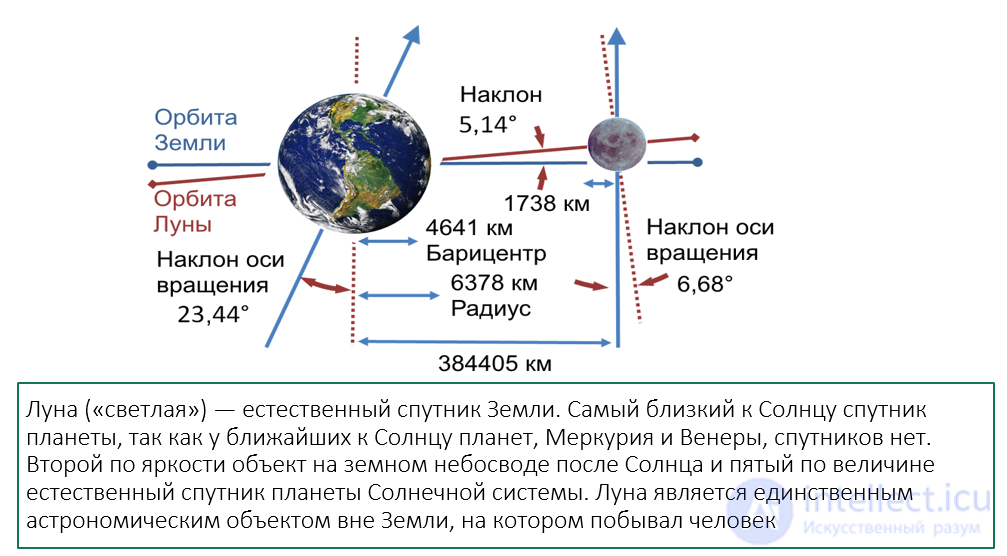
large difference in size. This gives some scientists grounds to call the Earth-Moon system a double planet. The two bodies revolve around a common center of mass, called the barycenter, located inside the Earth
at a distance of approximately 4,700 km from the center.
The distance between the centers of mass of the Earth and the Moon varies within fairly wide limits due to the influence of the combined gravity of the Earth, the Sun, and the Moon.
For example, during the period 1969-2000, the apogee of the lunar orbit (the greatest
distance) varies from 404,063 to 406,711 km, while the perigee (the smallest distance) varies from 356,517 to 370,354 km.
Tidal interactions have slowed the Moon's rotation such that now the same side of it always faces the Earth.
The sidereal and synodic months change over time as a result of
tidal interactions. Tidal friction slows the
Earth's rotation, but the angular momentum of the Earth-Moon system remains constant. Consequently, the Moon slowly recedes from the Earth, so that eventually both the month and the day become longer. If one traces these trends into the past, it turns out that both periods must have been hundreds
of millions of years ago much shorter. This hypothesis is confirmed by measurement
of the daily and annual layers of coral fossils.
The Sun supplies the Earth with the heat necessary to sustain life. Scientists
have calculated that the Sun's luminosity has increased over several billion years
by a few percent. This growth will continue at the same rate, but over
a million years will be quite small. However, a change in the amount of heat received from the Sun will lead to strong changes in Earth's climate.
These changes in the flow of solar heat are responsible for the glaciations
that occurred every hundred million years. Now the ice has temporarily retreated.
When it returns, some regions will become uninhabitable for humans.
The Earth's atmosphere plays a large role in maintaining the temperature balance. It prevents strong cooling of the surface at night and overheating
during the day. Possessing a greenhouse effect, the atmosphere maintains a constant
temperature on Earth higher than in space.
The atmosphere protects the inhabitants of the Earth from the large flux of radiation harmful to life - X-ray, ultraviolet, gamma, and others.
The atmosphere protects against meteoric bodies, which constantly arrive from
interplanetary space.
Meteors collide with the Earth at speeds of up to 72 km/s. The force of impact of a particle
with a mass of 0.001g flying at such a speed is comparable to a shot fired point-blank. Billions of particles invade the atmosphere daily.
Small meteoric particles, moving in space near
the plane of the Earth's orbit, scattering sunlight, create a glow visible
near the Sun in the morning shortly before sunrise and in the evening shortly after its
setting. Since meteoric dust is concentrated near the plane of the ecliptic,
passing through the zodiacal constellations, this glow is called the zodiacal light.
The extinction of the dinosaurs at the end of the Cretaceous period 65 million years ago, as well as
the end of other geological periods, could have been connected with the fall on
Earth of bodies the size of an asteroid. The high content of iridium in the late Cretaceous layer proves that an asteroid about 10 km in diameter crashed into the Earth. As a
result of the explosion, clouds of dust were raised into the atmosphere, which for several
years blocked the path of sunlight. The process of photosynthesis was disrupted, which
broke the food chain, and all vertebrates with a mass greater than 20
kg died of starvation.
Another approach to the problem of the change of flora and fauna on Earth at the turn of geological epochs is connected with the assumption of an increase in radiation exposure at
certain periods of history (O. Schindewolf, V.I. Krasovsky,
I.S. Shklovsky). For example, the Solar System, while moving through the Galaxy, could have entered a region of increased radiation associated with the explosion of a supernova. Epochs when the flux of hard radiation from supernovae exceeded on
Earth the average level of cosmic radiation by tens of times lasted up to
several thousand years.
The increase in radiation caused an increase in the frequency of mutations. If for species with a short reproductive cycle doubling the mutation rate requires an increase in the intensity of cosmic radiation of hundreds and thousands of times, then for long-lived forms doubling of the mutation rate is achieved with an increase in
the radiation dose of only 3-10 times. Prolonged exposure, lasting thousands of years, to radiation increased by tens of times could have proven fatal for
of some species of animals. On other species of animals and plants, however, radiation
could have had a positive effect.
It has been roughly calculated that supernovae, which create on the surface of the Earth a dose of radiation lethal for many animals of 500 R,
flare up every 50 million years, while stars creating an exposure of 25,000 R do so once every
600 million years.
For mammals the lethal dose upon exposure over 30 days is from 250 to 600 R, for amoebae - 100,000 R. Blue-green algae can survive in conditions almost like those inside nuclear reactors.
However, these hypotheses run into many difficulties. For example, many dinosaurs died out over the course of millions of years, which completely contradicts
the asteroid hypothesis. If it were true, extinction would have had to occur very quickly.
Marine animals should not have suffered from an increase in radiation due to the
shielding effect of the large mass of water in the oceans and seas. In reality, however, they went extinct in synchrony with terrestrial animals.
A gigantic catastrophe capable of destroying life on half the globe would lead to the extinction of an insignificant number of animal and plant families. In the case of a catastrophe of a more global scale, extinction would turn out
to be indiscriminate.
Recently, hypotheses explaining extinction by the combined action of cosmic catastrophes and terrestrial events, such as volcanic activity, have become more popular.
The Sun emits streams of charged particles, which cause on Earth
the phenomenon of the polar aurora.
Earth also receives various radiation from distant regions of the Galaxy.
For life as we know it to exist on Earth, many conditions must be met:
- the distance from the planet to the star must be within narrow limits;
- the radiation flux from the star must be very stable;
- the planet must have an atmosphere capable of regulating temperature and
shielding the surface from cosmic rays;
- the atmosphere must have a certain composition.
The chemical composition of the Earth's atmosphere practically does not change up to a height of about 90 km.
Nitrogen - 78%
Oxygen - 21%
Water vapor - 0.2-0.4%
Carbon dioxide - 0.03%
Neon - 0.0018%
Helium - 0.0005%
As well as methane, krypton, sulfur dioxide, hydrogen, etc. in small amounts.
Special probes, rockets, and balloons are used to study the atmosphere.
Air temperature drops rapidly with altitude in a layer several
km thick, within which the main cloud cover is located.
As altitude increases, under the action of solar radiation a small fraction of the oxygen is converted into ozone. The absorption of ultraviolet radiation by ozone
contributes to the heating of the atmosphere and prevents further decline in
temperature. Therefore the temperature minimum is reached at an altitude of 17 km, and
at an altitude of 50 km the temperature rises almost to the near-surface value.
Above 300 km the atmosphere almost disappears, its traces being heated by the Sun to
1500°C.
Above 1000 km in the Earth's atmosphere are the radiation belts, discovered during
measurements aboard the first Soviet and American satellites.
The 1st belt begins at an altitude of 2400 km and ends at an altitude of 5600 km, and is located between latitudes of +30 and -30. The 2nd belt is located at altitudes from
12,000 to 20,000 km. The 3rd belt is located at an altitude of 50 - 60 thousand km. The higher the belt, the less energetic the particles it contains.
The radiation belts are regions of the Earth's atmosphere filled with very energetic atomic nuclei, mainly of hydrogen, and electrons, captured
by the Earth's magnetic field. The radiation belts are very dangerous for living organisms not protected by a layer equivalent to approximately 1.3 cm of lead.
Some fraction of the particles of the radiation belts arises from the interaction of
cosmic rays with the atmosphere, while the main part is created by powerful streams of particles ejected by the Sun, especially during flares. From the outer
parts of the belts particles leave fairly quickly, within a day or a few
hours, whereas in the central part individual particles can remain much longer.
During recombination of ions and electrons, excited atoms
and molecules are often produced, which give off weak radiation, observed at night. This glow
of the night sky limits the minimum brightness of cosmic objects that can be observed from the Earth. The stellar magnitude of the brightness of the night sky is
4
m
per square degree, or 22m
per square arcsecond.
At an altitude of about 95 km the density of the air is 1/million of the near-surface
value.
Half of all the air is contained in the first 5.6 km above the surface, half of the remainder up to an altitude of 11.3 km, and so on.
Magnetic field. At the surface it is about 0.5 Oe. The Earth's magnetic field
lines are close to the field lines of a certain dipole. This imaginary
the dipole whose field most closely matches the true one is called the equivalent magnetic dipole. The points where its axis intersects the surface of
the Earth are called the geomagnetic poles. They do not coincide with the geographic poles.
The coordinates of the north geomagnetic pole are φ = 79° N, λ = 70° W (Northern
Greenland).
It is assumed that the magnetic field arises owing to hydrodynamic
motions in the liquid core. If there is any initial magnetic field in the core, then when this field is crossed by a flow of conducting matter an electric current arises. The electric current creates a magnetic field, which,
given a favorable flow geometry, can amplify the initial field, and this
amplifies the current. The amplification process will continue until the losses to Joule heating, which grow with
increasing current, balance the influx of energy
supplied by the hydrodynamic motions.
For the formation of a strong magnetic field, tidal interaction with the Moon is necessary. At large distances from Earth, the shape of its field is distorted
by the action of the solar wind.
The internal structure of the Earth is far more difficult to study.
The deepest boreholes penetrate to a depth of up to 10 km.
Important information about the volumetric distribution of masses in the Earth's interior has been
gathered with the help of artificial satellites and measurements of the effect of the Earth's equatorial bulge
on the motion of the Moon.
Important methods are:
— measuring the acceleration of gravity from point to point;
— measuring the strength and direction of the geomagnetic field;
— studying the nature of the propagation within the Earth of waves generated by earthquakes (seismic waves).
The average density of the Earth is 5.52 g/cm3
.
The density of the layers adjoining the surface is 2.6 g/cm
3
.
The temperature rises with depth at a rate of 10
degrees per 50 m. If such a rate of increase
continued uninterrupted, the temperature inside the Earth would be 130,000°C. However, according to studies, its value is 6,000°C. In the deeper layers the matter has greater thermal conductivity. The radioactive elements uranium and thorium provide additional heating of the outer layers.
The age of terrestrial rocks is 4.6 billion years.
The Earth's core consists of a liquid part and a solid part. The density of the liquid part is 2
times greater than the average. The radius of the solid core is 1300 km.
The pressure inside the Earth is 3.7 million atm.
Since the Earth is magnetized and most meteorites are iron ones, researchers believe that the Earth's core is iron or iron-nickel with an admixture of sulfur, silicon, and oxygen.
The thickness of the crust varies from place to place. Continental crust has a thickness of
40 km, while oceanic crust has 6 km.
The crust floats on the upper liquid layer of the mantle (the asthenosphere). The mantle material
most likely possesses elasticity and the properties of a solid substance under impacts, and
fluidity under prolonged application of force.
The continents are constantly moving. This movement reflects the displacement of the Earth's crustal plates. The collision of continental plates leads to the formation of mountain ranges. When plates pull apart, seas are formed.
Earthquakes are a manifestation of the activity of the Earth's interior. They occur most often
in subduction zones.
There are two hypotheses regarding the origin of the Earth. One assumes that the Earth arose as a homogeneous body, which then melted
inside, and matter was distributed according to its density
(gravitational differentiation). The second assumes that in the protoplanetary
cloud, refractory substances condensed first, and from them the cores of the planets were formed, consisting of heavy elements, and then
shells of lighter matter formed (“heterogeneous” accretion).
The lunar surface is lifeless and empty. Its distinguishing feature is the complete
absence of atmospheric effects, which are observed on Earth. Night and
day arrive instantly, as soon as the Sun's rays appear.
Because there is no medium for the propagation of sound waves, complete
silence reigns on the surface.
The Moon's axis of rotation is inclined only 1.5°
from the normal to the ecliptic, so the Moon has no seasons, no changes of time of year. Sunlight is always
almost horizontal at the lunar poles, which makes these regions permanently
cold and dark.
The lunar surface is altered by the effects of human activity, meteorite bombardment, and irradiation by high-energy particles (X-rays and cosmic rays). These factors have no noticeable effect individually, but over astronomical time scales they strongly “plow up” the surface layer —
the regolith.
When a meteoroid particle strikes the surface of the Moon, a miniature
explosion occurs, scattering particles of soil and meteoritic matter in all directions. Most of these particles leave the Moon's gravitational field.
The range of daily temperature variation is 250°C. It ranges from
101°
to -153°
. But the heating and cooling of the rocks happens slowly. Rapid temperature change occurs only during lunar eclipses. It was
measured that the temperature changes from 71 to - 79°C in an hour.
Radio astronomy methods were used to measure the temperature of the underlying
layers; it turned out to be constant at a depth of 1 m, and equal to -50°C at the equator. This means that the upper layer is a good thermal insulator.
Analysis of lunar rocks brought to Earth showed that they had never
been exposed to water.
The Moon's average density is 3.3 g/cm3
.
The period of the Moon's rotation about its axis equals the period of its revolution around the Earth,
which is why it is observed from Earth with only one side. The far side
of the Moon was first photographed in 1959.
The bright areas of the lunar surface are called highlands and occupy 60%
of its surface. These are uneven, mountainous regions. The remaining 40% of the surface is
maria. These are basins filled with dark lava and dust. They were named in the
17th century.
The highlands are crossed by mountain ranges located along the shores of the
maria. The greatest height of the lunar mountains reaches 9 km.
Lunar craters are for the most part of meteoritic origin. Volcanic ones are few, but there are also combined ones. The largest lunar craters
have a diameter of up to 100 km.
Bright flashes have been observed on the Moon, which may be related to volcanic
eruptions.
The Moon has almost no liquid core, as evidenced by the absence of a magnetic field. Magnetometers show that the Moon's magnetic field does not exceed
1/10,000 of Earth's.
Atmosphere:
Although the Moon is surrounded by a vacuum more perfect than one that could
be created under Earth laboratory conditions, its atmosphere is extensive and of great scientific interest.
During the two-week lunar day, atoms and molecules knocked off the lunar surface by a number
of processes onto ballistic trajectories are ionized
by solar radiation and then governed by electromagnetic effects
as a plasma.
The Moon's position in its orbit determines the behavior of the atmosphere.
The scale of atmospheric phenomena was measured by a number of instruments placed
on the lunar surface by Apollo astronauts. But the analysis of the data was hampered by the fact that the natural lunar atmosphere is so insignificant that contamination from gases emitted by the Apollo spacecraft significantly affected
the results.
The main gases present on the Moon are neon, hydrogen, helium, and argon.
In addition to the surface gases, a small amount of dust has been detected,
circulating at altitudes of up to several meters above the surface.
The number of atoms and molecules per unit volume of the atmosphere is less than one trillionth of the number of particles contained in an equal volume of Earth's atmosphere at sea level. The Moon's gravitational force is too weak to hold molecules near
the surface.
Any body with a velocity greater than 2.4 km/s will escape the Moon's gravitational control. This velocity is slightly greater than the average velocity of hydrogen molecules at normal temperature. The dissipation of hydrogen occurs almost instantaneously. The dissipation of oxygen and nitrogen occurs more slowly, since these
molecules are heavier. Over astronomically short periods of time, the Moon
is capable of losing its entire atmosphere, if it ever had one.
At present the atmosphere is replenished from interplanetary space.
M. Mendillo and J. Baumgardner (Boston University), after analyzing the observational results of the total lunar eclipse of 11/29/1993, concluded that the lunar
atmosphere is twice as extensive (equal to 10 lunar diameters) as had previously been thought.
It is sustained not by impacts on the lunar soil from micrometeorites and elementary particles of the solar wind (protons and electrons), but by the effect on
it of light and thermal photons from solar radiation.
The main components are atoms and ions of sodium and potassium, knocked out of the lunar
soil. The atmosphere is very rarefied, but sodium atoms are easily excited and radiate strongly, so they are easy to detect. (Nature 10.5.1995).
Origin: According to prevailing modern theories, the Moon formed
together with the Earth from a single planetesimal. Scientists believe that initially
the Moon was located very close to the Earth, and J. Darwin wrote that the Moon was once in contact with the Earth and the period of revolution of the two bodies was about 4 hours. But this assumption seems unlikely. Many believe that the Moon
formed at a distance significantly less than half of the present one.
In that case, tidal waves on Earth would have had to reach 1 km.
There are other theories as well. New evidence has been found for the hypothesis that the Moon formed from the collision of some body with the Earth.
According to data from the lunar satellite "Clementine," processed at the University of Hawaii (USA), a map of the percentage content of iron on the surface of the Moon was compiled. It can vary from 0% in the highlands to 14% at the bottom of the maria. If
the Moon had the same mineralogical composition as the Earth, there would be
significantly more iron. This means it is unlikely to have formed from the same protoplanetary cloud as the Earth.
Huge areas on the far side of the Moon contain no iron at all, but
are covered with anorthosite, a rock rich in aluminum. Pure anorthosite is rare
on Earth.
Influence on Earth: Americans R. Balling and R. Cerveny studied data on
global temperature distribution, obtained from satellites between
1797 and 1994. The data show that the Earth tends to be warmer when the Moon is full,
and colder when the Moon is new. With its light, at full moon the Moon warms the Earth by 0.02°C. Even such temperature changes can affect
Earth's climate. (Astronomy Now, May 1995).

Comments