
Lecture
The structure of stars is not the same. Main-sequence stars, giants,
dwarfs, and neutron stars differ from one another in structure. The differences
are based on the conditions determined by the mass and radius of a star. If the mass and radius are known for some star, one can get an idea of
the physical conditions in its interior.
The temperature of a star is directly proportional to its mass and inversely proportional to its radius.
T = KM/R.
K is a certain proportionality coefficient.
This formula is valid for stars similar to the Sun.
For main-sequence stars the following formula holds:
T = 1.5.
107
R1/3
.
As stars move along the main sequence their radii
increase. Therefore the temperatures in the interiors of main-sequence stars rise smoothly with increasing luminosity. For B0 V class stars the interior temperature is about 30 million kelvins, for K0 V stars it is less than
10 million K.
The character of the nuclear reactions occurring in a star's interior depends on its
temperature. In the interiors of Sun-type stars nuclear energy release occurs through
the proton-proton reaction. In hot stars of early spectral
classes the main role is played by the conversion of hydrogen into helium via the carbon
cycle. This reaction releases significantly more energy than
the proton-proton reaction, which explains the greater luminosity of stars
of the early spectral classes.
Stars of the upper part of the main sequence. These are hot stars, with mass greater than the Sun's. The temperature and pressure in their interiors are higher than in stars of later spectral classes. Thermonuclear energy release occurs at an accelerated rate via the carbon cycle. Their luminosity is greater and
they must evolve faster.
This means that hot stars located at the top of the main sequence are young.
Energy release in the carbon cycle is proportional to a high power of the
temperature (T
20), the radiation flux grows according to the Stefan-Boltzmann law
as T
4
. Radiation turns out to be unable to carry the energy out of the star's interior
that arises there in the carbon cycle. Therefore the matter itself must transport the energy,
and it begins to mix, so that in the interiors of massive stars
central convective zones arise. The layers of the star surrounding the convective core
are in radiative equilibrium.
Stars of the lower part of the main sequence. These stars are similar in structure
to the Sun. The proton-proton reaction predominates. Convection does not arise at the center of the star and the core turns out to be radiative. Because of the strong
opacity of the cooler outer layers, stars in the lower part of the main
sequence develop extended outer convective envelopes. The colder the star, the deeper the mixing extends.
For the Sun only 2% of the outer subphotospheric layers are covered by convection.
For a K V dwarf with a mass of 0.6 solar masses, 10% of the entire
mass takes part in the mixing.
Subdwarfs. These stars contain few heavy elements. Subdwarfs are
old stars that arose at early stages of the Galaxy's evolution from matter
that had never been inside stars, and is therefore poor in heavy elements. The matter of subdwarfs is distinguished by great transparency, because it consists of
strongly ionized plasma, in which all the light elements are stripped of their electrons and their atoms cannot absorb quanta.
Subdwarfs have almost no convective zones.
Red giants. Red giants have masses not much exceeding
the solar mass (1.3 times), radii larger by about 20 times, luminosities 220 times.
These stars have an inhomogeneous structure. As hydrogen burns out in
main-sequence stars, the energy-generating region gradually
shifts into the peripheral layers. As a result a thin energy-generating layer forms, where the hydrogen reaction alone can occur. It divides the star into two parts: an inner part, with a helium core nearly devoid of hydrogen,
in which there are no nuclear reactions, and an outer part, in which there is hydrogen, but
the temperature and pressure are too low for the reaction to proceed. At first the pressure in the energy-generating layer is greater than in the core, which begins to contract, and,
releasing gravitational energy, heats up. This contraction continues until
the gas becomes degenerate. The enormous pressure needed to
prevent contraction is provided by a large increase in density.
For a star with a mass of 1.3 solar masses a helium core forms. The core temperature
reaches 40 million K, but is still too low for the nuclear reactions converting helium into carbon to proceed. The helium core turns out to be devoid of nuclear sources and isothermal. It contains about a quarter of the mass of the whole star,
with dimensions of about 0.001 of the radius. The density at the center of the core is 350 g/cm
3
. The gas in the core
is degenerate and does not differ in its properties from the matter of white dwarfs. This
similarity leads to the conclusion that a white dwarf lies at the core of the red giant
. The core is surrounded by a shell of the same extent, where
energy release occurs. Next comes a radiative zone 0.1 of the radius thick. The bulk of the outer layers of the red giant, about 70% by mass, making up 0.9 of its radius, form a powerful convective zone of red color.
The reason such an extended convective zone forms is the opacity
of the matter, the same as in red dwarfs.
White dwarfs. The helium core of a red giant has a mass roughly equal
to the Sun's mass and consists of degenerate gas. Such an object has a considerable
temperature, small dimensions (0.01 - 0.001 of the Sun's radius), and low luminosity. The position of such an object on the Hertzsprung-Russell diagram corresponds to the region of white dwarfs.
Thus, white dwarfs are superdense degenerate stars that have exhausted their hydrogen sources of thermonuclear energy. The density at the center of white
dwarfs can reach hundreds of tons per cubic centimeter. Cooling slowly, they
gradually radiate away the large store of thermal energy of the degenerate gas.
Some white dwarfs, called polars, exhibit strong
magnetic fields (up to 10^8 Oe). Their radiation is polarized up to 30%.
Low-mass stars, with a mass less than 0.08 of the Sun's, also become white dwarfs. During the contraction of the protostar the temperature in its interior is so low that no thermonuclear reactions can resist gravitational contraction, and the star continuously contracts until it reaches the state of a white
dwarf.
Red dwarfs. These are stars of low mass, less than the Sun's. Their time
spent on the main sequence exceeds the age of the Galaxy. If
the mass is less than 0.3 of the Sun's mass, the stars remain fully convective
at all times. A radiative core never forms in them. The temperature at the center of such
stars is too low for the proton-proton cycle to run to completion. It stops at the formation of the isotope 3He, and
4He itself is never synthesized. Over 10
billion years
only 1% of the hydrogen would turn into 3He. These stars are called red dwarfs.
Brown dwarfs. These are the faintest objects accessible to observation. Their brightness is tens of thousands of times less than the Sun's. Their mass is smaller by several tens of times. The low mass does not allow nuclear reactions to ignite. Such stars
can make up the hidden mass of galaxies (by some estimates up to 90%
of the total mass).
In 1994-1995, studies at the Palomar Observatory and with the space
telescope produced a photograph of a brown dwarf. This object, GL229B, is a small companion of the cool red star Gliese 229, located 19 light years from Earth in the constellation Lepus. The dwarf's mass equals 20-50
masses of Jupiter. GL229B is too massive and hot to be a planet, but
too small and cool to shine like a star. Its luminosity
is 100,000 times less than the Sun's. This brown dwarf has a spectrum resembling that of Jupiter. Infrared spectroscopic studies have shown that the dwarf contains a great deal of methane. Methane is not found in stars, but is present in the giant planets of the Solar System.
Brown dwarfs form in the same way as other stars, but they do not have
enough mass to generate the high interior temperatures needed to ignite nuclear reactions.
Brown dwarfs have the same heating mechanism as the giant planets
- through gravitational contraction.
Neutron stars. Beyond a certain mass value, the pressure of the degenerate gas can no longer balance the force of gravity. Such a star can contract without limit. Collapse is inevitable at masses of 2-3 solar masses. However,
at masses of 1.2-2 solar masses, the gravitational forces are resisted by the pressure of degenerate neutron gas, and the star turns into a neutron star. During this transformation a nuclear explosion occurs, observed as a supernova
flash. As a result of this explosion, all the available nuclear energy is released and
a neutron star is formed.
A neutron star has a solid surface; its outer layers (the crust) consist
of heavy nuclei of Fe and He. The crust's thickness is on the order of 1 km, and the star's total radius is
10 km.
Beneath the crust the pressure is very great, heavy nuclei break down into nucleons,
electrons are forced into protons, and a neutron liquid is formed. The star's central part, about 1 km in diameter, is in a solid state.
Currently, the most popular idea is that star formation occurs through the condensation of gas-and-dust interstellar matter. Under the action of gravitational forces, a protostellar gas-and-dust cloud takes on a spherical shape and begins to contract. As potential energy decreases, the protostar heats up. This phase of stellar development is called
the contraction phase.
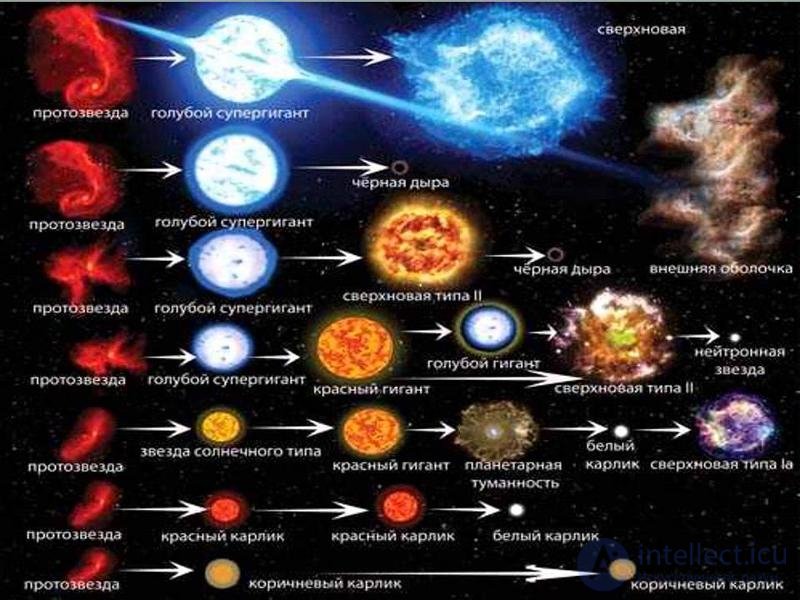
At the beginning of the contraction stage, the only source of protostar heating is gravitational energy. Energy transport inside the star occurs only by convection.
After the star reaches a sufficiently high luminosity, it rapidly
moves down the H-R diagram almost vertically, which is caused by a rapid decrease in its radius and an increase in internal temperature. In the
outer envelope of the star, brief reactions of heavy-element burning occur. A region of radiative equilibrium arises at the center of the star. As
this region grows, gravitational contraction slows down, and the decline in luminosity stops. The radius continues to decrease, the surface temperature begins to
rise, and the star turns to the left on the H-R diagram, approaching the main
sequence. At this stage hydrogen burning begins and the rate
of evolution slows down greatly. From this time on, stars with solar mass need tens of millions of years to reach the main sequence, while stars with 0.1
- 0.2 solar masses need hundreds of millions of years.
The star reaches a state of high luminosity from the phase of a cold and weakly luminous
object very quickly. To an outside observer, this creates the impression of the birth of a star that did not previously exist. Such a phenomenon has been observed in the region of the Orion Nebula in the form of star-like knots, revealed by comparing photographs taken decades
apart.
An example of this is also the star FU Orionis, associated with a globule, a comet-like nebula, and a bright hydrogen nebula. This star experienced very rapid brightness changes of 6m
per year.
Having entered the main sequence, a not-very-massive star changes
very slowly. The Sun entered the main sequence 3 billion years
ago. During this time it has come to radiate 20% more energy. On Earth at this
time algae already existed (Precambrian period) and the average annual
temperature was about 0°C.
Not only massive stars, but also stars of moderate mass, spend some time during the contraction stage
of development in the region of the H-R diagram occupied by giants and subgiants. However, their internal structure is completely different from
the internal structure of old stars with a degenerate core.
The vast majority of stars change their basic characteristics (luminosity and radius) very slowly. But the star still gradually changes,
evolving. In the process of evolution its chemical composition changes. The hydrogen content gradually decreases, and the amount of helium increases.
The chemical composition ceases to be uniform. Hydrogen decreases at the center, while its former amount remains at the periphery. As evolution proceeds, the model of the star and its structure change. Its luminosity, radius, and surface
temperature change. The star gradually changes its position on the Hertzsprung-Russell diagram. It traces out a certain track on the diagram.
The protostar contracts until the temperature and pressure in its interior
reach a value at which the proton-proton reaction becomes possible. From this
time a young star is born, occupying a definite place on the
main sequence. Its exact place is determined by the value of the initial mass. Massive protostars are located in the upper part, stars with
a mass smaller than the Sun's are located in the lower part. Thus
protostars appear along the entire main sequence. Massive
stars pass through the protostar stage in a few hundred thousand years. Therefore their
number in the Galaxy is small. Once a star enters the main sequence, it remains there for a long time without significant change in its
properties.
The nature of a star's change of state depends on whether the matter in its interior is mixed or not. If the matter is intensively mixed, then as
evolution proceeds the star leaves the main sequence to the left. In the opposite case, in the absence of complete mixing - to the right. In practice, many stars are observed to the right of the main sequence, and
none are observed to the left. This means that, as evolution proceeds, main-sequence stars turn into red giants. Evolution itself is not accompanied by complete mixing of matter in the interior. Calculations show that as
the star evolves, the size and mass of its convective core decrease.
As massive stars burn hydrogen, they move across the main
sequence, without going beyond its width. When the hydrogen content reaches about 1%, the pace of evolution accelerates. To maintain energy generation at the required level as the hydrogen fuel content sharply decreases, an increase in core temperature is necessary. This is achieved through
contraction of the star as a whole. During this time the star's luminosity is sustained by
nuclear reactions in a thin layer adjacent to the core and by contraction of the core, which consists of pure helium. The evolutionary tracks turn sharply to the left, since
the surface temperature rises. Soon the contraction stops, since all the
hydrogen burns out. As the helium core contracts and heats up, the outer layers swell quickly and greatly. This means that with a nearly constant flux, the surface temperature decreases significantly. Its evolutionary track
turns sharply to the right and the star acquires the characteristics of a supergiant. As
the core heats to hundreds of millions of K and the density exceeds 4000 g/cm
3
, the helium reaction switches on. The radiated energy will halt further contraction of the core.
Massive stars leave the main sequence along a winding path,
forming the giant branch on the Hertzsprung-Russell diagram.
In this process, stars with a mass close to that of the Sun form the subgiant branch, while those with a
mass of 10-15 solar masses form the supergiant branch. The fewer heavy elements in a
star, the more transparent it is and the higher its temperature.
In the final phase of evolution, the temperature of matter in the central regions of a massive star is very high, on the order of several billion kelvins.
At such a temperature hydrogen and helium have already burned out. Nuclear reactions proceed
very quickly. The equilibrium state of matter is characterized by the predominance of
nuclei of iron-group elements. The iron core of such a star is surrounded by a mantle
of lighter elements (oxygen, nitrogen, neon, etc.). These elements represent potential fuel needed for a supernova explosion. Beyond that, the star is surrounded by a rarefied hydrogen-helium envelope.
In the course of evolution, the iron core begins to contract catastrophically. At
this point the mechanical equilibrium of the rest of the star is disrupted. The weight of the layers
lying above is no longer balanced by the gas pressure below, and they begin to fall toward the center. Within 1 second the kinetic energy of the infalling
envelope is converted into heat, which causes it to heat up rapidly.
This creates the conditions for a nuclear explosion of the light
elements located there. This nuclear explosion leads to a Type II supernova outburst, the ejection of the outer layers, and the collapse of the core into a black hole.
Approximately half of main-sequence stars are part
of multiple systems, and among massive hot stars — 70%. Novae and X-ray stars occur only in binary systems. Therefore the mechanism of evolution
of a binary system is very important.
In 1951 scientists noticed that in binary systems the component with the highest luminosity has the lower mass. The situation appears such that the more massive component is on the main sequence, while the less massive one has excess luminosity, i.e., is almost
a giant — a star that has left the main sequence in the course of evolution.
In 1955 this paradox was explained by the fact that the star with the high luminosity
in the pair originally had the greater mass. Having exhausted most of its
nuclear fuel, it began to swell. In the process, a significant part of its mass
flowed onto the neighboring component. Thus the mass of the neighbor came to exceed the mass of the more rapidly evolving star.
An important process determining the evolution of stars in a binary system is mass exchange.
Novae have a peculiar mechanism of repeated outbursts. The evolved hot compact star is an object
similar to a white dwarf and poor in hydrogen. At the same time, hydrogen-rich gas from the red component, which fills its Roche lobe, constantly falls onto the evolved
star. This gas, after it accumulates in the surface layer of the hot star over hundreds and thousands of years, can cause a thermal explosion of a local nature, i.e., not
encompassing the entire structure of the star as a whole. In such an explosion a significant amount of mass is ejected — 0.0001 solar masses, as follows from
spectral observations of novae. approximately the same mass flows onto
the hot compact star from the neighboring component during the time between two
outbursts.
2. The hypothesis of star formation from superdense matter was put forward
by academician V.A. Ambartsumian. It holds that stars form from
of some kind of superdense matter.
The basis of this hypothesis is the conclusion that in the observable Universe, processes of decay predominate over the process of combination. This means that the process of star formation must be a transition of matter from a denser state to a less dense one.
The hypothesis requires that there exist in the Universe a material - superdense
matter, which no one has yet observed and whose properties remain unknown. Superdense matter, if it exists, must be inaccessible to current means of observation, since it occupies very small vol-
umes of space and emits almost no radiation. Its main properties are an extraordinarily high density and an enormous store of energy, which is released violently upon the decay of such matter.
There is not yet a coherent mathematical theory based on this hypothesis. The main argument of its proponents is that it corresponds to observational data.

Comments