
Lecture
The main task of astrophotometry is to study the intensity of radiation from celestial bodies.
If a cosmic object has a visible angular size, its brightness is determined. If it appears as a point, its magnitude of light (blesk) is determined.
The light of a point object, such as a star, is the astronomical equivalent of the concept of illuminance.
Let a radiation flux F fall perpendicularly onto an area σ. Then the illuminance E of the area σ is called the ratio
E = F/ σ.
To measure illuminance, the unit used is the lux (lx). This is the illuminance produced by an international candle at a distance of one
meter.
The illuminance produced on the Earth's surface by the Sun is close to 135,000
lux, by the Moon - 0.25 lux, and by the light of the night sky - 0.0003 lux.
Illuminance and brightness decrease inversely proportional to the square of the distance from the source of radiation.
The illuminance of a surface perpendicular to the incident rays determines
the brightness of the light source.
To measure the brightness of light in astronomy, the concept of stellar magnitude is introduced.
Consider an area S on the surface of a luminous body. Suppose that in the direction perpendicular to it, it emits radiation with intensity I.
The ratio I/S is called the luminance of the area.
Luminance does not depend on the distance of the light source from the observer. As the luminous area moves away from the observer, the intensity of the radiation decreases
inversely proportional to the square of the distance, but the visible area also decreases
in the same proportion. Therefore their ratio, i.e. the luminance, retains
its value.
That is why one cannot say “the luminance of a star”.
To measure luminance, the unit stilb (sb) is used. This is the luminance possessed by an area of 1 cm
2
, if the intensity of the light it emits equals one
international candle.
The luminance of the Sun's surface is about 150,000 sb, and that of the disk of the full Moon - 0.25 sb.
The apparent stellar magnitude m, or brightness, is a measure of the illuminance E,
produced by a source on a surface perpendicular to its rays at the location
of observation.
The division, established since ancient times, of stars visible to the naked eye
into «stellar magnitudes» is a reflection of the general psychophysiological law
of Weber-Fechner (sensitivity changes as the logarithm of the intensity of the stimulus), which determines the change in «sensation» with a change in
«stimulation». The relationship between m and E is expressed by the formula:
m= a + blgE,
where the coefficient b= -2.5 was introduced in the mid-19th century by the English astronomer Pogson, who noticed that for different observers an interval of 5 stellar magnitudes corresponds to a ratio of light fluxes or illuminances of about
100. (This rule was already used as the basis for the scale of stellar magnitudes by Hipparchus).
It was taken to equal 100 so that the logarithm of the illuminance ratio would be
exactly equal to 0.400.
Then the ratio
Em/Em+1 = 2.512.
The quantity a represents the zero point of the stellar magnitude scale and is established by international agreement, related to the choice of a photometric
standard. At first this standard was the stellar magnitude of Polaris,
then - the stellar magnitudes of about 100 stars of the North Polar Sequence.
Relative to the standard star, using the formula
m2 - m1 = -2.5 (lgE2 - lgE1)
one can determine the brightness of any source.
The brightness of a star is related to its apparent stellar magnitude by Pogson's formula.
We can derive this formula in the following way.
Let us denote by ln the brightness of a star of the n-th magnitude.
It was already introduced by Hipparchus that
l1/l2 = l2/l3 = l3/l4 = ... = ln-1/ln = 2.512.
Multiplying the relations, we find that
l1/l4 = l1/l2* l2/l3* l3/l4 = 2.5123
.
These relations can be generalized in the following form:
lm/ln = 2.512n-m
.
or, since lg2.512 = 0.4, then
n-m = 2.5 lg(lm/ln)
The numbers m and n can also be fractional, since stellar magnitudes need not be
whole numbers.
The modern definition of stellar magnitude:
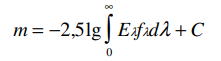
Here Eλ - is the illuminance, λ - the wavelength, fλ - the spectral sensitivity
of the recording apparatus, C - a constant setting the zero point of the magnitude
system. The coefficient -2.5 determines the stellar magnitude scale and is called
Pogson's coefficient. The minus sign indicates that as brightness increases, the stellar magnitude decreases.
The Earth's atmosphere absorbs a significant portion of the energy arriving from astronomical objects. Absorption strongly depends on wavelength, the zenith distance of the object, the altitude of the observatory above sea level, and the state of the
atmosphere. Therefore measurements are corrected for atmospheric extinction. In
this case Eλ determines the distribution of energy in the spectrum outside
the Earth's atmosphere.
By measuring the ratio of star brightness with a photometer, one can determine
the difference of stellar magnitudes according to Pogson's formula. The zero point, however, is chosen conventionally, by agreement. It has been agreed that a standard star of the first
magnitude (the average of the 20 brightest stars) gives 100 times more light than a star of the sixth magnitude, located at the limit of vision.
For an interval of 1 stellar magnitude (1m
) an illumination ratio of
2.512 times is adopted. Its decimal logarithm equals 0.4, and an interval of 5m
corresponds
to a ratio of 100 times.
The limit of vision of the naked eye is about 6m
, with a large telescope one can see up to 19m
, and photograph up to 22m
.
A first magnitude star is brighter than a 21m
star by 100 million times.
A 23 m star gives 630 million times less light than a 1 m
star.
Since stellar magnitude characterizes the measured radiation flux from a luminary, its definition can be extended to extended objects as well.
By measuring the illumination created by the Sun, the full Moon, and the planets, one can find their corresponding stellar magnitudes.
Sun - 26m.8
Moon (full moon) - 12m.7
Venus (greatest elongation) - 4m.1
Jupiter (at opposition) - 2m.4
Sirius - 1m.46
The number of first magnitude stars is 20, second - 60, third - 170, fourth - 400,
fifth - 1100, sixth - 4000, etc.
There are about
300,000 ninth magnitude stars.
After the invention of the photometer, the brightness of a star was compared with a reference star by equalizing the latter to the brightness of the former.
These estimates were made by eye and are called visual magnitudes.
Stellar magnitudes measured in different parts of the spectrum differ from
each other.
The color characteristics of the stellar magnitude system are determined by the range of
wavelengths recorded by the receiver.
The eye perceives yellow-green rays best of all.
Stellar magnitudes measured from photographs differ somewhat from visual ones.
The difference between the photographic and visual magnitudes is called the color index.
For white stars, the color index is conventionally equal to zero.
A photographic plate does not perceive red rays, so for red
stars the color index will be positive. It happens that a red star with a visual magnitude of 5m
appears as 8m
on a photographic plate.
The stellar magnitude obtained from the determination of the total energy radiated across the entire spectrum is called bolometric.
The results of visual, photographic, and photoelectric measurements of radiation flux make it possible to establish systems of visual, photographic,
and photoelectric stellar magnitudes.
Visual and photographic methods of determining magnitudes are not sufficiently
accurate. The error is 0.05.
A more accurate method is the photoelectric one. It determines stellar magnitudes with
errors of 0m
.01 to 0m
.02.
The photoelectric method uses an effect in which, when
certain substances are illuminated, an electric current arises in them whose strength is proportional to the intensity of the incident light. Measurements of "light"
magnitudes are replaced by measurements of current, which are made much more accurately.
In connection with this, more convenient photometric systems of stellar magnitudes were obtained.
The U system determines the stellar magnitudes of stars in the ultraviolet region
of the spectrum, with an average wavelength of 3640 A.
The B system is close to the photographic region and is referred to a wavelength of 4445 A.
The V system corresponds to the visual one and refers to a wavelength of 5505 A.
The R and I systems correspond to the infrared region.
The UBVRI system was adopted by the International Astronomical Union as
a standard.
Specially selected stars determine the zero point from which stellar magnitudes are reckoned in each established color. The measured magnitudes of all other stars are compared with these standards.
The color of each star is characterized by its color index.
For each star one can determine not just one, but several color indices U -
B, B - V, V - R, R - I, i.e., compare the intensity of radiation in different parts
of the spectrum.
In the system of bolometric stellar magnitudes, all the radiation of the
star across all parts of the spectrum is summed.
The light of stars is so strongly absorbed by the Earth's atmosphere in the region of wavelengths
shorter than 0.3 microns that there is no possibility of using a standard system for this region unless stars are observed from space.
Research is currently being conducted at space stations located in near-Earth orbit.
But even from space stations it is difficult to study stars at wavelengths shorter than 0.09 microns, mainly because of the "galactic fog" formed
by atoms of neutral hydrogen of the interstellar gas, which absorb most of the far ultraviolet radiation beyond the Lyman limit.
The Earth's atmosphere presents significant obstacles to observation at certain wavelengths, as it intensively absorbs light. For example, in the range from
1 to 4 microns and near 1.8 and 2.8 microns light is absorbed, but near 1.3, 2.2, 3.4 microns
there are windows of transparency.
For satisfactory observations it is sometimes necessary to choose dry weather, to climb into the mountains to an altitude of more than 2700 m, so that there is less water vapor above the instrument.
Most of the atmospheric absorption can be avoided by making observations from aircraft, rising to an altitude of 12-15 km.
An important task of photometry is establishing in the sky a broad and comprehensive
network of standard stars, for which stellar magnitudes and colors have been determined.
For this, precise measurements must be made using specific systems of filters and photocells with constant properties.
Harold Johnson made such measurements for the UBV color system. The lists he compiled contain data on several hundred stars.
For stars closest to us, the color index directly characterizes
the temperature of the star.
The temperature can be found by the formula:
T = 72000
/(C + 0 m, 64) .
This is the color temperature of the star. It only approximately characterizes
the true temperature of the star. It depends on the effective wavelengths
used.
Blue-white stars with a surface temperature of 25,000 K radiate in blue
light much more intensely than red stars with a surface temperature of
3,000 K.
The light of distant stars reddens strongly due to the effect of cosmic dust located between the stars.
By analyzing the shape of a star's spectrum, it is often possible to say what its color index
was before absorption by the interstellar medium. This quantity is called the true
color index.
Knowing the true color index, one can compare it with the observed one and determine the degree of reddening caused by cosmic dust. In this way we
obtain information about the absorption of light by dust in the Milky Way system.
The apparent brightness and apparent stellar magnitude of a star depend on its distance
from the observer r. To free ourselves from the influence of distance, the concept
of absolute brightness and absolute magnitude of a star was introduced.
The absolute brightness of a star L is called the brightness it would have,
if it were removed from the observer to a distance equal to 10 parsecs.
Since illuminance decreases inversely proportional to the square of the distance,
the absolute brightness L and apparent brightness l are related by:
L/l = r2
/100 = 2.512m-M
.
m - the apparent stellar magnitude, M - the absolute stellar magnitude, by which
is meant the stellar magnitude that the star would have if it were removed
to a distance equal to 10 parsecs.
From the above relation we obtain the formula:
M = m + 5 - 5lg r.
(or, since r =1/π, M = m + 5 + 5lg π).
Taking interstellar absorption into account:
M = m + 5 - 5lg r - A(r).
where A(r) - is the absorption of light, proportional to the distance to the star.
This formula makes it possible to calculate the absolute stellar magnitude of a star if
the distance is known, and to calculate the distance if the absolute magnitude is known, by the formula:
lg r = (m - M)/5 + 1.
Absolute stellar magnitudes can be bolometric, visual,
or photographic.
The values of absolute stellar magnitudes lie within the range from +18m
to -10m
.
The Sun has an absolute stellar magnitude of +4.7m
.
The luminosity of a star is often used - the ratio of the absolute brightness of the star
to the absolute brightness of the Sun.
The brightest stars are brighter than the Sun by 14m
, they emit more energy by a factor of 1,000
,000 times. The faintest stars are fainter by 14m
. They emit less energy by a factor of 300,000
times.
The ratio of the luminosities of the brightest and faintest stars reaches about 100
billion.

Comments